
The Basic and Heavy Industry
The iron and steel industry is the basic industry because all other industries — heavy, medium and light — depend on it for their machinery. Steel is needed to make engineering goods, construction materials, defence, medical, scientific and telephonic equipment, and a variety of consumer goods.
The production and consumption of steel is often regarded as the index of a country's development. It is a heavy industry because both its raw materials and finished goods are heavy and bulky, involving heavy transport costs.
Raw Materials and Ideal Location
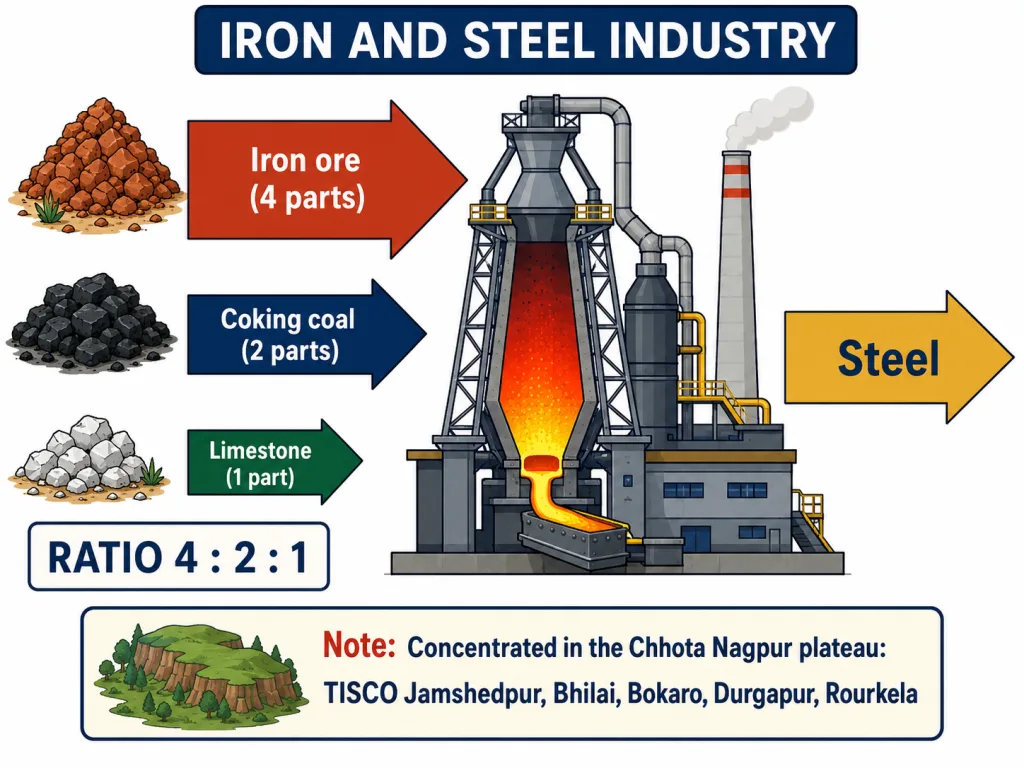
Iron and steel-making needs three main raw materials in a fixed ratio:
- Iron ore : coking coal : limestone ≈ 4 : 2 : 1 (plus small amounts of manganese to harden the steel).
Because all these are bulky, steel plants are ideally located where the raw materials, cheap labour and a market come together. The Chhota Nagpur plateau region (spread over Jharkhand, Odisha, Chhattisgarh and West Bengal) has the maximum concentration of iron and steel industries, because of:
- Low-cost iron ore and other high-grade raw materials in close proximity,
- Cheap labour, and
- Vast growth potential in the home market.
Important steel plants include TISCO (Jamshedpur), Bhilai, Durgapur, Rourkela, Bokaro, Vishakhapatnam and Salem.
India's Position and Challenges
India is among the world's top steel producers — it ranked second in crude steel production and is the largest producer of sponge iron. Yet the industry faces several challenges:
- High cost and limited availability of coking coal,
- Lower productivity of labour,
- Irregular supply of energy, and
- Poor infrastructure.
Efforts to liberalise the industry and bring in new technology are helping it overcome these problems.
Exam tip: Remember — iron ore : coking coal : limestone = 4:2:1; main region = Chhota Nagpur plateau; steel = index of development.
Questions and Answers
Q1. Why is the iron and steel industry called a basic industry?
Answer: The iron and steel industry is called a basic (or key) industry because all other industries — heavy, medium and light — depend on it for their machinery and equipment. Steel is used to make engineering goods, construction materials, and defence and scientific equipment, so its production is regarded as the index of a country's development.
Q2. In what ratio are the raw materials of the iron and steel industry required?
Answer: Iron and steel-making requires iron ore, coking coal and limestone in a ratio of approximately 4 : 2 : 1, along with small amounts of manganese to harden the steel. Because all these are bulky, the plants are located where they can be assembled cheaply.
Q3. Why is the Chhota Nagpur plateau the leading region for iron and steel?
Answer: The Chhota Nagpur plateau has the maximum concentration of iron and steel industries because of its low-cost iron ore, high-grade raw materials in close proximity, cheap labour, and a vast home market — all the advantages needed for this heavy industry.
Q4. State any two challenges faced by the iron and steel industry in India.
Answer: Two challenges are (1) the high cost and limited availability of coking coal, and (2) the lower productivity of labour. Others include an irregular supply of energy and poor infrastructure.