
Aluminium Smelting
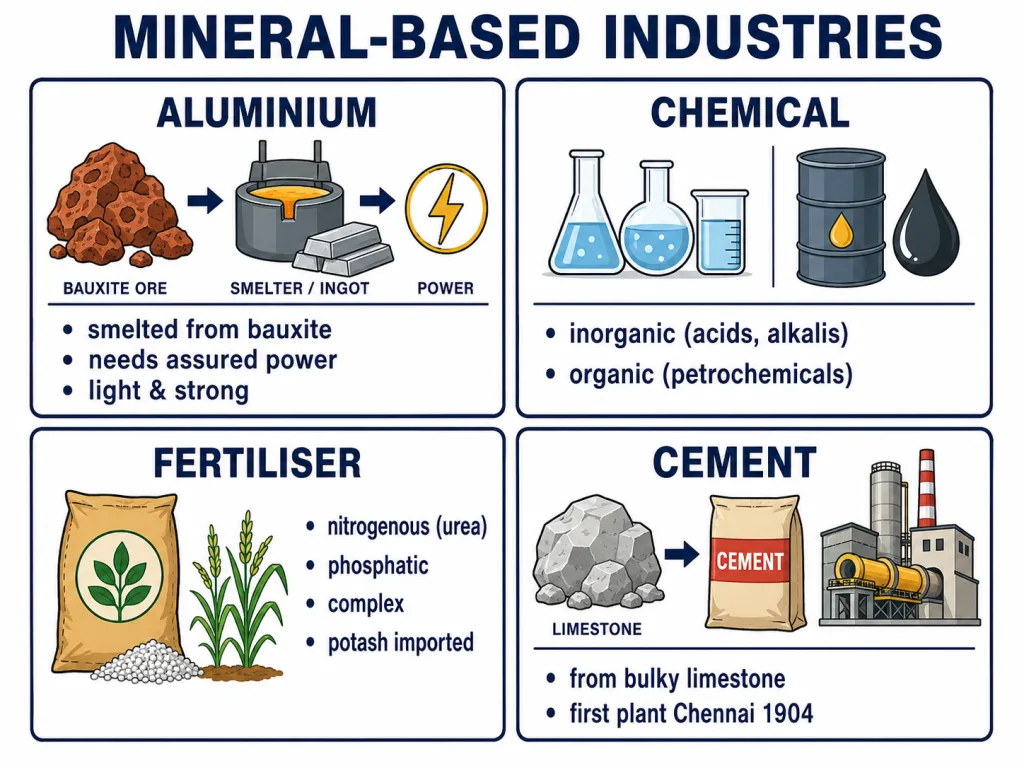
Aluminium smelting is the second most important metallurgical industry in India (after iron and steel). Aluminium is light, resistant to corrosion, a good conductor of heat, malleable, and becomes strong when mixed with other metals. It is used to make aircraft, utensils and wires, and is a substitute for steel, copper, zinc and lead.
- The raw material is bauxite, a bulky, dark-reddish rock.
- The two prime factors for location are a regular supply of electricity and an assured source of raw material at minimum cost.
- Plants are located in Odisha, West Bengal, Kerala, Uttar Pradesh, Chhattisgarh, Maharashtra and Tamil Nadu.
Chemical and Fertiliser Industries
The chemical industry is fast-growing and diversifying, with both large and small-scale units:
- Inorganic chemicals — sulphuric acid (for fertilisers, plastics, dyes), nitric acid, alkalies, soda ash (for glass, soaps, paper) and caustic soda.
- Organic chemicals — petrochemicals (for synthetic fibres, rubber, plastics, drugs and dyes); these plants are located near oil refineries.
The fertiliser industry produces nitrogenous fertilisers (mainly urea), phosphatic fertilisers, ammonium phosphate (DAP) and complex fertilisers (a combination of nitrogen N, phosphate P and potash K). Potash is entirely imported, as India has no commercially usable reserves. The industry expanded after the Green Revolution; Gujarat, Tamil Nadu, Uttar Pradesh, Punjab and Kerala contribute about half the production.
Cement Industry
Cement is essential for construction — houses, factories, bridges, roads, airports and dams.
- It needs bulky and heavy raw materials like limestone, silica, alumina and gypsum, along with coal and electric power and rail transport.
- The first cement plant was set up in Chennai in 1904; after Independence, the industry expanded.
- Plants in Gujarat are strategically located to access the market in the Gulf countries for export.
Key Point: Aluminium needs cheap power; cement needs bulky raw materials (limestone); fertiliser depends on imported potash for complex fertilisers.
Questions and Answers
Q1. Why is aluminium a valuable metal, and what are the prime factors for locating an aluminium smelter?
Answer: Aluminium is light, resistant to corrosion, a good conductor, malleable, and strong when alloyed, so it is used in aircraft, utensils and wires and as a substitute for steel and copper. The two prime location factors for a smelter are a regular supply of electricity and an assured source of raw material (bauxite) at minimum cost.
Q2. Distinguish between inorganic and organic chemicals with examples.
Answer: Inorganic chemicals include sulphuric acid, nitric acid, alkalies, soda ash and caustic soda, used for fertilisers, glass, soaps and paper. Organic chemicals include petrochemicals used for synthetic fibres, rubber, plastics, drugs and dyes; these plants are located near oil refineries.
Q3. What types of fertilisers does the fertiliser industry produce, and which nutrient is entirely imported?
Answer: The fertiliser industry produces nitrogenous fertilisers (mainly urea), phosphatic fertilisers, ammonium phosphate (DAP) and complex fertilisers (a combination of N, P and K). Of these, potash (K) is entirely imported, as India has no commercially usable reserves of potash.
Q4. What raw materials does the cement industry need, and why are some plants located in Gujarat?
Answer: The cement industry needs bulky, heavy raw materials — limestone, silica, alumina and gypsum — plus coal and electric power. Some plants are located in Gujarat because of suitable access to ports, allowing export of cement to the Gulf countries.