
The Jute Textile Industry
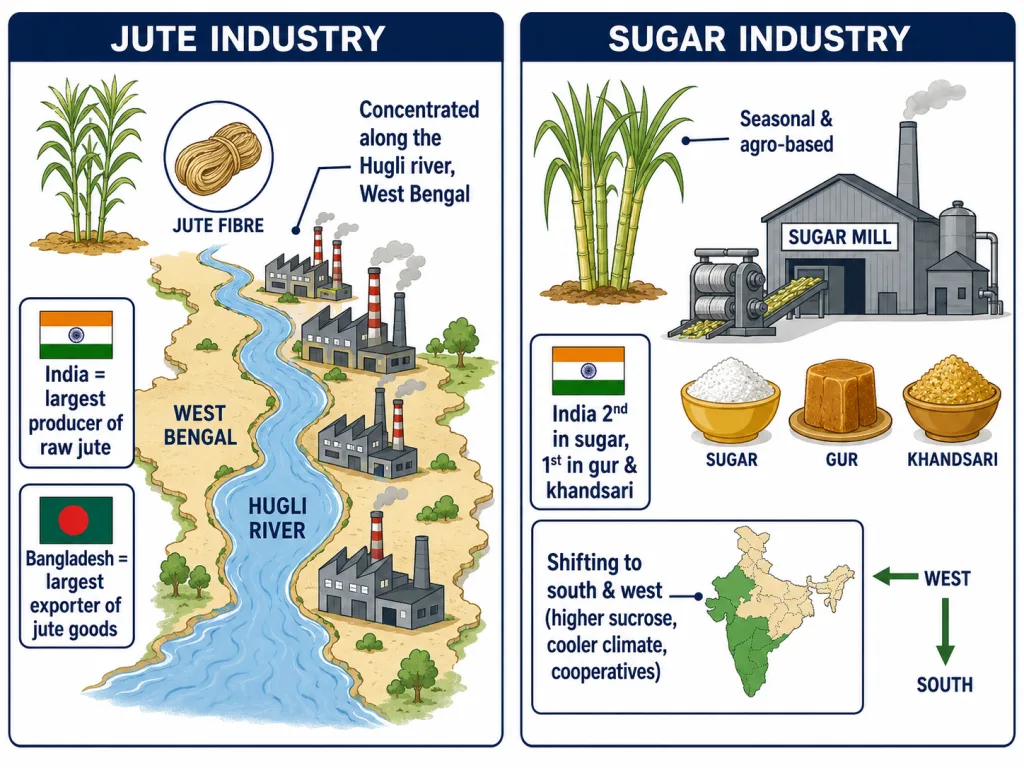
India is the largest producer of raw jute and jute goods in the world and the second largest exporter after Bangladesh. Most jute mills are located in West Bengal, mainly along the banks of the Hugli river in a narrow belt. The first jute mill was set up near Kolkata (at Rishra) in 1855.
Factors for location along the Hugli:
- Proximity to the jute-producing areas of West Bengal and Assam.
- Cheap water transport, supported by a network of railways, roadways and waterways.
- Abundant water for processing raw jute.
- Cheap labour from West Bengal and neighbouring Bihar, Odisha and Uttar Pradesh.
- Kolkata provides banking, insurance and port facilities for export.
Challenges and Products of Jute
After Partition in 1947, the jute mills remained in India, but about three-fourths of the jute-growing area went to Bangladesh (then East Pakistan).
The industry faces stiff competition from synthetic substitutes and from other producers like Bangladesh. To support it, the government formulated a National Jute Policy (2005) to raise productivity and demand.
Jute is used to make gunny bags, mats, ropes, yarn, carpets and other artefacts. Because it is a natural, biodegradable, eco-friendly fibre, demand for jute products is growing again.
The Sugar Industry
India stands second in the world in sugar production, but first in the production of gur and khandsari.
- The raw material (sugarcane) is bulky, and its sucrose content reduces during haulage, so mills are located close to the cane-growing areas.
- Main states: Uttar Pradesh, Bihar, Maharashtra, Karnataka, Tamil Nadu and others — about 60 per cent of the mills are in Uttar Pradesh and Bihar.
- The industry is seasonal, which makes it ideally suited to the cooperative sector.
In recent years, the mills have tended to shift to the southern and western states, especially Maharashtra, because the cane there has a higher sucrose content, the cooler climate allows a longer crushing season, and the cooperatives are more successful.
Exam tip: Jute → West Bengal (Hugli); Sugar → near cane (UP & Bihar 60%), shifting south for higher sucrose.
Questions and Answers
Q1. Why is the jute industry concentrated along the Hugli river in West Bengal?
Answer: The jute industry is concentrated along the Hugli because of the proximity to jute-producing areas, cheap water transport with a good rail-road-waterway network, abundant water for processing, cheap labour from West Bengal, Bihar, Odisha and UP, and Kolkata's banking, insurance and port facilities for export.
Q2. How did Partition (1947) affect India's jute industry?
Answer: After Partition in 1947, the jute mills remained in India, but about three-fourths of the jute-growing area went to Bangladesh (then East Pakistan). This left the Indian mills short of raw jute and remains a major challenge for the industry.
Q3. Why is the sugar industry ideally suited to the cooperative sector, and why do mills locate near cane fields?
Answer: The sugar industry is seasonal (it runs only during the crushing season), so a cooperative of cane farmers can run it efficiently and share the profits. Mills locate near the cane fields because sugarcane is bulky and its sucrose content falls during long haulage, so processing near the source is cheaper.
Q4. Why are sugar mills shifting to the southern and western states?
Answer: Sugar mills are shifting to the southern and western states, especially Maharashtra, because the sugarcane there has a higher sucrose content, the cooler climate ensures a longer crushing season, and the cooperatives are more successful in these states.