
History of Cotton Textiles
In ancient India, cotton textiles were produced by hand-spinning and handloom weaving. After the 18th century, power-looms came into use.
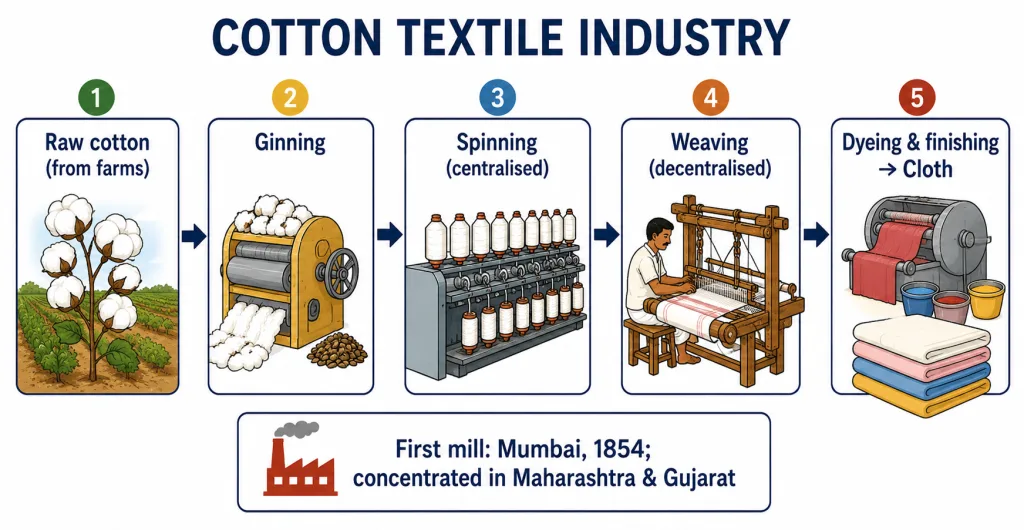
During the colonial period, India's traditional cotton textile industry suffered a great setback because it could not compete with the cheap mill-made cloth from England. The first successful cotton textile mill was established in Mumbai in 1854.
Location and Links with Agriculture
In its early years, the cotton textile industry was concentrated in the cotton-growing belt of Maharashtra and Gujarat. This was because of the availability of raw cotton, market, transport (including accessible ports), labour and a moist climate.
The industry has close links with agriculture and provides a living to farmers, cotton-boll pluckers, and workers engaged in ginning, spinning, weaving, dyeing, designing, packaging, tailoring and sewing. By creating demand, it also supports many other industries such as chemicals and dyes, packaging materials and engineering works.
Spinning, Weaving and Khadi
- Spinning continues to be centralised in Maharashtra, Gujarat and Tamil Nadu.
- Weaving is highly decentralised to make room for traditional skills and designs (in cotton, silk, zari, embroidery). India has world-class spinning, but weaving supplies a lower quality of fabric because it cannot use much of the high-quality yarn produced in the country.
- Handspun khadi provides large-scale employment to weavers in their homes as a cottage industry.
India exports yarn in large quantities.
Exam tip: Remember — first mill = Mumbai, 1854; early concentration = Maharashtra & Gujarat; spinning = centralised, weaving = decentralised.
Questions and Answers
Q1. Why was the cotton textile industry initially concentrated in Maharashtra and Gujarat?
Answer: The industry was concentrated in the cotton-growing belt of Maharashtra and Gujarat because of the ready availability of raw cotton, a good market, transport and accessible port facilities, cheap labour, and a moist climate suitable for spinning. These favourable factors led to its localisation there.
Q2. How does the cotton textile industry have close links with agriculture?
Answer: The industry depends on raw cotton, an agricultural product, and provides a living to farmers and cotton-boll pluckers. It also employs workers in ginning, spinning, weaving, dyeing, packaging and tailoring, and, by creating demand, supports the chemical, dye, packaging and engineering industries — linking farming with industry.
Q3. Distinguish between spinning and weaving in India's cotton textile industry.
Answer: Spinning (making yarn from cotton) is centralised in Maharashtra, Gujarat and Tamil Nadu and is of world-class quality. Weaving (making cloth from yarn) is highly decentralised to include traditional skills, but it supplies lower-quality fabric because it cannot use much of the high-quality yarn produced in the country.
Q4. What role does khadi play in the cotton textile industry?
Answer: Handspun khadi is produced as a cottage industry in weavers' homes, and it provides large-scale employment in rural areas. It preserves traditional skills and gives livelihood to many, which is why Mahatma Gandhi laid great emphasis on spinning yarn and weaving khadi.