
Sodium Hydroxide () — Caustic Soda
Sodium hydroxide is also called caustic soda — 'caustic' meaning 'burning' — because it damages skin, wood, and similar materials.
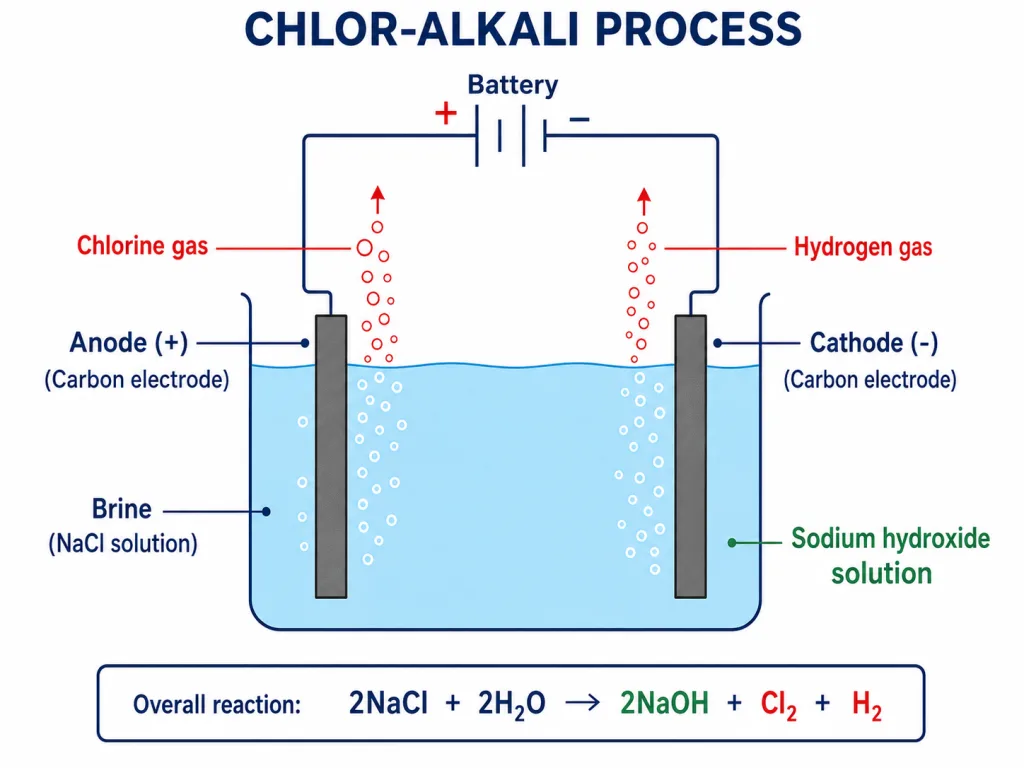
Preparation — The Chlor-Alkali Process
is produced by the electrolysis of an aqueous solution of common salt (called brine).
Reaction:
Three useful products:
- At the anode: chlorine gas ()
- At the cathode: hydrogen gas ()
- In solution near the cathode: sodium hydroxide ()
Uses of Each Product
(chlorine gas):
- Water purification (drinking water).
- Bleaching in the paper industry.
- Making PVC plastic.
- Producing bleaching powder ().
(hydrogen gas):
- Making ammonia (Haber process).
- As a fuel.
- Hydrogenation (making vegetable ghee).
(caustic soda):
- Soap and detergent industry.
- Paper manufacture.
- Making artificial fibres.
- Petroleum refining.
- Making dyes.
[Board Important] Three products of the chlor-alkali process and their uses.
Bleaching Powder ()
Formula: — calcium oxychloride Common name: bleaching powder
Preparation
Method: Action of chlorine gas on dry slaked lime.
Reaction:
(slaked lime) (chlorine) (bleaching powder)
Physical Properties
- Colour: pale yellow-white
- Smell: strong chlorine-like odour
- State: solid powder
- Property: decomposes when exposed to moisture and
Uses
1. Textile industry:
- Bleaching cotton and linen.
- Releases — destroys dyes.
2. Paper industry:
- Bleaching paper pulp.
3. Water purification:
- Killing bacteria in drinking water.
- In swimming pools.
4. Disinfectant:
- In hospitals and homes.
5. Chemical industry:
- Making chloroform ().
How Does Bleaching Work?
In contact with moisture/, bleaching powder releases :
The free is a strong oxidising agent — it makes dyes colourless and disinfects water.
Precautions
- Store in airtight container (away from moisture and ).
- Avoid direct skin contact (causes burns).
- If splashed in eyes, wash immediately with water.
[Board Important] Formula, preparation, and three uses of bleaching powder.
Baking Soda ()
Formula: — sodium hydrogen carbonate Common name: baking soda
Preparation — Part of the Solvay Process
Produced by the action of and on a solution.
Reaction:
(low solubility allows to be filtered out as a precipitate.)
Physical Properties
- Colour: white powder
- Smell: odourless
- Taste: mildly basic (bitter-salty)
- pH: ~ 8.5 (slightly basic)
- Soluble in water
Decomposition on Heating
(That is, on heating it releases — the basis of most of its uses.)
Uses
1. Food industry — baking:
- For making cakes, biscuits, bread.
- On heating, is released — this raises the dough.
- Food becomes light and spongy.
2. Home remedy for acidity: (stomach is neutralised)
3. Fire extinguishers:
- + dilute acid →
- smothers the fire.
4. Treatment of insect stings:
- For bee, ant stings (acidic).
5. Component of baking powder:
- Baking powder = + tartaric acid.
- On contact with water, is released.
Baking Powder vs. Baking Soda
| Feature | Baking Soda | Baking Powder |
|---|---|---|
| Composition | + tartaric acid | |
| Use | Alone in some cakes/biscuits | Cakes, biscuits, bread |
| Action | Releases on heating | Releases on adding water |
A Curious Fact
Why are cakes spongy? The released by baking soda forms bubbles — the dough rises and becomes light.
[Repeatedly asked in boards] Formula, preparation, and four uses of baking soda.
Washing Soda ()
Formula: — sodium carbonate decahydrate Common name: washing soda or soda ash
Preparation
Step 1: Heat baking soda:
Step 2: Recrystallise anhydrous from water:
(10 water molecules of crystallisation bind — this is washing soda.)
Physical Properties
- Colour: white, crystalline
- pH: ~ 11-12 (basic)
- Highly soluble in water
- 10 water molecules of crystallisation —
Uses
1. In laundry:
- Being basic, removes oil and dirt.
- Softens hard water (precipitates Ca²⁺/Mg²⁺).
2. Glass industry:
- Main raw material for glass-making.
- Forms .
3. Paper industry:
- In the treatment of paper pulp.
4. Soap and detergent industry.
5. Manufacture of borax.
6. In the laboratory:
- As a reagent.
Softening Hard Water
Hard water contains and ions — does not lather well with soap.
Adding washing soda:
(hardness ions () precipitate — water becomes soft.)
[Board Important] Formula, preparation of washing soda, and how it softens hard water.
Plaster of Paris ()
Formula: — calcium sulphate hemihydrate (or written as )
Common name: Plaster of Paris (POP) (once mined near Paris — hence the name.)
Preparation
Method: Carefully heat gypsum () at 373 K (100°C).
Reaction:
(gypsum) (POP)
Caution: Above 373 K, all the water leaves (giving anhydrous ) — this does not behave like POP.
Physical Properties
- Colour: white
- State: solid powder
- On adding water — sets quickly
Special Property — Reaction with Water
When water is added to POP, it turns back to gypsum, but in doing so it forms a hard solid.
Reaction:
(POP) (gypsum — hard)
Uses
1. Medicine:
- For making plaster casts for broken bones.
- POP + water sets into a cast — keeps the bone stable.
2. Art and sculpture:
- For making statues, toys.
- Decorative wall panels.
3. Construction industry:
- False ceilings.
- Wall decorations.
- Filling cracks.
4. Laboratory:
- For drying gases (moisture absorber).
5. Fire-resistant materials.
Storage Caution
Keep POP away from moisture in airtight containers — even small amounts of water cause it to set into hard gypsum and become useless.
A Curious Fact
POP and gypsum — both are forms of — but differ in number of water molecules.
- Gypsum: (2 water molecules)
- POP: (½ water per unit)
- Anhydrous: (no water — does not behave like POP)
[Board Important] Formula, preparation (from gypsum), and three uses of POP.
🧠 Memory Capsule
A one-glance recap to revisit just before the board exam.
1. Five Important Chemicals — From Common Salt
| Chemical | Formula | Common Name |
|---|---|---|
| Sodium hydroxide | Caustic soda | |
| Bleaching powder | — | |
| Baking soda | — | |
| Washing soda | Soda ash | |
| Plaster of Paris | POP |
2. The Chlor-Alkali Process
Three products: , , — all useful.
3. Bleaching Powder
- Preparation:
- Uses: bleaching (cotton, paper), water purification, disinfectant.
4. Baking Soda
- Preparation (Solvay):
- On heating:
- Uses: baking, antacid, fire extinguisher.
5. Washing Soda
- Preparation: Heat baking soda → + recrystallise.
- Uses: laundry, glass industry, softening hard water.
6. Plaster of Paris
- Preparation:
- With water — sets to gypsum: plaster casts, statues, ceilings.
7. Famous Reactions
| Chemical | Reaction |
|---|---|
| Heating baking soda | |
| Baking soda + acid | |
| Bleaching powder + water | |
| Washing soda + hard water | |
| POP + water |
8. Board's 'Golden' Questions
- Three products of the chlor-alkali process and their uses.
- Preparation and three uses of bleaching powder.
- Difference between baking soda and washing soda.
- How is POP made? Three uses.
- Why are cakes spongy?
- Baking powder vs. baking soda.
The Bottom Line: From common salt, 5 vital chemicals — caustic soda, bleaching powder, baking soda, washing soda, and Plaster of Paris — all useful in everyday life.
Solved Examples
Example 1: NCERT — The Chlor-Alkali Process
What is the chlor-alkali process? Name its three products, state where they are formed, and give one use of each.
Solution:
Definition: Electrolysis of an aqueous solution of common salt (brine) — yielding three important chemicals.
Reaction:
Three products and their locations:
| Product | Location | One use |
|---|---|---|
| gas | At the anode (+) | Water purification; PVC; bleaching powder |
| gas | At the cathode (−) | Ammonia synthesis; fuel; vegetable ghee |
| In solution near the cathode | Soap industry; paper manufacture |
'Chlor' = chlorine; 'alkali' = base () — hence the name.
[NCERT textbook question]
Example 2: NCERT — Bleaching Powder
What is bleaching powder? State its preparation, formula, and three uses.
Solution:
Bleaching powder () — calcium oxychloride.
Preparation:
Action of chlorine gas on dry slaked lime ().
Reaction:
(slaked lime) (chlorine) (bleaching powder)
Formula:
Three uses:
1. Bleaching in the textile industry:
- Bleaching cotton and linen white.
- release destroys dyes.
2. In the paper industry:
- Bleaching paper pulp.
3. Water purification:
- Disinfecting drinking water.
- In swimming pools.
Other uses:
- Disinfectant (in hospitals and homes).
- Manufacturing chloroform.
Caution: Store in an airtight container (away from moisture and ).
[NCERT textbook question]
Example 3: NCERT — Baking Soda
What is baking soda? State its preparation, formula, and four uses.
Solution:
Baking soda () — sodium hydrogen carbonate.
Common name: baking soda.
Preparation (part of the Solvay Process):
Action of and on a solution.
Reaction:
(low solubility allows to precipitate out.)
Formula:
On heating:
Four uses:
1. Food industry — baking:
- For cakes, biscuits, bread. On heating, is released — the dough rises and becomes spongy.
2. Home remedy for acidity: (stomach is neutralised)
3. In fire extinguishers:
- + acid → — extinguishes fires.
4. Treating insect stings:
- For bee, ant stings (acidic).
[NCERT textbook question — repeatedly asked]
Example 4: NCERT — Washing Soda
What is washing soda? Give its formula, preparation, and explain how it softens hard water.
Solution:
Washing soda () — sodium carbonate decahydrate.
Common name: soda ash.
Formula: (10 molecules of crystallisation water).
Preparation (in two steps):
Step 1: Heat baking soda:
Step 2: Recrystallise anhydrous from water:
How does it soften hard water?
Hard water contains and ions — does not lather well with soap.
On adding washing soda:
Result:
- Hardness ions () precipitate as insoluble carbonates.
- Only remains in the water — soft water.
- Soap now lathers well.
Other uses:
- Glass industry.
- Paper, soap, detergent.
- Borax manufacture.
[NCERT textbook question]
Example 5: NCERT — Plaster of Paris
What is Plaster of Paris? State its preparation, formula, and three uses.
Solution:
Plaster of Paris (POP) — calcium sulphate hemihydrate.
Formula: (or ).
Origin of the name: Once mined near Paris — hence 'Plaster of Paris'.
Preparation:
Carefully heat gypsum () at 373 K (100°C).
Reaction:
Caution: Do not exceed 373 K — above this, all the water leaves (giving anhydrous ), which does not behave like POP.
Special property:
When water is added, POP turns back into gypsum — and in this process forms a hard solid.
(hard — useful for making casts)
Three uses:
1. Medicine — plaster casts for broken bones:
- POP + water sets into a cast.
- Keeps the bone immobile — helping it heal.
2. Art and sculpture:
- Statues, toys, models.
- Suitable for fine surfaces.
3. Construction industry:
- False ceilings.
- Wall decorations.
- Filling cracks.
Other uses:
- Drying agent in laboratories.
- In dentistry.
Caution: Store POP in airtight containers, away from moisture.
[NCERT textbook question — repeatedly asked]
Example 6: Baking Soda vs. Washing Soda
State five differences between baking soda and washing soda.
Solution:
Comparison Table:
| Aspect | Baking Soda | Washing Soda |
|---|---|---|
| Chemical name | Sodium hydrogen carbonate | Sodium carbonate decahydrate |
| Formula | ||
| Crystal water | None | 10 water molecules |
| pH | ~ 8.5 (weakly basic) | ~ 11-12 (more basic) |
| Use | In food, antacid | Laundry, glass industry |
| On heating | Gives | Loses water on mild heating |
| Edible? | Yes (in food) | No (not caustic, but not edible) |
Connection:
- Both relate to .
- Heating baking soda yields (the precursor to washing soda).
Practical difference:
- Baking soda in the kitchen.
- Washing soda in laundry.
[Board 5-mark question]
Example 7: NCERT — Why Is a Cake Spongy?
When baking soda is used in cake-making, why does the cake become spongy? Write the chemical reaction.
Solution:
Principle: Baking soda releases gas on heating — which forms bubbles in the dough, making it rise.
Reaction (on heating):
Step by step what happens:
- While preparing cake batter — baking soda or baking powder is added.
- In the oven, on heating — baking soda decomposes.
- bubbles form throughout the dough.
- The dough rises, becoming light and fluffy.
- After baking, these bubbles remain trapped — giving a spongy structure.
Action of baking powder:
- Baking powder = + tartaric acid.
- On adding water, tartaric acid reacts with — giving immediate .
- No need to wait for the oven — works at room temperature too.
Why is tartaric acid added?
- Without it, only remains — which has a bitter taste.
- Tartaric acid + = sodium tartrate (tasteless).
- So the food's taste is preserved.
[NCERT textbook question]
Example 8: A Mixed Question — Uses of the Five Chemicals
Give one main use each of the following: (a) (b) (c) (d) (e)
Solution:
| Chemical | Main use |
|---|---|
| (a) (caustic soda) | In the soap and detergent industry |
| (b) (bleaching powder) | Bleaching cotton/paper; water purification |
| (c) (baking soda) | Raising cakes/biscuits; treating acidity |
| (d) (washing soda) | Laundry; softening hard water; glass industry |
| (e) (POP) | Plaster casts for broken bones; sculpture; ceilings |
Big picture — most are linked to common salt:
NaCl (common salt)
   |
   |--> NaOH (chlor-alkali) -----> Cl_2 ----> CaOCl_2 (bleach)
   |                                |
   |                                |
   |--> NaHCO_3 (Solvay) -------> Na_2CO_3 -----> Na_2CO_3 . 10H_2O
                                                  (washing soda)
While POP comes from gypsum (only indirectly related to common salt).
[Board 5-mark question]
Example 9: NCERT — POP and Gypsum
What is the difference between gypsum and Plaster of Paris? Why is POP stored in airtight containers?
Solution:
Comparison Table:
| Aspect | Gypsum | Plaster of Paris |
|---|---|---|
| Chemical name | Calcium sulphate dihydrate | Calcium sulphate hemihydrate |
| Formula | ||
| Water molecules | 2 | 1/2 |
| State | Natural mineral | Made from gypsum |
| Reaction with water | No change | Forms hard gypsum |
Conversion between the two:
Why store POP in airtight containers?
Reason:
- POP absorbs moisture (hygroscopic).
- In humid air, POP picks up water and turns back into gypsum.
- Once gypsum is formed, it no longer behaves like POP.
- It becomes useless.
Reaction (in moist air):
(POP) (gypsum — hardened, useless)
Precautions:
- Airtight container.
- Store in a dry place.
- Extra care during humid weather.
[NCERT textbook question]
Example 10: Acidity and Baking Soda
Why is baking soda taken to relieve acidity? Write the chemical reaction. What if you take too much baking soda?
Solution:
Treatment of acidity:
Excess in stomach → burning. Baking soda is basic — it neutralises the acid.
Reaction:
Benefits:
- Stomach pH returns to normal.
- Burning is reduced.
- Relief is felt.
If too much baking soda?
Immediate problem — burping:
- A lot of is formed.
- Released as burps.
- Sometimes stomach burning.
Long-term consequences:
- Alkalosis — blood pH rises.
- High blood pressure — high sodium intake.
- Kidney problems.
- Mineral imbalance.
Better alternatives:
1. Milk of magnesia ():
- Basic but sodium-free.
- No effect on blood pressure.
2. Calcium carbonate tablets ():
- Stable, safe.
3. For long-term issues — see a doctor.
Precaution:
- Do not take baking soda daily.
- Not more than 1-2 teaspoons.
[Board + safety-related question]
Example 11: NCERT — Why Is It Called 'Caustic' Soda?
Why is sodium hydroxide called 'caustic soda'?
Solution:
Meaning of 'caustic': burning, damaging — from the Latin causticus.
Why is caustic?
1. Effect on skin:
- is a very strong base.
- Direct skin contact — severe burning.
- Type of burn: a chemical burn.
- It denatures the skin's proteins.
2. Effect on cellulose:
- Paper, wood, cotton — all organic.
- breaks them down.
- That's why it's used in the paper/textile industry.
3. Effect on fats/oils:
- It saponifies fats.
- Hence its use in soap-making.
Precautions:
- Keep away from skin.
- Wear goggles and gloves.
- In an accident, immediately wash with plenty of water.
- Work under professional supervision.
Applications where its causticity is useful:
1. Soap industry: Fat + → soap + glycerol (saponification)
2. Paper manufacture: Making paper pulp from wood.
3. Petroleum refining.
4. Drain cleaning:
- Dissolves hair and grease in drains.
- Caution: dangerous for home use.
Lesson: The name 'caustic' captures its strongly basic, corrosive nature.
Example 12: NCERT — Hard Water and Soda
What is hard water? How does washing soda soften it? Write the chemical reactions.
Solution:
Hard water:
Water containing higher amounts of and ions — which does not lather well with soap.
Problems caused by hard water:
- Less lather with soap — more soap is needed.
- A 'rough' precipitate (scum) forms — leaves marks on cloth.
- Deposits in pipes — eventual blockage.
- 'Scale' in boilers — reduced efficiency.
How does washing soda work?
Principle: Washing soda () precipitates the hardness ions () as insoluble carbonates.
Reactions:
(1) For hardness:
(2) For hardness:
(3) For hardness:
Result:
- ions are removed as insoluble carbonates.
- Only stays in the water — soft water.
- Soap now lathers well.
Other methods to soften water:
- Ion-exchange resins.
- Distillation.
[Board 5-mark question]
Example 13: Numerical — POP and Gypsum
How much POP is produced from 100 g of gypsum? (Ca=40, S=32, O=16, H=1)
Solution:
Reaction:
Molecular masses:
- Gypsum = g/mol
- POP = g/mol
Mole ratio: 1 mol gypsum → 1 mol POP
Mass ratio: 172 g → 145 g
From 100 g of gypsum:
Answer: 84.3 g of POP is produced.
Reason for the difference: The remaining mass ( g) leaves as water.
Verification:
- Water lost: g per mole of gypsum.
- That is, g per 100 g gypsum. ✓
Special note: Heating gypsum at exactly 373 K is essential — too high a temperature drives off all the water.
Example 14: NCERT — Action of Bleaching Powder
How does bleaching powder bleach? Write the chemical reaction.
Solution:
Bleaching: the process of making coloured substances colourless.
Action of bleaching powder :
Step 1: In contact with water or moisture, bleaching powder releases free :
Step 2: Free reacts with water to form hypochlorous acid ():
Step 3: Decomposition of — releasing nascent oxygen ():
Step 4: Nascent oxygen is a strong oxidising agent. It oxidises dye molecules into colourless products.
Simplified equation:
Applications of Bleaching
1. Textile industry:
- Cotton, linen — making cloth white.
2. Paper industry:
- Whitening paper pulp.
3. Pulp to white paper.
Bleaching Powder vs. Direct Chlorine
Using chlorine gas directly is dangerous. Bleaching powder acts as a 'storage' form — releasing as needed.
[Board 3-5 marks]
Example 15: Safety Question — Caustic Soda
What precautions must be taken while working with caustic soda () in the laboratory?
Solution:
The danger of caustic soda:
- Very strong base (pH ~ 14).
- 'Burns' the skin (chemical burn).
- Risk of blindness if it gets into the eyes.
- Destroys clothes.
- Dissolves paper and wood.
Necessary precautions:
1. Personal Protective Equipment (PPE):
- Safety goggles — mandatory.
- Rubber gloves.
- Long-sleeved lab coat.
- Closed shoes.
2. While working:
- Dilution with cold water: always add caustic soda to water (never water to it).
- Add slowly.
- Stir continuously.
- Heat is released — keep the beaker cool.
3. Storage:
- Airtight container.
- Away from moisture.
- Away from acids.
- Out of children's reach.
4. Emergencies:
- On skin: immediately rinse with plenty of water for 15 minutes.
- In eyes: rinse the eye with water; see a doctor.
- If swallowed: see a doctor immediately — give milk or water.
- Never induce vomiting.
5. Waste disposal:
- Do not pour directly into drains.
- Dilute and neutralise (with vinegar) before disposal.
6. Heed the labels:
- 'Danger — Corrosive' label.
- Read the Safety Data Sheet (SDS).
[Board + lab safety]
Example 16: Closing Question — The Common Salt Family
How many important chemicals are derived from common salt? Give their formulae, common names, and one use each.
Solution:
From common salt directly or indirectly, several chemicals are made — at the Class 10 level, mainly four:
| # | Chemical | Formula | Common Name | One use |
|---|---|---|---|---|
| 1 | Sodium hydroxide | Caustic soda | Soap industry | |
| 2 | Sodium hydrogen carbonate | Baking soda | In cakes/biscuits | |
| 3 | Sodium carbonate decahydrate | Washing soda | Laundry | |
| 4 | Bleaching powder | — | Water purification |
Plaster of Paris () — not from common salt — but from gypsum.
Connection diagram:
         NaCl
           |
  +-----------------+
  |                 |
  |                 |
NaOH (electricity)  NaHCO_3 (Solvay)
  |                 |
  | + Cl_2          |
  |                 |
Cl_2              Na_2CO_3 (on heating)
  |                 |
  | + Ca(OH)_2      |
  |                 |
CaOCl_2          Na_2CO_3 . 10H_2O
Key differences relevant to boards:
- NaOH: strong base — soap, petroleum.
- NaHCO₃: weak base — in food, antacid.
- Na₂CO₃ . 10H₂O: moderate base — in laundry.
- CaOCl₂: oxidising agent — bleaching, water purification.
- POP: sets hard with water — bone casts, sculpture.
[Board 5-mark multi-topic question]