
What Is Common to All Acids?
We have seen many acid reactions — — all with different formulae, yet showing the same chemical properties. Why?
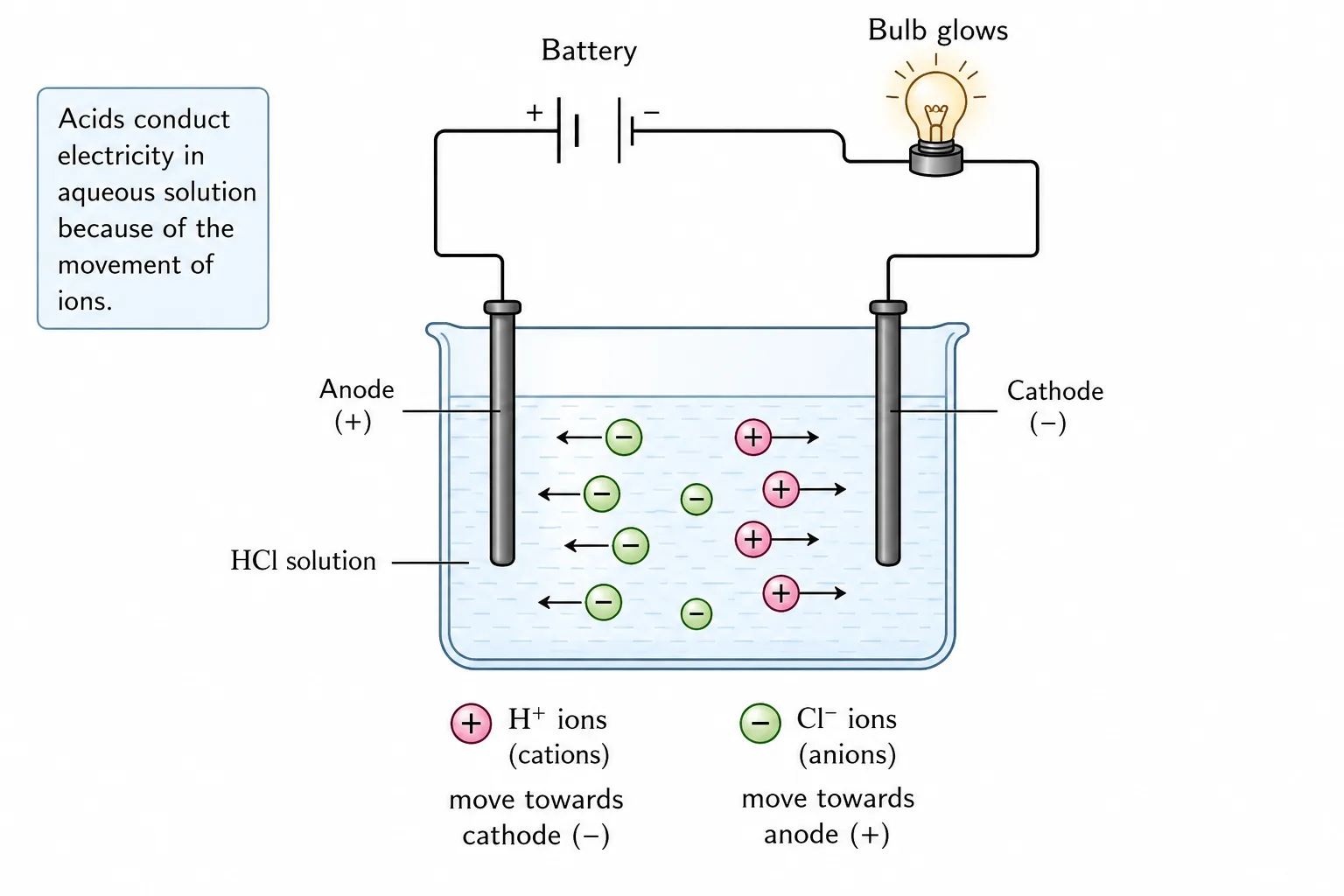
Activity 2.7 — Electrical Conduction by Acids
Set up a circuit with two graphite electrodes, a battery, and a bulb, with a beaker between the electrodes.
Test in different substances:
| Substance | Bulb glows? | Conclusion |
|---|---|---|
| Dry gas | No | Doesn't conduct |
| Dry glucose | No | Doesn't conduct |
| Aqueous | Yes | Conducts |
| Aqueous | Yes | Conducts |
| Aqueous | Yes | Conducts |
| Aqueous alcohol | No | Doesn't conduct |
Conclusion — Ionisation
Aqueous acids and bases conduct electricity — because they ionise in water.
What All Acids Have in Common
All acids release ions in water:
These are the cause of all acidic properties.
What All Bases Have in Common
All water-soluble bases release ions:
These are the cause of all basic properties.
[Board Important] Definition of acids and bases in terms of H⁺ and OH⁻.
What Really Happens with an Acid in Water — The Hydronium Ion
In reality, doesn't stay alone — it combines with a water molecule, forming the hydronium ion ().
Detailed Equation
That is, never stays alone — it always exists as .
Why Is This Important?
- is very small (only a proton) — extremely unstable on its own.
- A water molecule 'grabs' it — forming the stable .
- In most equations we simply write — but in reality it is always .
Simplified vs. Realistic
| Simplified | Realistic |
|---|---|
In the board exam: Both forms are acceptable — but is more scientifically accurate.
Behaviour of Bases
Bases also ionise in water — releasing :
(no extra water molecule attaches.)
A Curious Question
Why do acidic properties only show up in water?
Answer: A dry acid (like pure gas) has no ions yet — only molecules. Only when dissolved in water does ionisation occur, and that's when forms — providing acidic properties.
Example: Dry does not turn blue litmus red; aqueous does.
[Board Important] This is a 3-mark question.
Dilution of Acids and Bases
What Happens When Acid or Base Is Added to Water?
Dilution = reducing the concentration of a concentrated solution by adding water.
What Changes Upon Dilution?
| Property | Concentrated acid | Dilute acid |
|---|---|---|
| / concentration | High | Low |
| pH | Low (1-3) | Higher (3-5) |
| Reaction with metals | Vigorous | Slow |
| Corrosiveness | High | Low |
| Indicator colour intensity | Strong | Faint |
Scientific Explanation of Dilution
When an acid is added to water:
- The total number of ions remains the same (already formed by ionisation).
- But the volume of solution increases.
- So the concentration of per unit volume decreases.
- Hence the acid is less strong — pH rises.
Crucial Safety — How to Dilute
Always add concentrated acid to water — never water to concentrated acid!
Why?
Dilution of acid is exothermic — a lot of heat is released.
- If water is added to acid: heat is released suddenly in a small region — the solution can splash out — risk of severe burns.
- If acid is added to water: the larger water volume absorbs the heat, keeping it safe.
A Memory Rule
"Water first, acid later."
"Always Add Acid to Water (AAAW)"
The Same Rule for Bases
A concentrated base (like ) must also be added to water — never water to base.
Reason: Dilution of a base is also exothermic.
[Board Important] This safety question is asked every year.
Strong and Weak Acids / Bases
Strong Acids
Those that ionise completely in water (~ 100%).
Examples:
- Hydrochloric acid ()
- Sulphuric acid ()
- Nitric acid ()
Why strong? Because all their molecules ionise to release in water.
Weak Acids
Those that ionise partially in water (< 5%).
Examples:
- Acetic acid () — vinegar
- Citric acid — lemon
- Carbonic acid () — soda
- Formic acid () — ant sting
Why weak? Because only a small fraction of molecules ionise.
Strong Bases
Those that ionise completely (~ 100%) and release plenty of .
Examples:
- Sodium hydroxide ()
- Potassium hydroxide ()
- Calcium hydroxide () — limited solubility
Weak Bases
Those that ionise partially.
Examples:
- Ammonium hydroxide ( or )
- Magnesium hydroxide () — limited solubility
Comparison Table
| Property | Strong | Weak |
|---|---|---|
| Ionisation | Complete | Partial |
| or concentration | High | Low |
| Electrical conductivity | High | Low |
| pH (for acid) | 1-3 | 4-6 |
| pH (for base) | 12-14 | 8-10 |
| Reaction with metal/carbonate | Vigorous | Slow |
[Board Important] Strong and weak acids/bases — definitions and 2 examples each.
The Ionic View — A Common Thread Across Reactions
In this section we learnt that all acidic properties come from (or ), and all basic properties from .
Now Analyse Reactions Ionically
1. Acid + Metal:
Full:
Ionic: (Cl⁻ is just a spectator ion)
2. Acid + Base (Neutralisation):
Full:
Ionic: (Na⁺ and Cl⁻ are spectators)
3. Acid + Carbonate:
Full:
Ionic:
Key Conclusion
All acidic reactions involve . Whether the acid is , , or — they all behave alike because they all release in water.
All basic reactions involve . Whether the base is , , or — they all release .
A Curious Question
A dilute acid turns blue litmus red. What if dry gas is brought near blue litmus?
Answer: Dry has no ions — just molecules. It will not turn the litmus red (or only very slowly).
This proves that water is essential for acidic properties — because only then are / formed.
[Board HOTS] A reasoning-based question that comes up in exams.
🧠 Memory Capsule
A one-glance recap to revisit just before the board exam.
1. Ionic Definitions of Acids and Bases
- Acid: a substance that gives (or ) in water.
- Base: a substance that gives in water.
2. What All Acids Have in Common
- All release ions in water.
- doesn't stay alone — is formed.
3. What All Bases Have in Common
- All aqueous bases release .
4. Examples of Ionisation
| Substance | Ionisation in water |
|---|---|
5. The Electrical Conductivity Test
- Dry acid/base: does not conduct.
- Aqueous acid/base: conducts.
- Reason: ionisation in water.
6. Strong vs. Weak
| Strong acid | Weak acid |
|---|---|
| , | |
| Ionisation ~ 100% | Ionisation < 5% |
| Strong base | Weak base |
|---|---|
7. Rules of Dilution
Safety rule: Always add concentrated acid to water — never water to acid!
Dilution causes:
- Lower / concentration.
- pH moves toward neutral.
- Heat is released (exothermic).
8. Board's 'Golden' Questions
- What is common in all acids? Show in ionic form.
- What precaution must be taken when diluting a concentrated acid?
- Difference between strong and weak acids — two examples.
- Why doesn't dry turn blue litmus red?
- What is the hydronium ion?
The Bottom Line: Acid = gives ; base = gives . Dilution = exothermic, requires care.
Solved Examples
Example 1: NCERT — What Is Common in All Acids?
What do all acids have in common? Express in ionic form.
Solution:
Common feature of all acids: They all ionise in water to release ions (or strictly, ).
These are the source of all the chemical properties of acids.
In ionic form:
More accurate (with hydronium ion):
Principle: All acidic properties — sour taste, turning blue litmus red, releasing from metals — are due to .
[NCERT textbook question]
Example 2: What Is Common to All Bases?
What do all water-soluble bases have in common? Show in ionic form.
Solution:
Common feature of all aqueous bases: They all release ions in water.
These are the source of all basic properties.
In ionic form:
Principle: All basic properties — bitter taste, slippery touch, turning red litmus blue — are due to .
[Repeatedly asked in boards]
Example 3: NCERT — Caution When Diluting Concentrated Acid
When mixing an acid with water, what should you keep in mind, and why?
Solution:
Cardinal rule: Always add concentrated acid to water — never water to concentrated acid!
*(In English: "Always Add Acid to Water (AAAW)")
Why?
- Dilution of acid is exothermic — a lot of heat is released.
- If water is added to acid:
- A small amount of water meets a lot of acid.
- Heat is generated rapidly in a small region.
- The mixture can suddenly boil — solution may splash out.
- This can cause severe acid burns.
- If acid is added to water:
- Large amount of water absorbs the heat.
- Mixture stays safe.
- No splashing.
Additional precautions:
- Add slowly.
- Keep the beaker cool (in an ice-water bath).
- Wear goggles and gloves.
- Stir while mixing.
Same rule for concentrated bases ().
[NCERT textbook question — frequently asked in board]
Example 4: The Hydronium Ion
What is the hydronium ion? How is it formed?
Solution:
Hydronium ion (): A positively charged ion formed when an acid's combines with a water molecule ().
Formula: — one proton () and one water molecule () combined.
Formation:
That is, never exists alone — a water molecule 'grabs' it.
Detailed explanation:
- is just a proton — no electrons — extremely small and unstable.
- It bonds with a lone pair on the water molecule ().
- The result is — stable and hydrated.
For board exams:
- Simplified equations write .
- is more scientifically accurate.
- Both are acceptable — but a note about is desirable.
[Board 2-3 mark question]
Example 5: The Dry HCl Question
Dry gas does not turn dry blue litmus red, but aqueous does. Why?
Solution:
Principle: Acidic properties are due to (or ) — and these form only in water.
Detailed explanation:
Dry gas:
- Only molecules are present.
- No ionisation — no separated or .
- Hence it does not turn blue litmus red.
Aqueous (or when added to water):
- ionises in water:
- reacts with the blue litmus — turns it red.
How to demonstrate?
Experiment:
- Take dry gas in a test tube (directly from a gas generator).
- Bring dry blue litmus paper near — no change.
- Now bring wet blue litmus paper near — it turns red instantly.
Conclusion: Water is essential for acidic properties — because only then are formed.
[Board HOTS — 3 marks]
Example 6: Difference Between Strong and Weak Acids
State the difference between strong and weak acids. Give two examples of each.
Solution:
Comparison Table:
| Aspect | Strong acid | Weak acid |
|---|---|---|
| Ionisation | Complete in water (~ 100%) | Partial in water (< 5%) |
| concentration | High | Low |
| pH (1M solution) | 0-1 | 3-5 |
| Reaction with metal | Vigorous | Slow |
| Electrical conductivity | High | Low |
| Corrosiveness | High | Low |
Strong acids (two examples):
- Hydrochloric acid () — in the stomach, in laboratories.
- Sulphuric acid () — in batteries, in industry.
- Nitric acid () — in fertilisers.
Weak acids (two examples):
- Acetic acid () — in vinegar.
- Citric acid — in lemon.
- Carbonic acid () — in soda water.
Daily-life intuition:
- Vinegar (weak) — edible, safe on skin.
- (strong) — never let it touch you.
[Board Important — 3 marks]
Example 7: NCERT — Electrical Conduction Test
In a circuit with a bulb, aqueous solutions of , , glucose, and alcohol were tested one by one. In which solutions did the bulb glow?
Solution:
| Solution | Bulb glows? | Reason |
|---|---|---|
| Aqueous | Yes | Acid — ionises |
| Aqueous | Yes | Base — ionises |
| Aqueous glucose | No | No ionisation |
| Aqueous alcohol | No | No ionisation |
Analysis:
Condition for electrical conduction: Free charged ions must be present in the solution.
- and — ionise in water, releasing free ions → conduct electricity.
- Glucose and alcohol — covalent compounds, do not ionise in water → do not conduct.
Conclusion: Acids and bases conduct electricity because they form ions — but glucose and alcohol do not.
[NCERT — Board 5-mark question]
Example 8: NCERT — What Happens on Dilution?
When we add concentrated to water, what happens to the concentration of ? Does it increase, decrease, or remain the same?
Solution:
Analysis:
- Concentrated : more molecules, less water → high concentration.
- On dilution:
- The total number of stays the same.
- But the volume of solution increases.
- So the concentration of per unit volume decreases.
Per-unit changes:
- Total count: constant
- Volume of solution: high
- (molar concentration): decreases
Answer: The concentration of decreases.
Other effects:
- pH increases (1 → 3 → 5 …).
- Acid is less strong — less corrosive.
- Slower reaction with metals.
- Less intense colour with indicators.
Heat change:
- Dilution is exothermic.
- A lot of heat is released when concentrated acid is added to water.
- That's why caution is needed.
[NCERT textbook — Board 3-5 marks]
Example 9: Numerical — Ionisation
If M ionises ~ 100%, what is the concentration? And if M ionises only 1%, what is its concentration?
Solution:
(strong acid):
- Ionisation = 100%
- M M
- pH =
(weak acid):
- Ionisation = 1%
- M M
- pH =
Comparison:
| Aspect | ||
|---|---|---|
| Initial concentration | 0.1 M | 0.1 M |
| Ionisation | 100% | 1% |
| 0.1 M | 0.001 M | |
| pH | 1 | 3 |
Lesson: Even at the same concentration, strong and weak acids can differ in concentration by a factor of 100 — explaining their different chemical strengths.
(Detailed pH discussion follows in Section 5.)
Example 10: NCERT — Comparing Five Acids
Classify the following acids as 'strong' and 'weak' — , , , , , , .
Solution:
Strong acids (complete ionisation):
- — hydrochloric acid
- — sulphuric acid
- — nitric acid
(These three are the main members of the 'seven strong acids'.)
Weak acids (partial ionisation):
- — acetic acid (vinegar)
- — carbonic acid (soda)
- — formic acid (ant)
- — phosphoric acid (moderately weak)
Full list of strong acids: — a total of 7
Special note:
- 's first ionisation is complete (strong); the second is partial (moderate).
- — partial in all three steps — moderately weak.
[Board Important — 3 marks]
Example 11: NCERT — Ionic Form of Neutralisation
Explain neutralisation at the ionic level. Give two examples.
Solution:
Neutralisation at the Ionic Level:
The acid ionises in water:
The base ionises in water:
On mixing: and combine to form water:
The remaining ions (Na⁺ and Cl⁻) stay in solution — these are spectator ions.
On evaporating the solution: Na⁺ and Cl⁻ combine to form crystals.
Two examples:
(i) :
Full:
Ionic: (Na⁺ and Cl⁻ are spectators)
(ii) :
Full:
Ionic: (K⁺ and are spectators)
Core principle: Behind every acid-base neutralisation is the same ionic equation — .
[Board Important — 5 marks]
Example 12: Reasons and Effects of Dilution
(a) Why is dilution exothermic? (b) What can happen if the dilution of is done carelessly?
Solution:
(a) Why is dilution exothermic?
Principle — Hydration Energy:
- In a concentrated acid, the acid molecules are close together.
- When water is added, water molecules form a 'water shell' around the acid's ions.
- This process releases hydration energy.
- This energy appears as heat.
The case of : It has a very large hydration energy — that's why dilution of is highly exothermic.
(b) Consequences of careless dilution:
Wrong way — adding water to acid:
- Sudden, intense heat.
- Water's temperature rises above — it begins to boil.
- The solution can splash out (volcanic eruption-like).
- Acid burns on skin — deep wounds, burning.
- If it gets in the eyes, risk of blindness.
- The apparatus can crack.
Right way — adding acid to water:
- Large volume of water absorbs heat.
- Temperature rises only moderately.
- No splashing.
Precautions:
- Add concentrated to water very slowly.
- Keep stirring.
- Wear goggles and gloves.
- Keep a bucket of cold water nearby (for emergencies).
[Board safety question]
Example 13: A Reasoning-Based Question
A student prepares two solutions — M and M . Equally sized pieces of magnesium are added to both. What are the observations?
Solution:
The reaction in both:
where HX = or .
In M (strong):
- Ionisation ~ 100% → M
- High concentration of
- Brisk bubbles — hydrogen escapes vigorously
- Magnesium dissolves quickly
In M (weak):
- Ionisation ~ 1% → M
- Low concentration of
- Slow bubbles
- Magnesium dissolves slowly
Comparison:
| Property | ||
|---|---|---|
| Bubble rate | Fast | Slow |
| Mg dissolution | Quick | Slow |
| Heat released | More | Less |
| Final amount | Same | Same |
Special note: Both will produce the same total (since all eventually reacts) — but the rate is different.
Principle: This shows that the strength of an acid determines the vigour of its chemical reactions.
[Board + entrance]
Example 14: NCERT — The Connection Between Ionisation and pH
The pH of pure water is 7 — but where do the ions in pure water come from? Explain.
Solution:
Principle — Self-ionisation of Water:
Pure water also ionises to a very small extent:
(or simplified: )
Key points:
- The extent of ionisation is extremely low (~ M).
- M in pure water.
- pH =
That's why the pH of pure water = 7 (neutral).
The ionic product:
(This is the ionic product of water — at room temperature.)
On adding acid/base:
- Add acid → rises, falls (but stays constant).
- Add base → rises, falls.
Simplified board-level answer:
"Pure water also ionises very, very slightly, so it contains a small number of and — in equal amounts. That's why the pH = 7 (neutral)."
Example 15: A Famous Board Question
Which of the following is/are the strongest acid(s)? —
Solution:
Analysis:
| Acid | Type | Ionisation |
|---|---|---|
| Strong | ~ 100% ✓ | |
| Weak | ~ 1% | |
| Very weak | ~ 0.1% | |
| Strong | ~ 100% ✓ | |
| Weak | ~ 4% |
Strongest acids: and — both ionise 100%.
Comparative ranking:
Special note:
- and — both in the 'strong acid' category.
- 's first ionisation is 100%; the second is limited — but it is generally considered the 'strongest' overall.
[Frequently asked in boards]
Example 16: A Final Multi-Topic Question
(a) What is common to all acids? (b) What is the role of the hydronium ion? (c) What changes occur on dilution? (d) What is the correct method of diluting a concentrated acid?
Solution:
(a) Common to all acids:
All acids ionise in water to give ions (or ).
These are the source of all acidic properties.
(b) Role of the hydronium ion:
- on its own is highly unstable.
- It bonds with a water molecule () to form .
- This is the stable form that actually delivers acidic properties.
(c) Changes upon dilution:
- concentration decreases.
- pH rises (acid less strong).
- Electrical conductivity decreases (fewer ions per unit volume).
- Reaction with metals slows.
- Heat is released (dilution is exothermic).
- Less corrosive.
(d) Correct method:
"Always add concentrated acid slowly to water — never water to concentrated acid!"
Procedure:
- Take water in a large beaker.
- While constantly stirring with a glass rod, add concentrated acid slowly.
- Wear goggles and gloves.
- Keep the beaker cool (place in an ice-water bath if needed).
Why? Because of the exothermic nature, there is a risk of splashing.
[Board 5-mark question]