
Acids and Bases — An Introduction
Think for a moment — have you ever tasted a sour mango, lemon, or tamarind? What causes the sour taste? Acids.
And if soap ever touches your tongue, it tastes bitter — that's the taste of a base.
Basic Properties of Acids and Bases
| Property | Acid | Base |
|---|---|---|
| Taste | Sour | Bitter |
| Touch | — | Soapy / slippery |
| Blue litmus | Turns red | No change |
| Red litmus | No change | Turns blue |
Common Examples
Acidic substances (in daily life):
- Lemon, tamarind — citric acid
- Vinegar — acetic acid ()
- Curd / yoghurt — lactic acid
- Apple — malic acid
- Stomach — hydrochloric acid ()
- Ant sting — formic acid
Basic substances (in daily life):
- Soap — various bases
- Caustic soda (food industry) —
- Milk of magnesia (antacid) —
- Baking soda at home —
- Window cleaner — ammonia ()
A Curious Experience
When you have acidity trouble, you take baking soda. Why? Because baking soda is basic — it neutralises the excess in the stomach.
This is the central principle of this chapter — acids and bases nullify each other's effects.
Caution: Never identify acids or bases in the laboratory by tasting them — this is very dangerous. Always use indicators.
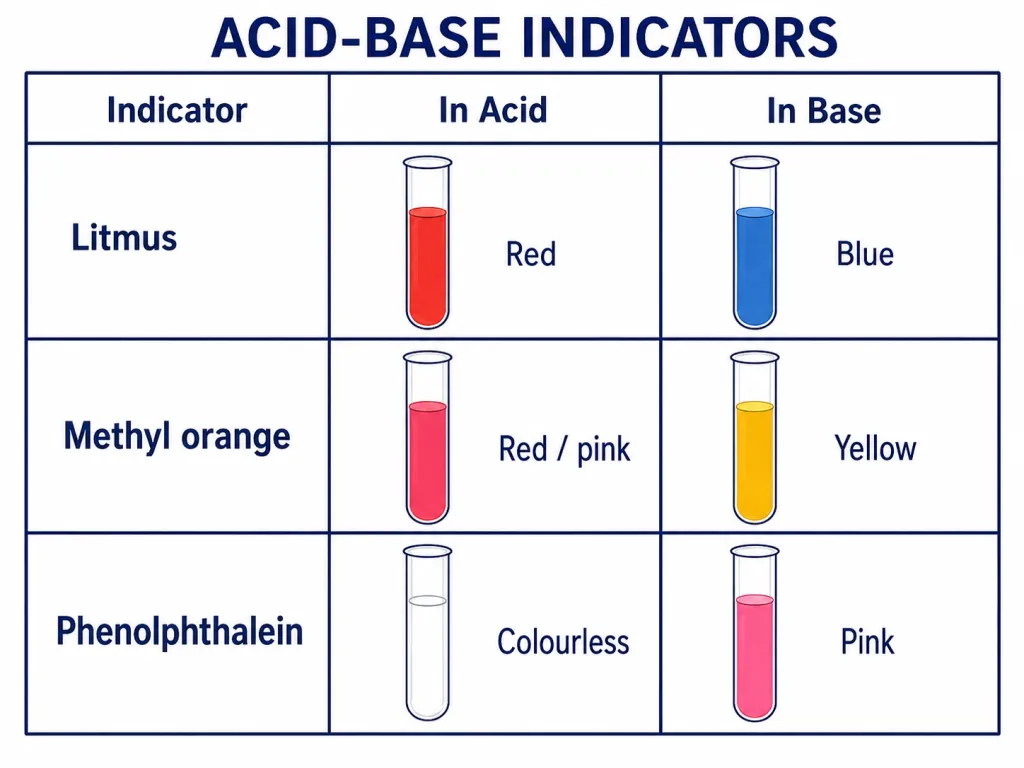
Acid-Base Indicators
Indicators = substances that show the presence of an acid or base — usually by changing colour or odour.
Why Are Indicators Necessary?
Identifying acids and bases by taste in the laboratory is dangerous (some are highly corrosive). So we use indicators.
Three Types of Indicators
1. Natural Indicators
- Litmus — most famous
- Turmeric — yellow on cloth
- Red cabbage juice
- Petals of certain flowers — Hydrangea, Petunia, Geranium
2. Synthetic Indicators
- Methyl orange
- Phenolphthalein
- Universal indicator
3. Olfactory Indicators
- Cloth strips dipped in onion juice
- Vanilla essence
- Clove oil
Litmus — The Most Famous Indicator
Source of litmus: A purple-coloured dye extracted from lichen, a plant of the Thallophyta division.
In neutral state: Litmus is purple.
Colour changes with acids and bases:
| Indicator | In acid | In base |
|---|---|---|
| Blue litmus | Red | Unchanged (blue) |
| Red litmus | Unchanged (red) | Blue |
Memory rule: Acid turns blue litmus red; base turns red litmus blue.
[Board Important] The litmus colour change is asked almost every year.
Activity 2.1 — Testing Different Indicators
Collect the following solutions in the lab — (acids), and (bases).
Put a drop of red/blue litmus, phenolphthalein, and methyl orange on each solution and observe the colour change.
Colours of the Four Indicators — A Table
| Indicator | Neutral | In acid | In base |
|---|---|---|---|
| Red litmus | Red | Red (unchanged) | Blue |
| Blue litmus | Blue | Red | Blue (unchanged) |
| Phenolphthalein | Colourless | Colourless (unchanged) | Pink / magenta |
| Methyl orange | Orange | Red / pink | Yellow |
Key Points
Phenolphthalein:
- The lab's most popular indicator.
- Shows colour only in a base — pink.
- Stays colourless in an acid.
- Widely used in neutralisation titration.
Methyl orange:
- Red/pink in acid.
- Yellow in base.
- Orange when neutral.
- Especially useful for weak bases.
A Curious Fact — The Turmeric Stain
When soap (basic) is rubbed on a turmeric stain on white cloth, the stain turns reddish-brown. Washing with plenty of water makes it yellow again. Turmeric is a natural base indicator.
[Board Important] The colour changes of methyl orange and phenolphthalein are commonly tested.
Activities 2.2 and 2.3 — Olfactory Indicators
Some substances change odour in acidic or basic environments. These are called olfactory indicators.
Activity 2.2 — Testing with Onion
Procedure:
- Place finely chopped onions in a plastic bag along with strips of clean cloth.
- Tie the bag tightly and leave it overnight in the fridge.
- The cloth strips now carry the smell of onion.
- Put a few drops of dilute on one strip and dilute on another.
- Smell each strip.
Observation:
- Strip with dilute : the onion smell remains.
- Strip with dilute : the onion smell changes (or fades away).
So onion changes odour in the presence of a base.
Activity 2.3 — Vanilla and Cloves
Procedure: Take dilute and dilute in two separate test tubes. Add a few drops of dilute vanilla essence to each. Repeat the test with clove oil.
Observations:
| Substance | Smell in | Smell in | Conclusion |
|---|---|---|---|
| Onion | Unchanged | Changes | Indicator for base |
| Vanilla | Unchanged | Changes / fades | Indicator for base |
| Clove oil | Changes / fades | Unchanged | Indicator for acid |
Lesson
- Onion and vanilla — odour changes in the presence of a base.
- Clove oil — odour changes in the presence of an acid.
[Board Important] Three examples of olfactory indicators and which medium they work in — a 3-mark question.
Universal Indicator
The earlier indicators only tell us whether a substance is an acid or a base — not how strong it is.
The universal indicator is a mixture — of several indicators — that shows different colours at different pH values.
Universal Indicator Colours and pH
| pH | Colour | Nature |
|---|---|---|
| 1-3 | Red | Strong acid |
| 4-5 | Orange / yellow | Weak acid |
| 6 | Pale green-yellow | Very weak acid |
| 7 | Green | Neutral |
| 8-9 | Blue-green | Weak base |
| 10-11 | Blue | Moderate base |
| 12-14 | Violet / purple | Strong base |
Three Forms
1. Paper: universal indicator paper — most common. 2. Solution: for adding to a test tube. 3. Digital pH meter: for precise measurement.
What Has These Colours?
| pH ~ | Substance |
|---|---|
| 1 | Stomach acid |
| 2 | Lemon, vinegar |
| 4 | Tomato, beer |
| 5 | Coffee |
| 6 | Milk, urine |
| 7 | Pure water |
| 8 | Sea water |
| 9 | Baking soda solution |
| 11 | Ammonia |
| 13-14 | Concentrated solution |
(The pH scale will be studied in detail in Section 5.)
[Board Important] What is the universal indicator? State its use. — A common 2-mark question.
🧠 Memory Capsule
A one-glance recap to revisit just before the board exam — every key idea about indicators in one place.
1. Acids and Bases — Basic Identification
| Property | Acid | Base |
|---|---|---|
| Taste | Sour | Bitter |
| Blue litmus | Red | Unchanged |
| Red litmus | Unchanged | Blue |
2. Acids in Daily Life
- Lemon → citric acid
- Vinegar → acetic acid ()
- Curd → lactic acid
- Stomach → hydrochloric acid ()
- Ant sting → formic acid
3. Bases in Daily Life
- Soap — basic
- Antacid (milk of magnesia) —
- Baking soda —
- Caustic soda —
4. Four Indicator Colours
| Indicator | Acid | Base |
|---|---|---|
| Red litmus | Red | Blue |
| Blue litmus | Red | Blue |
| Phenolphthalein | Colourless | Pink |
| Methyl orange | Red | Yellow |
5. Olfactory Indicators
| Substance | Where odour changes |
|---|---|
| Onion | Base |
| Vanilla | Base |
| Clove oil | Acid |
6. Universal Indicator — pH Colour Code
- Red = strong acid
- Green = neutral
- Violet = strong base
7. Source of Litmus
Litmus = purple dye extracted from lichen (Thallophyta).
8. Repeatedly Asked Board Questions
- What are indicators? Give three examples.
- What colour does phenolphthalein show in acids and bases?
- What are olfactory indicators? Give examples.
- Given only red litmus paper, how do you identify three solutions (acid, base, water)?
- From which plant is litmus extracted?
The Bottom Line: Acid sour-red; base bitter-blue; neutral-green.
Solved Examples
Example 1: NCERT — Identifying Three Solutions with Only Red Litmus
You are given three test tubes — one contains distilled water and the other two contain an acidic solution and a basic solution. If you have only red litmus paper, how will you identify the contents of each tube?
Solution:
Step-by-step procedure:
- First test: Put the red litmus paper in each tube.
- Observation:
- The tube where red litmus turns blue → that is a base (identified).
- The two tubes where red litmus is unchanged — could be water or acid.
- Second test: Take the now-blue litmus from the basic tube (or first dip the red litmus in the base to convert it to blue).
- Put this blue litmus in the remaining two tubes:
- Where it turns red → that is an acid.
- Where it stays unchanged (blue) → that is water.
Answer:
- Base = turns red litmus blue.
- Acid = turns blue litmus (made by reaction with base) red.
- Water = no change.
[NCERT textbook question — frequently asked]
Example 2: Definition and Examples of Indicators
What are acid-base indicators? Name three types and give one example of each.
Solution:
Definition: Acid-base indicators are substances that show the acidic or basic nature of a solution by changing colour or odour.
Three types:
1. Natural indicators:
- Litmus — extracted from lichen, purple in colour.
- Turmeric — yellow, turns reddish-brown in a base.
- Red cabbage juice.
2. Synthetic indicators:
- Phenolphthalein — colourless in acid, pink in base.
- Methyl orange — red in acid, yellow in base.
3. Olfactory indicators:
- Onion — odour changes in a base.
- Vanilla — odour changes in a base.
- Clove oil — odour changes in an acid.
[Board 3-mark question]
Example 3: Phenolphthalein Colour
What colour does phenolphthalein show in (a) dilute (b) dilute (c) distilled water?
Solution:
| Medium | Colour of phenolphthalein |
|---|---|
| (a) dilute (acid) | Colourless |
| (b) dilute (base) | Pink / magenta |
| (c) distilled water (neutral) | Colourless |
Explanation:
- Phenolphthalein is a weak acid.
- In acidic or neutral medium, it remains un-ionised — colourless.
- In a base, it ionises into the pink ion.
Practical use:
- Identifying the endpoint in neutralisation titration.
- For example, in a + titration, the pink colour disappears at the endpoint.
[Repeatedly asked in board]
Example 4: Colour of Methyl Orange
What colour does methyl orange show in different media? Make a table.
Solution:
| Medium | Colour of methyl orange |
|---|---|
| Acid (, , …) | Red / pink |
| Base (, , …) | Yellow |
| Neutral (water) | Orange |
Explanation:
- Methyl orange changes colour between pH 3.1 (red) and pH 4.4 (yellow).
- It is more useful in titrations of weak bases.
Comparison — Methyl Orange vs. Phenolphthalein:
| Property | Methyl orange | Phenolphthalein |
|---|---|---|
| pH range | 3.1 - 4.4 | 8.3 - 10 |
| In acid | Red | Colourless |
| In base | Yellow | Pink |
| Indicates | End of strong acid | End of strong base |
[Board Important — 2 marks]
Example 5: NCERT — Olfactory Indicators
From vanilla, onion, and clove, which can be used as olfactory indicators?
Solution:
Definition of olfactory indicator: A substance whose odour changes in an acidic or basic medium.
Analysis (based on Activity 2.3):
| Substance | Smell in acid | Smell in base | Olfactory indicator? |
|---|---|---|---|
| Vanilla | Unchanged | Changes | Yes ✓ |
| Onion | Unchanged | Changes | Yes ✓ |
| Clove oil | Changes | Unchanged | Yes ✓ |
Answer: Vanilla, onion, and clove — all three are olfactory indicators.
Specifics:
- Vanilla and onion → odour changes in the presence of a base (so they indicate bases).
- Clove oil → odour changes in the presence of an acid (so it indicates acids).
[NCERT textbook question]
Example 6: The Mystery of the Turmeric Stain
Why does the colour of a turmeric stain on white cloth turn reddish-brown when soap is rubbed on it? And why does it turn yellow again when washed with water?
Solution:
- Nature of turmeric: Turmeric is a natural indicator. It stays yellow in acidic/neutral medium.
- Nature of soap: Soap is basic.
- On rubbing soap on the stain: turmeric meets a base → colour turns reddish-brown.
- On washing with water: soap washes away → turmeric returns to neutral medium → colour goes back to yellow.
Principle: This confirms that turmeric is a natural base indicator.
Daily-life applications:
- We don't apply baking soda/lemon-soda on turmeric stains in the kitchen.
- After washing, the turmeric stain returns to its yellow colour.
[Board Important — daily-life question]
Example 7: Comparative Numerical with Indicators
A student has red litmus, blue litmus, phenolphthalein, and methyl orange. They tested an unknown solution —
- Blue litmus: no change
- Phenolphthalein: pink
- Methyl orange: yellow
What is the nature of the solution?
Solution:
Analysis:
- Blue litmus unchanged → the solution is not acidic.
- Phenolphthalein pink → the solution is basic.
- Methyl orange yellow → the solution is basic.
Conclusion: The solution is basic.
Verification: If red litmus were tested, it would turn blue (since red → blue indicates a base).
[Lab-based question — common in boards]
Example 8: Acids/Bases in Daily Life
Classify the following as acidic or basic — (a) vinegar (b) soap (c) milk of magnesia (d) lemon juice (e) tomato (f) lime water
Solution:
| Substance | Acid/Base? | Acid/base present |
|---|---|---|
| (a) Vinegar | Acid | Acetic acid () |
| (b) Soap | Base | Various bases |
| (c) Milk of magnesia | Base | |
| (d) Lemon juice | Acid | Citric acid |
| (e) Tomato | Acid | Oxalic acid |
| (f) Lime water | Base |
Rule — How to tell?
- Acid: sour taste, turns blue litmus red.
- Base: bitter taste, slippery touch, turns red litmus blue.
Example 9: The Source of Litmus
From which plant is litmus extracted? What is its nature?
Solution:
- Source: Litmus is extracted from a plant called lichen. This plant belongs to the Thallophyta division.
- Colour: Litmus is a purple-coloured dye.
- Neutral state: Pure litmus is purple (neither red nor blue).
- Two types of litmus paper:
- Red litmus: prepared by treating with acid.
- Blue litmus: prepared by treating with base.
- Uses:
- The most common indicator in the lab.
- Quick, cheap, and reliable.
Interesting fact: Lichen is a 'symbiotic' plant — it consists of a fungus and an alga living together.
Example 10: A Caution Question
Why should one never identify acids or bases in the laboratory by tasting? What should be done instead?
Solution:
Why not taste?
- Highly corrosive: Acids and bases can destroy cells.
- Risk of burns: Sharp burns on skin, tongue, mouth.
- Toxicity: Some acids/bases are deadly (like , , ).
- No visible clue: Most acids and bases are colourless — taste tells you nothing about them.
So what should be done?
- Use indicators — litmus, phenolphthalein, methyl orange.
- pH paper for an accurate pH value.
- Digital pH meter for even more precision.
Precautions:
- Wear goggles.
- Use rubber gloves.
- Follow lab safety rules.
[Safety-based question]
Example 11: Ant Sting
Why does an ant sting cause a burning sensation? What is the home remedy?
Solution:
- Cause of burning: An ant's sting contains formic acid (HCOOH). It causes burning on the skin.
- Home remedy: Apply a baking soda () solution.
- How does it work?
- Baking soda is basic.
- It neutralises the formic acid (acidic).
- The acid's effect is reduced.
- Reaction:
- Comparison: If you applied lemon (acidic), the pain would worsen! Only basic remedies work.
Daily-life applications:
- Bee sting — also acidic; treated with bases.
- Wasp sting — basic; treated with lemon/vinegar (acid).
Example 12: Home Remedy for Acidity
After a meal, you have stomach burning (acidity). You have two choices — lemon water or baking soda. Which is the correct remedy? Explain.
Solution:
Cause of acidity: Excess in the stomach.
Analysis of the two options:
(a) Lemon water:
- Lemon = citric acid (acidic).
- Stomach already has too much acid — adding more will worsen the problem.
- ❌ Not the right remedy.
(b) Baking soda:
- Baking soda = (basic).
- The base will neutralise the excess stomach acid.
- ✓ Correct remedy.
- Reaction:
Conclusion: Baking soda is the correct remedy because the acid is neutralised by a base.
[Board frequently-asked daily-life question]
Example 13: Comparative Question — Acid vs. Base
Compare five physical/chemical properties of acids and bases.
Solution:
| # | Property | Acid | Base |
|---|---|---|---|
| 1 | Taste | Sour | Bitter |
| 2 | Touch | Normal | Slippery (soap-like) |
| 3 | Effect on blue litmus | Turns red | Unchanged |
| 4 | Effect on red litmus | Unchanged | Turns blue |
| 5 | Phenolphthalein | Colourless | Pink |
| 6 | Methyl orange | Red/pink | Yellow |
| 7 | Reaction with metals | Releases gas | Usually no reaction (exceptions: Zn, Al) |
| 8 | Ions in water | Give | Give |
| 9 | pH | < 7 | > 7 |
| 10 | Neutralisation | With base → salt + water | With acid → salt + water |
Daily examples:
- Acids: lemon, vinegar, tamarind
- Bases: soap, baking soda, antacid
[Board 5-mark question]
Example 14: A Question About Soap
Why is soap basic? Why does it feel slippery on the hand?
Solution:
- How soap forms: Soaps are sodium/potassium salts of long-chain fatty acids. They are made by treating fatty acids with bases — so they retain a basic character.
- Why is soap basic?
- The aqueous solution of soap releases ions.
- So it is basic.
- Why does it feel slippery?
- Basic solutions react with the oily layer on the skin.
- This reaction 'saponifies' the skin oil.
- The new product gives a slippery feel.
- Applications:
- In washing clothes — removes dirt.
- In hand-washing — removes germs, dust, and oil.
- Caution: Leaving soap on the skin too long can cause irritation (itching, dryness) — because of its basic nature.
Example 15: Universal Indicator
What is the universal indicator? How is it different from ordinary litmus? Give its pH-colour code.
Solution:
Universal indicator: A mixture — of several indicators — that shows different colours at different pH values.
Difference from litmus:
| Aspect | Litmus | Universal indicator |
|---|---|---|
| What does it tell? | Acid/base presence | Also the strength |
| Number of colours | 2 (red/blue) | 7+ (one per pH value) |
| Accuracy | Approximate | Precise pH value |
pH-Colour Code:
| pH | Colour | Nature |
|---|---|---|
| 1-2 | Red | Strong acid |
| 3-5 | Orange / yellow | Moderate acid |
| 6 | Pale green-yellow | Weak acid |
| 7 | Green | Neutral |
| 8-9 | Blue-green | Weak base |
| 10-12 | Blue | Moderate base |
| 13-14 | Violet | Strong base |
Uses: as pH paper, solution, or digital meter.
[Board 3-mark question]
Example 16: An Experiment — Identifying an Unknown Solution
In an experiment, the following tests were performed on five unknown solutions ():
| Solution | Red litmus | Phenolphthalein | Methyl orange |
|---|---|---|---|
| A | Unchanged | Colourless | Red |
| B | Blue | Pink | Yellow |
| C | Unchanged | Colourless | Orange |
| D | Unchanged | Colourless | Red |
| E | Blue | Pink | Yellow |
State the nature of each.
Solution:
Analysis:
- A: Red litmus unchanged (not basic), methyl orange red (acidic), phenolphthalein colourless (acid or neutral) → Acidic.
- B: Red litmus blue (basic), phenolphthalein pink (basic), methyl orange yellow (basic) → Basic.
- C: Red litmus unchanged (acid or neutral), phenolphthalein colourless (acid or neutral), methyl orange orange (neutral) → Neutral (water).
- D: Same as A → Acidic.
- E: Same as B → Basic.
Final classification:
| Solution | Nature |
|---|---|
| A | Acidic |
| B | Basic |
| C | Neutral (pure water) |
| D | Acidic |
| E | Basic |
Lesson: Using two or more indicators makes the identification of a solution precise.
[Board HOTS — 5 marks]