
Reaction of Acids with Metals
In the previous section, we learnt to identify acids and bases with indicators. Now let's study their chemical properties.
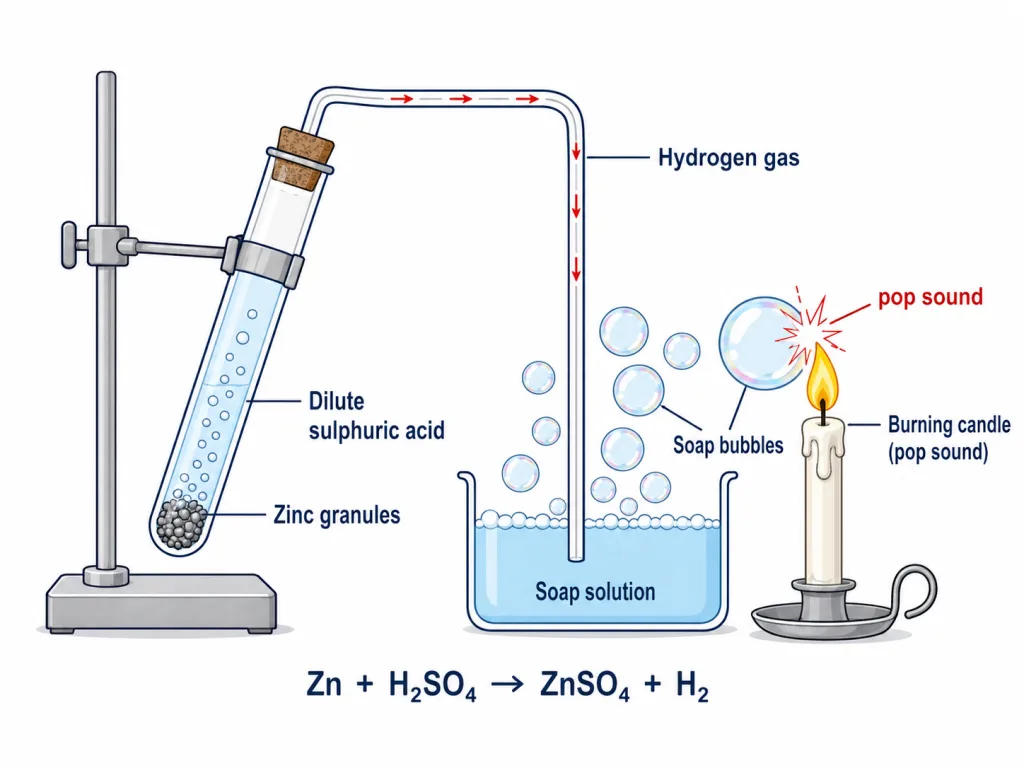
Activity 2.3 — Zinc and Dilute
Take some dilute in a test tube and add granulated zinc.
Observations:
- Bubbles appear around the zinc granules.
- The test tube becomes warm (exothermic).
- Zinc gradually dissolves.
Reaction:
Test for Hydrogen Gas
Pass the evolved gas through a soap solution — soap bubbles form (filled with hydrogen). Bring a burning candle close — the gas burns with a 'pop' sound.
With Other Acids
The same experiment with , , and (acetic acid) gives the same observations.
(i) Zinc + :
(ii) Magnesium + :
(iii) Iron + :
General Rule
Acid + Active Metal → Salt + Hydrogen Gas
Recall — this is a displacement reaction (from Chapter 1). The metal displaces the of the acid.
Which Metals Will React with Acids?
Metals above hydrogen in the activity series () can release from acids. Metals below hydrogen () do not react with dilute acids.
[Board Important] Activity questions are asked nearly every year.
Reaction of Bases with Metals
Do all metals also react with bases? No — only some.
Activity 2.4 — Zinc and Sodium Hydroxide
Take 2 mL of solution in a test tube. Add zinc pieces and heat.
Observations:
- Bubbles of hydrogen gas are evolved.
- Zinc gradually dissolves.
- A new salt is formed — sodium zincate ().
Reaction:
(sodium zincate)
Special Note — Which Metals?
Only some metals react with bases:
- Zinc (Zn)
- Aluminium (Al)
- Some other 'amphoteric' metals
These metals are called 'amphoteric' — because they react with both acids and bases.
Example with aluminium:
(sodium aluminate)
General Rule
Base + Amphoteric Metal → Salt + Hydrogen Gas
Acid vs. Base — Reaction with Metal
| Aspect | Acid + Metal | Base + Metal |
|---|---|---|
| Which metals? | Active (above H) | Only Zn, Al, etc. |
| Products | Metal salt + | Metal zincate/aluminate + |
| Example |
[Board Important] This comparison is often a 3-mark question.
Reaction of Acids with Metal Carbonates
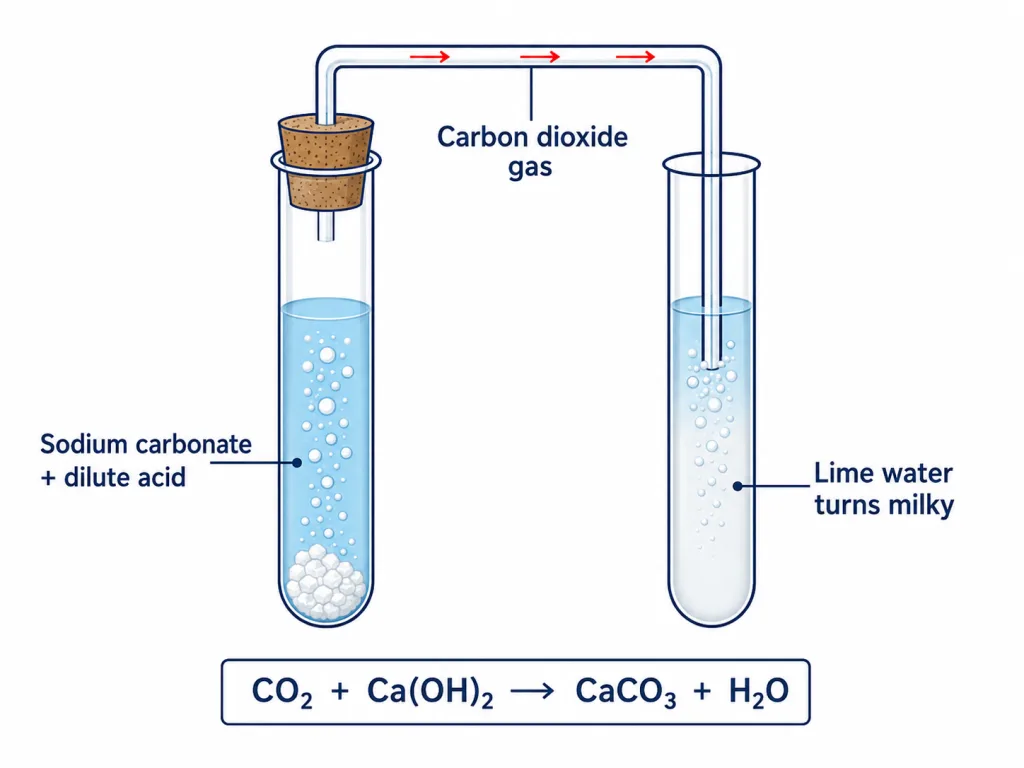
Activity 2.5 — Sodium Carbonate and Hydrochloric Acid
Take some sodium carbonate () in a test tube. Add dilute .
Observations:
- Brisk effervescence — a colourless, odourless gas is released.
- This gas turns lime water milky (test it).
Reaction:
General Rule
Acid + Metal Carbonate → Salt + Water +
Other Examples
(i) Calcium carbonate + :
This is the same reaction used to prepare gas in the laboratory.
(ii) Magnesium carbonate + :
Test for — Lime Water Test
(lime water turns milky)
If excess is bubbled, the precipitate dissolves (a bicarbonate forms):
(calcium bicarbonate — soluble)
Reaction of Acids with Metal Hydrogen Carbonates
Sodium Hydrogen Carbonate +
(notice — water and form, just like with carbonates.)
General Rule
Acid + Metal Hydrogen Carbonate → Salt + Water +
A Famous Example
In a fire extinguisher:
and dilute react —
The released helps extinguish the fire.
Ant Sting — An Example
When an ant bites, it injects formic acid (). To relieve the pain, we apply baking soda () —
(the acid is neutralised, the burning sensation reduces)
Memorise in One Line
"Acid + Carbonate = Salt + Water + "
"Acid + Bicarbonate = Salt + Water + "
The outcomes are the same — only the proportions differ.
[Board Important] This reaction is asked every year.
Vigour of the Acid-Metal Reaction
Not all acids react with metals at the same rate. It depends on their 'strength'.
Strong vs. Weak Acids
| Property | Strong acid | Weak acid |
|---|---|---|
| Ionisation in water | Complete (~ 100%) | Partial (< 5%) |
| Examples | (acetic) | |
| concentration | High | Low |
| Reaction with metal | Vigorous | Slow |
| pH | 1-3 | 4-6 |
Experimental Comparison
Dilute (strong acid) with Zn — vigorous bubbling.
Dilute (weak acid) with Zn — slow bubbling.
Both eventually produce or + .
Summary of All Reactions in This Section
| Reaction Type | General Form | Example |
|---|---|---|
| Acid + active metal | Acid + Zn → salt + | |
| Base + amphoteric metal | Base + Zn → salt + | |
| Acid + carbonate | Acid + → salt + water + | |
| Acid + bicarbonate | Acid + → salt + water + |
Daily-Life Applications
- Treating acidity: Baking soda + stomach .
- Treating ant stings: Baking soda + formic acid.
- Fire extinguishers: + acid → → puts out fires.
- Lime water test: for identifying .
- Food industry: how baking powder works.
🧠 Memory Capsule
A one-glance recap to revisit just before the board exam — every key reaction.
1. Acid + Metal → Salt +
Strong acid and active metal (above H)
Must-memorise examples:
2. Base + Amphoteric Metal → Salt +
Only Zn, Al, etc.
Must-memorise example:
- (sodium zincate)
3. Acid + Carbonate → Salt + +
Must-memorise examples:
- (lab preparation of )
4. Acid + Bicarbonate → Salt + +
Must-memorise example:
5. Test for Hydrogen
Burns with a 'pop' sound.
6. Test for
Turns lime water milky:
7. Strong vs Weak Acids
| Strong | Weak |
|---|---|
| pH 1-3 | pH 4-6 |
| Vigorous reaction with metals | Slow reaction |
8. Board's 'Golden' Questions
- What are the observations when Zn reacts with dilute ? Write the reaction.
- State the general rule for acid + carbonate reactions.
- Do bases always release from metals? Why?
- What gas turns lime water milky? Write the reaction.
- What do you apply on an ant sting and why?
The Bottom Line: Acid + active metal = salt + ; acid + carbonate = salt + water + .
Solved Examples
Example 1: NCERT — Zn + Experiment
Granulated zinc was placed in a test tube and dilute was added. (a) What are the observations? (b) Write the reaction. (c) How would you identify the gas evolved?
Solution:
(a) Observations:
- Bubbles appear around the zinc granules.
- The test tube becomes warm.
- Zinc gradually dissolves.
(b) Reaction:
(c) Test for hydrogen:
- Pass the gas through a soap solution — soap bubbles will form.
- Bring a burning candle close — the gas burns with a 'pop' sound.
- This is the classic test for .
[NCERT textbook — frequently asked]
Example 2: General Rule of Acid-Metal Reaction
What is the general rule for the reaction between an acid and a metal? Give three examples.
Solution:
General rule: An active metal reacts with an acid to give a salt and hydrogen gas.
Three examples:
(i)
(ii)
(iii)
Exception: (below hydrogen) do not react with dilute acids.
[Board 3-mark question]
Example 3: Zinc +
What happens when zinc metal is heated with sodium hydroxide?
Solution:
Reaction:
(sodium zincate)
Observations:
- Zinc gradually dissolves.
- Hydrogen gas is evolved.
- A colourless solution (sodium zincate) is formed.
Special note:
- This shows that zinc is an amphoteric metal.
- It reacts with both acids and bases.
- Other amphoteric metals — aluminium (Al), tin (Sn), lead (Pb).
Common feature with acid: in both cases hydrogen gas is released.
[Board Important]
Example 4: NCERT — Formation of
What are the observations when sodium carbonate is reacted with dilute ? Write the reaction.
Solution:
Observations:
- Brisk effervescence — a colourless, odourless gas is evolved.
- If the gas is passed through lime water, it turns milky.
Reaction:
Test for :
A white precipitate of forms — making lime water milky.
(If excess is bubbled, the white precipitate dissolves — calcium bicarbonate is formed, which is soluble.)
[NCERT textbook question]
Example 5: General Acid-Carbonate Rule
What is the general rule for the reaction between an acid and a metal carbonate? Give two examples.
Solution:
General rule:
Two examples:
(i) Calcium carbonate + (lab preparation of ):
(ii) Sodium carbonate + :
Type of reaction:
- Double displacement (referring to Chapter 1) — ion exchange.
- Gas-evolution reaction.
Daily life:
- In fire extinguishers.
- The reason food rises (baking powder).
- In treatment of acidity.
Example 6: NCERT — Baking Soda on Ant Stings
Why do we apply baking soda on an ant sting? Write the chemical reaction.
Solution:
Cause: An ant's sting contains formic acid () — which causes burning on the skin.
Action of baking soda:
- is basic.
- It neutralises the formic acid.
- The acid's effect is reduced — pain and burning are relieved.
Reaction:
(sodium formate + water + )
Daily life:
- A bee sting is also acidic — baking soda is effective.
- A wasp sting is alkaline — treated with vinegar/lemon (acid).
[Repeatedly asked in board]
Example 7: Fire Extinguisher
A type of fire extinguisher uses baking soda and dilute acid. How does it work? Write the reaction.
Solution:
Principle:
- gas is effective in extinguishing fires ( is heavier than air, prevents oxygen from reaching the fire).
- When the button is pressed, and dilute mix and release .
Reaction:
(or in single equation form:)
How does it extinguish fire?
- is released — heavier than air, forms a 'blanket' over the fire.
- Oxygen is cut off — the fire is put out.
- Water is also produced — provides cooling.
Modern extinguisher: cylinder direct — pre-stored.
[Board Important — daily life]
Example 8: Numerical — Gas Volume
How much gas is liberated at STP from the complete reaction of 3.25 g of Zn with dilute ? (Zn=65, molar volume=22.4 L)
Solution:
- Reaction:
- Moles of Zn: mol
- Moles of : 0.05 mol (1:1 ratio)
- Volume at STP:
- Answer: 1.12 L of hydrogen gas.
Lesson: Stoichiometry — first find the mole ratio, then convert to volume.
Example 9: Dilute vs. Concentrated Acid
Both dilute and concentrated react with Zn. What is the difference in their reaction?
Solution:
The basic reaction is the same in both:
Differences:
| Aspect | Dilute | Concentrated |
|---|---|---|
| concentration | Lower | Higher |
| Rate of reaction | Slow / moderate | Fast |
| Bubbles | Slow | Quick and brisk |
| Heat released | Some | More |
| Final products | + | Same |
Special note:
- Concentrated behaves differently — it acts as an oxidising agent, sometimes giving instead of .
- Concentrated also — does not give ; instead or .
- This is a Class 11 level concept.
Caution: When working with concentrated acids, goggles and gloves are essential.
Example 10: Which Metal Will Not React with Acid?
Which of the following metals will not react with dilute ? (a) Zn (b) Fe (c) Cu (d) Mg (e) Ag (f) Au
Solution:
Activity series (relevant part):
Rule: Metals above H can displace from a dilute acid; those below cannot.
| Metal | Position vs H | Reacts with acid? |
|---|---|---|
| Zn | Above | Yes ✓ |
| Fe | Above | Yes ✓ |
| Cu | Below | No ✗ |
| Mg | Above | Yes ✓ |
| Ag | Below | No ✗ |
| Au | Below | No ✗ |
Answer: Cu, Ag, and Au will not react with dilute .
Daily life: This is why silver and gold ornaments don't deteriorate easily — they are not affected by most acids.
[Common question in boards]
Example 11: Test for Hydrogen Gas
When Zn was added to dilute , hydrogen gas was produced. How would you identify this gas? Describe the test.
Solution:
The famous 'pop' test for hydrogen:
- Procedure:
- Collect the evolved gas in an inverted test tube (by water displacement).
- Bring a burning matchstick close to the mouth of the tube.
- Observation:
- The gas burns with a 'pop' (small explosive) sound.
- Sometimes a faint blue flame is also seen.
- Chemical reaction (during the pop):
- Special test — soap bubbles:
- Pass the gas through a soap solution.
- Soap bubbles form and rise in the air ( is lighter than air).
- Touch them with a burning matchstick — the pop sound results.
Caution: + mixtures can be explosive. Perform with care.
[Frequently asked in boards]
Example 12: Test for
An unknown gas was passed through lime water — the lime water turned milky. Which gas is it? Give the chemical reaction.
Solution:
- Gas: Carbon dioxide ().
- Reaction:
- Cause of the milky appearance: is insoluble — it disperses as fine particles, making the solution milky.
- On bubbling more :
The white precipitate dissolves (calcium bicarbonate is soluble).
Where does come from in daily life?
- Released in respiration.
- Released in combustion.
- Carbonated drinks.
- In fire extinguishers.
This is the most famous test for .
Example 13: Three Reactions — A Mini Numerical
Balance and state the type of each: (a) (b) (c)
Solution:
(a):
- Type: Acid + active metal → salt + (displacement).
(b):
- Type: Acid + carbonate → salt + water + (double displacement + gas evolution).
(c):
- Type: Acid + bicarbonate → salt + water + (double displacement + gas evolution).
- (already balanced)
Example 14: NCERT — Strong vs. Weak Acid
We know is a strong acid and (acetic) is a weak acid. What happens if Zn is added to solutions of equal concentration of each?
Solution:
+ Zn (strong acid):
- Brisk bubbles appear.
- High concentration of , so the reaction is fast.
+ Zn (weak acid):
- Slow bubbles appear.
- Low concentration of (only partial ionisation).
Comparison:
| Aspect | ||
|---|---|---|
| Ionisation | Complete | Partial |
| concentration | High | Low |
| Reaction rate with Zn | Fast | Slow |
| pH (1M solution) | ~ 0 | ~ 2.4 |
Lesson: The practical difference between a strong and a weak acid — the vigour of chemical reactions.
[Board Important]
Example 15: Reactions That Will Not Occur
Which of the following reactions will not occur? Give reasons: (a) (b) (c) (d)
Solution:
Activity series:
Analysis:
| Reaction | Metal vs H | Will it occur? |
|---|---|---|
| (a) Zn + HCl | Zn > H | Yes ✓ |
| (b) Cu + HCl | Cu < H | No ✗ |
| (c) Mg + | Mg > H | Yes ✓ |
| (d) Ag + HCl | Ag < H | No ✗ |
Answer: Reactions (b) and (d) will not occur.
Reason: Cu and Ag are below H in the activity series — they cannot displace from a dilute acid.
Exception: Concentrated or concentrated can react with Cu — but those are oxidation-reduction, not simple displacement.
[Common question in boards]
Example 16: A Concise Multi-Topic Question
(a) Write the reaction of dilute + . (b) Which gas is evolved? (c) What is the test for this gas? (d) What happens if more is passed through lime water?
Solution:
(a) Reaction:
(This is the same reaction used to prepare in the laboratory.)
(b) Gas evolved: Carbon dioxide ().
(c) Test for the gas:
- Lime water test: pass the gas through solution.
- Observation: lime water turns milky.
- Reaction:
(d) On passing more :
- The white precipitate begins to dissolve.
- Because calcium bicarbonate is formed — which is soluble.
Lesson: Lime water remains milky only for a while — it returns to clear (with excess ).
[Board 5-mark question]