
pH in Our Body
pH is not just a laboratory concept — pH balance is critical to every aspect of our lives.
pH in the Stomach
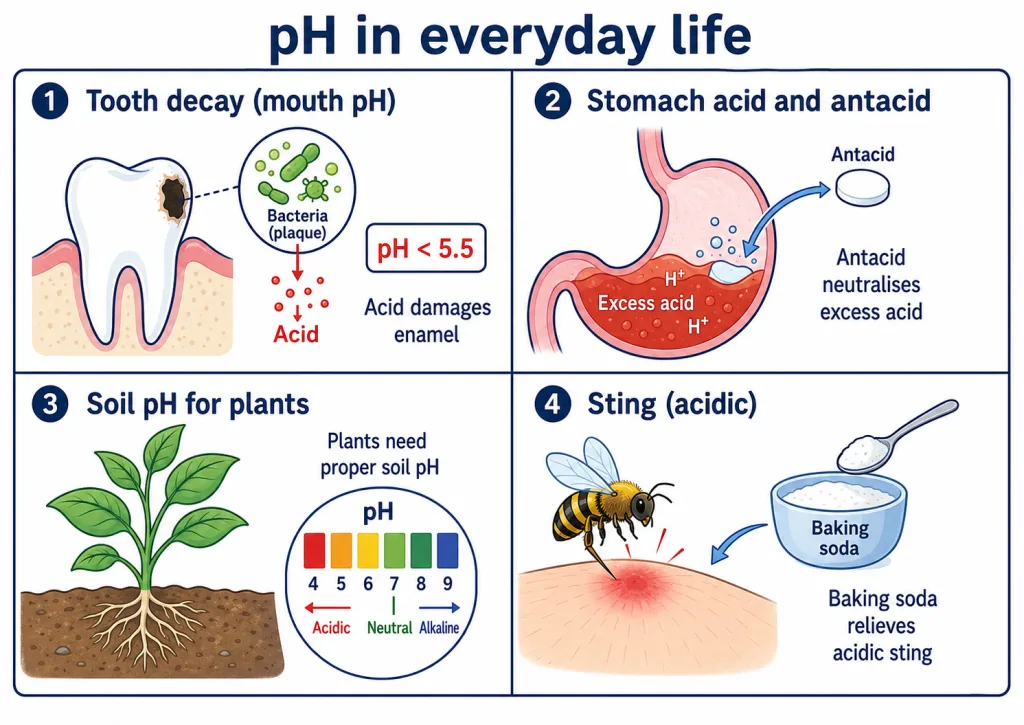
Our stomach contains hydrochloric acid () — pH between 1.5-2.
What does it do?
- Aids digestion — breaks proteins into simpler forms.
- Activates enzymes — pepsin (digestive enzyme) works at this pH.
- Antimicrobial — kills germs entering with food.
Caution: The inner stomach lining is covered by a layer of mucus — protecting it from .
The Problem of Acidity
When the stomach has excess , acidity sets in. Symptoms:
- Burning in the stomach
- Acidic burping
- Stomach pain
- Sometimes vomiting
How Antacids Work
Antacid = a basic substance that neutralises the excess in the stomach.
Common antacids:
- Milk of magnesia =
- Baking soda =
- Aluminium hydroxide =
- Calcium carbonate =
Example reaction:
(acid neutralised, pH normal)
pH of the Mouth
Normal mouth: pH 6.5-7.5 After eating (5-30 min): pH 4-5 (acidic)
Food residues + bacteria → acid → mouth pH falls.
[Board Important] pH values of stomach and mouth, and the action of antacids — asked every year.
Tooth Decay
What Is Tooth Decay?
Teeth are coated with enamel — composed of calcium phosphate (). It is very hard, but dissolves when pH falls below 5.5.
How Does Tooth Decay Happen?
Step 1: We eat sugar. Step 2: Mouth bacteria (Streptococcus) consume the sugar and produce lactic acid. Step 3: The mouth's pH drops below 5.5. Step 4: Tooth enamel begins to dissolve in the acid. Step 5: Over time, this leads to cavities.
Prevention
1. Mouth hygiene: Rinse and brush after meals.
2. Basic toothpaste: Most toothpastes are basic — they neutralise mouth acid.
Basic ingredients of toothpaste:
3. Reduce sugar intake: Less sugar = less bacterial acid.
4. Fluoride: Fluoride in toothpaste strengthens teeth.
5. Regular dental check-ups.
A Curious Fact
Sugar-free chewing gum after meals stimulates saliva. Saliva is slightly basic — helping to restore mouth pH.
[Repeatedly asked in boards] How does tooth decay happen? Prevention. — a 3-5 mark question.
Acid Rain
pH of Normal Rain
Normal rain has pH ~ 5.6 (slightly acidic) — because atmospheric + water → carbonic acid ().
What Is Acid Rain?
When the pH of rainwater drops below 5.6, it is called acid rain.
How Does Acid Rain Form?
Acidic gases from industries and vehicles:
- Sulphur dioxide () — from burning coal and oil
- Nitrogen oxides () — from vehicle engines
These gases dissolve in rainwater to form acids:
Effects of Acid Rain
1. Rivers and lakes: Water pH falls — fish die.
2. Soil: Soil becomes acidic — crop yields drop.
3. Buildings: Marble () dissolves. Famous example — the Taj Mahal.
4. Iron: The rate of rusting increases.
5. Vegetation: Leaves are damaged.
Prevention
- Reduce burning of coal and oil.
- Use catalytic converters in vehicles.
- Use renewable energy (solar, wind).
- Plant trees.
[Board Important] Causes and effects of acid rain — environmental-education question.
Soil pH and Agriculture
Importance of pH for Crops
Each crop has a specific pH range that suits it. If the soil is too acidic or too alkaline, crops do not grow well.
pH Range for Different Crops
| Crop | Optimal pH |
|---|---|
| Rice | 5.0-7.5 |
| Wheat | 6.0-7.5 |
| Potato | 5.0-6.0 (acidic) |
| Sugarcane | 6.0-7.5 |
| Tomato | 6.0-7.0 |
| Soybean | 6.0-7.5 |
| Millet | 5.5-7.5 |
Most crops grow best between pH 6-7.5 (slightly acidic to neutral).
Why Does Soil pH Go Wrong?
Acidic soil (pH < 5.5):
- Acid rain
- Excessive use of chemical fertilisers
- Decomposing organic matter
Alkaline soil (pH > 8.5):
- Low-rainfall regions
- Saline groundwater
- Salt accumulation from irrigation
Correcting Soil pH
Treating acidic soil:
- Slaked lime () — raises pH.
- Calcium oxide () — traditional method.
- Dolomite () — slow action.
Treating alkaline soil:
- Gypsum () — lowers pH.
- Sulphur — microbes convert it to .
How Do Farmers Test Soil?
- Take a soil sample from the field.
- Test pH in a lab using a pH meter.
- Apply the appropriate treatment.
In modern India, government 'Soil Health Cards' are based on this principle.
[Board Important] Methods for correcting soil pH — agriculture-focused question.
pH Defence in Living Beings
Bee and Wasp Stings
Bee sting:
- Is acidic (formic/methanoic acid).
- Causes burning and swelling on the skin.
- Treatment: Baking soda () — basic — neutralises the acid.
Wasp sting:
- Is basic.
- Causes burning on the skin.
- Treatment: Vinegar (acetic acid) or lemon (citric acid) — acidic — neutralises the base.
A Memory Rule
"Bee → treat with bicarbonate; Wasp → treat with vinegar."
(B for Bicarbonate; W for Wasp = aciW)
Ant Sting
- Acidic (formic acid).
- Treatment: baking soda or milk of magnesia.
Stinging Nettle
- Acidic.
- Traditional remedy: dock plant (Rumex) — basic juice.
A Curious Question
If a bee stings you and you apply lemon — what happens?
Answer: The pain will increase — because lemon is acidic, and the sting is also acidic. Adding acid to acid does not produce neutralisation.
Correct treatment: baking soda or milk of magnesia.
Stings/Burns from Plants
- Karanj, stinging nettle: acidic juice.
- Treatment: basic substances (baking soda, lime, or basic plants).
Conclusion
Treatment for any sting/burn is the opposite of its nature — base for acid, acid for base.
This is a direct daily-life application of neutralisation.
[Repeatedly asked in boards] What to apply on a bee sting and why? — a 2-3 mark question.
🧠 Memory Capsule
A one-glance recap to revisit just before the board exam.
1. pH Values in the Body
| Part | pH | Nature |
|---|---|---|
| Stomach | 1.5-2 | Strong acid |
| Mouth (normal) | 6.5-7.5 | Neutral |
| Blood | 7.4 | Slightly basic |
| Skin | 4.5-5.5 | Acidic |
| Intestine | 7.5-8.5 | Basic |
2. Acidity and Antacids
- Cause: excess in the stomach.
- Treatment: a basic antacid.
- Common antacids: , , .
- Reaction:
3. Tooth Decay
- Enamel dissolves below pH 5.5.
- Cause: sugar + bacteria → lactic acid.
- Prevention: brushing, basic toothpaste, less sugar.
4. Acid Rain
- Normal rain pH ~ 5.6
- Acid rain pH < 5.6
- Cause: , → .
- Effects: rivers, soil, buildings (Taj Mahal), vegetation.
5. Soil pH
- Most crops in pH 6-7.5.
- Acidic soil treatment: slaked lime ().
- Alkaline soil treatment: gypsum ().
6. Sting Treatment
| Sting | Nature | Treatment |
|---|---|---|
| Bee | Acidic | Baking soda |
| Ant | Acidic (formic) | Baking soda |
| Wasp | Basic | Vinegar/lemon |
7. Board's 'Golden' Questions
- What are acidity and antacid?
- How does tooth decay happen? Prevention.
- What is acid rain? Causes.
- What do you apply on a bee sting?
- Treatment for acidic soil.
- Why must blood pH stay constant? Importance.
The Bottom Line: pH is everywhere in daily life — stomach, teeth, rain, soil, stings — pH balance matters everywhere.
Solved Examples
Example 1: NCERT — Acidity and Antacid
When a person has acidity, an antacid is given. How does it work? Write the chemical reaction.
Solution:
Cause of acidity: Excess in the stomach — very low pH.
How an antacid works:
- An antacid is a basic substance.
- It neutralises the excess .
- The stomach pH returns to normal (3-4).
- Burning and pain are reduced.
Common antacids and reactions:
(1) Milk of magnesia ():
(2) Baking soda ():
(3) Calcium carbonate ( — tablets):
Principle: This is a neutralisation reaction — acid + base → salt + water.
[NCERT textbook question — repeatedly asked]
Example 2: NCERT — Tooth Decay
Why do teeth decay after eating sugar? How can it be prevented?
Solution:
Mechanism of tooth decay (5 steps):
- Sugar intake: We consume sweet foods.
- Bacterial action: Mouth bacteria (Streptococcus) convert sugar into acid (mainly lactic acid).
- pH drops: Mouth pH falls from 6.5 to below 5.5.
- Enamel dissolves: Enamel = — insoluble in water, but dissolves at pH < 5.5.
- Cavities form: Over time, cavities develop in the teeth.
Prevention:
- Rinse the mouth after eating.
- Brush twice daily — especially before bed.
- Use basic toothpaste — toothpastes are basic (containing , ), neutralising mouth acid.
- Reduce sugar intake.
- Fluoride toothpaste — strengthens teeth.
- Regular dental check-ups.
[NCERT textbook question — repeatedly asked]
Example 3: NCERT — Bee Sting
Why does a bee sting cause burning? What is the home remedy? Write the chemical reaction.
Solution:
Cause of burning: A bee's sting contains formic/methanoic acid (). It causes burning, swelling, and pain on the skin.
Home remedy: Apply a solution of baking soda ().
How does it work?
- Baking soda is basic.
- Formic acid is acidic.
- They react via neutralisation.
- The acid's effect is reduced — pain and burning are eased.
Reaction:
(sodium formate + water + carbon dioxide)
Comparison — right and wrong remedies:
| Remedy | Nature | Effect |
|---|---|---|
| Baking soda | Base | ✓ correct — neutralises acid |
| Lemon | Acid | ✗ wrong — pain will worsen |
| Milk of magnesia | Base | ✓ correct — antacid also works |
| Vinegar | Acid | ✗ wrong |
Application: A wasp sting is basic — apply vinegar/lemon (acid) on it.
[NCERT textbook question]
Example 4: NCERT — Acid Rain
What is acid rain? How does it form? What are its main effects?
Solution:
Definition: When rain has pH below 5.6, it is called acid rain.
pH of normal rain: 5.6 — slightly acidic (due to atmospheric ).
How acid rain forms:
Main culprits — air pollutant gases:
- from burning coal/oil
- from vehicle engines
These gases dissolve in rainwater to form acids:
Main effects:
1. On rivers and lakes:
- The pH of water drops.
- Fish and aquatic life die.
- Some lake ecosystems are destroyed.
2. On soil:
- Soil becomes acidic.
- Crop yields fall.
- Nutrients leach away.
3. On buildings:
- Marble () dissolves.
- The Taj Mahal is a famous example.
- Reaction:
4. On vegetation:
- Leaves are damaged.
- Forest decline.
5. On iron objects:
- Rusting rate increases.
Prevention:
- Reduce burning of coal and oil.
- Use catalytic converters.
- Solar/wind energy.
[NCERT — Board 5-mark question]
Example 5: NCERT — Soil pH
A farmer's soil is acidic — crop yield is dropping. What should they do? Write the chemical reaction.
Solution:
Problem:
- Most crops grow best between pH 6-7.5.
- In acidic soil (pH < 5.5), nutrients are less available.
- Yields drop.
Treatment: Add slaked lime ().
Procedure:
- Test the soil pH.
- Spread in the field in the required quantity.
- Rain/irrigation will mix it into the soil.
- Within a few weeks, pH rises.
Reaction (with soil acid):
(acid neutralised — pH rises)
Other options:
- Quick lime () — applied directly (acts quickly, requires care).
- Dolomite () — slow-acting, longer-lasting.
Reverse case — alkaline soil:
- Add gypsum () — lowers pH.
In daily life: Government 'Soil Health Cards' tell farmers about their soil's nature.
[Board 5-mark question]
Example 6: NCERT — Mouth pH
What is the typical pH of our mouth? Why does it matter? What happens if it changes after eating sugar?
Solution:
Normal mouth pH: 6.5-7.5 (nearly neutral).
Why does it matter?
- Tooth protection — enamel is safe only above pH 5.5.
- Start of digestion — the salivary enzyme amylase works at pH 7.
- Bacterial control — normal pH keeps most harmful bacteria in check.
After eating sugar:
Step by step:
- Food residues lodge between teeth.
- Bacteria (mainly Streptococcus) consume them.
- They make lactic acid.
- Mouth pH drops — from 6.5 to 5.0 or lower.
- Tooth enamel () starts dissolving.
- Over time cavities develop.
Lesson: Rinsing and brushing after meals is the simplest defence against tooth decay.
[NCERT textbook question]
Example 7: Blood pH and Life
Human blood has pH ~ 7.4 — and it stays in a very narrow range. Why is this important? What if it changes?
Solution:
Normal blood pH: 7.35-7.45 (slightly basic).
Why such a narrow range?
1. Enzyme activity:
- Body enzymes work best at pH 7.4.
- A 0.1-unit change reduces enzyme efficiency.
2. Oxygen transport:
- Haemoglobin releases/binds oxygen correctly at pH 7.4.
- A change disrupts oxygen transport.
3. Protein structure:
- A pH change can denature proteins.
If pH changes:
Acidosis (pH < 7.35):
- Causes: diabetes, lung disease, kidney disease.
- Symptoms: rapid breathing, fatigue, coma.
- Severe cases: death.
Alkalosis (pH > 7.45):
- Causes: rapid breathing, vomiting.
- Symptoms: muscle cramps, dizziness.
How does the body manage pH?
Buffer systems:
- Bicarbonate buffer: — most important.
- Phosphate buffer
- Protein buffer
Organs that regulate pH:
- Kidneys: by excreting acid/base in urine.
- Lungs: by exhaling .
Lesson: Blood pH must always remain near 7.4. The body's amazing buffer system maintains it.
[Board + general knowledge]
Example 8: Wasp Sting
If a wasp stings you, what would you apply and why? Give a chemical justification.
Solution:
Nature of a wasp sting: Basic (not acidic — opposite of a bee).
Comparison:
| Sting | Nature | Treatment |
|---|---|---|
| Bee | Acidic (formic) | Base — baking soda |
| Wasp | Basic | Acid — vinegar/lemon |
| Ant | Acidic | Baking soda |
Correct remedy: Apply vinegar (acetic acid) or lemon juice (citric acid).
Why does it work?
- The wasp sting is basic.
- Vinegar/lemon is acidic.
- They neutralise each other.
- The base's effect is reduced — pain subsides.
Reaction (schematic):
If treated incorrectly:
- Baking soda (a base) on a wasp sting — no benefit, may worsen.
- Base on base = no neutralisation.
Memory rule:
"For Bee — Bicarbonate; for Wasp — Vinegar."
[Board reasoning question]
Example 9: NCERT — Managing Acidity
A person has acidity after a spicy meal. Which of these is the right remedy and why? (a) Lemon water (b) Vinegar (c) Baking soda (d) Coffee
Solution:
Principle: Acidity = excess in stomach → needs a basic antacid.
Analysis:
(a) Lemon water: acidic (citric acid) → wrong; will worsen acidity.
(b) Vinegar: acidic (acetic acid) → wrong; acidity will worsen.
(c) Baking soda: basic () → correct ✓ — will neutralise .
(d) Coffee: acidic (pH ~ 5) → wrong; caffeine also stimulates acid secretion.
Correct answer: (c) Baking soda
Reaction:
Principle: Use a base to neutralise excess acid — pH returns to normal.
Additional advice:
- Don't take too much baking soda — burping may result.
- Milk of magnesia is also a good option.
- Persistent acidity — see a doctor.
[Board daily-life question]
Example 10: NCERT — pH and Agriculture
A farmer is told that his soil pH is 4.5. What should he conclude and what should he do?
Solution:
Conclusion:
- pH 4.5 = very acidic.
- Most crops thrive at pH 6-7.5.
- At pH 4.5:
- Phosphorus (a crop nutrient) is less available.
- Risk of aluminium toxicity.
- Microbes are less active.
What to do?
1. Raise the pH — apply lime:
- Slaked lime () is most common.
- Dolomite () — more permanent.
Reaction:
(soil acid neutralised)
2. Estimate the amount:
- Test with a soil-test kit.
- Typically 200-500 kg per acre — depending on pH.
3. How to apply:
- Spread it in the field.
- Plough lightly.
- Allow rain/irrigation to mix it in.
4. How quickly does it work?
- pH normalises in 3-6 months.
- The next crop benefits.
5. Regular testing:
- Test soil pH annually.
- Treat as required.
Special note:
- Adding too much lime can make the soil alkaline (pH > 8) — creating new problems.
- Balance is key.
[Board 5-mark question]
Example 11: The Taj Mahal and Acid Rain
What effect does acid rain have on the Taj Mahal? Write the chemical reaction.
Solution:
Construction of the Taj Mahal: Marble () — calcium carbonate.
Threat from acid rain:
- Acid rain contains and .
- These react with marble.
Reactions:
(1) With sulphuric acid:
(2) With nitric acid:
Result:
- Marble slowly dissolves.
- The surface becomes rough.
- White takes on a yellow/brown colour.
- Carvings become blurred.
Studies on the Taj Mahal:
- Industries around Agra were releasing a lot of .
- Since the 1990s, the government has restricted this.
- The 'Taj Trapezium Zone' — a special environmental-protection zone.
Other famous monuments:
- Parthenon (Greece) — marble damaged by acid rain.
- Albert Cathedral (England).
Preventive measures:
- Control of nearby industries.
- Tree planting.
- Special coatings.
- Regular cleaning.
[Board + cultural context]
Example 12: A Mixed Daily-Life Question
Give the right treatment for the following: (a) Acidity (b) Bee sting (c) Wasp sting (d) Acidic soil (e) Alkaline soil (f) Preventing tooth decay
Solution:
| Situation | Nature of problem | Right treatment | Reason |
|---|---|---|---|
| (a) Acidity | Excess acid (stomach) | Baking soda / Milk of magnesia | Base — neutralises acid |
| (b) Bee sting | Acidic (formic) | Baking soda | Base — neutralises acid |
| (c) Wasp sting | Basic | Vinegar / lemon | Acid — neutralises base |
| (d) Acidic soil | Excess acid | Slaked lime () | Base — neutralises acid |
| (e) Alkaline soil | Excess base | Gypsum () | Mildly acidic — neutralises base |
| (f) Tooth decay prevention | Mouth acid | Basic toothpaste | Neutralises acid |
General principle: Treatment of every problem is the opposite of its nature — base for acid, acid for base.
This is a direct daily-life application of neutralisation.
[Board 5-mark question]
Example 13: NCERT — A Specific Situation
A student has both headache and acidity. Which of these should they not take: (a) milk of magnesia (b) lemon water (c) baking soda (d) water?
Solution:
Analysis:
Acidity must be treated with a base. So:
(a) Milk of magnesia (): base → ✓ correct
(b) Lemon water (citric acid): acid → ❌ should not take
(c) Baking soda (): base → ✓ correct
(d) Water: neutral → no harm, somewhat helpful
Answer: (b) Lemon water should not be taken.
Reason: Lemon contains citric acid. Acidity already involves excess acid. Adding more acid will worsen the problem.
Selection principle: If the body has excess acid — use a basic remedy; if excess base — use an acidic remedy.
[Board MCQ]
Example 14: A pH-Related Skin Question
Why is our skin's pH 4.5-5.5 (slightly acidic)? What happens if we use harsh basic soaps?
Solution:
Why is the skin's pH acidic?
1. Antimicrobial effect:
- Acidic pH is uncomfortable for most harmful bacteria.
- The skin's 'acid mantle' — a natural shield.
2. Protein structure:
- Skin's keratin protein — stable at acidic pH.
3. Protecting beneficial bacteria:
- Some good bacteria prefer an acidic pH — they keep harmful bacteria in check.
On using harsh basic soap:
Immediate effect:
- Disrupts the skin's 'acid mantle'.
- pH rises from 4.5 to 8-9.
Long-term effects:
- Skin becomes dry (oils are lost).
- Itching, roughness.
- Risk of bacterial infection.
- Conditions like eczema can develop.
- Risk of skin cancer (less UV protection).
Better choices:
- Mild soap use.
- pH-balanced products.
- Use of moisturisers.
- Avoid over-washing.
[Board + health education]
Example 15: A Numerical-Practical Question
A river's pH has fallen to 5 (normally 7). How many times more acidic is it? What is the effect on aquatic life?
Solution:
Analysis:
- Normal river: pH = 7 → M
- Polluted river: pH = 5 → M
How much more acidic?
Answer: 100 times more acidic.
Effect on aquatic life:
1. Fish:
- Most fish live at pH 6.5-7.5.
- At pH 5 they begin to die.
- Their gills (respiratory organs) get damaged.
2. Plankton:
- Photosynthesis stops.
- Food chain breaks down.
3. Frogs/amphibians:
- Eggs are damaged.
- They cannot develop properly.
4. Insects:
- Many sensitive insects die.
- Food chain disrupted.
5. Calcium-shelled organisms:
- Snails, mussels — their calcium-carbonate shells dissolve.
Long term:
- The river ecosystem is destroyed.
- 'Dead lake' — no life.
Prevention:
- Stop acid rain.
- Treat factory wastewater.
- Adding lime to a river to restore pH (a temporary measure).
[Board + environmental education]
Example 16: A Final Multi-Topic Question
Give brief answers: (a) Treatment for acidity and one reaction. (b) How do we prevent tooth decay? (c) What do we apply on an ant sting? (d) Two effects of acid rain. (e) Two ways to correct soil pH.
Solution:
(a) Treatment for acidity:
Common antacids (basic) — milk of magnesia, baking soda, .
Reaction:
(b) Preventing tooth decay:
- Rinse the mouth after meals.
- Brush twice a day with basic toothpaste.
- Reduce sugar intake.
- Use fluoride toothpaste.
- Get regular dental check-ups.
(c) On an ant sting: Solution of baking soda — the ant's sting contains formic acid, baking soda is a base that neutralises it.
(d) Two effects of acid rain:
- River/lake pH falls — fish die.
- Marble buildings dissolve — damage to monuments like the Taj Mahal.
(e) Two ways to correct soil pH:
- For acidic soil: add slaked lime .
- For alkaline soil: add gypsum .
[Board 5-mark question]