
Introduction to the pH Scale
In the previous section we saw 'strong' and 'weak' acids/bases — but how strong or how weak — how do we put a number to it?
For this, scientists invented the pH scale.
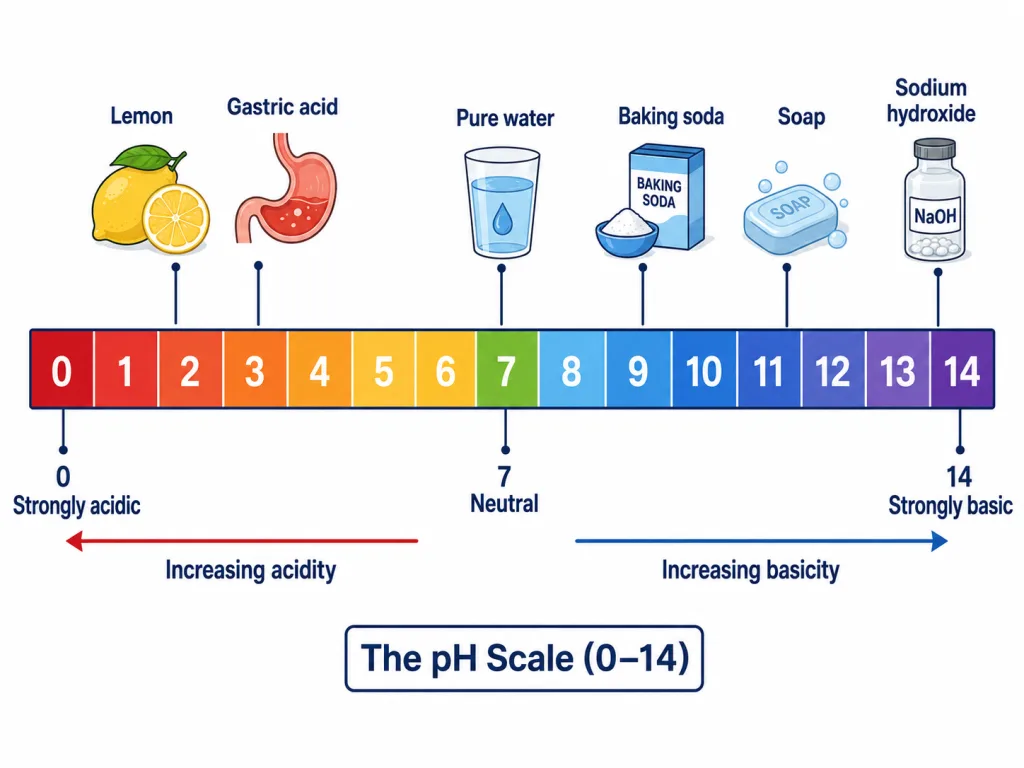
The pH scale: A numerical scale (0 to 14) that indicates the concentration of ions in a solution — that is, how acidic or basic the solution is.
What Do 'p' and 'H' Mean?
p = power — from the Danish word 'potenz' H = hydrogen ion ()
So pH = 'power of hydrogen'.
The pH Scale at a Glance
| pH value | Nature | Examples |
|---|---|---|
| 0 | Very strong acid | Concentrated HCl |
| 1-3 | Strong acid | Stomach acid, lemon |
| 4-6 | Weak acid | Tomato, coffee |
| 7 | Neutral | Pure water |
| 8-10 | Weak base | Sea water, baking soda solution |
| 11-13 | Strong base | Ammonia, soap solution |
| 14 | Very strong base | Concentrated NaOH |
Simple Rule
- pH < 7 → acidic (the lower, the more acidic)
- pH = 7 → neutral
- pH > 7 → basic (the higher, the more basic)
Crucial — A Logarithmic Scale
pH is a logarithmic scale — every one-unit difference represents a 10-fold change.
Example:
- A pH 3 solution is 10 times more acidic than a pH 4 solution.
- A pH 1 solution is 1000 times more acidic than a pH 4 solution.
Mathematical Definition
(here = molar concentration of hydrogen ions.)
Example:
- If M, then pH =
- If M, then pH = (neutral)
[Board Important] Definition and range of the pH scale — a 2-3 mark question every year.
Measuring pH — Universal Indicator and pH Paper
Measuring pH with the Universal Indicator
As we saw in Section 1 — the universal indicator is a mixture that gives different colours at different pH values.
Universal indicator pH-colour chart:
| pH | Colour | Nature |
|---|---|---|
| 1 | Deep red | Very strong acid |
| 2 | Red | Strong acid |
| 3 | Orange-red | Moderate acid |
| 4 | Orange | Weak acid |
| 5 | Yellow-orange | Less acidic |
| 6 | Yellow-green | Very weak acid |
| 7 | Green | Neutral |
| 8 | Blue-green | Weak base |
| 9 | Blue | Moderate base |
| 10 | Deep blue | Strong base |
| 11-12 | Blue-violet | Very strong base |
| 13-14 | Violet | Extremely strong base |
Three Ways to Measure pH
1. pH Paper:
- Paper soaked in universal indicator solution and dried.
- Dip in the solution, observe the colour, compare with the chart.
- Cheap and quick — but approximate.
2. Universal Indicator Solution:
- Add a few drops to the solution.
- Observe the colour — match with chart.
- Slightly more accurate.
3. Digital pH Meter:
- An instrument that gives the pH directly via electrical signal.
- Most accurate (to a decimal place).
- The standard tool in laboratories.
Rules for pH Testing
- The solution should be fresh (the pH of an old solution can change).
- Temperature near room temperature (~ 25°C).
- The paper/meter should be clean.
[Board Important] Methods of measuring pH — a 2-3 mark question.
pH of Various Substances
pH of Everyday Substances
Acidic substances (pH < 7):
| Substance | pH |
|---|---|
| Stomach juice | 1.0-2.0 |
| Lemon juice | 2.2-2.4 |
| Vinegar | 2.4-3.4 |
| Orange juice | 3.0-4.0 |
| Tomato | 4.0-4.5 |
| Coffee | 4.5-5.5 |
| Milk | 6.4-6.8 |
| Urine | 5.5-7.0 |
Neutral substances (pH = 7):
| Substance | pH |
|---|---|
| Pure water | 7.0 |
| Blood | 7.35-7.45 (slightly basic) |
Basic substances (pH > 7):
| Substance | pH |
|---|---|
| Sea water | 7.5-8.4 |
| Baking soda solution | 8.4 |
| Soap solution | 9-10 |
| Ammonia | 11-12 |
| Lime water | 12-13 |
| Concentrated | 14 |
Strong vs. Weak — In Terms of pH
Strong acids (complete ionisation):
- M → pH = 1
- M → pH ≈ 0.7
Weak acids (partial ionisation):
- M → pH ≈ 2.9
- M → pH ≈ 4
(Even at the same concentration, the pH of a strong acid is about 100 times lower than a weak acid.)
Strong bases:
- M → pH = 13
- M → pH = 13
Weak bases:
- M → pH ≈ 11
[Board Tip] Memorising the pH values of everyday substances is useful — especially blood, urine, and stomach.
The Relation Between pH and H⁺/OH⁻ Concentration
The Main Formula
Simple Calculation Examples
Example 1: M → pH =
Example 2: M → pH = (basic)
Example 3: M → pH = 14
Reverse — pH to
Example: If pH = 4, then M.
Self-Ionisation of Water and pOH
Pure water also ionises slightly:
Ionic product:
Relation between pH and pOH (a Class 11-level note):
(For any aqueous solution at 25°C.)
Key Conclusion
| pH | Nature | ||
|---|---|---|---|
| 1 | M | M | Strong acid |
| 4 | M | M | Weak acid |
| 7 | M | M | Neutral |
| 10 | M | M | Weak base |
| 13 | M | M | Strong base |
A Curious Question
How much more acidic is a pH 2 solution than a pH 5 solution?
Answer: Difference = 5 - 2 = 3 units. So times more acidic.
This is a consequence of pH's logarithmic nature.
[Board Important] Simple pH calculation questions appear regularly — the relation between and pH.
Practical Significance of the pH Scale
Scientific History
The concept of pH was introduced in 1909 by the Danish chemist Søren Sørensen. That's why it's sometimes called the 'Sørensen pH scale'.
Why Is It Necessary?
pH allows us to:
- Compare solutions — with precise numbers.
- Quantify ratios — a pH 1 solution is 1000 times more acidic than pH 4.
- Control chemical processes — in industry, medicine, agriculture.
- Understand biological processes — blood, digestion, enzymes.
Some Curious Facts
1. Lemon and bee sting:
- Lemon pH = 2 (acidic)
- Bee sting is also acidic (pH < 7)
- Both have similar strength
2. Stomach juice:
- pH = 1-2 — very strong acid
- Yet the stomach lining is safe — because of a layer of mucus
3. Blood pH:
- 7.35-7.45 — a very narrow range
- Even a 0.1 unit change is life-threatening
4. Sea water:
- pH ~ 8 (slightly basic)
- Calcium carbonate stays dissolved
The Range of pH — A Note
The pH scale is not strictly limited to 0 to 14.
The truth:
- Very concentrated acid → pH < 0 (negative pH is possible)
- Very concentrated base → pH > 14 (up to 16-17)
But for everyday life, 0-14 is sufficient. This range is what is taught in board exams.
[Board Important] The pH scale range is 0-14, and is a logarithmic scale.
🧠 Memory Capsule
A one-glance recap to revisit just before the board exam.
1. Definition of pH
pH = a numerical measure of the power of hydrogen ions.
2. Range of the pH Scale
- 0-7: acidic (the lower, the more acidic)
- 7: neutral (pure water)
- 7-14: basic (the higher, the more basic)
3. Logarithmic Nature
A 1-unit difference in pH = 10× change in . A 3-unit difference = 1000× change.
4. Famous pH Values to Remember
| Substance | pH |
|---|---|
| Stomach juice | 1-2 |
| Lemon | 2-3 |
| Vinegar | 3 |
| Pure water | 7 |
| Blood | 7.4 |
| Baking soda | 8-9 |
| Ammonia | 11 |
| Concentrated | 14 |
5. Methods of pH Measurement
- pH paper (cheap, approximate)
- Universal indicator solution
- Digital pH meter (most accurate)
6. Universal Indicator — Colour Code
- Red → strong acid (pH 1-3)
- Orange/yellow → weak acid (pH 4-6)
- Green → neutral (pH 7)
- Blue → basic (pH 8-10)
- Violet → strong base (pH 11-14)
7. Relation Between pH and Concentration
| pH | |
|---|---|
| 1 | M |
| 7 | M |
| 14 | M |
8. Strong vs. Weak Acid — Difference in pH
- M (strong) → pH 1
- M (weak) → pH ~ 3
- Even at same concentration, 2-unit pH difference = 100× difference.
9. Board's 'Golden' Questions
- What is the pH scale? Definition and range.
- Universal indicator colour code.
- How much more acidic is pH 2 compared to pH 5?
- What is the pH of stomach acid?
- If M, what is the pH?
The Bottom Line: pH = . Lower pH = more acidic; higher pH = more basic; pH 7 = neutral.
Solved Examples
Example 1: Definition of the pH Scale
What is the pH scale? State its range. What is its use?
Solution:
Definition: The pH scale is a numerical scale showing the concentration of ions in a solution — telling us how acidic or basic the solution is.
Formula:
Meaning of 'p': Power — from the Danish 'potenz'. 'H' = hydrogen ion.
Range: 0 to 14.
- pH < 7: acidic
- pH = 7: neutral (pure water)
- pH > 7: basic
Uses:
- Measuring solution strength precisely with a number.
- Controlling chemical processes in the laboratory.
- Soil pH testing in agriculture.
- Testing pH of blood and urine in medicine.
- In the food industry.
[Board 3-mark question]
Example 2: Numerical — pH Calculation
Find the pH for the following concentrations: (a) M (b) M (c) M
Solution:
Formula:
(a) M: Nature: strong acid
(b) M: Nature: neutral (pure water)
(c) M: Nature: strong base
Key takeaway: The exponent of the concentration (without the minus sign) is the pH.
Example 3: pH to Concentration
Find for the following pH values: (a) pH = 3 (b) pH = 8 (c) pH = 13
Solution:
Formula:
(a) pH = 3: Nature: moderately acidic (like vinegar)
(b) pH = 8: Nature: weakly basic (like sea water)
(c) pH = 13: Nature: strong base (like M )
Special note:
- pH 3 = more (acidic)
- pH 13 = very little (basic)
That is, as pH rises, decreases.
Example 4: pH Difference — How Many Times More?
How much more acidic is a pH 2 solution compared to a pH 5 solution?
Solution:
Given:
- Solution A: pH = 2 → M
- Solution B: pH = 5 → M
Ratio:
Answer: A pH 2 solution is 1000 times more acidic than a pH 5 solution.
General rule:
- A 1-unit difference in pH = 10× difference in concentration
- A 2-unit difference in pH = 100× difference
- A 3-unit difference in pH = 1000× difference
This is due to pH being a logarithmic scale.
[Repeatedly asked in boards]
Example 5: NCERT — Universal Indicator
What is the universal indicator? How is it used? Give the colour for three pH values.
Solution:
Definition: The universal indicator is a mixture — a combination of several indicators — which changes to different colours depending on the pH of the solution.
Use:
- As pH paper — dip in solution, observe colour, estimate pH.
- As a solution — add a few drops, observe colour.
- A pH meter is a digital alternative.
Colour for three pH values:
| pH | Colour | Nature |
|---|---|---|
| 2 | Red | Strong acid |
| 7 | Green | Neutral |
| 12 | Violet | Strong base |
Full colour code:
- 1-3: Red
- 4-5: Orange/yellow
- 6: Yellow-green
- 7: Green (neutral)
- 8-10: Blue
- 11-14: Violet
[NCERT textbook question]
Example 6: Different pH at Same Concentration
A student prepared two solutions — both M, but one of and the other of . Why are their pH values different?
Solution:
Main reason: The two acids have different degrees of ionisation.
M (strong acid):
- Ionisation ~ 100%
- M = M
- pH =
M (weak acid):
- Ionisation ~ 1.3%
- M
- pH ≈ 2.9 (~ 3)
Comparison:
| Aspect | ||
|---|---|---|
| Concentration | M | M |
| Ionisation | 100% | ~ 1% |
| M | M | |
| pH | 1 | ~ 3 |
Lesson: Even at the same concentration, the pH of a strong acid is about 100 times lower than that of a weak acid.
Application: That is why is more dangerous, while (vinegar) is edible.
[Board 5-mark question]
Example 7: Methods of pH Measurement
How many ways are there to measure the pH of a solution in the laboratory? Briefly describe each.
Solution:
Three main methods:
1. pH Paper (Litmus / Universal Indicator Paper):
- Paper soaked in universal indicator solution and dried.
- Use: Dip a small piece in the solution, observe the colour, compare with a chart.
- Accuracy: Approximate (whole numbers).
- Pros: Cheap, fast, easy.
- Limitation: No decimal accuracy.
2. Universal Indicator Solution:
- Use: Add a few drops to the solution and observe the colour.
- Accuracy: A bit better — more indicator present.
- Pros: Moderate accuracy.
- Limitation: The indicator mixes into the solution.
3. Digital pH Meter:
- An instrument that gives the pH directly via electrical signal.
- Use: Dip a glass electrode in the solution; the screen shows pH.
- Accuracy: Highest (to two decimal places).
- Pros: Precise, digital, repeatable.
- Limitation: Expensive, requires calibration.
Right choice:
- Quick identification → pH paper
- Moderate accuracy → universal indicator solution
- Research/industry → digital pH meter
[Board 3-mark question]
Example 8: Practical pH Examples
A student must give the pH values of: stomach, blood, pure water, tomato, concentrated — and their nature.
Solution:
| Substance | pH (approx.) | Nature |
|---|---|---|
| Stomach juice | 1-2 | Strong acid |
| Tomato | 4-4.5 | Acidic (weak) |
| Pure water | 7 | Neutral |
| Blood | 7.4 | Slightly basic |
| Concentrated | 14 | Very strong base |
Comments:
1. Stomach juice: pH 1-2, very strong acid — but the stomach lining has a layer of mucus that protects it.
2. Tomato: pH 4-4.5 — contains oxalic acid. That's why it has a slightly sour taste.
3. Pure water: pH 7 — perfectly neutral. The centre of the pH scale.
4. Blood: pH 7.35-7.45 — a very narrow range. A 0.1-unit shift can be life-threatening.
5. Concentrated : pH = 14 (very strong) — extremely corrosive. Used in soaps and industry.
[Board Important — 5 marks]
Example 9: NCERT — Identifying a Solution
A solution has pH = 11. The solution is — (a) acidic (b) basic (c) neutral? How would you use the universal indicator to verify the colour?
Solution:
Analysis:
- pH = 11 → greater than 7 → basic
- More precisely: it is a moderately strong base (like ammonia).
Answer: (b) basic — the correct option.
Verification with universal indicator:
- Add a few drops of universal indicator (or dip pH paper) into the solution.
- Observe the colour.
- Expected colour at pH 11: deep blue (turning toward blue-violet).
- If the colour is violet → pH 12-14 (more basic).
- If the colour is green → pH 7 (neutral).
Bonus: A pH meter would give the precise reading.
[NCERT textbook question]
Example 10: The Logarithmic Nature of pH
The pH scale is a 'logarithmic' scale. What does this mean and why is it important?
Solution:
Meaning of logarithmic:
A one-unit difference in pH = a 10-fold difference in concentration.
That is:
- A pH 1 solution is 10× more acidic than pH 2.
- A pH 1 solution is 100× more acidic than pH 3.
- A pH 1 solution is 1000× more acidic than pH 4.
Formula: Difference = times
Why is this important?
1. Compresses a vast range into compact numbers:
- Actual : from to M — 14 orders of magnitude!
- pH scale: 0 to 14 — simple integers.
2. Precise comparison:
- pH 3 vs. pH 6 — clear: 1000× difference.
3. Practical use:
- If stomach pH shifts from 1 to 4, has dropped by 1000×.
- If blood pH falls from 7.4 to 7.0 — life-threatening, since has risen ~ 2.5×.
A Curious Example
Acid rain (pH 5) is ten times more acidic than normal rain (pH 6). That's why acid rain causes such rapid damage.
[Board + JEE/NEET level]
Example 11: NCERT — Ranking Solutions
Arrange the following solutions in order of increasing pH: M , M , M , pure water, M .
Solution:
Estimate the pH of each:
| Solution | Type | pH (approx.) |
|---|---|---|
| M | Strong acid | 1 |
| M | Weak acid | 2.9 (~ 3) |
| Pure water | Neutral | 7 |
| M | Weak base | 11 |
| M | Strong base | 13 |
In order of increasing pH:
(pH = 1 < 3 < 7 < 11 < 13)
Explanation:
- Lowest pH = most acidic =
- pH 7 = neutral = water
- Highest pH = most basic =
Lesson: Strong acid → weak acid → neutral → weak base → strong base — in order of increasing pH.
[NCERT important — 5-mark question]
Example 12: A Curious Application Question
If phenolphthalein turns pink in a solution and methyl orange turns yellow, what is the possible pH range?
Solution:
The pH range of each indicator:
Phenolphthalein:
- Colourless (pH < 8.3)
- Pink (pH 8.3 - 10)
- Deep magenta (pH > 10)
Given: phenolphthalein is pink → pH > 8.3
Methyl orange:
- Red (pH < 3.1)
- Orange (pH 3.1 - 4.4)
- Yellow (pH > 4.4)
Given: methyl orange is yellow → pH > 4.4
Combining both conditions:
pH > 8.3 (from phenolphthalein) — and — pH > 4.4 (from methyl orange)
Conclusion: pH > 8.3 — the solution is basic (pH roughly between 8.3 and 14).
Estimate: It could be:
- Ammonia water (pH ~ 11)
- Baking soda solution (pH ~ 9)
- A dilute solution of a weak base
[Board HOTS]
Example 13: pH and Indicators — A Mixed Question
For the following solutions, estimate the pH and describe the indicator colour: (a) Stomach juice (b) Lemon juice (c) Pure water (d) Sea water (e) Dilute
Solution:
| Substance | pH | Phenolphthalein | Methyl orange | Universal indicator |
|---|---|---|---|---|
| (a) Stomach juice | 1-2 | Colourless | Red/pink | Red |
| (b) Lemon juice | 2-3 | Colourless | Red | Orange-red |
| (c) Pure water | 7 | Colourless | Orange | Green |
| (d) Sea water | 7.5-8.4 | Colourless (pH<8.3) to slightly pink | Yellow | Blue-green |
| (e) Dilute | 12-13 | Pink | Yellow | Deep blue/violet |
Key takeaways:
- The universal indicator gives the most information for any substance.
- Phenolphthalein is better for the basic range.
- Methyl orange is better for the acidic range.
[Board 5-mark question]
Example 14: pH Calculation — A Challenge
What is the pH of M ? What if this solution is diluted 10 times?
Solution:
Original solution ( M ):
- is a strong acid — full ionisation.
- M = M
- pH =
On 10× dilution:
- New concentration = M = M
- New M
- New pH =
Comparison:
| Aspect | Original | 10× Diluted |
|---|---|---|
| Concentration | M | M |
| pH | 3 | 4 |
Lesson: 10× dilution increases pH by 1 unit (in an acidic solution).
Caveat: This rule works while the solution concentration remains above M. For very dilute solutions, water's self-ionisation also matters.
Example 15: pH and Biological Processes
Which organs/fluids in our body have specific pH values? Why does this matter?
Solution:
pH of various body parts/fluids:
| Organ/Fluid | pH | Note |
|---|---|---|
| Stomach juice | 1-2 | — for digestion |
| Saliva | 6.5-7.5 | Slightly basic |
| Blood | 7.35-7.45 | Very narrow range |
| Intestine (pancreatic juice) | 7.5-8.5 | Basic |
| Urine | 4.5-8.0 | Variable |
| Skin | 4.5-5.5 | Acidic (antimicrobial) |
| Cytoplasm | 7.0-7.4 | Neutral |
Why is this important?
1. Enzyme activity:
- Each enzyme has a 'preferred pH'.
- Example: Stomach pepsin — active at pH 1.5-2.
- Example: Intestinal trypsin — active at pH 8.
- A change in pH denatures enzymes — digestion stops.
2. Oxygen transport:
- A blood pH of 7.4 ensures correct oxygen delivery.
- pH 7.0 → 'acidosis' — life-threatening.
- pH 7.8 → 'alkalosis' — life-threatening.
3. Internal balance:
- Kidneys and lungs together maintain pH.
- Our body has 'buffer systems' — to keep pH stable.
4. Skin protection:
- The acidic pH of skin (4.5-5.5) protects against germs.
- Strongly basic soaps damage the skin.
[Board + general knowledge]
Example 16: A Final Multi-Topic Question
(a) Introduce the pH scale and state its range. (b) Explain its logarithmic nature. (c) State the universal indicator colour for three pH values. (d) How do you check how acidic a solution is?
Solution:
(a) The pH scale:
- A numerical scale (0 to 14).
- Indicates the concentration of ions.
- pH < 7 = acidic; pH = 7 = neutral; pH > 7 = basic.
(b) Logarithmic nature:
- A 1-unit change in pH = a 10× change in .
- A pH 2 solution is 100× more acidic than pH 4.
- That's why even very dilute acid solutions stay within 'normal' numbers.
(c) Three pH values (universal indicator):
| pH | Colour |
|---|---|
| 1 (strong acid) | Deep red |
| 7 (neutral) | Green |
| 13 (strong base) | Violet |
(d) Methods to check the acidity of a solution:
- Litmus paper — only acid/base/neutral.
- pH paper — approximate pH.
- Universal indicator solution — more accurate.
- Digital pH meter — most accurate (decimals).
Lesson: First a quick litmus check, then pH paper for an estimate, and finally a meter for the precise value.
[Board 5-mark question]