
Neutralisation Reaction
This is the most important principle of this chapter — acids and bases nullify each other's effects.
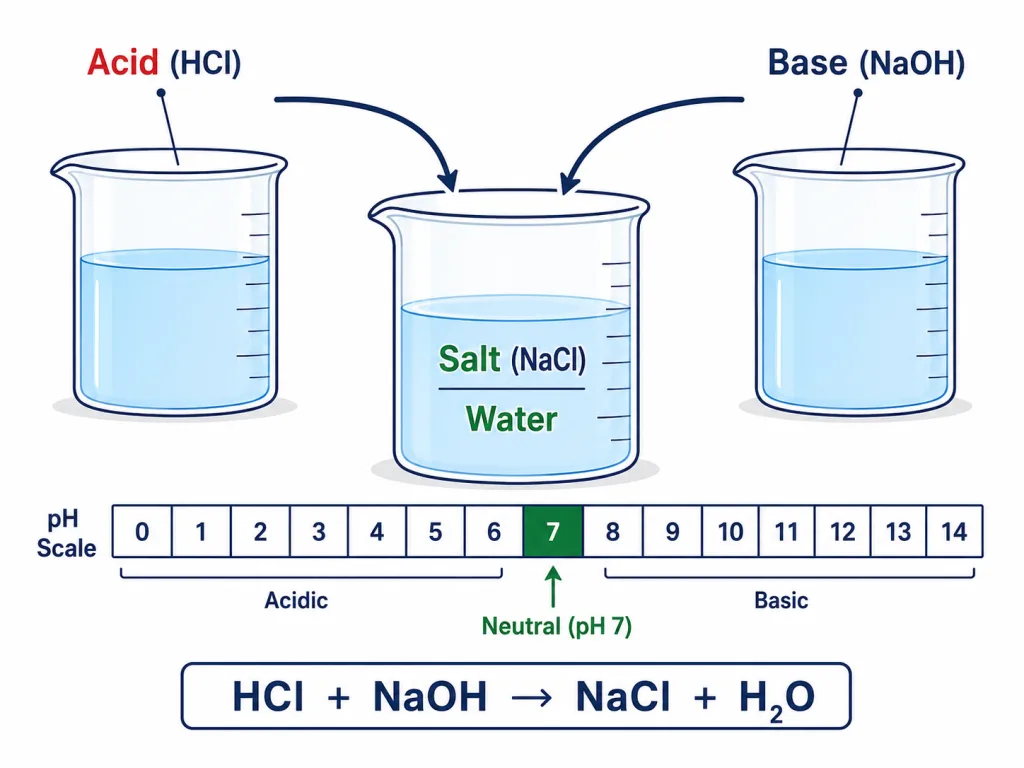
Definition: The reaction between an acid and a base that produces a salt and water is called a neutralisation reaction.
General Form
It is a special case of a double displacement reaction (Chapter 1 reference).
Activity — +
Take some solution in a test tube. Add a few drops of phenolphthalein — the solution turns pink.
Now add drop by drop — at some point, the solution becomes colourless.
That is the endpoint of neutralisation.
Reaction:
At the Ionic Level
This is the essence of neutralisation — and combine to form water.
More Examples
(i) + :
(ii) + :
(iii) + (in antacids):
[Board Important] Define neutralisation and give an example — a 1-2 mark question almost every year.
Features of Neutralisation
1. Exothermic Nature
Neutralisation is exothermic — heat is released. The beaker feels warm.
2. The Endpoint
When the right amounts of acid and base meet, the solution becomes neutral — pH = 7.
With an indicator, the colour changes (this is the endpoint).
3. The Salt Formed
The salt formed depends on which acid and which base reacted:
| Acid | Base | Salt Formed | pH of Salt |
|---|---|---|---|
| Strong () | Strong () | 7 (neutral) | |
| Strong () | Weak () | < 7 (acidic) | |
| Weak () | Strong () | > 7 (basic) | |
| Weak | Weak | Special | depends |
(pH of salts will be studied in detail in Section 7.)
Neutralisation in Daily Life
1. Treating acidity: (stomach + antacid)
2. Treating ant stings:
3. Preventing tooth decay: Food residues in the mouth produce acids — toothpaste is basic, neutralising them.
4. Industrial waste: Acidic factory waste is neutralised with slaked lime () before being released into rivers.
5. In agriculture: Acidic soil is amended with lime () to raise the pH. Alkaline soil is amended with gypsum () to lower the pH.
Reaction of Acids with Metallic Oxides
Metallic oxides are basic in nature. So acids react with them to give a salt and water.
Activity 2.6 — +
Take some copper oxide (II) in a beaker — it is black. Add dilute and warm gently.
Observations:
- The black slowly dissolves.
- The solution turns bluish-green.
- This new colour is that of copper chloride ().
Reaction:
(black) (bluish-green)
General Rule
Acid + Metallic Oxide → Salt + Water
More Examples
(i) + :
(ii) + :
(iii) + :
(yellow solution — ferric chloride)
Conclusion
Metallic oxides are basic — because they react with acids to give a salt and water (just like neutralisation).
This is direct proof of their basic nature.
[Board Important] This activity is often a 3-mark question.
Reaction of Bases with Non-Metallic Oxides
Non-metallic oxides are acidic in nature. So bases react with them to give a salt and water.
A Famous Reaction — Lime Water +
This is the same reaction we saw in identifying :
(lime water) () (calcium carbonate)
Here:
- — base (lime water)
- — non-metallic oxide (carbon dioxide)
- Products — salt () + water
General Rule
Base + Non-Metallic Oxide → Salt + Water
More Examples
(i) + :
(ii) + :
(iii) + :
Conclusion
Non-metallic oxides are acidic — because they react with bases to give a salt and water.
Table — Four Types of Oxides
| Type of Oxide | Nature | Reacts with | Example |
|---|---|---|---|
| Metallic oxide | Basic | Acid | |
| Non-metallic oxide | Acidic | Base | |
| Amphoteric oxide | Both | Acid and base | |
| Neutral oxide | Neither | — |
Summary — All Reactions Together
See all the main reactions of this section in one table:
| Reaction Type | General Form | Famous Example |
|---|---|---|
| Neutralisation | Acid + Base → Salt + Water | |
| Acid + Metallic oxide | Acid + M.Ox. → Salt + Water | |
| Base + Non-metallic oxide | Base + N-M.Ox. → Salt + Water |
A Curious Question — Why Are All Three Similar?
All three reactions produce salt + water — this is no coincidence!
The fundamental principle:
- (from acid) + (from base) = (water)
- The remaining ions form a salt.
Common to all three:
- The acid's ⟷ the base/metallic oxide's
- The base's ⟷ the acid/non-metallic oxide's (indirectly)
All three — essentially are forms of neutralisation.
Importance in Daily Life
- Treating acidity — antacid (base) neutralises stomach acid.
- Preventing tooth decay — basic toothpaste.
- Treating factory wastewater — neutralised with lime.
- Improving soil pH in agriculture.
- In the kitchen — taste of milk-curd, baking soda in food.
- Fire extinguishers — alongside , an acid-base neutralisation.
- Water purification — pH adjustment.
[Board Important] Daily-life applications of neutralisation — a 5-mark question.
🧠 Memory Capsule
A one-glance recap to revisit just before the board exam.
1. The Neutralisation Formula
2. Famous Reactions
| Reaction | Class |
|---|---|
| Strong acid + strong base | |
| Strong acid + strong base | |
| Strong acid + strong base | |
| In antacid |
3. Nature of Oxides
| Oxide | Nature | Reacts with |
|---|---|---|
| Metallic | Basic | Acid |
| Non-metallic | Acidic | Base |
| Amphoteric () | Both | Acid and base |
| Neutral () | Neither | — |
4. Two Important Equations
Acid + metallic oxide: (black → bluish-green)
Base + non-metallic oxide: (lime water turns milky)
5. Daily-Life Applications
- Acidity → antacid
- Ant sting → baking soda
- Acidic soil → lime
- Factory waste → lime
6. Board's 'Golden' Questions
- What is neutralisation? Give it in ionic form.
- Write the reaction of + — describe the colour change.
- Which non-metallic oxide turns lime water milky?
- Which oxide is basic — , , , ?
- Why is baking soda used for acidity? Write the reaction.
The Bottom Line: Acid + base = salt + water. Metallic oxides are basic; non-metallic oxides are acidic.
Solved Examples
Example 1: Definition of Neutralisation
What is a neutralisation reaction? Write the general equation in ionic form.
Solution:
Definition: The reaction between an acid and a base that produces a salt and water is called a neutralisation reaction.
General equation:
Ionic form:
This is the essence of neutralisation — and combine to form water.
Example:
Features:
- A type of double displacement reaction.
- Exothermic (the beaker becomes warm).
- At the endpoint, pH = 7 (neutral).
[Board Important — 3 marks]
Example 2: +
What are the observations when black copper oxide is heated with dilute ? Write the reaction.
Solution:
Observations:
- The black slowly dissolves.
- The solution turns bluish-green (the colour of ).
- A new salt is formed.
Reaction:
(black) (bluish-green)
Type of reaction:
- Acid + metallic oxide → salt + water
- This is a form of neutralisation.
- It proves that is basic.
A common board question:
"What does the reaction + tell us?"
Answer: It shows that metallic oxides are basic — because they react with acids to form a salt and water.
Example 3: Lime Water +
What happens when gas is passed through lime water? Write the reaction. Explain the observations.
Solution:
Observations:
- Initially — lime water is colourless.
- As is added — the solution turns milky (turbid).
- If excess is passed — it becomes clear again.
Reactions (in two steps):
Step 1 — Becoming milky:
A white precipitate of — making lime water milky.
Step 2 — Clearing up (excess ):
Calcium bicarbonate — soluble, so the precipitate dissolves.
Type of reaction:
- Base + non-metallic oxide → salt + water
- A form of neutralisation.
- It shows that is acidic.
[NCERT textbook question]
Example 4: NCERT — How an Antacid Works
Why is milk of magnesia () given for acidity? Write the chemical reaction.
Solution:
Problem: During acidity, the stomach has too much . There is burning and pain.
Solution: Milk of magnesia = — a base. It neutralises the stomach .
Reaction:
How does it work?
- Excess in the stomach is neutralised.
- The stomach pH returns to normal (3-4).
- The burning is relieved.
Other antacids:
- (baking soda)
- (calcium carbonate)
- (aluminium hydroxide)
All are basic — all neutralise .
[Board Important — daily life]
Example 5: Classification of Oxides
Classify the following as metallic, non-metallic, amphoteric, or neutral oxides: (a) (b) (c) (d) (e) (f)
Solution:
| Oxide | Metal/Non-metal? | Class |
|---|---|---|
| (a) | Metal (Na) | Metallic (basic) |
| (b) | Non-metal (C) | Non-metallic (acidic) |
| (c) | Metal (Al) — but amphoteric | Amphoteric |
| (d) | Non-metal (S) | Non-metallic (acidic) |
| (e) | Metal (Ca) | Metallic (basic) |
| (f) | Non-metal (C) — but neutral | Neutral |
Special note:
- and — amphoteric (react with both acid and base).
- , , , — neutral (react with neither).
Rule:
- Metal oxide = basic
- Non-metal oxide = acidic
- Exceptions exist (amphoteric and neutral).
Example 6: Numerical — Neutralisation
How many grams of are needed to neutralise 40 g of ? Also find the mass of formed. (Na=23, O=16, H=1, Cl=35.5)
Solution:
- Reaction:
- Molecular masses:
- Ratio: 40 g + 36.5 g → 58.5 g
- For the given 40 g :
- = 36.5 g
- = 58.5 g
- Verification: Total reactants = 40 + 36.5 = 76.5 g; total products = 58.5 + 18 (water) = 76.5 g ✓
- Answer: 36.5 g of is needed, and 58.5 g of is formed.
(Alongside, 18 g of water is also formed.)
Example 7: Writing Correct Equations
Write balanced equations for: (a) + (b) + (c) + (d) +
Solution:
(a) + :
(b) + :
(c) + :
(d) + :
(All are neutralisation reactions — acid + base → salt + water.)
[Board common question — 3 marks]
Example 8: Treating Industrial Wastewater
A chemical factory's wastewater has pH = 3. What should be done before releasing it into a river, and why?
Solution:
Problem:
- pH = 3 → strongly acidic.
- River pH ~ 7 — acidic waste would harm aquatic life.
Solution — Neutralisation:
Method: Add slaked lime () to the wastewater.
Reaction (if is the waste):
Result:
- The acid is neutralised.
- pH rises to ~ 7.
- Releasing into the river — no harm to aquatic life.
Applications:
- Chemical industry.
- Paper industry.
- Textile industry.
- Food processing.
Rule: Acidic waste → neutralised by base; basic waste → neutralised by acid.
[Environmental-education context]
Example 9: Neutralisation in Agriculture
A farmer's soil is highly acidic (pH = 4.5) — crop yield is dropping. Suggest a treatment.
Solution:
Problem:
- Normal soil pH = 6.5-7.5
- pH 4.5 = very acidic
- Most crops do not thrive in acidic soil.
Solution — Apply Lime (calcium oxide):
Reaction:
(neutralises soil acid)
or
Options:
- Quicklime () — added directly.
- Slaked lime () — generally preferred.
- Dolomite () — slow action.
Opposite case — alkaline soil:
- pH > 8.5 = highly alkaline
- Treatment: add gypsum () — mildly acidic.
[Class 10 + general knowledge]
Example 10: Oxides and Their Salts
Name the salts formed when acids/bases react with the following oxides: (a) + (b) + (c) + (d) +
Solution:
(a) + : Salt: Copper chloride (bluish-green)
(b) + : Salt: Calcium nitrate
(c) + : Salt: Sodium sulphate
(d) + : Salt: Calcium carbonate (white precipitate)
General rules:
- Metallic oxide + acid → salt + water
- Non-metallic oxide + base → salt + water
[Board + exercise question]
Example 11: A Detailed Question on Acidity
(a) What is acidity? (b) State two common home remedies for acidity. (c) Write the chemical reactions for these remedies. (d) Why are these remedies effective?
Solution:
(a) Acidity: Discomfort caused by an excessive amount of gastric juice () in the stomach — burning, pain, and acidic burps.
(b) Home remedies:
- Baking soda ()
- Milk of magnesia ()
(c) Chemical reactions:
(1) Baking soda:
(2) Milk of magnesia:
(d) Why are they effective?
- Both are basic.
- They neutralise the excess stomach .
- This is a neutralisation reaction.
- + → — the acid's effect is removed.
- The stomach pH returns to normal (3-4).
- The burning subsides.
Caution: Excess baking soda produces — leading to burping.
[Board 5-mark question]
Example 12: Comparing Three Reaction Types
State the differences between the following reactions: (a) Neutralisation (b) Acid + metallic oxide (c) Base + non-metallic oxide
Solution:
Comparison Table:
| Aspect | Neutralisation | Acid + Metallic Oxide | Base + Non-metallic Oxide |
|---|---|---|---|
| Reactant 1 | Acid | Acid | Base |
| Reactant 2 | Base | Metallic oxide | Non-metallic oxide |
| Products | Salt + water | Salt + water | Salt + water |
| Example |
Key conclusion:
All three — essentially are forms of neutralisation. All produce salt + water because:
- Acid's
- Base/metallic oxide's (indirectly)
- Non-metallic oxide + water → acid
In the end, they all carry out .
Lesson: Treat all three as 'three forms of acid-base neutralisation'.
[Board Important — 5 marks]
Example 13: A Famous NCERT Question
Moist gas is passed through a solution of . (a) What happens? (b) What if more is bubbled? (c) Write the reactions for both stages.
Solution:
(a) Initially:
- solution is transparent (lime water).
- As is added — the solution turns milky.
- Reason: a white precipitate is formed.
Reaction:
(b) On bubbling more :
- The precipitate begins to dissolve.
- The solution becomes transparent again.
- Reason: + + → (soluble).
Reaction:
Special note — the cave story:
- This reaction explains the formation of stalactites and stalagmites in caves.
- Rainwater + → weak acid → dissolves limestone.
- When the water evaporates in the cave, deposits again.
[NCERT textbook question]
Example 14: A Reasoning Question
Mark the following statements true or false: (a) All oxides are basic. (b) Neutralisation always produces a neutral salt (pH=7). (c) Metallic oxides are basic. (d) Lime water turns milky only with .
Solution:
(a) False — Only metallic oxides are basic. Non-metallic oxides (like ) are acidic. There are also amphoteric () and neutral () oxides.
(b) False — The pH of a salt depends on the strengths of the parent acid and base:
- Strong acid + strong base → neutral (, pH=7)
- Strong acid + weak base → acidic (, pH<7)
- Weak acid + strong base → basic (, pH>7)
(c) True — Metallic oxides (like ) are basic — they react with acids to form salt + water.
(d) False — Lime water turns milky with most acidic gases, e.g. (and to some extent). But the test for is the most specific.
(Although the precipitate from () is also white and insoluble — but the test is the standard.)
Example 15: An Experimental Question
A beaker contains solution with red litmus paper (which has turned blue). is being added drop by drop. Describe: (a) The colour of the litmus initially. (b) The colour midway. (c) The colour after adding more . (d) The chemical reaction.
Solution:
(a) Initially:
- is basic.
- Red litmus has turned blue in it.
- Colour: blue.
(b) Midway:
- Some + some have already reacted to form + .
- Some remains, but less.
- Colour may be light blue.
At the endpoint (perfect neutralisation):
- All has been neutralised by .
- The solution is neutral (pH=7).
- Litmus turns purple/neutral.
(c) After adding more :
- is now in excess.
- The solution becomes acidic.
- Litmus turns red.
(d) Reaction:
Lesson: This is the principle of titration — identifying the endpoint by colour change.
[Lab-based question]
Example 16: A Final Multi-Topic Question
For the following reactions, give the products and identify the type: (a) (b) (c) (d) (e)
Solution:
(a) : Type: Neutralisation (acid + base).
(b) : Type: Acid + metallic oxide → salt + water.
(c) : Type: Base + non-metallic oxide → salt + water.
(d) : Type: Neutralisation (occurs in antacid action).
(e) : Type: Acid + metallic oxide → salt + water.
General conclusion: All reactions produce salt + water — all are forms of neutralisation.
[Board 5-mark question]