
What Is a Salt?
We have seen many reactions producing salts — particularly in neutralisation. Now let's study salts in depth.
Definition: A compound formed by the neutralisation reaction between an acid and a base — in which the cation comes from the base and the anion from the acid — is called a salt.
General Form
Example:
Here — is the salt.
- (cation) — from the base
- (anion) — from the acid
Some Common Examples of Salts
| Salt | Formula | From which acid | From which base |
|---|---|---|---|
| Sodium chloride | |||
| Potassium sulphate | |||
| Calcium chloride | |||
| Ammonium chloride | |||
| Sodium nitrate | |||
| Copper sulphate |
General Properties of Salts
- Solid state (mostly, at normal temperatures).
- Crystalline — ordered structure.
- High melting point — being ionic compounds.
- Conduct electricity — when molten or in aqueous solution.
- Soluble in water (most salts).
Salts in Daily Life
- Common salt — — in the kitchen
- Washing soda —
- Baking soda —
- Plaster of Paris —
- Bleaching powder —
(Detailed study of these in Section 8.)
[Board Important] Definition of salt and 5 examples — a 2-3 mark question.
Family of Salts
Salts that share a common acid or base are members of the same family.
Chloride Family
All salts containing — they all come from .
Members:
- — sodium chloride
- — potassium chloride
- — calcium chloride
- — magnesium chloride
- — ammonium chloride
Sulphate Family
All salts containing — they all come from .
Members:
- — sodium sulphate
- — potassium sulphate
- — calcium sulphate (gypsum)
- — copper sulphate
- — ferrous sulphate
Sodium Family
All salts containing — they all come from .
Members:
- — sodium chloride
- — sodium sulphate
- — sodium nitrate
- — sodium carbonate
- — sodium bicarbonate
Potassium Family
All salts containing — all from .
Members:
- , , , ,
A Useful Cation-Anion Matrix
Many salts arise from the matrix of cations and anions:
[Board Tip] Name five salts of the chloride family.
pH of Salts
Are all salts neutral? No!
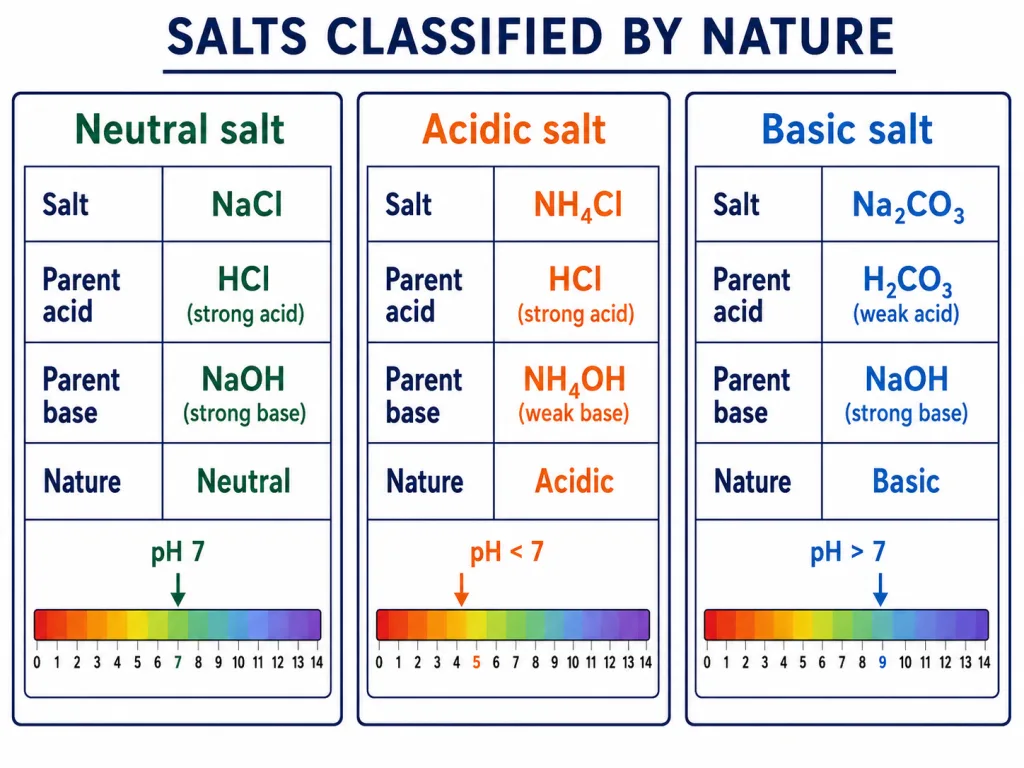
The pH of a salt depends on the strengths of its parent acid and base.
Four Types of Salts
1. Strong Acid + Strong Base → Neutral Salt (pH = 7)
Example:
- Acid: (strong)
- Base: (strong)
- pH: 7 (neutral)
More examples: .
2. Strong Acid + Weak Base → Acidic Salt (pH < 7)
Example:
- Acid: (strong)
- Base: (weak)
- pH: < 7 (acidic, ~ 5)
More examples: .
3. Weak Acid + Strong Base → Basic Salt (pH > 7)
Example: (sodium acetate)
- Acid: (weak)
- Base: (strong)
- pH: > 7 (basic, ~ 9)
More examples: .
4. Weak Acid + Weak Base → Mixed Salt
Example: (ammonium acetate)
- Both parents are weak
- pH: depends — usually near 7
Why Does This Happen?
Hydrolysis of the salt: When salts dissolve in water, their ions can react with water.
Example — :
Here — the carbonate ion takes from water, increasing in the solution — making it basic.
Table — Salts and Their pH
| Salt | Parent Acid | Parent Base | pH | Nature |
|---|---|---|---|---|
| Strong () | Strong () | 7 | Neutral | |
| Strong | Weak | < 7 | Acidic | |
| Weak | Strong | > 7 | Basic | |
| Weak () | Strong () | > 7 | Basic | |
| Strong | Strong | 7 | Neutral | |
| Strong | Weak | < 7 | Acidic |
[Board Important] Classifying salts by pH — asked every year.
Common Salt — Sodium Chloride ()
This is the most common and important salt.
Preparation
(Strong acid + strong base → neutral salt; pH = 7)
Sources
1. Sea water: The largest source. Sea water is evaporated to give sea salt.
2. Underground: Rock salt — crystals of ancient dried-up seas. In India: Rajasthan and Himachal.
3. Salt lakes: Sambhar Lake (Rajasthan) — a famous source.
Physical Properties
- Colour: white (pure form), slightly brown (with impurities).
- Taste: salty.
- Crystalline.
- Melting point: 801°C.
- Highly soluble in water.
Daily-Life Uses
1. Food: for taste and seasoning.
2. Food preservation: pickles, fish, meat — salt controls bacteria.
3. Raw material for the chemical industry:
- Making (chlor-alkali process).
- Making (washing soda).
- Making (baking soda).
- Producing gas.
4. In the soap industry.
5. De-icing: spread on roads in winter to melt ice (lowers the freezing point).
6. In the body: balance is essential (electrolyte).
Salt Production in India
- Gujarat — the largest producer (~ 75% of the country).
- Tamil Nadu, Rajasthan, Odisha, Andhra Pradesh — other producing states.
During India's independence movement, the 'Salt Satyagraha' (1930) made salt historically important.
[Board Important] Preparation, sources, and uses of sodium chloride.
Are Salt Crystals Really Dry?
A curious question that NCERT raises.
Water Inside Crystalline Salts
Many salt crystals contain chemically bound water — called the water of crystallisation.
Activity — Heating Copper Sulphate
Take some blue crystals in a test tube. Heat.
Observations:
- Blue crystals turn white.
- Water droplets appear on the inner walls of the tube.
Reaction:
(blue) (white)
On cooling and adding water to the white powder — it turns blue again. This is the famous test for water.
Some Famous Hydrated Salts
| Salt | Formula | Water molecules | Colour |
|---|---|---|---|
| Copper sulphate | 5 | Blue | |
| Sodium carbonate | 10 | White | |
| Gypsum | 2 | White | |
| Ferrous sulphate | 7 | Green | |
| Alum | 24 | White |
Importance of Water of Crystallisation
- Colour: the colour of most hydrated salts is due to water. On dehydration, the colour changes.
- Crystal structure: water molecules play a key role in the geometry.
- Industrial use: plaster of Paris from gypsum (Section 8).
- Detection of water: anhydrous (white) detects moisture.
A Curious Naming Convention
The number of water molecules can even be a fraction:
- Plaster of Paris: — half a water molecule!
- (How can it be half a water molecule?) — one water per two formula units. So half per formula unit.
[Repeatedly asked in boards] What is the water of crystallisation? Three examples.
🧠 Memory Capsule
A one-glance recap to revisit just before the board exam.
1. Definition of Salt
A compound formed by the neutralisation of an acid with a base.
2. Families of Salts
- Chloride family: all from ()
- Sulphate family: all from ()
- Sodium family: all from ()
- Potassium family: all from ()
3. Four pH Types of Salts
| Parent | Salt's nature | Example |
|---|---|---|
| Strong acid + strong base | Neutral (pH = 7) | |
| Strong acid + weak base | Acidic (pH < 7) | |
| Weak acid + strong base | Basic (pH > 7) | |
| Weak + weak | Mixed |
4. Common Salt () — Essential Facts
- Preparation:
- Sources: sea water, rock salt, salt lakes.
- Uses: food, preservation, raw material for the chemical industry.
- Industry: for making .
5. Water of Crystallisation
Chemically bound water within a salt's crystal.
Must-memorise examples:
- (blue vitriol)
- (washing soda)
- (gypsum)
- (plaster of Paris)
- (green vitriol)
6. Board's 'Golden' Questions
- What is a salt? Five examples.
- Three members each of the chloride/sulphate/sodium family.
- Four types of salt pH and examples.
- What is the water of crystallisation?
- Why does copper sulphate change colour on heating?
- Preparation, sources, and uses of .
The Bottom Line: Acid + base = salt + water. The pH of a salt depends on the strengths of its parents.
Solved Examples
Example 1: Definition of Salt
What is a salt? Give five examples and their parent acids and bases.
Solution:
Definition: An ionic compound formed by the neutralisation of an acid with a base — in which the cation comes from the base and the anion from the acid.
Five examples:
| # | Salt | Formula | Parent Acid | Parent Base |
|---|---|---|---|---|
| 1 | Sodium chloride | |||
| 2 | Potassium sulphate | |||
| 3 | Calcium chloride | |||
| 4 | Sodium nitrate | |||
| 5 | Ammonium chloride |
Key properties:
- Solid, crystalline.
- Ionic compounds.
- Soluble in water.
- Conduct electricity (in solution or molten).
[Board 3-mark question]
Example 2: Families of Salts
Write five members of the chloride family. Write five members of the sodium family.
Solution:
Chloride family (all contain — all from ):
- Sodium chloride —
- Potassium chloride —
- Calcium chloride —
- Magnesium chloride —
- Ammonium chloride —
Sodium family (all contain — all from ):
- Sodium chloride —
- Sodium sulphate —
- Sodium nitrate —
- Sodium carbonate —
- Sodium bicarbonate —
Special note: Sodium chloride () belongs to both families (it has both sodium and chloride).
[Board 2-3 marks]
Example 3: NCERT — Preparation of Sodium Chloride
How is sodium chloride formed? State its sources and three uses.
Solution:
Preparation:
This is a neutralisation reaction — strong acid + strong base.
Salt's nature: neutral (pH = 7).
Sources:
- Sea water — the largest source.
- Sea water is held in large open basins for sun-evaporation.
- The salt left behind is collected.
- Rock salt — found underground.
- Crystals of ancient dried-up seas.
- Mined out.
- In India: Mandi district of Himachal Pradesh.
- Salt lakes — like the Sambhar Lake (Rajasthan).
Three uses:
- Food industry: to add salty flavour, food preservation.
- Raw material for the chemical industry: in making , , , .
- Daily use: in soap-making, melting ice on winter roads.
[NCERT textbook question]
Example 4: NCERT — pH of Salts
State the pH (acidic / basic / neutral) of these salts — .
Solution:
Principle: A salt's pH depends on the strengths of its parent acid and base.
| Salt | Parent Acid | Parent Base | pH | Nature |
|---|---|---|---|---|
| (strong) | (strong) | 7 | Neutral | |
| (strong) | (weak) | < 7 | Acidic | |
| (weak) | (strong) | > 7 | Basic | |
| (strong) | (strong) | 7 | Neutral | |
| (weak) | (strong) | > 7 | Basic | |
| (strong) | (strong) | 7 | Neutral |
Quick rules to remember:
- Both strong → neutral
- One strong, one weak → the nature of the weaker partner dominates
- Strong acid + weak base = acidic
- Weak acid + strong base = basic
[NCERT textbook question — repeatedly asked]
Example 5: NCERT — Copper Sulphate Experiment
What are the observations when blue copper sulphate crystals are heated? Write the reaction. What is the explanation?
Solution:
Observations:
- The blue crystals turn white.
- Water droplets appear on the walls of the test tube.
- On cooling and adding water — the colour returns to blue.
Reaction:
(blue) (white — anhydrous)
Explanation:
Blue colour — due to water molecules:
- Copper sulphate crystals contain 5 water molecules chemically bound — this is the water of crystallisation.
- This water gives copper its characteristic blue colour.
On heating:
- The heat drives off the water molecules (vaporisation).
- Anhydrous — white.
On cooling and adding water:
- Anhydrous + water → hydrated
- The colour returns to blue.
Practical use:
- Detecting the presence of water: anhydrous is white, but turns blue with even a single drop of water. A very sensitive test.
This is a famous example of water of crystallisation.
[NCERT textbook question — important]
Example 6: Water of Crystallisation — Five Examples
What is the water of crystallisation? Give five examples.
Solution:
Definition: A definite number of water molecules that are chemically bound in the crystal of a salt — known as the water of crystallisation.
This water is not just 'trapped' in the crystal — it is an essential part of the crystal structure.
Five examples:
| # | Salt | Formula | Water molecules | Colour |
|---|---|---|---|---|
| 1 | Copper sulphate (blue vitriol) | 5 | Blue | |
| 2 | Washing soda | 10 | White | |
| 3 | Gypsum | 2 | White | |
| 4 | Ferrous sulphate (green vitriol) | 7 | Green | |
| 5 | Plaster of Paris | 1/2 | White |
Special note — Plaster of Paris:
- '' means — one water per two units.
- It can also be written as .
- Made by heating gypsum:
(detailed in Section 8)
[Board 3-5 marks]
Example 7: Why is the pH of Basic?
Why is an aqueous solution of sodium carbonate basic? How would you prove it?
Solution:
Analysis:
Parents of :
- Parent acid: carbonic acid () — a weak acid (very partial ionisation).
- Parent base: sodium hydroxide () — a strong base.
Rule: Weak acid + strong base → basic salt
Therefore, the aqueous solution of is basic.
Hydrolysis in water:
When dissolves:
Then takes from water:
(the weak acid's ion grabs from water, leaving more )
Result: excess in solution → basic.
How to prove?
Using indicators:
- Take an aqueous solution of .
- Dip red litmus — turns blue ✓ (proof of base).
- Add phenolphthalein — turns pink ✓.
- With a pH meter — gives pH ~ 11.
Practical use:
- Because is basic, it is good for washing clothes (removes grease).
- Hence the name 'washing soda'.
[Board 5-mark question]
Example 8: Why is the pH of Acidic?
Why is an aqueous solution of ammonium chloride acidic?
Solution:
Analysis:
Parents of :
- Parent acid: — a strong acid.
- Parent base: — a weak base.
Rule: Strong acid + weak base → acidic salt
So the solution of is acidic.
Hydrolysis in water:
Then reacts with water:
(the weak base's cation gives to water — making the solution acidic)
Result: excess in solution → acidic.
To prove:
- Blue litmus → turns red.
- pH < 7 (about 5).
Practical use:
- is used in dry cell batteries.
- An acidic medium is required for current flow.
[Board 3-mark question]
Example 9: Group Classification
In the following salts, which are (a) neutral, (b) acidic, (c) basic? —
Solution:
Analysis of each:
: (strong) + (strong) → neutral ✓
: (strong) + (weak) → acidic ✗
(potassium acetate): (weak) + (strong) → basic ✓
: (strong) + (strong) → neutral ✓
: (weak) + (strong) → basic ✓
Final classification:
| Nature | Salt |
|---|---|
| Neutral (pH = 7) | , |
| Acidic (pH < 7) | |
| Basic (pH > 7) | , |
Lesson: The pH is decided by the strengths of the parent acid and base.
[Board 5-mark — mixed question]
Example 10: NCERT — Sambhar Lake
What are the main sources of salt production in India? What is the importance of Sambhar Lake?
Solution:
Main sources of salt production in India:
1. Sea water (largest):
- Gujarat — ~ 75% of national output.
- Tamil Nadu, Odisha, Andhra Pradesh — other coastal states.
- Method: sea water held in vast basins, sun-evaporated.
2. Salt lakes:
- Sambhar Lake (Rajasthan) — the most famous.
- Didwana Lake (Rajasthan).
3. Rock salt:
- Mandi district of Himachal Pradesh.
- Khewra mine in Pakistan (world-famous).
Importance of Sambhar Lake:
1. Geographic:
- Near Jaipur in Rajasthan.
- India's largest inland salt lake.
- Area: ~ 230 sq km.
2. Salt production:
- Country's second-largest inland salt producer.
- Method:
- Lake fills during rains.
- Sun's heat evaporates water.
- Salt crystals form.
- These are collected and refined.
3. Ecological:
- Flamingos visit the lake.
- 'Ramsar Site' — a protected international wetland.
4. Historical:
- Salt production since the 7th century.
- Important during India's independence struggle.
[Board + India-focused question]
Example 11: Using Anhydrous for Water Detection
A student needs to test whether a white substance contains water. How can they do it using copper sulphate?
Solution:
Method: anhydrous copper sulphate test.
Step by step:
Step 1 — Make anhydrous :
- Heat blue .
- It turns white (the five water molecules leave).
Step 2 — Test:
- Place a few drops of the test substance on some white .
- If water is present:
- White → turns blue.
- + →
- If no water: no change.
Practical examples:
- Older method for making dry alcohol.
- Detecting moisture in foodstuffs.
- A simple lab test for dryness.
Why does it work?
- Anhydrous has a strong tendency to absorb water.
- Even a single drop is taken up.
- The colour change is immediate — the indicator.
How sensitive is this test?
- Very — it can detect a few microlitres of water.
- The most common water test at the Class 10 level.
[Board daily-life question]
Example 12: A Curious Classification Question
For the following salts, identify the parent acid and base: (a) (b) (c) (d) (e)
Solution:
Method: Split the salt into cation and anion — identify their parent acid/base.
(a) (magnesium nitrate):
- Cation: → base
- Anion: → acid
- Reaction:
(b) (potassium phosphate):
- Cation: → base
- Anion: → acid
- Reaction:
(c) (ammonium sulphate):
- Cation: → base
- Anion: → acid
- Reaction:
(d) (ferric chloride):
- Cation: → base
- Anion: → acid
- Reaction:
(e) (sodium sulphite):
- Cation: → base
- Anion: → acid
- Reaction:
Key takeaway:
- Salt = cation (from base) + anion (from acid)
- Most salts can be analysed using this principle.
[Board 5-mark question]
Example 13: Industrial Uses of NaCl
Which chemical products are made from common salt ()? (A preview of Section 8.)
Solution:
— the raw material of the chemical industry.
1. Sodium hydroxide ( — caustic soda):
Method: the chlor-alkali process — electrolysis of solution.
Products: , , — all useful.
2. Sodium carbonate ( — washing soda):
Method: the Solvay Process — + + + → → on heating, .
3. Sodium hydrogen carbonate ( — baking soda):
An intermediate of the Solvay Process.
4. Chlorine gas ():
From the chlor-alkali process. Uses — water purification, bleaching, PVC.
5. Bleaching powder ():
From the action of on slaked lime.
6. Hydrogen chloride ():
A multi-billion-dollar industry from :
Global production of common salt is ~ 270 million tonnes/year — of which ~ 60% goes into the chemical industry.
[Board + introduction to Section 8]
Example 14: Numerical — Molecular Mass of a Salt
Find the molecular mass of . What percentage of its mass is water? (Cu=64, S=32, O=16, H=1)
Solution:
Calculating molecular mass:
Mass of :
- Total:
Mass of :
Total mass of :
Percentage of water:
So is 36% water by mass — i.e., 100 g of blue vitriol contains 36 g of water and 64 g of anhydrous .
Practical use:
- To check the purity of a salt — measure the water percentage.
- Test by mass loss on heating.
[Board 3-mark question]
Example 15: NCERT — A Mixed Question
Classify the following salts by their parent acid/base and state their nature: (a) (b) (c) (d) (e) (f)
Solution:
| Salt | Parent Acid | Parent Base | Type | pH |
|---|---|---|---|---|
| (a) | (weak) | (strong) | W+S | basic (~ 11) |
| (b) | (strong) | (weak) | S+W | acidic |
| (c) | (strong) | (strong) | S+S | neutral (7) |
| (d) | (strong) | (weak) | S+W | acidic |
| (e) | (strong) | (moderate) | S+M | nearly neutral |
| (f) | (strong) | (weak) | S+W | acidic |
Final classification into three types:
Neutral: ,
Acidic: , ,
Basic:
Lesson: The pH of a salt is predicted by the strengths of its parents.
[NCERT important — 5-mark question]
Example 16: A Closing Question
(a) What is a salt? Definition. (b) Preparation and two uses of sodium chloride. (c) What is the water of crystallisation? Three examples. (d) Why is the pH of greater than 7?
Solution:
(a) Definition of a salt:
An ionic compound formed by neutralisation of an acid with a base — in which the cation comes from the base and the anion from the acid.
(b) Sodium chloride:
Preparation:
Two uses:
- In food — taste, preservation.
- In the chemical industry — raw material for .
(c) Water of crystallisation:
A definite number of water molecules chemically bound in a salt's crystal.
Three examples:
- (blue)
- (washing soda)
- (gypsum)
(d) Why pH of > 7:
Reason:
- Parent acid = (carbonic acid) — weak
- Parent base = — strong
- Rule: weak acid + strong base → basic salt
In water:
(The carbonate ion takes from water, leaving more — making the solution basic.)
[Board 5-mark question]