
Carbon — A Special Element
Carbon is everywhere — in our food, fuel, clothes, body, and even in the breath we exhale.
Look around — most things you see contain carbon!
How Special is Carbon?
Earth's crust has only 0.02% carbon (as carbonates, hydrocarbons, and CO₂). Atmosphere has only 0.03% carbon (as CO₂).
Yet — all known life is carbon-based!
Why? Because carbon forms an enormous variety of compounds — millions of them.
Most other elements form only a few hundred compounds. Carbon alone — more than 10 million!
Position of Carbon in the Periodic Table
Carbon (C):
- Atomic Number: 6
- Electronic Configuration: 2, 4
- Group: 14 (IVA)
- Period: 2
Outer shell has 4 electrons.
Why Doesn't Carbon Form Ionic Bonds?
To attain a noble gas configuration (octet), carbon would need to either:
Option 1: Lose 4 electrons → become C⁴⁺ (like helium 'He', 2 electrons). Problem: needs enormous energy to remove 4 electrons.
Option 2: Gain 4 electrons → become C⁴⁻ (like neon 'Ne', 10 electrons). Problem: nucleus with only 6 protons cannot hold 10 electrons stably.
Both options — energetically unfavourable.
The Solution — Covalent Bond
Carbon shares its 4 electrons with other atoms. This way, both atoms attain a stable octet without losing or gaining electrons.
This shared electron-pair bond = Covalent Bond.
Why is Carbon Unique?
Carbon's 4 valence electrons mean it can:
- Share with 4 other atoms (single bonds).
- Share 2 pairs with one atom (double bond).
- Share 3 pairs with one atom (triple bond).
This versatility is unique among elements.
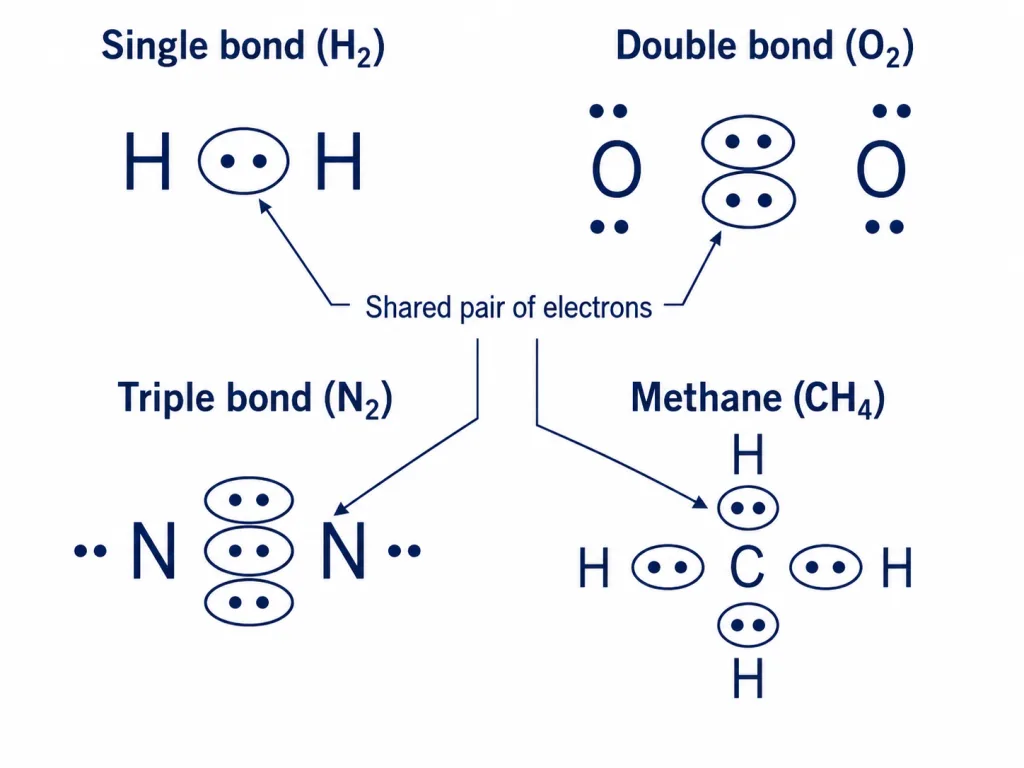
What is a Covalent Bond?
Definition: A chemical bond formed by the sharing of electrons between two atoms — so that both can attain a stable noble gas configuration.
Simple Examples
1. Hydrogen Molecule ()
Two H atoms — each has 1 electron, needs 1 more for stability (like helium).
Each shares its 1 electron — both now have 2 electrons (helium configuration).
Lewis dot structure: H : H or H — H
One shared pair = single bond (one line).
2. Oxygen Molecule ()
Two O atoms — each has 6 valence electrons, needs 2 more for octet.
Each shares 2 electrons — total 4 shared (2 pairs).
Lewis dot structure: O :: O or O = O
Two shared pairs = double bond (two lines).
3. Nitrogen Molecule ()
Two N atoms — each has 5 valence electrons, needs 3 more for octet.
Each shares 3 electrons — total 6 shared (3 pairs).
Lewis dot structure: N ::: N or N ≡ N
Three shared pairs = triple bond (three lines).
Carbon Compounds — Examples
Methane ()
Carbon (4 valence electrons) + 4 Hydrogens (1 each).
Each H shares 1 electron with C. C ends up with 8 electrons (octet). Each H ends up with 2 electrons (helium config).
Structure:
       H
       |
   H — C — H
       |
       H
All 4 bonds = single bonds.
Ethene ()
Two C atoms + 4 H atoms. C-C bond is a double bond (2 shared pairs).
Structure:
    H       H
     \     /
      C = C
     /     \
    H       H
Ethyne / Acetylene ()
Two C atoms + 2 H atoms. C-C bond is a triple bond (3 shared pairs).
Structure: H — C ≡ C — H
Bond Strength Order
Triple bond > Double bond > Single bond. (More shared pairs = stronger bond.)
But also: triple > double > single — shorter bond length.
Common Covalent Compounds
Water ()
O has 6 valence electrons; needs 2 more for octet. Each H shares 1 electron with O.
Structure: H — O — H
Two single bonds.
Ammonia ()
N has 5 valence electrons; needs 3 more for octet. Three H atoms each share 1 electron.
Structure:
    H — N — H
        |
        H
Three single bonds.
Carbon Dioxide ()
C shares 2 pairs with each O atom (double bonds with both).
Structure: O = C = O
Two double bonds.
Hydrogen Chloride ()
H shares 1 electron with Cl. Cl already has 7 electrons; gains 1 more for octet.
Structure: H — Cl
Single bond.
General Rule for Covalent Compounds
Covalent compounds form between non-metals.
Examples:
- C—H, C—C, C—O, C—N, C—Cl bonds.
- H—H, O—O, N—N, F—F bonds.
- H₂O, CO₂, NH₃, HCl, etc.
Octet Rule — In Practice
Octet Rule: Atoms tend to have 8 electrons in their outermost shell (or 2 for elements close to helium).
Achieved by:
- Ionic bond (transfer of electrons) — for metal + non-metal.
- Covalent bond (sharing of electrons) — for non-metal + non-metal.
Properties of Covalent Compounds
Covalent compounds have very different properties from ionic compounds.
1. Physical State
Covalent compounds can exist in all three states:
- Gas: O₂, N₂, CH₄, CO₂, NH₃, HCl
- Liquid: H₂O, ethanol (C₂H₅OH), petrol
- Solid: sugar (C₁₂H₂₂O₁₁), naphthalene
2. Melting and Boiling Points
Generally low (compared to ionic compounds).
Examples:
- melting point: -182°C
- boiling point: 100°C
- boiling point: -33°C
- boiling point: 78°C
Reason: Weak intermolecular forces (van der Waals).
Compared to ionic NaCl (801°C) — covalent compounds are much softer.
3. Electrical Conductivity
Covalent compounds are poor conductors of electricity.
Why?
- No free ions.
- No free electrons.
- Bonds are localised between specific atoms.
Exceptions:
- Acids (HCl, H₂SO₄) — ionise in water → conduct.
- Graphite — has free electrons → conducts.
4. Solubility
Generally:
- Soluble in non-polar solvents (kerosene, benzene).
- Insoluble in water (mostly).
Exceptions:
- Polar covalent (HCl, NH₃, sugar) — soluble in water.
- Ionic-like behaviour (acids) — soluble in water.
5. Bond Strength
Very strong within a molecule (intramolecular). But weak between molecules (intermolecular).
This is why:
- Covalent compounds are difficult to break chemically.
- But easy to melt or boil physically.
Comparison Table — Ionic vs Covalent
| Property | Ionic | Covalent |
|---|---|---|
| Bond formation | Electron transfer | Electron sharing |
| Elements | Metal + Non-metal | Non-metal + Non-metal |
| Physical state | Solid (mostly) | Solid/Liquid/Gas |
| Melting point | High | Low |
| Boiling point | High | Low |
| Solubility in water | Soluble | Mostly insoluble |
| Solubility in kerosene | Insoluble | Soluble |
| Conductivity (in water) | Yes | No (mostly) |
| Examples | NaCl, MgO | H₂O, CO₂, CH₄ |
Carbon's Special Tetravalency
Carbon's electronic configuration: 2, 4.
Carbon needs 4 more electrons to complete its octet.
It does this by sharing 4 electrons with other atoms.
This means carbon forms exactly 4 covalent bonds.
Tetravalency in Action
Carbon makes 4 bonds — these can be:
1. Four single bonds: Methane (CH₄): 4 C-H single bonds. Ethane (C₂H₆): 1 C-C single + 6 C-H single bonds.
2. Two single + one double bond: Ethene (C₂H₄): 1 C=C double + 4 C-H single bonds.
3. One single + one triple bond: Ethyne (C₂H₂): 1 C≡C triple + 2 C-H single bonds.
4. Two double bonds: Carbon dioxide (CO₂): 2 C=O double bonds.
This flexibility is what makes carbon so versatile.
Bond Lengths and Strengths
| Bond | Length (pm) | Strength (kJ/mol) |
|---|---|---|
| C — C (single) | 154 | 348 |
| C = C (double) | 134 | 614 |
| C ≡ C (triple) | 120 | 839 |
| C — H | 109 | 413 |
| C — O | 143 | 358 |
| C = O | 122 | 745 |
More bonds → shorter and stronger.
Why Are Carbon Compounds Special?
Combining tetravalency + ability to bond with itself + small size:
- C can form long chains.
- C can form rings.
- C can have branches.
- C can have multiple bonds.
- C can bond with H, O, N, S, halogens.
Result: millions of compounds.
This is what makes life — carbon-based.
A Glimpse of What's Coming
In the next sections, we'll see:
- Allotropes of carbon (diamond, graphite, fullerene).
- Hydrocarbons (CH compounds).
- Functional groups.
- Important compounds — ethanol, ethanoic acid.
- Soaps and detergents.
All — possible because of carbon's covalent bonding ability.
🧠 Memory Capsule
A quick glance just before the board exam.
1. Carbon's Configuration
C: atomic number 6, configuration 2, 4. Valency = 4 (tetravalency).
2. Why Covalent and Not Ionic?
Losing 4 electrons → too much energy. Gaining 4 electrons → unstable nucleus. Solution: share 4 electrons → covalent bonds.
3. Covalent Bond Definition
Bond formed by sharing of electrons between two atoms — so that both attain stable octet.
4. Types of Covalent Bonds
| Type | Shared pairs | Example |
|---|---|---|
| Single | 1 | H-H, C-C, H-Cl |
| Double | 2 | O=O, C=C, C=O |
| Triple | 3 | N≡N, C≡C |
5. Bond Length / Strength
Triple > Double > Single (strength) Single > Double > Triple (length)
6. Properties of Covalent Compounds
- Low melting/boiling points.
- Insoluble in water (mostly).
- Soluble in organic solvents (kerosene).
- Poor conductors of electricity.
- All physical states (gas, liquid, solid).
7. Common Covalent Examples
- H₂, O₂, N₂ (diatomic)
- H₂O, NH₃, CO₂ (small molecules)
- CH₄, C₂H₆, C₂H₄, C₂H₂ (hydrocarbons)
8. Ionic vs Covalent — Quick Recall
| Feature | Ionic | Covalent |
|---|---|---|
| Bond | Transfer | Sharing |
| Melting point | High | Low |
| Water solubility | Yes | No |
| Conductivity | Yes (in water) | No |
9. Carbon's 4 Bonds — Possible Combinations
- 4 single bonds (CH₄, C₂H₆)
- 2 single + 1 double (CH₂=CH₂)
- 1 single + 1 triple (HC≡CH)
- 2 double bonds (CO₂)
10. Board's 'Golden' Questions
- Why does carbon form covalent bonds?
- Properties of covalent compounds.
- Lewis dot structure of , , .
- Tetravalency of carbon.
- Difference between ionic and covalent.
Final Formula: Carbon shares 4 electrons → covalent bonds → millions of compounds → life itself.
Solved Examples
Example 1: NCERT — Why Carbon Forms Covalent Bonds
Why does carbon form compounds mainly by covalent bonding?
Solution:
Carbon's electronic configuration: 2, 4
Carbon has 4 valence electrons. To achieve stable octet, it could:
Option 1: Lose 4 electrons → C⁴⁺
- Requires very high energy (4 successive ionisations).
- Too unstable.
Option 2: Gain 4 electrons → C⁴⁻
- Carbon nucleus has only 6 protons.
- Cannot hold 10 electrons stably.
- Highly unstable ion.
Option 3: Share electrons (Covalent bonding)
- Each C atom shares 4 electrons with other atoms.
- Both atoms achieve octet.
- No need for energetically expensive transfer.
- Stable.
Hence, carbon prefers covalent bonding.
Examples:
- : C shares 4 electrons with 4 H atoms.
- : C shares 4 electrons with 2 O atoms (double bonds).
- : 2 C atoms share with each other and with H.
[NCERT — fundamental question]
Example 2: NCERT — Lewis Dot Structures
Draw the Lewis dot structures (electron-dot structures) for: (a) (b) (c) (d) (e) (f)
Solution:
(a) H₂
Each H has 1 electron. Share to form 1 pair.
H : H or H — H (single bond)
(b) O₂
Each O has 6 valence electrons. Each needs 2 more for octet. Share 2 pairs.
: O :: O : or O = O (double bond)
(c) N₂
Each N has 5 valence electrons. Each needs 3 more. Share 3 pairs.
: N ::: N : or N ≡ N (triple bond)
(d) CH₄
C has 4 valence electrons. 4 H atoms each share 1 electron with C.
Structure:
      H
      |
  H : C : H    or    H — C — H
      |                  |
      H                  H
4 single bonds.
(e) H₂O
O has 6 valence electrons. 2 H atoms share 1 each. O has 2 lone pairs (4 unshared electrons).
Structure: H : O : H or H — O — H
(f) CO₂
C shares 2 pairs with each O.
Structure: O :: C :: O or O = C = O
2 double bonds.
[NCERT textbook — every year]
Example 3: NCERT — Properties of Covalent Compounds
List the main physical properties of covalent compounds with examples.
Solution:
1. Physical State
Covalent compounds exist in all three states:
- Gas: H₂, O₂, CO₂, NH₃, CH₄
- Liquid: H₂O, C₂H₅OH (ethanol), petrol
- Solid: sugar, naphthalene, urea
2. Low Melting and Boiling Points
Examples:
- CH₄: -182°C melting
- H₂O: 0°C melting, 100°C boiling
- C₂H₅OH: -114°C melting, 78°C boiling
Reason: weak intermolecular forces (van der Waals).
3. Poor Electrical Conductivity
Generally non-conductors.
Reason: no free ions or electrons.
Exceptions:
- HCl in water (ionises)
- Graphite (delocalised electrons)
4. Solubility
Soluble in non-polar solvents (kerosene, benzene). Insoluble in water (mostly).
Exceptions:
- HCl, NH₃, sugar — soluble in water (polar).
- HCl in water → H⁺ + Cl⁻ (ionic-like behaviour).
5. Bond Strength
Bonds within molecule — strong. Forces between molecules — weak.
Examples Compared
| Compound | State | M.P. (°C) | Water sol. |
|---|---|---|---|
| H₂O | Liquid | 0 | — |
| CH₄ | Gas | -182 | No |
| Sugar | Solid | 186 | Yes |
| HCl | Gas | -114 | Yes (ionises) |
| Naphthalene | Solid | 80 | No |
[NCERT — every year]
Example 4: NCERT — Ionic vs Covalent
Distinguish between ionic and covalent compounds with examples.
Solution:
Comparison Table
| Property | Ionic | Covalent |
|---|---|---|
| Bond formation | Electron transfer | Electron sharing |
| Elements | Metal + Non-metal | Non-metal + Non-metal |
| State | Mostly solid | Solid/Liquid/Gas |
| Melting point | High (>800°C) | Low (<200°C usually) |
| Boiling point | High | Low |
| Solubility in water | Soluble | Mostly insoluble |
| Solubility in kerosene | Insoluble | Soluble |
| Conductivity (solid) | No | No |
| Conductivity (in water) | Yes | No (mostly) |
| Brittleness | Brittle | Variable |
Examples
Ionic:
- NaCl (M.P. 801°C, conducts in water)
- MgO (M.P. 2852°C)
- CaCl₂ (M.P. 772°C)
Covalent:
- H₂O (M.P. 0°C)
- CH₄ (M.P. -182°C)
- CO₂ (M.P. -78°C, sublimes)
- C₆H₁₂O₆ (glucose, M.P. 146°C)
Why the Difference?
Ionic:
- Strong electrostatic forces (cation-anion).
- Crystal lattice — must break entirely.
- Hence high M.P., B.P.
Covalent:
- Strong intramolecular bonds.
- But weak intermolecular forces.
- Hence low M.P., B.P.
Key Insight: Type of bond determines properties.
[NCERT — important]
Example 5: NCERT — Tetravalency of Carbon
Explain the concept of tetravalency of carbon. Give examples.
Solution:
Definition
'Tetravalency' = property of carbon to form 4 covalent bonds with other atoms.
From Latin: 'tetra' = 4, 'valens' = strength/valency.
Origin of Tetravalency
Carbon: atomic number 6, configuration 2, 4.
4 valence electrons → needs 4 more for octet. Shares 4 electrons → forms 4 bonds.
Examples of Tetravalency
1. Methane () — 4 single bonds
4 H atoms, each forming a single bond with C.
        H
        |
    H — C — H
        |
        H
4 C-H single bonds.
2. Ethane () — 7 single bonds
2 C atoms + 6 H atoms. 1 C-C single bond + 6 C-H single bonds.
3. Ethene () — 1 double + 4 single
Each C uses 4 bonds:
- 1 C=C double bond (counts as 2)
- 2 C-H single bonds (each C connects 2 H atoms)
4. Ethyne () — 1 triple + 2 single
Each C uses 4 bonds:
- 1 C≡C triple bond (counts as 3)
- 1 C-H single bond
5. Carbon Dioxide () — 2 double bonds
1 C atom + 2 O atoms. 2 C=O double bonds (each counts as 2 bonds). Total: 4 bonds.
Verification — Counting Bonds
Each carbon must have exactly 4 bonds:
| Compound | C-C | C-H | C-O | Total |
|---|---|---|---|---|
| CH₄ | 0 | 4 | 0 | 4 ✓ |
| C₂H₆ | 1 | 3 (per C) | 0 | 4 (per C) ✓ |
| C₂H₄ | 2 (double) | 2 (per C) | 0 | 4 ✓ |
| C₂H₂ | 3 (triple) | 1 (per C) | 0 | 4 ✓ |
| CO₂ | 0 | 0 | 4 (2 double) | 4 ✓ |
Importance of Tetravalency
This unique tetravalency allows carbon to:
- Form long chains.
- Form branched chains.
- Form rings.
- Form double, triple bonds.
- Connect to many different atoms.
Result: millions of carbon compounds — including all of life!
[NCERT — important]
Example 6: An Interesting — Single, Double, Triple Bonds
What are single, double, and triple bonds? Give examples.
Solution:
Single Bond
One pair of electrons shared between two atoms. Represented by one line (—).
Examples:
- H — H ()
- H — Cl ()
- C — C (in ethane)
- C — H (in methane)
Bond strength: ~348 kJ/mol (C-C). Bond length: longer (154 pm for C-C).
Double Bond
Two pairs of electrons shared. Represented by two lines (=).
Examples:
- O = O ()
- C = O (in CO₂)
- C = C (in ethene)
Bond strength: ~614 kJ/mol (C=C). Bond length: shorter (134 pm for C=C).
Triple Bond
Three pairs of electrons shared. Represented by three lines (≡).
Examples:
- N ≡ N ()
- C ≡ C (in ethyne / acetylene)
- C ≡ N (in cyanide)
Bond strength: ~839 kJ/mol (C≡C). Bond length: shortest (120 pm for C≡C).
Comparison Table
| Bond | Pairs | Length | Strength | Example |
|---|---|---|---|---|
| Single | 1 | 154 pm | 348 kJ/mol | C-C |
| Double | 2 | 134 pm | 614 kJ/mol | C=C |
| Triple | 3 | 120 pm | 839 kJ/mol | C≡C |
Why Multiple Bonds?
To achieve octet:
In O₂: each O has 6 valence electrons. Sharing 2 pairs gives each O an octet (8 electrons).
In N₂: each N has 5 valence electrons. Sharing 3 pairs gives each N an octet.
In ethene: each C has 4 valence electrons. Sharing 2 pairs between C-C and sharing 1 pair each with 2 H atoms — gives each C an octet.
Practical Insight
Multiple bonds (especially double bonds) make compounds more reactive.
Example: ethene () is more reactive than ethane ().
The double/triple bonds can break to add other atoms (addition reactions).
[Board: 5-mark]
Example 7: NCERT — Why Are Covalent Compounds Poor Conductors?
Explain why covalent compounds are generally poor conductors of electricity.
Solution:
Basic Principle
Electrical conduction requires free charge carriers (ions or electrons).
Covalent Compounds
In covalent bonds:
- Electrons are shared between specific atoms.
- They are localised in the bonds.
- No free electrons.
- No free ions (no transfer of electrons).
Hence: no charge carriers → no conduction.
Examples of Non-Conductors
- (methane) — gas, no conduction.
- (pure water) — almost no conduction.
- Sugar in water — molecules don't ionise → no conduction.
- Petrol, kerosene — non-conductors.
Important Exceptions
1. Acids (like HCl, H₂SO₄)
Although covalent in pure state, in water they ionise:
Now free ions present → conducts electricity.
This is why aqueous acids are conductors.
2. Graphite
Although carbon (covalent), graphite has a special structure:
- Layers of C atoms.
- Each C bonded to 3 others.
- 4th electron is delocalised (free).
- These free electrons → conduction.
Hence graphite is a unique conductor among covalent solids.
Graphite is used in:
- Electrodes.
- Pencils.
- Lubricants.
Comparison
| Substance | Conducts electricity? | Reason |
|---|---|---|
| NaCl (solid) | No | Ions fixed |
| NaCl (in water) | Yes | Ions free |
| Sugar (in water) | No | Molecules, not ions |
| HCl (in water) | Yes | Ionises |
| Diamond | No | All bonds localised |
| Graphite | Yes | Free electrons |
| H₂O (pure) | No | Almost no ions |
Summary
Covalent compounds:
- Pure: poor conductors.
- In water: still poor (unless they ionise).
- Acids and graphite are notable exceptions.
[NCERT — 3-mark]
Example 8: NCERT — Identifying Covalent Bonds
Which of the following compounds are covalent? , , , , , , , ,
Solution:
Rule
Ionic = Metal + Non-metal. Covalent = Non-metal + Non-metal.
Analysis
| Compound | Elements | Type |
|---|---|---|
| NaCl | Na (metal) + Cl (non-metal) | Ionic |
| H₂O | H + O (both non-metal) | Covalent |
| MgO | Mg (metal) + O (non-metal) | Ionic |
| CO₂ | C + O (both non-metal) | Covalent |
| CH₄ | C + H (both non-metal) | Covalent |
| K₂S | K (metal) + S (non-metal) | Ionic |
| CCl₄ | C + Cl (both non-metal) | Covalent |
| NH₃ | N + H (both non-metal) | Covalent |
| CaCl₂ | Ca (metal) + Cl (non-metal) | Ionic |
Covalent Compounds (5)
✓ H₂O, CO₂, CH₄, CCl₄, NH₃
Ionic Compounds (4)
✓ NaCl, MgO, K₂S, CaCl₂
Verification by Properties
Covalent compounds:
- Lower melting points.
- Don't dissolve in water (mostly).
- Don't conduct electricity.
Ionic compounds:
- High melting points.
- Soluble in water.
- Conduct in water/molten.
Practical Test
If unsure, check:
- What's the melting point? (high → ionic; low → covalent)
- Does it conduct electricity in water? (yes → ionic; no → covalent)
- Is it gas/liquid at room temperature? (often → covalent)
[NCERT — fundamental]
Example 9: NCERT — Comparing and
Compare the bonding in and .
Solution:
H₂ Molecule
Atoms: 2 hydrogen atoms. Each H has 1 electron.
Bond formation: Both H atoms share 1 electron each — total 1 pair. Each H now has 2 electrons (helium config).
Structure: H — H
Type: Pure (non-polar) covalent bond.
Both atoms are identical → equal sharing of electrons → no charge separation.
HCl Molecule
Atoms: 1 hydrogen + 1 chlorine. H has 1 electron; Cl has 7 valence electrons.
Bond formation: H shares 1 electron with Cl. Cl shares 1 electron with H. Total 1 pair shared.
H has 2 electrons (helium config). Cl has 8 electrons (argon config).
Structure: H — Cl
Type: Polar covalent bond.
Cl is more electronegative than H → electrons are pulled towards Cl. Result: Cl has slight negative charge (); H has slight positive charge ().
Key Differences
| Property | H₂ | HCl |
|---|---|---|
| Bond type | Pure covalent | Polar covalent |
| Sharing | Equal | Unequal |
| Charge separation | None | Yes () |
| Dipole | No | Yes |
| In water | Insoluble | Highly soluble (ionises) |
| Conductivity | No | Yes (in water) |
Why HCl Behaves Like Acid in Water?
Although HCl is covalent in pure state, in water:
Water's polarity helps ionise HCl.
Free H⁺ (or H₃O⁺) → makes the solution acidic. Free Cl⁻ → balances the charge.
This gives HCl its ionic-like behaviour in water.
Hence: HCl gas — covalent; HCl in water — acts ionic.
Key Insight: Polarity of bonds → polarity of molecules → behaviour in water.
[Board: 3-5 mark]
Example 10: A Concluding Question
(a) Why does carbon prefer covalent bonding? (b) Draw electron-dot structure of methane. (c) Compare: and . (d) Explain tetravalency with one example.
Solution:
(a) Why Carbon Prefers Covalent Bonding
Carbon configuration: 2, 4. Has 4 valence electrons.
Three options:
- Lose 4 electrons → C⁴⁺ (too much energy needed).
- Gain 4 electrons → C⁴⁻ (small nucleus can't hold 10 electrons stably).
- Share 4 electrons → covalent bonds → both stable.
Hence carbon prefers covalent bonding.
(b) Electron-Dot Structure of Methane (CH₄)
C has 4 valence electrons (4 dots). Each H has 1 electron (1 dot). Each H shares 1 electron with C.
        H (1 dot)
        :
        :
H : : C : : H
        :
        :
        H (1 dot)
Or simplified:
      H
      |
  H — C — H
      |
      H
4 single bonds; C has 8 electrons in outer shell; each H has 2.
(c) Comparison: H₂O and CO₂
| Property | H₂O | CO₂ |
|---|---|---|
| Bond | 2 single (O-H) | 2 double (C=O) |
| Structure | Bent (V-shape) | Linear |
| State at 25°C | Liquid | Gas |
| Polarity | Polar | Non-polar (overall) |
| Bond polarity | O-H polar | C=O polar |
| In water | Universal solvent | Slightly soluble |
H₂O is bent because of lone pairs on O. CO₂ is linear because no lone pairs on C.
(d) Tetravalency with One Example
Tetravalency: Carbon's ability to form 4 covalent bonds.
Example: Methane ()
      H
      |
  H — C — H
      |
      H
C has 4 single bonds with 4 H atoms. Each H provides 1 electron; C provides 1 electron per bond. Total: 4 shared pairs.
Each C-H bond:
- 2 electrons (1 from each atom).
- C ends with 8 electrons (octet).
- H ends with 2 electrons (helium config).
All 4 bonds are equal — methane is tetrahedral in shape.
This is the simplest example of carbon's tetravalency.
[Board — 5-mark mixed]
Example 11: A Numerical — Counting Electrons
In , count the total number of: (a) Valence electrons of C. (b) Valence electrons of H atoms. (c) Total shared electrons. (d) Total bonds formed.
Solution:
Atoms in CH₄:
- 1 C atom
- 4 H atoms
(a) Valence electrons of C
C: configuration 2, 4. Valence electrons = 4.
(b) Valence electrons of H atoms
Each H has 1 valence electron. 4 H atoms × 1 = 4 valence electrons.
(c) Total shared electrons
Each C-H bond shares 2 electrons (1 from C, 1 from H). 4 bonds × 2 electrons = 8 shared electrons.
Or: C contributes 4, H atoms contribute 4 → total 8 shared.
(d) Total bonds formed
4 C-H single bonds. Total bonds = 4.
Verification
Octet rule check:
- C: 8 electrons (4 bonds × 2 each) ✓
- Each H: 2 electrons (1 bond × 2) ✓
All atoms satisfied.
Bond Distribution
         H
         |
     H — C — H     ← 4 single bonds
         |
         H
Tetrahedral structure — 109.5° bond angle.
[Board: 3-mark numerical]
Example 12: NCERT — Why Diamond is Hard, Graphite is Soft
Both diamond and graphite are covalent forms of carbon. Explain why diamond is the hardest substance and graphite is soft.
Solution:
Diamond — Structure
Each C atom is bonded to 4 other C atoms in a tetrahedral arrangement. All 4 valence electrons are used in covalent bonds. Forms a giant 3D network.
Properties due to structure:
- All bonds are equal and strong.
- 3D rigid network.
- No layers to slide.
- Hardest natural substance.
- High melting point (~3500°C).
- Non-conductor (no free electrons).
- High density (3.5 g/cm³).
Graphite — Structure
Each C atom is bonded to only 3 other C atoms in a planar (flat) hexagonal arrangement. One electron per C atom is delocalised (free). Forms layers of hexagonal sheets. Layers held together by weak van der Waals forces.
Properties due to structure:
- Layers can slide over each other → soft and slippery.
- Free electrons → good conductor of electricity.
- Lower density (2.2 g/cm³).
- Used in pencils (slides off on paper).
- Used as a lubricant.
- Used in electrodes (conducts).
Comparison
| Property | Diamond | Graphite |
|---|---|---|
| Bonds per C | 4 | 3 |
| Structure | 3D network | 2D layers |
| Free electrons | None | Yes |
| Hardness | Hardest | Soft |
| Conductivity | None | Good |
| Density | 3.5 g/cm³ | 2.2 g/cm³ |
| Use | Cutting, jewellery | Pencils, electrodes |
Key Insight
Same element (C), different structure → drastically different properties.
This shows the importance of arrangement in determining properties.
Both are 'allotropes' — different forms of the same element.
(More on allotropes in Section 2!)
[NCERT — important]
Example 13: Polar vs Non-Polar Covalent Bonds
Classify the following bonds as polar or non-polar covalent: (a) H — H (b) C — H (c) O — H (d) C = O (e) N — H (f) Cl — Cl
Solution:
Principle
Polarity depends on electronegativity difference:
- Pure covalent (non-polar): same atoms (no difference).
- Polar covalent: different atoms (some difference).
Electronegativity values:
- H: 2.1
- C: 2.5
- N: 3.0
- O: 3.5
- Cl: 3.0
Analysis
(a) H — H
Same atoms; difference = 0. ✗ Non-polar.
(b) C — H
Difference: 2.5 - 2.1 = 0.4 (small). ✗ Almost non-polar (slightly polar).
(c) O — H
Difference: 3.5 - 2.1 = 1.4 (significant). ✓ Polar covalent. O has slight δ⁻; H has slight δ⁺.
(d) C = O
Difference: 3.5 - 2.5 = 1.0. ✓ Polar covalent. O has δ⁻; C has δ⁺.
(e) N — H
Difference: 3.0 - 2.1 = 0.9. ✓ Polar covalent. N has δ⁻; H has δ⁺.
(f) Cl — Cl
Same atoms; difference = 0. ✗ Non-polar.
Summary
| Bond | Difference | Type |
|---|---|---|
| H — H | 0 | Non-polar |
| C — H | 0.4 | Almost non-polar |
| O — H | 1.4 | Polar |
| C = O | 1.0 | Polar |
| N — H | 0.9 | Polar |
| Cl — Cl | 0 | Non-polar |
Practical Significance
Polar bonds → polar molecules → solubility in water. Non-polar bonds → non-polar molecules → solubility in oil.
Example:
- H₂O (polar) — dissolves NaCl, sugar.
- CCl₄ (non-polar) — dissolves naphthalene, oil.
- Petrol (non-polar) — won't mix with water.
'Like dissolves like' — fundamental rule.
[Board: 3-mark]
Example 14: Summary Question
(a) Define covalent bond. (b) Why is carbon's valency 4? (c) Draw structure of (ethene). (d) Compare melting point of NaCl vs CH₄. (e) Mention 3 properties of covalent compounds.
Solution:
(a) Covalent Bond
A chemical bond formed by mutual sharing of electron pairs between two atoms — so that both achieve a stable noble gas configuration (octet).
Examples: H-H, C-C, O-H, etc.
(b) Carbon's Valency = 4
Reason: Configuration 2, 4 → 4 valence electrons.
To complete octet (8 electrons), C needs 4 more. By sharing 4 electrons → 4 covalent bonds.
Hence valency = 4 (tetravalency).
(c) Structure of Ethene ()
2 C atoms + 4 H atoms. 1 C=C double bond + 4 C-H single bonds.
    H       H
     \     /
      C = C
     /     \
    H       H
Bonds:
- Each C: 1 double bond (counts as 2) + 2 single (with H) = 4 bonds ✓
- Each H: 1 single bond ✓
Total: 6 bonds (1 C=C + 4 C-H + considering double counts as 2).
(d) NaCl vs CH₄ Melting Point
| Compound | M.P. | Reason |
|---|---|---|
| NaCl | 801°C | Strong ionic bonds (electrostatic) |
| CH₄ | -182°C | Weak intermolecular forces |
Difference: ~983°C!
Reason:
- NaCl: ions held strongly in 3D crystal lattice.
- CH₄: small non-polar molecules, only van der Waals forces.
(e) 3 Properties of Covalent Compounds
1. Low melting and boiling points. Examples: H₂O (B.P. 100°C), CH₄ (B.P. -161°C).
2. Insoluble in water (mostly). Examples: oil, petrol, naphthalene. Exceptions: HCl, sugar (polar).
3. Poor conductors of electricity. Reason: no free ions/electrons. Exceptions: acids (in water), graphite.
[Board: 5-mark mixed]
Example 15: An Interesting — Lone Pairs
What are lone pairs? Identify lone pairs in , , and .
Solution:
Definition
'Lone pair' = a pair of valence electrons that is not shared in any bond.
These belong to one atom only — no bonding partner.
H₂O — 2 Lone Pairs
O has 6 valence electrons. 2 are shared with H atoms (in 2 O-H bonds). 4 remain as lone pairs (2 pairs).
        ..
    H — O — H
        ..
The two dots above and below O represent 2 lone pairs.
NH₃ — 1 Lone Pair
N has 5 valence electrons. 3 are shared with H atoms (in 3 N-H bonds). 2 remain as 1 lone pair.
        ..
    H — N — H
        |
        H
The two dots on N represent 1 lone pair.
HCl — 3 Lone Pairs
Cl has 7 valence electrons. 1 is shared with H (in 1 H-Cl bond). 6 remain as 3 lone pairs.
        : :
    H — Cl
        : :
Cl has 3 lone pairs.
Why Lone Pairs Matter
1. They affect molecular shape.
- : 2 lone pairs → V-shaped (bent).
- : 1 lone pair → pyramidal.
- : 0 lone pairs → tetrahedral.
2. They make molecules polar.
- Lone pairs create asymmetry → dipole moment.
- Hence H₂O and NH₃ are polar.
3. They allow further bonding.
- Lone pairs can form 'coordinate' or 'dative' bonds.
- Example: (ammonium) — N's lone pair shared with H⁺.
Summary
| Molecule | Lone pairs | Shape | Polarity |
|---|---|---|---|
| H₂O | 2 | Bent | Polar |
| NH₃ | 1 | Pyramidal | Polar |
| CH₄ | 0 | Tetrahedral | Non-polar |
| HCl | 3 (on Cl) | Linear | Polar |
Lone pairs — invisible but important!
[Board: 3-mark]
Example 16: An Application — Bond Energy and Stability
Which bond is most stable: C-C, C=C, or C≡C? Why?
Solution:
Comparison Table
| Bond | Shared Pairs | Length | Energy (kJ/mol) |
|---|---|---|---|
| C — C | 1 | 154 pm | 348 |
| C = C | 2 | 134 pm | 614 |
| C ≡ C | 3 | 120 pm | 839 |
Most Stable: C ≡ C (Triple Bond)
Triple bond has highest bond energy (839 kJ/mol). Hence requires most energy to break. Most stable in terms of energy.
But — Most Reactive Different Question
'Stable' (high bond energy) ≠ 'unreactive'.
Triple bonds are more reactive in many ways:
- Can undergo addition reactions.
- Can break partially (3 → 2 → 1).
- More electron density → easier to attack.
Single bonds are less reactive:
- All electrons are bonded.
- No multiple bond to break.
- Stable to addition.
Trade-off — Stability vs Reactivity
Triple bond:
- High energy (stable).
- But can react more (lose 1 pair to become double).
Single bond:
- Lower energy (less stable in terms of energy).
- But less reactive (no extra pairs to lose).
Practical Examples
Ethyne ():
- Triple bond.
- Reacts easily with H₂, Br₂.
- Used in oxyacetylene welding.
Ethene ():
- Double bond.
- Reacts with H₂, Br₂ (decolourises bromine water — a test).
Ethane ():
- Single bond.
- Less reactive (only substitution reactions).
- Stable, used as fuel.
Industrial Applications
Cracking heavy hydrocarbons:
- Long single-bond chains broken.
- Form smaller molecules with double bonds.
- These are more reactive — used to make plastics, etc.
Polymerisation:
- Many ethene molecules join via double bond.
- Form polyethylene plastic.
Conclusion
Most stable: C ≡ C (highest bond energy). Most reactive: C ≡ C (multiple bonds).
A paradox: same bond can be both stable (energetically) and reactive (chemically)!
[Board: 5-mark]