
Why a Naming System?
With millions of organic compounds, we need a systematic way to name them.
Otherwise:
- Same compound called different things by different chemists.
- Communication becomes impossible.
- Confusion in industry, research, medicine.
Two Naming Systems
1. Common Names (Traditional):
- Old, historical names.
- Often based on source (e.g., 'formic acid' from formica = ant).
- May not give structural information.
- Examples: ethyl alcohol, formic acid, acetone.
2. IUPAC Names (Systematic):
- Modern, internationally agreed.
- IUPAC = International Union of Pure and Applied Chemistry.
- Rules-based — name tells you the structure!
- Examples: ethanol, methanoic acid, propanone.
Throughout this chapter, we use IUPAC names mostly. Common names sometimes too.
Why IUPAC?
IUPAC names tell you:
- How many C atoms in main chain.
- What functional group is present.
- Where the functional group is.
- Whether there are branches and where.
Just from the name, you can draw the structure!
The 'Word Word' Pattern
An IUPAC name has 3 parts:
Prefix (optional) + Root (must) + Suffix (often)
Where:
- Prefix: position of branches/groups, or substituents.
- Root: number of C atoms (chain length).
- Suffix: functional group.
Step-by-Step Naming
Step 1: Count carbon atoms in the longest chain → Root. Step 2: Identify functional group → Suffix. Step 3: Identify branches/substituents → Prefix. Step 4: Number the chain (so functional group/branch gets lowest number). Step 5: Combine: Prefix + Root + Suffix.
Examples we'll see:
- 'Methane' = 1 C + alkane.
- '2-bromopropane' = 3 C, Br on C-2, alkane base.
- 'But-1-ene' = 4 C, alkene at position 1.
A Simple Hierarchy
When multiple functional groups present, IUPAC has priority:
Priority order (highest first):
- Carboxylic acid (-COOH)
- Aldehyde (-CHO)
- Ketone (>C=O)
- Alcohol (-OH)
- Halogen (-X)
The highest priority group determines the suffix; lower priority becomes a prefix.
(Don't worry — most Class 10 questions have only one functional group.)
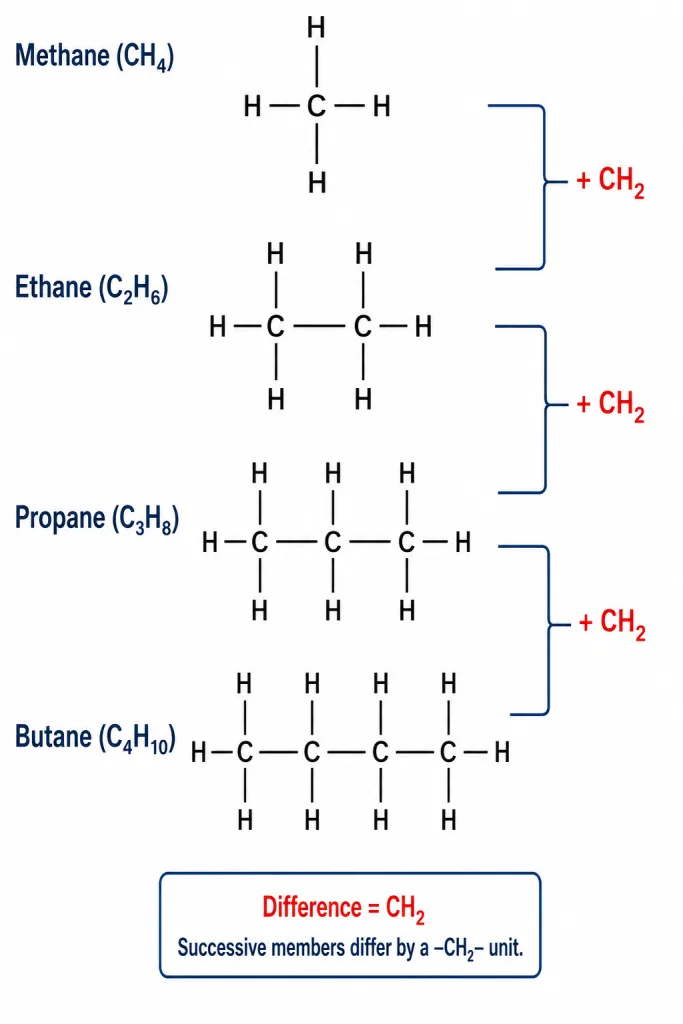
Roots — Numbers of Carbons
The 'root' tells how many C atoms in the main chain.
Greek/Latin Roots
| Number of C | Root | Examples |
|---|---|---|
| 1 | meth- | methane, methanol |
| 2 | eth- | ethane, ethanol |
| 3 | prop- | propane, propanol |
| 4 | but- | butane, butanol |
| 5 | pent- | pentane, pentanol |
| 6 | hex- | hexane, hexanol |
| 7 | hept- | heptane |
| 8 | oct- | octane |
| 9 | non- | nonane |
| 10 | dec- | decane |
First 4 (meth, eth, prop, but) — historical names. 5 onwards — Greek/Latin numbers.
Suffixes — Functional Groups
| Functional Group | Suffix | Example |
|---|---|---|
| Alkane (only single bonds) | -ane | methane |
| Alkene (double bond) | -ene | ethene |
| Alkyne (triple bond) | -yne | ethyne |
| Alcohol (-OH) | -ol | ethanol |
| Aldehyde (-CHO) | -al | methanal |
| Ketone (>C=O) | -one | propanone |
| Carboxylic acid (-COOH) | -oic acid | ethanoic acid |
| Ester (-COOR) | -oate | ethyl ethanoate |
Prefixes — Common Substituents
| Substituent | Prefix |
|---|---|
| -F | fluoro |
| -Cl | chloro |
| -Br | bromo |
| -I | iodo |
| -CH₃ | methyl |
| -C₂H₅ | ethyl |
| -NO₂ | nitro |
Example: 'chloroethane' = ethane with Cl substituent.
Putting It Together
To name CH₃-CH₂-CH₂-OH:
- Count C: 3 → 'prop'.
- Functional group: -OH → '-ol'.
- Position of OH: at end (C-1) → no number needed for one OH.
- Name: propan-1-ol (or just 'propanol' for simple cases).
To name CH₃-CH=CH-CH₃:
- Count C: 4 → 'but'.
- Functional group: C=C double bond → '-ene'.
- Position of double bond: between C-2 and C-3 → 'but-2-ene'.
- Name: but-2-ene.
Naming Examples — Step by Step
Example 1: Naming Alkanes
Methane ()
Step 1: 1 C → 'meth'. Step 2: only single bonds → '-ane'. Name: methane.
Ethane ()
1 C in chain… wait, let me re-examine. 2 C → 'eth'. Single bonds → '-ane'. Name: ethane.
Propane ()
3 C → 'prop'. Single bonds → '-ane'. Name: propane.
2-Methylpropane (Iso-butane)
Main chain: 3 C (prop). Branch: 1 CH₃ (methyl). Position of branch: C-2 (numbered to give lowest position). Name: 2-methylpropane.
Common name: iso-butane.
Example 2: Naming Alkenes
Ethene ()
2 C → 'eth'. Double bond → '-ene'. Name: ethene.
Propene ()
3 C → 'prop'. Double bond → '-ene'. Position of C=C: between C-1 and C-2. Name: prop-1-ene (or just propene — only one position possible).
But-2-ene ()
4 C → 'but'. Double bond → '-ene'. Position: C-2 (between C-2 and C-3). Name: but-2-ene.
Example 3: Naming Alkynes
Ethyne ()
2 C → 'eth'. Triple bond → '-yne'. Name: ethyne.
Propyne ()
3 C → 'prop'. Triple bond → '-yne'. Position: between C-1 and C-2. Name: prop-1-yne (or simply propyne).
Example 4: Naming Alcohols
Methanol ()
1 C → 'meth'. -OH → '-ol'. Name: methanol.
Ethanol ()
2 C → 'eth'. -OH → '-ol'. Name: ethanol.
Propan-1-ol ()
3 C → 'prop'. -OH on C-1 → 'propan-1-ol'. Name: propan-1-ol or 1-propanol.
Propan-2-ol ()
3 C → 'prop'. -OH on C-2 → 'propan-2-ol'. Name: propan-2-ol or iso-propanol (common name).
Example 5: Naming Aldehydes and Ketones
Methanal/Formaldehyde ()
1 C → 'meth'. -CHO → '-al'. Name: methanal (also called formaldehyde).
Ethanal/Acetaldehyde ()
2 C → 'eth'. -CHO → '-al'. Name: ethanal (also called acetaldehyde).
Propanone/Acetone ( or )
3 C → 'prop'. >C=O → '-one'. Name: propanone (also called acetone).
Example 6: Naming Carboxylic Acids
Methanoic Acid/Formic Acid ()
1 C → 'meth'. -COOH → '-oic acid'. Name: methanoic acid (also formic acid).
Ethanoic Acid/Acetic Acid ()
2 C → 'eth'. -COOH → '-oic acid'. Name: ethanoic acid (also acetic acid).
Note: -COOH counts as part of the chain. So 'ethanoic acid' = 2 C total (1 from CH₃ + 1 from COOH).
Naming Substituted Compounds
Halogens as Substituents
Halogens are named with prefixes:
- F: fluoro
- Cl: chloro
- Br: bromo
- I: iodo
Add position number if needed.
Examples
: chloromethane (or methyl chloride)
: chloroethane
: 2-bromopropane (Br on C-2 of propane.)
: trichloromethane (chloroform)
: tetrachloromethane (carbon tetrachloride)
Numbering Rules
When numbering the chain, give the lowest possible numbers to:
- Functional group (highest priority).
- Then double/triple bonds.
- Then substituents.
Read from the end that gives lower numbers.
Example: 2-Methylbutane
Structure:
CH₃ — CH — CH₂ — CH₃
      |
      CH₃
Number from left: C-1, C-2 (with methyl), C-3, C-4. Methyl at C-2.
Number from right: C-1, C-2, C-3 (with methyl), C-4. Methyl at C-3.
Choose the numbering with lower number → C-2 from left. Hence: 2-methylbutane (not 3-methylbutane).
Multiple Substituents
If multiple branches, list them alphabetically.
Example: 2-bromo-3-methylpentane
If two same substituents: Use prefixes: di- (2), tri- (3), tetra- (4).
Example: 2,2-dimethylpropane (= neo-pentane).
Naming with Functional Group Priority
If multiple functional groups present:
Use the highest priority as suffix. Others become prefixes.
Priority order:
- -COOH (-oic acid) [highest]
- -CHO (-al)
- >C=O (-one)
- -OH (-ol)
- -X (-halo, prefix only)
Example with two groups
Compound:
- Has -COOH (highest priority, suffix).
- Also -OH (lower priority, prefix as 'hydroxy').
- Main chain: 2 C.
- Name: 2-hydroxyethanoic acid (also called glycolic acid).
Practice Problems
What's CH₃-CH(OH)-CH₃?
3 C → prop. -OH → -ol. Position 2. Name: propan-2-ol (or iso-propanol).
What's CH₃-CH₂-CH₂-CHO?
4 C (count: CH₃-CH₂-CH₂-CHO = 4) → but. -CHO → -al. Position 1 (always at end for aldehydes). Name: butanal.
What's CH₃-CO-CH₂-CH₃?
4 C (CH₃-CO-CH₂-CH₃ = 4) → but. >C=O → -one. Position 2 (between C-2 and C-3 in the 4-C chain). Name: butan-2-one.
Notice: ketones must have the C=O between two C atoms. Position is always the carbon of C=O.
Common Names — Important Examples
While IUPAC is preferred, you should know common names too — they appear in real-world contexts and exams.
Alcohols
| Common Name | IUPAC Name | Formula |
|---|---|---|
| Methyl alcohol | Methanol | CH₃OH |
| Wood alcohol | Methanol | CH₃OH |
| Ethyl alcohol | Ethanol | C₂H₅OH |
| Grain alcohol | Ethanol | C₂H₅OH |
| Iso-propyl alcohol | Propan-2-ol | (CH₃)₂CHOH |
Aldehydes
| Common Name | IUPAC Name | Formula |
|---|---|---|
| Formaldehyde | Methanal | HCHO |
| Acetaldehyde | Ethanal | CH₃CHO |
| Propionaldehyde | Propanal | C₂H₅CHO |
Ketones
| Common Name | IUPAC Name | Formula |
|---|---|---|
| Acetone | Propanone | (CH₃)₂CO |
| Methyl ethyl ketone | Butan-2-one | CH₃-CO-C₂H₅ |
Carboxylic Acids
| Common Name | IUPAC Name | Formula |
|---|---|---|
| Formic acid | Methanoic acid | HCOOH |
| Acetic acid | Ethanoic acid | CH₃COOH |
| Propionic acid | Propanoic acid | C₂H₅COOH |
| Butyric acid | Butanoic acid | C₃H₇COOH |
Source of historical names:
- Formic acid: Latin 'formica' = ant (in ant stings).
- Acetic acid: Latin 'acetum' = vinegar.
- Butyric acid: Latin 'butyrum' = butter (in rancid butter).
Hydrocarbons
| Common Name | IUPAC Name |
|---|---|
| Methane | Methane |
| Ethane | Ethane |
| Propane | Propane |
| n-Butane | Butane |
| Iso-butane | 2-methylpropane |
| Acetylene | Ethyne |
| Ethylene | Ethene |
| Toluene | Methylbenzene |
Halogens (Common vs IUPAC)
| Common Name | IUPAC Name |
|---|---|
| Methyl chloride | Chloromethane |
| Ethyl chloride | Chloroethane |
| Iso-propyl chloride | 2-chloropropane |
| Chloroform | Trichloromethane |
| Carbon tetrachloride | Tetrachloromethane |
Practical Tips
1. Recognise both names. Common names are everyday vocabulary. 2. Use IUPAC for clarity. Especially in exams and scientific writing. *3. Memorise key compounds:
- Methanol, Ethanol, Propanone, Methanal, Methanoic acid, Ethanoic acid.
These are the most common in board exams.
Summary — Quick Reference
A 2-carbon compound's IUPAC names:
- Hydrocarbon (only single bonds): ethane.
- With double bond: ethene.
- With triple bond: ethyne.
- With -OH: ethanol.
- With -CHO: ethanal.
- With -COOH: ethanoic acid.
- With -Cl: chloroethane.
- With -Br: bromoethane.
For 1 C: methane, methanol, methanal, methanoic acid, chloromethane. For 3 C: propane, propan-1-ol or propan-2-ol, propanal, propanone, propanoic acid.
Master these patterns and you can name most simple organic compounds.
🧠 Memory Capsule
A quick glance just before the board exam.
1. IUPAC Name Structure
Prefix + Root + Suffix
Where:
- Root: number of C in main chain.
- Suffix: functional group.
- Prefix (optional): substituents (Cl, Br, methyl branches, etc.).
2. Roots — C Atoms
| n | Root |
|---|---|
| 1 | meth- |
| 2 | eth- |
| 3 | prop- |
| 4 | but- |
| 5 | pent- |
| 6 | hex- |
| 7 | hept- |
| 8 | oct- |
| 9 | non- |
| 10 | dec- |
3. Suffixes — Functional Groups
| Group | Suffix |
|---|---|
| Alkane | -ane |
| Alkene | -ene |
| Alkyne | -yne |
| Alcohol (-OH) | -ol |
| Aldehyde (-CHO) | -al |
| Ketone (>C=O) | -one |
| Acid (-COOH) | -oic acid |
4. Common Prefixes
- chloro- (-Cl), bromo- (-Br), fluoro- (-F), iodo- (-I)
- methyl- (CH₃-)
- ethyl- (C₂H₅-)
- hydroxy- (HO- as substituent, when -OH is not main group)
5. Numbering Rule
Number the chain to give the lowest number to functional group. If tie, then lowest to substituents.
6. Important Examples
| Compound | IUPAC Name |
|---|---|
| CH₄ | Methane |
| CH₃CH₂OH | Ethanol |
| CH₂=CH₂ | Ethene |
| HC≡CH | Ethyne |
| HCHO | Methanal |
| CH₃CHO | Ethanal |
| (CH₃)₂CO | Propanone |
| CH₃COOH | Ethanoic acid |
| CH₃Cl | Chloromethane |
| CH₃CHBrCH₃ | 2-bromopropane |
7. Common ↔ IUPAC Conversions
| Common | IUPAC |
|---|---|
| Methyl alcohol | Methanol |
| Ethyl alcohol | Ethanol |
| Acetone | Propanone |
| Formaldehyde | Methanal |
| Acetaldehyde | Ethanal |
| Formic acid | Methanoic acid |
| Acetic acid | Ethanoic acid |
| Iso-butane | 2-methylpropane |
| Acetylene | Ethyne |
| Ethylene | Ethene |
8. Board's 'Golden' Questions
- Name the IUPAC name of CH₃CH₂OH and CH₃COOH.
- Common name of methanal? formaldehyde.
- Difference between propanone and propanal.
- Name CH₃-CO-CH₃ in IUPAC.
- What is iso-propanol in IUPAC?
Final Formula: Root tells C count; Suffix tells function; Prefix tells branches/groups. Read the name → get the structure.
Solved Examples
Example 1: NCERT — Name These Compounds
Give IUPAC names for: (a) CH₃CH₂CH₂OH (b) CH₃CHO (c) HCOOH (d) CH₃-CO-CH₃ (e) CH₃Cl
Solution:
(a) CH₃CH₂CH₂OH
Identify:
- C count in main chain: 3 → 'prop'.
- Functional group: -OH (alcohol) → '-ol'.
- Position of OH: on terminal C (C-1).
IUPAC Name: Propan-1-ol (or simply propanol)
Common name: n-propyl alcohol.
(b) CH₃CHO
Identify:
- C count: 2 (1 in CH₃ + 1 in CHO) → 'eth'.
- Functional group: -CHO (aldehyde) → '-al'.
- Position: always at end (C-1) for aldehydes.
IUPAC Name: Ethanal
Common name: acetaldehyde.
(c) HCOOH
Identify:
- C count: 1 → 'meth'.
- Functional group: -COOH (carboxylic acid) → '-oic acid'.
IUPAC Name: Methanoic acid
Common name: formic acid.
Source: 'formic' from Latin 'formica' = ant. Ants produce this acid.
(d) CH₃-CO-CH₃
Identify:
- C count: 3 → 'prop'.
- Functional group: >C=O (ketone) → '-one'.
- Position: on the middle C (C-2 in the 3-C chain).
IUPAC Name: Propanone (or propan-2-one if specified)
Common name: acetone.
Familiar use: nail polish remover.
(e) CH₃Cl
Identify:
- C count: 1 → 'meth'.
- Functional group: alkane base, Cl as prefix.
- Suffix: -ane.
- Prefix: chloro-.
IUPAC Name: Chloromethane
Common name: methyl chloride.
Summary Table
| Formula | IUPAC Name | Common Name |
|---|---|---|
| CH₃CH₂CH₂OH | Propan-1-ol | n-Propyl alcohol |
| CH₃CHO | Ethanal | Acetaldehyde |
| HCOOH | Methanoic acid | Formic acid |
| CH₃-CO-CH₃ | Propanone | Acetone |
| CH₃Cl | Chloromethane | Methyl chloride |
How to Approach
For each compound:
- Count C atoms → choose root (meth, eth, prop, but…).
- Identify functional group → choose suffix (-ol, -al, -one, -oic acid).
- Find position (if needed) → number lowest position.
- Check for substituents → add prefixes.
- Combine: prefix + root + suffix.
Practice with many examples — soon naming becomes second nature.
[NCERT — important]
Example 2: NCERT — Draw the Structures
Draw the structural formulas for: (a) Butanone (b) Hexanal (c) Pentan-2-ol (d) Propanoic acid (e) 2-Bromoethane
Solution:
Approach
From IUPAC name to structure:
- Root tells C count.
- Suffix tells functional group.
- Prefix/numbers tell substituent positions.
- Build the structure.
(a) Butanone
Decode:
- 'But' = 4 C.
- '-one' = ketone.
- 'Butan-2-one' implies C=O at C-2.
Structure:
CH₃ — CO — CH₂ — CH₃
Or detailed:
    H   H   O   H   H
    |   |   ||  |   |
    H — C — C — C — C — H
        |       |
        H       H
4 C in chain. C=O at C-2.
(b) Hexanal
Decode:
- 'Hex' = 6 C.
- '-al' = aldehyde.
- Aldehyde always at C-1.
Structure:
CH₃ — CH₂ — CH₂ — CH₂ — CH₂ — CHO
Or:
         O
         ||
... — C — H
at the end.
Total: 6 C in chain. CHO at one end.
(c) Pentan-2-ol
Decode:
- 'Pentan' = 5 C.
- '-ol' = alcohol.
- Position 2 = -OH on C-2.
Structure:
CH₃ — CH(OH) — CH₂ — CH₂ — CH₃
Or:
         OH
          |
    CH₃ — CH — CH₂ — CH₂ — CH₃
5 C in chain. OH on C-2.
(d) Propanoic Acid
Decode:
- 'Propan' = 3 C.
- '-oic acid' = carboxylic acid.
Structure:
CH₃ — CH₂ — COOH
Or:
                  O
                  ||
    CH₃ — CH₂ — C — OH
3 C in chain. -COOH at end.
(e) 2-Bromoethane
Wait — 'ethane' has only 2 C. Where would position 2 be?
Actually, 2-bromoethane would have Br on C-2 of ethane, but ethane only has 2 C → C-2 is one of the only two carbons.
The compound is just CH₃-CH₂Br (bromoethane), since for ethane there's no need to specify position.
Probably the question means 2-bromopropane or just bromoethane.
Let's assume 'bromoethane':
Decode:
- 'Eth' = 2 C.
- 'Bromo' = -Br.
- Suffix '-ane' = single bonds only.
Structure:
CH₃ — CH₂ — Br
Or:
    H   H
    |   |
H — C — C — Br
    |   |
    H   H
Summary
Drawing structures from IUPAC names:
| Name | Structure |
|---|---|
| Butanone | CH₃COC₂H₅ |
| Hexanal | CH₃(CH₂)₄CHO |
| Pentan-2-ol | CH₃CH(OH)C₃H₇ |
| Propanoic acid | CH₃CH₂COOH |
| Bromoethane | CH₃CH₂Br |
Practice Tip
The reverse process is also important — given a structure, name it. Try drawing structures of:
- Methanol
- Acetone
- Acetic acid
- 2-chloropropane
With practice, you'll be able to:
- Convert IUPAC name → structure.
- Convert structure → IUPAC name.
- Recognise compounds by either name.
[NCERT + Board]
Example 3: Naming Compounds with Branches
Name the following: (a) (CH₃)₂CHCH₃ (b) CH₃-CH(CH₃)-CH₂-CH₃ (c) CH₃-CHCl-CH₃ (d) (CH₃)₃C-OH
Solution:
(a) (CH₃)₂CHCH₃
Structural formula:
    CH₃
     |
  CH₃ — CH — CH₃
This is iso-butane.
IUPAC analysis:
- Main chain: 3 C (longest = 3).
- Branch: 1 CH₃ on C-2.
- Suffix: -ane (single bonds).
IUPAC Name: 2-Methylpropane
Common name: iso-butane.
(b) CH₃-CH(CH₃)-CH₂-CH₃
Structural formula:
         CH₃
          |
    CH₃ — CH — CH₂ — CH₃
IUPAC analysis:
- Longest chain: 4 C.
- Branch: 1 CH₃ on C-2.
- Suffix: -ane.
IUPAC Name: 2-Methylbutane
Common name: iso-pentane.
(c) CH₃-CHCl-CH₃
Structural formula:
         Cl
          |
    CH₃ — CH — CH₃
IUPAC analysis:
- Main chain: 3 C → 'prop'.
- Substituent: Cl on C-2 → '2-chloro' prefix.
- Suffix: -ane.
IUPAC Name: 2-Chloropropane
Common name: iso-propyl chloride.
(d) (CH₃)₃C-OH
Structural formula:
         CH₃
          |
    CH₃ — C — OH
          |
         CH₃
IUPAC analysis:
- Longest chain… here, 3 C is part of the main chain (with the carbon bearing OH).
- Wait, let me recount.
- Carbon with OH + 3 CH₃ = 4 C total.
- Longest chain: actually only 2 C straight (CH₃-C(CH₃)₂OH).
Hmm, this is a tricky one. Let me re-analyze:
(CH₃)₃C-OH
- Central C connected to: 3 CH₃ groups + 1 OH.
- Longest C chain: from a CH₃ through central C to another CH₃ = 3 C.
- The other CH₃ is a branch.
Naming:
- Main chain: 3 C → 'prop'.
- -OH on C-2 → 'propan-2-ol'.
- Branch: 1 CH₃ on C-2 (also).
IUPAC Name: 2-Methylpropan-2-ol
Common name: tert-butanol or tert-butyl alcohol.
Summary Table
| Compound | IUPAC Name | Common Name |
|---|---|---|
| (CH₃)₂CHCH₃ | 2-Methylpropane | Iso-butane |
| CH₃CH(CH₃)CH₂CH₃ | 2-Methylbutane | Iso-pentane |
| CH₃CHClCH₃ | 2-Chloropropane | Iso-propyl chloride |
| (CH₃)₃COH | 2-Methylpropan-2-ol | Tert-butanol |
Tips for Naming Branched Compounds
Step 1: Find the longest continuous chain.
Step 2: Number atoms from the end nearest to the substituent (gives lowest number).
Step 3: Identify branches and their positions.
Step 4: Combine: position-prefix-root-suffix.
Example: in 2-methylbutane:
- Longest chain = 4 C (butane).
- Methyl branch at position 2.
- Combined: 2-methylbutane.
Practice: Convert Common to IUPAC
Try yourself:
- Iso-pentane: answer is 2-methylbutane.
- Neo-pentane: answer is 2,2-dimethylpropane.
- Tert-butanol: answer is 2-methylpropan-2-ol.
With practice, you'll see the pattern.
[Board: 3-5 marks]
Example 4: A Concluding Question
(a) Define IUPAC nomenclature. (b) Give 5 examples of root + suffix combinations. (c) What is methanol vs methanal vs methanoic acid? (write structures) (d) Name CH₃CH(OH)CH₃ in IUPAC.
Solution:
(a) IUPAC Nomenclature
'IUPAC nomenclature' = the systematic, internationally agreed naming system for chemical compounds.
IUPAC = International Union of Pure and Applied Chemistry.
The system:
- Uses rules that are universally accepted.
- Each name has a clear meaning.
- Reading the name → you can draw the structure.
- Used in scientific publications, education, industry.
Format: Prefix + Root + Suffix
- Root: number of C in main chain (meth, eth, prop, but…).
- Suffix: functional group (-ane, -ene, -ol, -al, -oic acid, -one).
- Prefix: substituents (chloro, bromo, methyl, etc.).
Replaces older 'common names' that varied by region/source.
(b) 5 Examples of Root + Suffix
Example 1: Methane
meth (1 C) + ane (alkane) = methane (CH₄)
Example 2: Ethanol
eth (2 C) + ol (-OH) = ethanol (C₂H₅OH)
Example 3: Propanal
prop (3 C) + al (-CHO) = propanal (C₂H₅CHO)
Example 4: Butanone
but (4 C) + one (>C=O) = butanone (C₂H₅COCH₃)
Example 5: Pentanoic acid
pent (5 C) + oic acid (-COOH) = pentanoic acid (C₄H₉COOH)
(c) Methanol vs Methanal vs Methanoic acid
All have 1 C atom (root: meth-). Different functional groups → different suffixes.
Methanol — CH₃OH
Suffix: -ol (alcohol). Functional group: -OH.
Structure:
      H
      |
  H — C — OH
      |
      H
Common name: methyl alcohol or wood alcohol. Use: industrial solvent, fuel.
Methanal — HCHO (formaldehyde)
Suffix: -al (aldehyde). Functional group: -CHO.
Structure:
         O
         ||
      H — C — H
Common name: formaldehyde. Use: preserving biological specimens (formalin).
Methanoic acid — HCOOH (formic acid)
Suffix: -oic acid (carboxylic acid). Functional group: -COOH.
Structure:
         O
         ||
      H — C — O — H
Common name: formic acid. Source: ant stings.
Comparison Summary
| Compound | Functional Group | Structure |
|---|---|---|
| Methanol | -OH | CH₃-OH |
| Methanal | -CHO | H-CHO |
| Methanoic acid | -COOH | H-COOH |
Same C count (1), different functional groups, different chemistry.
All have similar root names — only suffix differs based on functional group.
(d) Name CH₃CH(OH)CH₃
Step 1: Count C atoms = 3 → root: 'prop'.
Step 2: Identify functional group = -OH (alcohol) → suffix: '-ol'.
Step 3: Find position of -OH: Structure:
CH₃ — CH(OH) — CH₃
   |       |       |
   1       2       3
The OH is on the middle carbon (C-2).
Step 4: Combine:
IUPAC Name: Propan-2-ol (also written as 2-propanol)
Common name: iso-propyl alcohol or iso-propanol (rubbing alcohol used as disinfectant).
Note: Numbering — both ends give the same number for OH (it's symmetric: C-1 and C-3 are CH₃, C-2 has OH). So no ambiguity.
Why Iso-propyl Alcohol is Useful
Iso-propanol (CH₃CH(OH)CH₃):
- Effective disinfectant.
- Used in hand sanitisers.
- Cleans electronic equipment.
- Boiling point 82°C — convenient for use.
Final Insight
The IUPAC nomenclature system:
1. Brings order to organic chemistry. 2. Allows clear communication globally. 3. Each name encodes the structure. 4. Master root + suffix combinations → name most simple compounds.
This systematic approach is one of the great achievements of modern chemistry — turning a chaotic mass of compounds into an organised system anyone can understand.
[Board: 5-mark mixed]