
Hydrocarbons — The Simplest Carbon Compounds
'Hydrocarbon' = a compound made of only hydrogen and carbon atoms.
These are the simplest carbon compounds.
Examples of Hydrocarbons
- (methane — natural gas)
- (ethane)
- (propane — LPG)
- (butane — LPG)
- (octane — petrol)
- (cetane — diesel)
- …long polymers like polyethylene
Two Major Types
1. Saturated Hydrocarbons: Only single bonds between carbons. 'Saturated' = full of hydrogens. Cannot accept more H atoms.
Examples: methane, ethane, propane. Series: Alkanes.
2. Unsaturated Hydrocarbons: Have double or triple bonds between carbons. 'Unsaturated' = can accept more H atoms. Less H than the saturated version with same C.
Sub-types:
- Alkenes — have double bonds.
- Alkynes — have triple bonds.
Why is This Distinction Important?
Saturated and unsaturated hydrocarbons have very different properties:
- Saturated: less reactive (single bonds — strong, hard to break).
- Unsaturated: more reactive (double/triple bonds — can be 'opened' to add atoms).
This affects:
- How they burn.
- How they react with other chemicals.
- Their uses (fuel, raw material for plastics, etc.).
Saturated vs Unsaturated — Quick Comparison
| Property | Saturated | Unsaturated |
|---|---|---|
| Bonds | All single (C-C) | Some double (C=C) or triple (C≡C) |
| Series | Alkane | Alkene, Alkyne |
| Reactivity | Less | More |
| Test | No reaction with bromine water | Decolourises bromine water |
A Common Example
Cooking gas (LPG) is mostly butane () — saturated. Burns cleanly with blue flame.
Industrial plastic raw material is ethene () — unsaturated. Reacts to form polyethene (plastic).
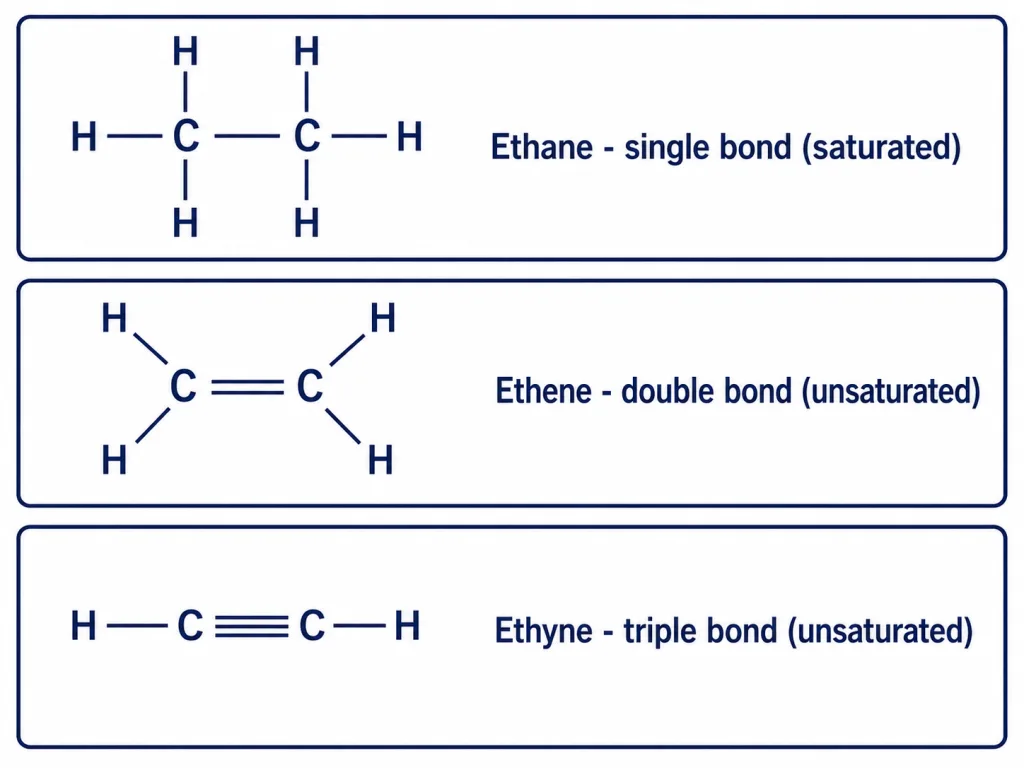
Alkanes — Saturated Hydrocarbons
'Alkane' family — only single bonds between C atoms.
General Formula
Where n = number of carbon atoms.
Calculating H Atoms
If 1 C: H = 2(1)+2 = 4 → CH₄ If 2 C: H = 2(2)+2 = 6 → C₂H₆ If 3 C: H = 2(3)+2 = 8 → C₃H₈ If 10 C: H = 2(10)+2 = 22 → C₁₀H₂₂
First Few Alkanes
| n | Formula | Name | Common Use |
|---|---|---|---|
| 1 | CH₄ | Methane | Natural gas, biogas |
| 2 | C₂H₆ | Ethane | In LPG mix |
| 3 | C₃H₈ | Propane | LPG |
| 4 | C₄H₁₀ | Butane | LPG |
| 5 | C₅H₁₂ | Pentane | Petrol component |
| 6 | C₆H₁₄ | Hexane | Petrol component |
| 7 | C₇H₁₆ | Heptane | Petrol component |
| 8 | C₈H₁₈ | Octane | Petrol |
| 9 | C₉H₂₀ | Nonane | — |
| 10 | C₁₀H₂₂ | Decane | Diesel component |
Naming Pattern
First 4: meth-, eth-, prop-, but- (historical names) 5+: pent-, hex-, hept-, oct-, non-, dec- (Greek numbers)
Suffix for alkane: -ane.
Structure of Alkanes
Methane ()
        H
        |
    H — C — H
        |
        H
1 C with 4 H. Tetrahedral.
Ethane ()
    H   H
    |   |
H — C — C — H
    |   |
    H   H
2 C joined by single bond. 6 H atoms total (3 on each C).
Propane ()
    H   H   H
    |   |   |
H — C — C — C — H
    |   |   |
    H   H   H
3 C in a row. 8 H atoms.
Properties of Alkanes
1. State at room temperature:
- C₁ to C₄: gases.
- C₅ to C₁₇: liquids.
- C₁₈ and above: solids.
2. Combustibility:
- All burn with clean blue flame in plenty of O₂.
- Used as fuels (natural gas, LPG, petrol, diesel).
- Reaction:
3. Stability:
- Single C-C bonds — strong and stable.
- Don't react easily.
- Called 'paraffins' (Latin: 'parum affinis' = little affinity).
4. Insolubility in water:
- Non-polar molecules.
- Soluble in non-polar solvents (kerosene, benzene).
Alkenes — Hydrocarbons with Double Bonds
'Alkene' family — have at least one C=C double bond.
General Formula
Where n = number of carbon atoms (n ≥ 2).
Note: 2 fewer H atoms than alkane with same n.
Calculating H Atoms
If 2 C: H = 2(2) = 4 → C₂H₄ If 3 C: H = 2(3) = 6 → C₃H₆ If 4 C: H = 2(4) = 8 → C₄H₈
First Few Alkenes
| n | Formula | Name |
|---|---|---|
| 2 | C₂H₄ | Ethene (Ethylene) |
| 3 | C₃H₆ | Propene (Propylene) |
| 4 | C₄H₈ | Butene |
| 5 | C₅H₁₀ | Pentene |
Suffix for alkene: -ene.
Structure of Alkenes
Ethene () — The Simplest
    H       H
     \     /
      C = C
     /     \
    H       H
1 double bond between 2 C. 4 H atoms (2 per C).
Each C has only 2 H (compared to 3 in ethane) — because double bond uses 2 of the 4 bonds.
Propene ()
    H       H   H
     \     /   |
      C = C — C — H
     /         |
    H          H
1 double bond between C₁ and C₂. 1 single bond between C₂ and C₃. 6 H atoms.
Properties of Alkenes
1. Reactivity:
- More reactive than alkanes.
- The double bond can break to add atoms.
- Addition reactions are characteristic.
2. State at room temperature:
- C₂ to C₄: gases.
- C₅ to C₁₅: liquids.
- Higher: solids.
3. Combustibility:
- Burn — but with slightly yellow flame (more soot due to higher C content per H).
4. Bromine Water Test:
- Alkenes decolourise brown bromine water (orange → colourless).
- This is a standard test for unsaturation (presence of double bond).
Reaction: (1,2-dibromoethane — colourless)
Importance — Why Alkenes Matter
Alkenes are raw materials for:
- Plastics (polyethene from ethene).
- Synthetic fibres (polyester from ethylene glycol).
- Antifreeze.
- Drugs and chemicals.
Ethene alone — produces 130+ million tonnes worldwide annually!
A Common Use
Ethene is also a plant hormone! It causes fruits to ripen. Bananas, mangoes, tomatoes — release ethene as they ripen. That's why one ripe fruit makes others ripen faster — ethene gas spreads.
Alkynes — Hydrocarbons with Triple Bonds
'Alkyne' family — have at least one C≡C triple bond.
General Formula
Where n = number of carbon atoms (n ≥ 2).
Note: 4 fewer H atoms than alkane with same n.
Calculating H Atoms
If 2 C: H = 2(2)-2 = 2 → C₂H₂ If 3 C: H = 2(3)-2 = 4 → C₃H₄ If 4 C: H = 2(4)-2 = 6 → C₄H₆
First Few Alkynes
| n | Formula | Name |
|---|---|---|
| 2 | C₂H₂ | Ethyne (Acetylene) |
| 3 | C₃H₄ | Propyne |
| 4 | C₄H₆ | Butyne |
Suffix for alkyne: -yne.
Structure of Alkynes
Ethyne () — Acetylene
H — C ≡ C — H
1 triple bond between 2 C atoms. Only 2 H atoms (1 per C). Linear molecule.
Each C has only 1 H (compared to 3 in ethane, 2 in ethene) — because triple bond uses 3 of the 4 bonds.
Propyne ()
H — C ≡ C — C — H
            |
            H
            |
            H
Triple bond + 1 single bond.
Properties of Alkynes
1. Highest Reactivity:
- Most reactive among hydrocarbons.
- The triple bond is rich in electrons.
- Many addition reactions possible.
2. State:
- C₂ to C₄: gases.
- Higher: liquids/solids.
3. Combustibility:
- Burn with smoky flame (high C content per H).
- High heat output → used in welding.
4. Bromine Water Test:
- Alkynes decolourise bromine water — same as alkenes.
- Test for unsaturation.
Importance of Ethyne (Acetylene)
is industrially very important:
1. Oxyacetylene welding:
- Burning C₂H₂ + O₂ → temperature ~3000°C.
- Used to weld and cut metals.
2. Manufacture of:
- Vinyl chloride (for PVC plastic).
- Acrylonitrile (for synthetic fibres).
- Acetic acid (vinegar component).
3. Source for synthetic rubber.
Comparison — Alkanes, Alkenes, Alkynes
| Feature | Alkane | Alkene | Alkyne |
|---|---|---|---|
| Bonds | All single | At least 1 double | At least 1 triple |
| Formula | |||
| Suffix | -ane | -ene | -yne |
| 2-C example | Ethane (C₂H₆) | Ethene (C₂H₄) | Ethyne (C₂H₂) |
| Reactivity | Low | High | Highest |
| H per C ratio | High | Medium | Low |
| Bromine water | No reaction | Decolourises | Decolourises |
| Flame | Clean blue | Slight yellow | Smoky |
Tests and Identification
How to Tell Saturated from Unsaturated?
Three quick tests:
1. Bromine Water Test (Most Famous)
Bromine water is reddish-brown ( dissolved in water).
Add to the hydrocarbon:
Saturated (alkane):
- No reaction.
- Bromine water remains brown.
Unsaturated (alkene/alkyne):
- Reacts immediately.
- Bromine water becomes colourless.
Why? Br₂ adds across the double/triple bond.
Examples: (1,2-dibromoethane, colourless)
2. Combustion Test (Flame Colour)
Burn the hydrocarbon in air:
| Type | Flame |
|---|---|
| Alkane | Clean blue, hardly any soot |
| Alkene | Slightly yellow with some soot |
| Alkyne | Yellow/sooty, much smoke |
Why? As C:H ratio increases, less oxygen is needed per carbon. Incomplete combustion → soot.
Saturated has more H per C → cleaner burn. Unsaturated has less H per C → sootier burn.
3. KMnO₄ Test (Optional, Advanced)
Dilute potassium permanganate solution (purple) is added.
Saturated: No change. Solution remains purple. Unsaturated: Decolourises (purple → colourless).
Reason: KMnO₄ oxidises the double/triple bond.
Naming Conventions Quick Reference
For straight-chain hydrocarbons:
| C atoms | Prefix | Alkane | Alkene | Alkyne |
|---|---|---|---|---|
| 1 | meth- | methane | (none) | (none) |
| 2 | eth- | ethane | ethene | ethyne |
| 3 | prop- | propane | propene | propyne |
| 4 | but- | butane | butene | butyne |
| 5 | pent- | pentane | pentene | pentyne |
| 6 | hex- | hexane | hexene | hexyne |
Suffixes:
- -ane = alkane (saturated)
- -ene = alkene (1 double bond)
- -yne = alkyne (1 triple bond)
Why So Many Hydrocarbons?
Carbon's catenation + tetravalency:
- Different chain lengths.
- Different bond types.
- Different arrangements.
Result: thousands of hydrocarbons known. And we can keep making more!
A Quick Quiz
Identify each:
- → alkane (1 C, all single bonds)
- → alkene (matches )
- → alkyne (matches )
- → alkane (matches )
🧠 Memory Capsule
A quick glance just before the board exam.
1. Hydrocarbons — Definition
Compounds of only C and H.
2. Two Main Types
Saturated (only single bonds) vs Unsaturated (double/triple bonds).
3. Three Series
| Series | Bond Type | Formula |
|---|---|---|
| Alkane | Single | |
| Alkene | Double | |
| Alkyne | Triple |
4. First Members
Alkanes:
- CH₄ (methane), C₂H₆ (ethane), C₃H₈ (propane), C₄H₁₀ (butane)
Alkenes:
- C₂H₄ (ethene), C₃H₆ (propene), C₄H₈ (butene)
Alkynes:
- C₂H₂ (ethyne), C₃H₄ (propyne), C₄H₆ (butyne)
5. Suffixes
- -ane = alkane
- -ene = alkene
- -yne = alkyne
6. Tests for Unsaturation
- Bromine water test: decolourises (brown → colourless).
- KMnO₄ test: decolourises (purple → colourless).
- Saturated: no change in colour.
7. Combustion
- Alkane: clean blue flame.
- Alkene: slightly yellow.
- Alkyne: smoky/yellow.
8. Reactivity Order
Alkyne > Alkene > Alkane
9. Important Hydrocarbons
- Methane: natural gas, biogas, marsh gas.
- Butane, propane: LPG (cooking gas).
- Octane: petrol.
- Ethene: plastic raw material; plant hormone.
- Ethyne (acetylene): welding.
10. Board's 'Golden' Questions
- Saturated vs Unsaturated — difference.
- Test to differentiate (bromine water).
- Why does ethene decolourise bromine water?
- General formulas of three series.
- Calculate H in for alkane / alkene / alkyne.
Final Formula: Saturated = full of H = unreactive; Unsaturated = less H = reactive.
Solved Examples
Example 1: NCERT — Saturated and Unsaturated
What are saturated and unsaturated hydrocarbons? Give examples.
Solution:
Hydrocarbons — Recap
Compounds containing only C and H atoms.
Saturated Hydrocarbons
Definition: Hydrocarbons in which all bonds between C atoms are single bonds.
'Saturated' = filled with maximum H atoms. Cannot accept any more H.
General Formula:
Series Name: Alkanes
Examples:
- Methane ()
- Ethane ()
- Propane ()
- Butane ()
- Octane ()
Properties:
- Less reactive (single bonds — strong, stable).
- Don't decolourise bromine water.
- Burn with clean blue flame.
Unsaturated Hydrocarbons
Definition: Hydrocarbons that have double or triple bonds between C atoms.
'Unsaturated' = can accept more H atoms.
Two types:
A. Alkenes (1 double bond)
- General Formula:
- Examples: Ethene (), Propene ()
B. Alkynes (1 triple bond)
- General Formula:
- Examples: Ethyne (), Propyne ()
Properties:
- More reactive (multiple bonds can break).
- Decolourise bromine water (test for unsaturation).
- Burn with sootier (yellow) flame.
Comparison Table
| Property | Saturated | Unsaturated |
|---|---|---|
| Bonds | All single | Double or triple |
| Formula | or | |
| Reactivity | Less | More |
| Bromine water | No reaction | Decolourises |
| Flame | Clean blue | Yellow, sooty |
[NCERT — every year]
Example 2: NCERT — Bromine Water Test
How can you distinguish between saturated and unsaturated hydrocarbons using bromine water?
Solution:
Bromine Water Test
'Bromine water' = dissolved in water. Colour: reddish-brown (or orange).
Procedure
Add bromine water to the hydrocarbon (in a test tube):
Observation 1: Saturated Hydrocarbon (e.g., methane, ethane)
Bromine water remains brown/orange.
No reaction at room temperature. Single C-C bonds — strong, no reaction with Br₂.
If exposed to UV light, slow substitution may happen — but at room temperature in dark, no change.
Observation 2: Unsaturated Hydrocarbon (e.g., ethene, ethyne)
Bromine water becomes colourless.
Br₂ adds across the double/triple bond.
Reaction with ethene: (1,2-dibromoethane, colourless)
The Br₂ is consumed → no more colour.
Reaction with ethyne: (1,1,2,2-tetrabromoethane, colourless)
Triple bond can absorb 2 Br₂ molecules.
Why This Test Works?
Br₂ has a brown colour due to its electronic structure. When Br₂ adds to a multiple bond, it breaks into 2 Br atoms, each forming a single bond. New molecule (with Br atoms attached) is colourless.
Important Notes
1. Both alkenes and alkynes decolourise bromine water. 2. Test doesn't distinguish between alkene and alkyne — it only confirms unsaturation. 3. To find the type: observe how much Br₂ is consumed.
- Alkene: 1 Br₂ per double bond.
- Alkyne: 2 Br₂ per triple bond.
A Practical Demonstration
Take 3 test tubes:
- A: Bromine water + methane → brown remains.
- B: Bromine water + ethene → colourless quickly.
- C: Bromine water + ethyne → colourless quickly.
Result:
- A: saturated (alkane).
- B, C: unsaturated.
Practical Significance
Used in industry to:
- Determine if a hydrocarbon is saturated or not.
- Quality test for organic compounds.
- Identification of new compounds.
[NCERT — important, every year]
Example 3: NCERT — Calculate Formulas
Calculate the molecular formula for: (a) Alkane with 5 C atoms (b) Alkene with 4 C atoms (c) Alkyne with 3 C atoms (d) Alkane with 8 C atoms
Solution:
Use General Formulas
- Alkane:
- Alkene:
- Alkyne:
(a) Alkane with 5 C atoms
n = 5 H = 2(5) + 2 = 12
Formula: (Pentane)
(b) Alkene with 4 C atoms
n = 4 H = 2(4) = 8
Formula: (Butene)
(c) Alkyne with 3 C atoms
n = 3 H = 2(3) - 2 = 4
Formula: (Propyne)
(d) Alkane with 8 C atoms
n = 8 H = 2(8) + 2 = 18
Formula: (Octane)
Summary Table
| Compound | n | Formula | Name |
|---|---|---|---|
| (a) Alkane | 5 | Pentane | |
| (b) Alkene | 4 | Butene | |
| (c) Alkyne | 3 | Propyne | |
| (d) Alkane | 8 | Octane |
Verification — Tetravalency Check
Each C has 4 bonds:
Pentane (C₅H₁₂):
- 5 C in chain.
- C-C single bonds: 4.
- C-H bonds per C: 3, 2, 2, 2, 3 (total 12 H).
- Each C has 4 bonds ✓
Butene (C₄H₈):
- 4 C in chain, 1 double bond.
- C=C: counts as 2 bonds.
- 8 H atoms attached.
- Each C has 4 bonds ✓
Propyne (C₃H₄):
- 3 C, 1 triple bond.
- C≡C: counts as 3 bonds.
- 4 H atoms.
- Each C has 4 bonds ✓
Octane (C₈H₁₈):
- 8 C in chain.
- 18 H atoms.
- Each C has 4 bonds ✓
Practical Application
These calculations:
- Help identify compound type.
- Useful in chemistry and pharmacology.
- Foundation for organic chemistry.
[Board: 3-mark numerical]
Example 4: NCERT — Combustion of Hydrocarbons
Write the balanced equation for the combustion of methane and ethyne.
Solution:
Combustion of Methane ()
Reactants: Methane + Oxygen Products: Carbon dioxide + Water + Heat
Unbalanced:
Balancing: Carbon: 1 = 1 ✓ Hydrogen: 4 = 2 — need 2 H₂O.* Oxygen: 4 = 4 — need 2 O₂.*
Balanced:
This is exothermic — releases heat. This is why methane is the main component of LPG and natural gas (used as fuel).
Combustion of Ethyne ()
Unbalanced:
Balancing: Carbon: 2 = 2 — need 2 CO₂.* Hydrogen: 2 = 2 — need 1 H₂O.* Oxygen: 2(2) + 1 = 5 — need 5/2 O₂.*
Balanced (multiply by 2 to remove fraction):
Or simplified per molecule:
Heat of Combustion
Methane: 891 kJ/mol Ethyne: 1300 kJ/mol
Ethyne releases more heat per mole — because of triple bond breaking. Hence ethyne (acetylene) used in welding — high temperature ~3000°C.
Comparison — Why Different Flames?
Methane (CH₄): C:H ratio = 1:4 → enough O₂ available → clean blue flame. Ethyne (C₂H₂): C:H ratio = 1:1 → needs more O₂ → if insufficient, soot forms (yellow/sooty flame).
That's why:
- Pure O₂ + C₂H₂ → very hot, clean welding flame.
- Air + C₂H₂ → smoky, sooty.
Practical Significance
Methane:
- Natural gas (homes, factories).
- LPG component.
- Biogas (from animal waste).
Ethyne:
- Welding (oxyacetylene torch).
- Cutting metals.
- Industrial chemicals.
[NCERT — important]
Example 5: NCERT — Drawing Structures
Draw the structures of: (a) Ethane (b) Ethene (c) Ethyne
Count the number of C-H and C-C bonds in each.
Solution:
(a) Ethane ()
    H   H
    |   |
H — C — C — H
    |   |
    H   H
Bonds:
- C-C single bonds: 1
- C-H bonds: 6
- Total bonds: 7
All single bonds (saturated). Each C has 4 bonds: 1 to other C + 3 to H.
(b) Ethene ()
    H       H
     \     /
      C = C
     /     \
    H       H
Bonds:
- C=C double bond: 1 (2 shared pairs)
- C-H bonds: 4
- Total bonds: 5 (in terms of bond count) or 6 (counting double as 2)
1 double bond (unsaturated alkene). Each C has 4 bonds: 2 in double bond + 2 to H.
(c) Ethyne ()
H — C ≡ C — H
Bonds:
- C≡C triple bond: 1 (3 shared pairs)
- C-H bonds: 2
- Total bonds: 3 (in terms of bond count) or 5 (counting triple as 3)
1 triple bond (unsaturated alkyne). Each C has 4 bonds: 3 in triple bond + 1 to H.
Comparison Table
| Compound | C-C bonds | C=C bonds | C≡C bonds | C-H bonds |
|---|---|---|---|---|
| Ethane | 1 (single) | 0 | 0 | 6 |
| Ethene | 0 | 1 | 0 | 4 |
| Ethyne | 0 | 0 | 1 | 2 |
Total Shared Electrons
Ethane:
- 1 C-C single = 2 e⁻
- 6 C-H = 12 e⁻
- Total: 14 e⁻
Ethene:
- 1 C=C double = 4 e⁻
- 4 C-H = 8 e⁻
- Total: 12 e⁻
Ethyne:
- 1 C≡C triple = 6 e⁻
- 2 C-H = 4 e⁻
- Total: 10 e⁻
Tetravalency Verification
Each C must have exactly 4 bonds:
Ethane: Each C: 1 (to other C) + 3 (to H) = 4 ✓ Ethene: Each C: 2 (in C=C) + 2 (to H) = 4 ✓ Ethyne: Each C: 3 (in C≡C) + 1 (to H) = 4 ✓
Pattern
As we go from ethane → ethene → ethyne:
- Multiplicity of C-C bond increases (single → double → triple).
- H atoms decrease (6 → 4 → 2).
- Reactivity increases.
- Bond length decreases.
- Bond strength increases.
[NCERT — fundamental]
Example 6: NCERT — Identifying Type of Hydrocarbon
Identify the type (alkane/alkene/alkyne) of: (a) (b) (c) (d) (e) (f)
Solution:
Use General Formulas
- Alkane:
- Alkene:
- Alkyne:
(a)
n = 4
Check alkane: 2(4)+2 = 10 ✓
Type: Alkane (Butane)
(b)
n = 5
Check alkane: 2(5)+2 = 12 ≠ 10 ✗ Check alkene: 2(5) = 10 ✓
Type: Alkene (Pentene)
(c)
n = 2
Check alkane: 2(2)+2 = 6 ≠ 2 ✗ Check alkene: 2(2) = 4 ≠ 2 ✗ Check alkyne: 2(2)-2 = 2 ✓
Type: Alkyne (Ethyne)
(d)
n = 3
Check alkane: 2(3)+2 = 8 ✓
Type: Alkane (Propane)
(e)
n = 6
Check alkane: 2(6)+2 = 14 ≠ 12 ✗ Check alkene: 2(6) = 12 ✓
Type: Alkene (Hexene)
Note: Could also be cyclohexane (a ring with 6 C and single bonds), which has same formula! We'll learn rings in Section 4.
(f)
n = 4
Check alkane: 2(4)+2 = 10 ≠ 6 ✗ Check alkene: 2(4) = 8 ≠ 6 ✗ Check alkyne: 2(4)-2 = 6 ✓
Type: Alkyne (Butyne)
Summary Table
| Formula | n | Verifies | Type | Name |
|---|---|---|---|---|
| 4 | Alkane (10) | Alkane | Butane | |
| 5 | Alkene (10) | Alkene | Pentene | |
| 2 | Alkyne (2) | Alkyne | Ethyne | |
| 3 | Alkane (8) | Alkane | Propane | |
| 6 | Alkene (12) | Alkene | Hexene | |
| 4 | Alkyne (6) | Alkyne | Butyne |
Quick Trick
To identify type from formula :
- If : alkane.
- If : alkene.
- If : alkyne.
Each formula has a 'gap' of 2 H atoms between consecutive types.
[Board: 3-mark]
Example 7: NCERT — Why Alkanes are Less Reactive
Why are alkanes generally less reactive than alkenes and alkynes?
Solution:
The Fundamental Reason
Alkanes have only single bonds (C-C and C-H).
All electrons are used in stable single bonds. No 'extra' electrons available for reactions.
Comparison with Alkenes and Alkynes
Alkenes:
- Have a C=C double bond.
- 2 pairs of electrons between the same 2 C atoms.
- 1 pair (called σ bond) is strong.
- The other pair (π bond) is weaker and exposed.
- π electrons can attack reactants → reactions.
Alkynes:
- Have a C≡C triple bond.
- 3 pairs between same 2 C atoms.
- 1 σ bond + 2 π bonds.
- 2 π bonds → very reactive.
- Even more reactive than alkenes.
The π electrons are like 'sticking out' — easy targets for reactants.
Key Idea — Reactivity Comes from Multiple Bonds
Multiple bonds are 'sites of reactivity'. They can break (the π part), and atoms can add across. This is called an addition reaction.
Reactions Showing Difference
Alkane + Bromine
No reaction at room temperature in dark. Slow substitution if exposed to UV light:
Alkene + Bromine (Addition — fast!)
Br₂ adds across the double bond. Decolourises bromine water at room temperature.
Alkyne + Bromine
2 Br₂ molecules add across the triple bond. Decolourises bromine water at room temperature.
Why Single Bonds Are Stable
Single bond:
- Strong σ overlap.
- Symmetric.
- All electron density is in the bond.
- Difficult to break.
Double bond:
- σ + π.
- π is above and below the line of bond.
- Weaker → easier to break.
Triple bond:
- σ + 2π.
- Even more electron density exposed.
Real-World Implications
Why alkanes are good fuels?
- Stable when stored.
- Burn cleanly in air.
- Provide good energy.
- LPG, petrol, diesel — all alkanes.
Why alkenes/alkynes are good for industry?
- Reactive nature → can be used to make polymers, plastics.
- React with H₂, Cl₂, Br₂, water.
- Form chains by addition (polymerisation).
Hence:
- Alkanes: good fuels (stable).
- Alkenes/Alkynes: good raw materials (reactive).
Summary
Single bonds = stable + less reactive (alkanes). Multiple bonds = reactive + good for chemical reactions (alkenes, alkynes).
This is why hydrocarbons have such varied applications in our daily life.
[NCERT — important]
Example 8: Numerical — Combustion of Methane
How much CO₂ and water is produced when 16 g of methane is completely burnt? (C=12, H=1, O=16)
Solution:
Reaction
Molecular masses
- = 12 + 4(1) = 16 g/mol
- = 12 + 2(16) = 44 g/mol
- = 2(1) + 16 = 18 g/mol
Moles of CH₄
16 g ÷ 16 g/mol = 1 mol
Moles of CO₂ produced
From equation: 1 mol CH₄ → 1 mol CO₂ So 1 mol CH₄ → 1 mol CO₂ = 44 g
Moles of H₂O produced
From equation: 1 mol CH₄ → 2 mol H₂O So 1 mol CH₄ → 2 mol H₂O = 36 g
Answers
CO₂ produced: 44 g H₂O produced: 36 g
Verification (Mass Conservation)
Reactants total mass:
- CH₄: 16 g
- O₂ used: 2 × 32 = 64 g
- Total = 80 g
Products total mass:
- CO₂: 44 g
- H₂O: 36 g
- Total = 80 g ✓
Mass balanced — physics says no atoms are lost in chemical reactions.
Heat Released
1 mol of CH₄ on combustion releases ~891 kJ of heat.
1 mol = 16 g. So 16 g CH₄ releases ~891 kJ heat.
That's enough heat to:
- Cook food for hundreds of meals.
- Heat a small room for hours.
- Power a small generator.
Volume of CO₂ at NTP (Bonus)
1 mol CO₂ at NTP = 22.4 L. So 1 mol CH₄ → 22.4 L CO₂ at NTP.
Volume of CO₂ at NTP
1 mol H₂O is liquid at NTP, takes negligible space.
Real-World Meaning
When you burn 16 g (~1 cubic foot) of natural gas:
- You get 44 g of CO₂ (greenhouse gas).
- You get 36 g of water (steam).
- You get 891 kJ of heat (useful energy).
This is why methane (natural gas) is one of the cleanest fossil fuels:
- Burns cleanly to CO₂ + H₂O only.
- No SO₂, NOₓ produced (compared to coal).
- Less CO₂ per unit of energy than coal/oil.
But CO₂ is still a greenhouse gas — contributes to climate change.
[Board: 3-mark numerical]
Example 9: NCERT — Why Hydrocarbons Are Important Fuels?
Why are hydrocarbons used as fuels? Give examples.
Solution:
Why Hydrocarbons as Fuels?
1. Easy to burn:
- React with O₂ in air.
- Combustion is exothermic — releases heat.
2. High energy output:
- Per gram, hydrocarbons release a lot of heat.
- Methane: 55 kJ/g.
- Octane (petrol): 47 kJ/g.
3. Easy to transport and store:
- Liquid (petrol, diesel) — pumped through pipes.
- Gas (natural gas) — pressurised in cylinders.
- Solid (coke) — convenient.
4. Burn relatively cleanly:
- Products: CO₂ + H₂O (mostly).
- Less harmful emissions than coal.
5. Naturally available:
- Found in petroleum, natural gas, coal.
- Easy extraction.
Examples of Hydrocarbon Fuels
1. Natural Gas
Mostly methane (CH₄) + ethane (C₂H₆) + propane (C₃H₈) + butane (C₄H₁₀). Used in: homes (LPG), factories, power plants, vehicles (CNG).
Reaction:
2. LPG (Liquefied Petroleum Gas)
Mainly butane (C₄H₁₀) + propane (C₃H₈). Used in: cooking gas cylinders.
Reaction:
3. Petrol
Mostly C₅H₁₂ to C₁₀H₂₂. Used in: cars, motorbikes, generators.
4. Diesel
Mostly C₁₀H₂₂ to C₁₆H₃₄. Used in: trucks, buses, generators, agricultural machinery.
5. Kerosene
Mostly C₁₀H₂₂ to C₁₅H₃₂. Used in: lamps, stoves (in rural areas), aviation fuel.
6. Coal/Coke
Mostly carbon, with hydrocarbons. Used in: power plants, industries.
7. CNG (Compressed Natural Gas)
Mostly methane. Used in: vehicles (cleaner than petrol/diesel).
Comparison of Fuels
| Fuel | Main hydrocarbon | Energy (kJ/g) | Use |
|---|---|---|---|
| Natural gas/CNG | CH₄ | 55 | Homes, vehicles |
| LPG | C₄H₁₀ | 50 | Cooking |
| Petrol | C₈H₁₈ (avg) | 47 | Cars |
| Diesel | C₁₂H₂₆ (avg) | 45 | Trucks |
| Kerosene | C₁₂H₂₆ (avg) | 43 | Lamps |
| Coal | C + others | 25-35 | Power plants |
Choosing the Right Fuel
Different fuels for different needs:
- Cooking: LPG (clean, controllable).
- Vehicles: petrol/diesel/CNG (compact, energy-dense).
- Power plants: coal/natural gas (cheap, large volumes).
- Aviation: jet fuel (high energy, special properties).
Advantages and Disadvantages
Advantages:
- High energy.
- Convenient.
- Established infrastructure.
Disadvantages:
- Non-renewable (oil/gas reserves limited).
- Burning produces CO₂ → greenhouse effect.
- Can produce pollutants (SO₂, NOₓ, CO if incomplete burning).
The Future
Hydrocarbons are still major fuels. But shifting to:
- Electric vehicles.
- Solar, wind energy.
- Hydrogen fuel.
Hydrocarbons may give way to cleaner alternatives in the next decades.
[NCERT — important]
Example 10: An Interesting — Octane Number
What is octane number? Why does premium petrol have higher octane?
Solution:
Petrol's Problem — 'Knocking'
In a car engine, petrol+air mixture is compressed in the cylinder, then ignited by a spark.
If the fuel ignites before the spark (due to high pressure), it causes:
- Knocking sound.
- Loss of efficiency.
- Damage to engine.
This is called 'knocking'.
What Causes Knocking?
Branched alkanes resist knocking. Straight-chain alkanes knock more easily.
So we want fuels that don't knock.
Octane Number — A Rating
Octane number rates a fuel's resistance to knocking.
Reference: -octane (2,2,4-trimethylpentane, a branched C₈H₁₈) — rated 100. n-Heptane (straight chain C₇H₁₆) — rated 0.
A petrol with octane rating 87 = behaves like a mix of 87% iso-octane + 13% n-heptane.
Octane Numbers in Real Petrol
| Type | Octane Number |
|---|---|
| Regular petrol | 87 |
| Mid-grade | 89 |
| Premium petrol | 91-93 |
| Aviation fuel | 100+ |
Higher Octane = Better?
Higher octane:
- Resists knocking more.
- Allows higher compression ratio.
- More efficient engines.
- Used in high-performance cars.
Regular cars don't need premium — engine designed for 87 will run fine on 87. Higher octane in regular car = wasteful (no benefit).
How Is High Octane Made?
Petroleum refineries do 'cracking' and 'reforming':
Cracking:
- Long alkanes broken into smaller ones.
- Some smaller ones have multiple isomers.
- Branched isomers preferred.
Reforming:
- Straight-chain alkanes converted to branched alkanes.
- Or to aromatic compounds (benzene, toluene).
- These have high octane.
Octane Boosters
Some chemicals added to increase octane:
- Tetraethyl lead (banned now — toxic).
- MTBE (methyl tert-butyl ether) — controversial.
- Ethanol (used in some countries).
- Aromatic compounds (benzene, toluene, xylenes).
A Lesson in Chemistry
Same chemical formula (C₈H₁₈ has many isomers):
- Straight chain: poor fuel.
- Branched chain: excellent fuel.
This is one reason why structural isomerism matters in industry.
(More on isomers in Section 4!)
Cetane Number — For Diesel
Diesel uses cetane number (similar concept). Cetane (n-hexadecane, C₁₆H₃₄) — rated 100. Higher cetane = better diesel fuel.
Typical diesel: 40-50 cetane number.
[Board + General Knowledge]
Example 11: Identifying from Properties
A compound burns with a clean blue flame, doesn't decolourise bromine water, and has formula . Find x and name the compound.
Solution:
Analysis Step by Step
Clue 1: Clean blue flame
Indicates alkane (saturated hydrocarbon). High C:H ratio of alkane → enough O₂ → clean burn.
Clue 2: Doesn't decolourise bromine water
Confirms saturated. Alkanes don't react with bromine water.
If it had decolourised → alkene or alkyne.
Conclusion
The compound is alkane.
Formula Verification
General alkane formula:
Given: (3 C atoms)
For alkane with 3 C: x = 2(3)+2 = 8
Answer
x = 8, so the compound is (Propane).
Verification
Propane:
- Formula: C₃H₈ ✓ (matches alkane formula).
- Property: clean blue flame ✓ (alkane, saturated).
- No reaction with bromine water ✓ (no double/triple bonds).
Structure of Propane
    H   H   H
    |   |   |
H — C — C — C — H
    |   |   |
    H   H   H
3 C atoms in chain. 8 H atoms total. All single bonds — saturated.
Practical Use
Propane:
- Major component of LPG (cooking gas).
- Used in heaters, generators.
- Liquid in cylinders, gas at room temperature when released.
- Clean burning fuel.
Mixed with butane (C₄H₁₀) in standard LPG cylinders for Indian homes.
Alternative Compounds — Why Not Others?
If :
- Matches alkene formula (2n=6 ✓).
- Would decolourise bromine water (contradicts clue 2).
- ✗ Not this.
If :
- Matches alkyne formula (2n-2=4 ✓).
- Would decolourise bromine water (contradicts).
- Burns with sooty flame (contradicts clue 1).
- ✗ Not this.
Only fits all clues — propane.
A Detective's Approach
This is how organic chemists identify unknown compounds:
- Check physical properties (state, smell, colour).
- Test with various reagents (bromine water, KMnO₄, etc.).
- Burn and observe flame.
- Determine molecular formula.
- Deduce structure.
[Board: 3-mark practical]
Example 12: NCERT — Importance of Ethene
Why is ethene () important in industry and biology?
Solution:
Industrial Importance
Ethene is the most produced organic chemical in the world. Annually, ~140 million tonnes of ethene are produced.
1. Polyethene (Polythene) — Plastic
Polymerisation:
Many ethene molecules join via the double bond → long polymer chain.
Uses of polyethene:
- Plastic bags.
- Bottles.
- Containers.
- Pipes.
- Insulation.
- Toys.
World's most-produced plastic.
2. Ethylene Glycol — Antifreeze
Ethene → ethylene oxide → ethylene glycol
Uses:
- Antifreeze in car radiators (lowers freezing point).
- Polyester production (fabrics).
- Coolant in some applications.
3. Ethanol
Ethene + water → ethanol
Industrial ethanol used in:
- Solvent.
- Fuel additive.
- Disinfectant.
- Pharmaceutical manufacturing.
4. Vinyl Chloride → PVC
Ethene + chlorine → vinyl chloride → PVC plastic.
Uses of PVC:
- Pipes (water, drainage).
- Wire insulation.
- Flooring.
5. Other Products
Ethene → many other chemicals:
- Acetic acid.
- Detergents.
- Synthetic fibres.
- Pharmaceuticals.
Biological Importance
Plant Hormone — Ripening
Ethene is a natural plant hormone. Released by ripening fruits. Causes:
- Softening of fruits.
- Conversion of starch to sugar.
- Colour change (green → ripe colour).
- Aroma development.
This is why:
- One ripe fruit ripens others nearby (ethene gas spreads).
- 'Don't put ripe bananas with green ones' — they'll ripen too fast.
- Apples emit ethene → use to ripen tomatoes.
Commercial Use in Agriculture
Farmers use ethene-releasing chemicals:
- To ripen fruits artificially (during transport).
- To trigger flower opening.
- To synchronise harvesting.
Calcium carbide () + water → acetylene (similar to ethene) — used illegally to ripen fruits in some markets.
This is harmful to health — should be avoided.
A Curious Observation
If you place a ripe banana with green tomatoes in a paper bag:
- Banana releases ethene.
- Ethene is trapped in the bag.
- Tomatoes ripen faster.
Try this at home — it works!
Industrial Production Methods
Ethene is produced from:
- Cracking of petroleum (most common).
- Cracking of ethane.
- Dehydration of ethanol.
Production: ~140 million tonnes annually worldwide. Major producers: USA, China, Saudi Arabia, India.
Summary — Why Ethene Matters
Industrial:
- Plastic raw material.
- Antifreeze.
- Ethanol production.
- Many chemicals.
Biological:
- Plant hormone.
- Fruit ripening.
- Agriculture.
Ethene — a simple 2-C alkene, but one of the most important molecules in modern industry and agriculture.
[Board + General Knowledge]
Example 13: NCERT — Importance of Ethyne (Acetylene)
What are the uses of ethyne ()?
Solution:
Ethyne — Acetylene
— simplest alkyne. Has triple bond between 2 C atoms. Most reactive among simple hydrocarbons.
Use 1: Oxyacetylene Welding/Cutting
The most famous use!
When ethyne burns in O₂:
Temperature reached: ~3000°C — among hottest flames.
Used to:
- Weld metals (joining iron pieces, steel).
- Cut metals (large steel plates).
- Forge in blacksmithing.
A handheld torch:
- One cylinder of acetylene.
- One cylinder of O₂.
- Mixed at the nozzle.
- Lit → blue flame.
Used in industries: shipbuilding, construction, automotive.
Use 2: Manufacture of Vinyl Chloride → PVC
Ethyne + HCl → vinyl chloride
Vinyl chloride is polymerised to make PVC plastic.
PVC uses:
- Pipes (water, drainage, electrical).
- Wire insulation.
- Floor tiles.
- Credit cards.
- Inflatable products.
Use 3: Manufacture of Acrylonitrile
Ethyne + HCN → acrylonitrile
Acrylonitrile is polymerised to make:
- Synthetic fibres (acrylic).
- Plastics (ABS).
- Used in clothing, carpets.
Use 4: Manufacture of Acetic Acid
Ethyne + water → acetaldehyde → acetic acid
Acetic acid uses:
- Vinegar (food).
- Solvent.
- Drug manufacturing.
Use 5: Source of Synthetic Rubber
Ethyne + 2H₂ + chlorine → chloroprene Chloroprene polymerises to → neoprene rubber.
Used in: tyres, gaskets, mats.
Use 6: Lighting (Historical)
Calcium carbide () + water → ethyne:
Old miners' lamps and street lamps used this 'carbide light' in the 19th-20th century. Burnt acetylene gives bright yellow-white light.
Use 7: Ripening Fruits (Illegal in Some Areas)
Calcium carbide + moisture → acetylene gas (similar to ethene). Used to artificially ripen fruits. Banned in many countries due to harmful side effects.
Production of Ethyne
Two main methods:
1. From Calcium Carbide (Lab):
2. From Methane (Industry): Cracking methane at very high temperature (~1500°C):
Properties Summary
- Colourless gas.
- Slight garlic-like smell (in pure form, odourless).
- Highly reactive.
- Burns with smoky flame in air.
- Burns with hot, clean flame in pure O₂.
- Slightly soluble in water.
A Note on Safety
Acetylene is highly explosive when compressed. Cannot be stored as compressed gas. In cylinders, it's dissolved in acetone (sealed in porous material) for safety.
Summary
Ethyne ():
- Welding/cutting metals (oxyacetylene).
- PVC plastic.
- Synthetic fibres.
- Acetic acid.
- Synthetic rubber.
- (Historical) lighting.
A small molecule with huge industrial impact.
[NCERT — important]
Example 14: A Concluding Question
(a) Define saturated and unsaturated hydrocarbons. (b) Give the general formulas of three series. (c) How does bromine water test work? (d) Why is methane a good fuel?
Solution:
(a) Saturated and Unsaturated
Saturated: Hydrocarbons in which all bonds between C atoms are single bonds. Cannot accept more H. Less reactive. Series: Alkanes. Example: methane (CH₄).
Unsaturated: Hydrocarbons that have double or triple bonds between C atoms. Can accept more H. More reactive. Series: Alkenes (1 double), Alkynes (1 triple). Examples: ethene (C₂H₄), ethyne (C₂H₂).
(b) General Formulas
| Series | General Formula | Bond Type |
|---|---|---|
| Alkane | All single | |
| Alkene | At least 1 double | |
| Alkyne | At least 1 triple |
Note: 2 fewer H atoms each time we add a double or triple bond.
(c) Bromine Water Test
Procedure: Add bromine water (orange-brown in water) to the hydrocarbon.
Saturated (alkane):
- No reaction at room temperature.
- Bromine water remains orange-brown.
Unsaturated (alkene/alkyne):
- Bromine water becomes colourless.
- Br₂ adds across the double/triple bond.
Reaction (alkene example):
Conclusion: Bromine water decolourised → unsaturated hydrocarbon. Bromine water unchanged → saturated hydrocarbon.
This is the standard test for unsaturation.
(d) Why Methane is a Good Fuel
Methane (CH₄) has many advantages as a fuel:
1. High energy:
- 891 kJ released per mole burnt.
- 55 kJ per gram (one of the highest among hydrocarbons).
2. Clean combustion:
- Burns to CO₂ + H₂O only.
- No SO₂, NOₓ, particulate matter (unlike coal/oil).
- Less greenhouse gas per energy unit.
3. Easy to handle:
- Gas — easy to pipe.
- Easy to ignite.
- Burns with clean blue flame.
4. Naturally available:
- Found in natural gas reserves.
- Produced from decomposing organic matter (biogas, marsh gas).
- Plentiful supply.
5. Versatile use:
- Cooking gas (in homes via LPG).
- Power plants (large scale).
- Vehicles (CNG).
- Industrial heating.
- Hydrogen production (industrial).
Reaction:
Compared to other fuels:
- Coal: 25-35 kJ/g.
- Oil: 40-45 kJ/g.
- Methane: 55 kJ/g (best!).
This is why natural gas is replacing coal in many power plants — cleaner and more efficient.
Final Insight
Hydrocarbons — simple compounds, but powerful fuels and raw materials for modern life.
From the gas in your kitchen to the plastic of your phone case — hydrocarbons are everywhere.
[Board: 5-mark mixed]
Example 15: An Application — Hydrocarbons in India
Discuss the importance of hydrocarbons in the Indian economy and daily life.
Solution:
Major Hydrocarbon Industry in India
1. Petroleum (Crude Oil) Industry
Major companies:
- ONGC (Oil and Natural Gas Corporation).
- Reliance Industries Ltd.
- Indian Oil Corporation (IOC).
- Bharat Petroleum (BPCL).
- Hindustan Petroleum (HPCL).
Major refineries:
- Jamnagar (Reliance) — world's largest refinery.
- Mathura (IOC).
- Visakhapatnam (HPCL).
India produces about 30% of its oil needs. Imports rest from Saudi Arabia, Iraq, UAE, etc.
2. Petroleum Products Used Daily
From crude oil, refineries make:
- LPG (kitchen cooking).
- Petrol (cars, motorbikes).
- Diesel (trucks, buses, generators).
- Kerosene (lamps, jet fuel).
- Naphtha (raw material for plastics).
- Bitumen (roads).
3. Natural Gas
Major fields in India:
- Krishna-Godavari Basin (KG basin).
- Mumbai High.
- Tripura.
Used for:
- PNG (Piped Natural Gas) for homes.
- CNG (Compressed Natural Gas) for vehicles.
- Power plants.
- Fertiliser industry (urea production).
4. Petrochemical Industry
Hydrocarbons → many products:
- Plastics (PE, PVC, PP).
- Synthetic fibres (polyester, nylon).
- Rubber.
- Detergents.
- Pesticides.
- Drugs.
Major centres:
- Jamnagar (Reliance).
- Vadodara (IOC).
- Hazira (Reliance).
Daily Life Examples
Cooking: LPG cylinders in 95%+ Indian homes (PMUY scheme). Transport: petrol/diesel for vehicles; CNG in cities like Delhi, Mumbai. Plastics: plastic bags, bottles, electronics, clothing. Roads: bitumen (asphalt) — covers most Indian roads. Lighting (rural): kerosene lamps in remote areas. Fertilisers: urea (made from natural gas) — used in agriculture.
Energy Consumption
India's energy mix (~2024):
- Coal: 50%
- Oil: 30%
- Natural gas: 6%
- Renewables: 14%
Major dependency on hydrocarbons.
Indian Achievements
1. World's largest refinery in Jamnagar. 2. Pradhan Mantri Ujjwala Yojana (PMUY) — providing free LPG cylinders to poor households. 3. Successful CNG conversion of Delhi public transport. 4. Polyester capital — large textile industry uses synthetic fibres from hydrocarbons.
Challenges
1. Import dependency — oil price fluctuations affect economy. 2. Pollution — vehicle emissions a major issue in cities. 3. Climate change — CO₂ emissions from hydrocarbons. 4. Plastic waste — non-biodegradable.
Future Direction
India is shifting towards:
- Electric vehicles (Tata, Mahindra, Maruti).
- Biofuels (ethanol blending in petrol).
- CNG infrastructure.
- Solar/wind energy.
- Hydrogen fuel research.
A Lesson
Hydrocarbons:
- Underpin modern economy.
- Enabled India's growth.
- Now require sustainable management.
Future India: balance of hydrocarbons + renewables.
[Board + General Knowledge]
Example 16: Numerical — Combustion of Ethyne
If 26 g of ethyne () is completely burnt, calculate: (a) Mass of needed. (b) Mass of produced. (c) Mass of produced. (C=12, H=1, O=16)
Solution:
Reaction
Molar Masses
- = 2(12) + 2(1) = 26 g/mol
- = 2(16) = 32 g/mol
- = 12 + 2(16) = 44 g/mol
- = 2(1) + 16 = 18 g/mol
Moles of
26 g ÷ 26 g/mol = 1 mol
From Reaction Stoichiometry
From: 2 → 5 O₂ → 4 CO₂ → 2 H₂O
For 1 mol :
- O₂ used: mol = 2.5 mol
- CO₂ produced: mol = 2 mol
- H₂O produced: mol = 1 mol
(a) Mass of
2.5 mol × 32 g/mol = 80 g
(b) Mass of
2 mol × 44 g/mol = 88 g
(c) Mass of
1 mol × 18 g/mol = 18 g
Final Answers
O₂ needed: 80 g CO₂ produced: 88 g H₂O produced: 18 g
Verification (Mass Conservation)
Reactants:
- 26 g (C₂H₂) + 80 g (O₂) = 106 g
Products:
- 88 g (CO₂) + 18 g (H₂O) = 106 g
Mass balanced ✓
Heat Released
1 mol C₂H₂ releases ~1300 kJ. So 26 g C₂H₂ → 1300 kJ heat.
Compare to methane (16 g → 891 kJ):
- Per gram: ethyne 50 kJ/g, methane 55 kJ/g.
- Per mole: ethyne 1300 kJ/mol, methane 891 kJ/mol.
Ethyne releases more heat per molecule (because of triple bond breaking).
Why Ethyne in Welding?
Combustion temp: ~3300°C in pure O₂! Hottest practical flame. Used to weld steel pipes, cut metals.
Comparison Table
| Hydrocarbon | M (g/mol) | Heat (kJ/mol) | Heat (kJ/g) |
|---|---|---|---|
| CH₄ (methane) | 16 | 891 | 55.7 |
| C₂H₆ (ethane) | 30 | 1560 | 52 |
| C₂H₄ (ethene) | 28 | 1410 | 50.4 |
| C₂H₂ (ethyne) | 26 | 1300 | 50 |
Methane has highest heat per gram — best home fuel. Ethyne has highest flame temperature — best for welding.
Practical Significance
This kind of calculation:
- Used in industry to plan O₂ supply.
- Used to size storage tanks.
- Used to calculate CO₂ emissions.
- Used in safety planning.
Chemistry — backbone of modern industry.
[Board: 3-5 mark numerical]