
Beyond Hydrocarbons — Functional Groups
Until now, we studied only hydrocarbons (C and H).
But carbon can bond with many other atoms: O, N, S, halogens (Cl, Br, I).
This vastly expands the variety of carbon compounds.
What is a Functional Group?
Functional Group = an atom or group of atoms attached to a hydrocarbon chain that determines the chemical properties of the compound.
The 'function' of these groups is to give specific chemical behaviour.
Why Functional Groups Matter
The functional group:
- Determines reactions a compound undergoes.
- Decides physical properties (b.p., m.p., solubility).
- Gives the compound its family (alcohols, acids, etc.).
- Often gives the compound its name.
Two compounds with same C-H skeleton but different functional groups → very different chemistry.
Major Functional Groups
The most important functional groups in Class 10 organic chemistry:
1. Halogen Group (—X)
X = F, Cl, Br, I (any halogen).
Examples:
- (chloromethane / methyl chloride)
- (bromomethane)
- (chloroform — old anaesthetic)
- (carbon tetrachloride — solvent)
Properties:
- Generally toxic.
- Used as solvents, refrigerants (CFCs).
- Some used as drugs.
2. Alcohol Group (—OH, hydroxyl)
The —OH group attached to a carbon.
Examples:
- (methanol — wood alcohol)
- (ethanol — drinking alcohol)
- (propanol)
Properties:
- Polar (due to —OH).
- Often soluble in water.
- Higher b.p. than corresponding hydrocarbon.
- Used as solvents, fuels, drinks.
Section 8 will discuss ethanol in detail.
3. Aldehyde Group (—CHO)
The —CHO group: a C=O double bond + H.
Structure: R-C(=O)-H (R = alkyl group)
Examples:
- HCHO (formaldehyde / methanal)
- (acetaldehyde / ethanal)
Properties:
- Sharp pungent smell.
- Used in preserving biological specimens (formaldehyde in formalin).
- Important industrial chemicals.
4. Ketone Group (>C=O)
A C=O between two C atoms (no H on the C=O carbon).
Structure: R-C(=O)-R' (R, R' = alkyl groups)
Examples:
- (acetone / propanone)
- Used as solvent (nail polish remover!)
Properties:
- Polar.
- Pleasant smell sometimes.
- Used as solvents.
5. Carboxylic Acid Group (—COOH)
The —COOH group: C=O + O-H combined.
Examples:
- HCOOH (formic acid — in ant stings)
- (acetic acid — vinegar)
- (butyric acid — rancid butter smell)
Properties:
- Acidic (gives H⁺ in water).
- Sour taste.
- Soluble in water (small ones).
Section 8 will discuss ethanoic acid in detail.
Naming with Functional Groups
The compound is named based on:
- Number of C atoms in main chain.
- Functional group present.
- Position of the group.
(More on IUPAC naming in Section 6.)
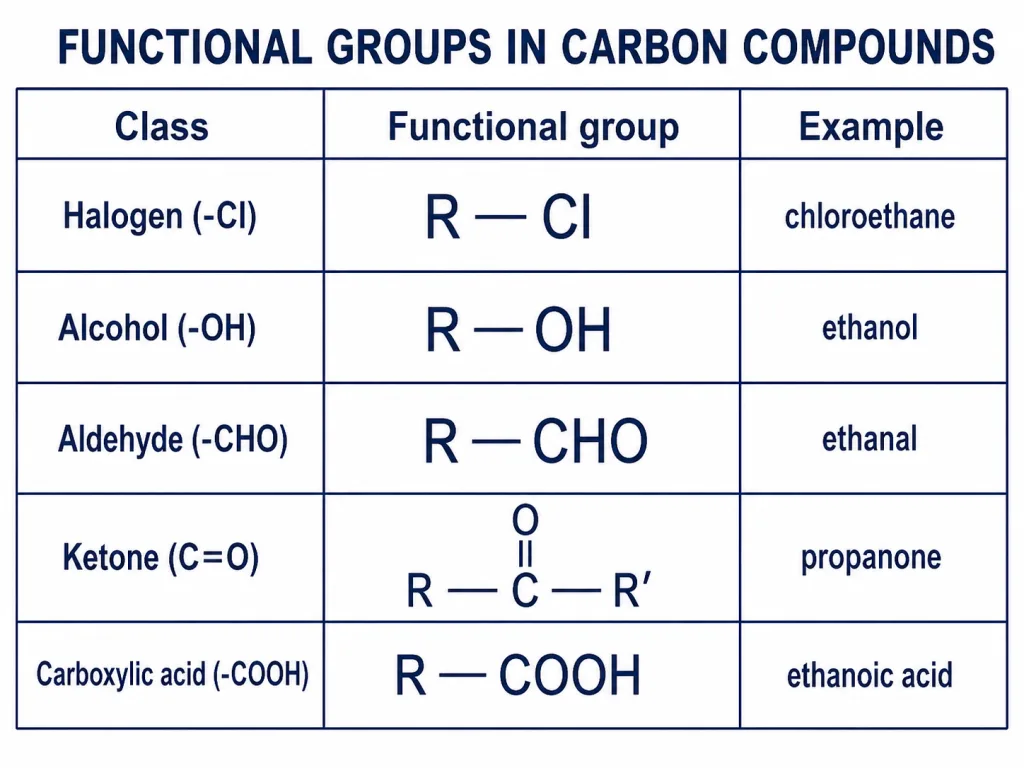
Summary Table — Common Functional Groups
Memorise this table — fundamental for organic chemistry!
| Functional Group | Symbol | Class | Suffix (IUPAC) | Example |
|---|---|---|---|---|
| Halogen | -F, -Cl, -Br, -I | Haloalkane | -halo (prefix) | CH₃Cl |
| Alcohol | -OH | Alcohols | -ol | CH₃OH |
| Aldehyde | -CHO | Aldehydes | -al | HCHO |
| Ketone | >C=O | Ketones | -one | CH₃COCH₃ |
| Carboxylic acid | -COOH | Carboxylic acids | -oic acid | HCOOH |
| Double bond | C=C | Alkenes | -ene | CH₂=CH₂ |
| Triple bond | C≡C | Alkynes | -yne | HC≡CH |
Also (advanced — for reference):
| Functional Group | Symbol | Class | Example |
|---|---|---|---|
| Ether | -O- | Ethers | CH₃-O-CH₃ |
| Ester | -COO- | Esters | CH₃COOC₂H₅ |
| Amine | -NH₂ | Amines | CH₃NH₂ |
| Amide | -CONH₂ | Amides | CH₃CONH₂ |
Drawing the Structure
Each functional group has a specific bond arrangement:
Alcohol (—OH):
R — O — H
OH directly on C.
Aldehyde (—CHO):
       O
       ||
R — C — H
C=O at the end of chain, H attached to that C.
Ketone (>C=O):
       O
       ||
R — C — R'
C=O in the middle of chain.
Carboxylic acid (—COOH):
       O
       ||
R — C — O — H
C=O + OH together.
How Functional Groups Affect Properties
Alcohols:
- Polar (—OH).
- Form hydrogen bonds.
- Higher b.p. than corresponding alkane.
- Soluble in water (small ones).
Carboxylic Acids:
- Most polar (—COOH).
- Strong hydrogen bonding.
- Acidic (gives H⁺).
- Highly soluble in water (small ones).
Ketones, Aldehydes:
- Polar but no H on the C=O.
- Less hydrogen bonding than alcohols/acids.
- Some solubility in water.
Halogens (—X):
- Slightly polar.
- Higher density than water.
- Generally toxic.
Comparing Boiling Points (Same Carbon Count)
| Compound | B.P. |
|---|---|
| Ethane (C₂H₆) | -89°C |
| Ethanol (C₂H₅OH) | 78°C |
| Acetic acid (CH₃COOH) | 118°C |
Even though all have 2 C atoms:
- Ethane: no polar group → very low b.p.
- Ethanol: —OH polar → much higher b.p.
- Acetic acid: —COOH most polar → highest b.p.
Functional groups dramatically change properties!
Homologous Series
A 'family' of organic compounds with the same functional group but different number of C atoms.
Definition
Homologous Series: A series of compounds with:
- Same functional group.
- Same general formula.
- Successive members differ by CH₂ (or 14 amu).
- Similar chemical properties.
- Gradually changing physical properties.
'Homologous' = similar (Greek: 'homo' = same). Members of a homologous series are called 'homologues'.
Why Homologous Series?
Carbon's catenation allows us to:
- Add CH₂ groups one by one to make longer chains.
- Each new compound = previous + CH₂.
- Same functional group → similar chemistry.
- Different chain length → different physical properties.
Example 1: Alkanes
General formula: .
| n | Compound | Formula | B.P. (°C) |
|---|---|---|---|
| 1 | Methane | CH₄ | -161 |
| 2 | Ethane | C₂H₆ | -89 |
| 3 | Propane | C₃H₈ | -42 |
| 4 | Butane | C₄H₁₀ | -1 |
| 5 | Pentane | C₅H₁₂ | 36 |
| 6 | Hexane | C₆H₁₄ | 69 |
Each member differs from the next by CH₂ (14 amu).
Pattern: as n increases, b.p. increases.
Example 2: Alcohols
General formula: .
| n | Compound | Formula | B.P. (°C) |
|---|---|---|---|
| 1 | Methanol | CH₃OH | 65 |
| 2 | Ethanol | C₂H₅OH | 78 |
| 3 | Propanol | C₃H₇OH | 97 |
| 4 | Butanol | C₄H₉OH | 118 |
| 5 | Pentanol | C₅H₁₁OH | 138 |
Each differs by CH₂.
Example 3: Carboxylic Acids
General formula: or .
| n | Compound | Formula | B.P. (°C) |
|---|---|---|---|
| 0 | Formic acid | HCOOH | 101 |
| 1 | Acetic acid | CH₃COOH | 118 |
| 2 | Propanoic acid | C₂H₅COOH | 141 |
| 3 | Butanoic acid | C₃H₇COOH | 164 |
Properties of Homologous Series
1. Same general formula. Members fit a single formula.
2. Successive members differ by CH₂ (or 14 amu). If one is C₂H₆, next is C₃H₈, then C₄H₁₀.
3. Same functional group. All alkanes have only C-C single bonds. All alcohols have -OH. All acids have -COOH.
4. Similar chemical properties. All members react similarly (same functional group). All alcohols + Na → produce H₂. All acids react with bases.
5. Gradual change in physical properties. Boiling point increases steadily. Density changes gradually. Solubility decreases as size increases.
This makes the series predictable and useful.
Why is This Useful?
Knowing one member of a series, we can predict properties of others:
- Same chemistry.
- Similar reactions.
- Just slightly different physical properties.
Saves enormous study time. Helps in industry to predict behaviour of new compounds.
All Common Homologous Series — At a Glance
1. Alkanes
Saturated hydrocarbons (single bonds only). General formula: . Suffix: -ane.
Members: methane, ethane, propane, butane, pentane…
2. Alkenes
Unsaturated hydrocarbons with 1 double bond. General formula: (n ≥ 2). Suffix: -ene.
Members: ethene, propene, butene, pentene…
3. Alkynes
Unsaturated hydrocarbons with 1 triple bond. General formula: (n ≥ 2). Suffix: -yne.
Members: ethyne, propyne, butyne, pentyne…
4. Alcohols
Have -OH functional group. General formula: . Suffix: -ol.
Members: methanol, ethanol, propanol, butanol…
5. Aldehydes
Have -CHO functional group. General formula: or (depending on counting). Suffix: -al.
Members: methanal (HCHO), ethanal (CH₃CHO), propanal…
6. Ketones
Have >C=O group (with C atoms on both sides). General formula: (similar to aldehydes). Suffix: -one.
Members: propanone (acetone), butanone, pentanone…
7. Carboxylic Acids
Have -COOH group. General formula: or . Suffix: -oic acid.
Members: formic acid, acetic acid, propanoic acid…
8. Halogenoalkanes
Have -X group (X = F, Cl, Br, I). General formula: .
Members: chloromethane, bromomethane…
Example Comparison — All 'Eth' Compounds
Compounds with 2 C atoms but different functional groups:
| Compound | Formula | Functional Group | B.P. (°C) |
|---|---|---|---|
| Ethane | C₂H₆ | None (alkane) | -89 |
| Ethene | C₂H₄ | C=C (alkene) | -104 |
| Ethyne | C₂H₂ | C≡C (alkyne) | -84 |
| Ethanol | C₂H₅OH | -OH (alcohol) | 78 |
| Ethanal | CH₃CHO | -CHO (aldehyde) | 21 |
| Acetic acid | CH₃COOH | -COOH (carboxylic acid) | 118 |
| Chloroethane | C₂H₅Cl | -Cl (halogen) | 12 |
Same C count, different functional groups → very different compounds!
A Beautiful Pattern
Each homologous series:
- Starts with a simple member.
- Adds CH₂ to make next member.
- Each addition increases:
- Molecular mass (by 14).
- Boiling point (by ~20-30°C usually).
- Density (slightly).
- All members do similar reactions.
This is the organising principle of organic chemistry.
How Functional Groups Determine Properties
Compounds Without Functional Groups
Pure hydrocarbons (alkanes, alkenes, alkynes):
- Generally non-polar.
- Insoluble in water.
- Lower boiling points.
- Less reactive (alkanes especially).
Adding Polar Groups
Adding -OH, -COOH, -NH₂, -CHO etc.:
- Makes molecule more polar.
- Increases water solubility.
- Raises boiling point.
- Makes compound more reactive.
Hydrogen Bonding
-OH and -COOH groups can form hydrogen bonds with water and other -OH/-COOH groups. This is why:
- Ethanol soluble in water (forms H-bonds).
- Acetic acid soluble in water.
- These compounds have higher b.p. than expected.
Trend in Boiling Points
For 2-carbon compounds:
| Compound | B.P. (°C) | Why |
|---|---|---|
| Ethane | -89 | Non-polar, weak forces |
| Ethene | -104 | Non-polar, similar forces |
| Chloroethane | 12 | Polar (slight), some forces |
| Ethanal | 21 | Polar (C=O), no H-bonding |
| Ethanol | 78 | Strong H-bonding |
| Acetic acid | 118 | Strongest H-bonding |
Note: not always perfectly ordered — depends on multiple factors.
Acidity
Different functional groups give different acid strength:
| Compound | pKa (lower = stronger) |
|---|---|
| Methane | ~50 (not acidic) |
| Ethanol | 16 (very weak) |
| Acetic acid | 4.76 (weak acid) |
| Sulphuric acid | -3 (very strong) |
Carboxylic acids — weakly acidic. Alcohols — very weakly acidic (essentially neutral).
Important Reactions of Functional Groups
Alcohols:
- Combustion: burn in air to give CO₂ + H₂O.
- With Na: react to give H₂ gas.
- Oxidation: gives aldehydes, then acids.
- Esterification: with acids to form esters (perfumes!).
Carboxylic Acids:
- With base: neutralise → salt + water.
- With alcohol: esterification → ester.
- With metal: react to give H₂.
Aldehydes/Ketones:
- Oxidation: aldehydes → acids; ketones don't oxidise easily.
- Reduction: both → alcohols.
Halogens (Haloalkanes):
- Substitution: halogen replaced by other groups.
- Used to make many other compounds.
Why This Matters in Daily Life
Functional groups define the behaviour of:
- Drinking alcohol (ethanol, -OH group).
- Vinegar (acetic acid, -COOH).
- Sugar (multiple -OH groups).
- Anesthetics (often have specific functional groups).
- Plastics, dyes, perfumes — all defined by functional groups.
Understanding functional groups = understanding most of organic chemistry.
🧠 Memory Capsule
A quick glance just before the board exam.
1. Functional Group — Definition
Atom or group of atoms that determines the chemical properties of a compound.
2. Common Functional Groups
| Group | Symbol | Class |
|---|---|---|
| Halogen | -Cl, -Br | Haloalkane |
| Alcohol | -OH | Alcohol (-ol) |
| Aldehyde | -CHO | Aldehyde (-al) |
| Ketone | >C=O | Ketone (-one) |
| Acid | -COOH | Carboxylic acid (-oic acid) |
3. Examples of Each
Alcohol:
- Methanol (CH₃OH)
- Ethanol (C₂H₅OH)
Aldehyde:
- Methanal/Formaldehyde (HCHO)
- Ethanal/Acetaldehyde (CH₃CHO)
Ketone:
- Propanone/Acetone ((CH₃)₂CO)
Carboxylic acid:
- Methanoic/Formic acid (HCOOH)
- Ethanoic/Acetic acid (CH₃COOH)
4. Homologous Series — Definition
A 'family' of organic compounds with:
- Same functional group.
- Same general formula.
- Differ by CH₂ between members.
- Similar chemistry, gradually changing physical properties.
5. Common Homologous Series
| Series | Formula | Suffix |
|---|---|---|
| Alkane | -ane | |
| Alkene | -ene | |
| Alkyne | -yne | |
| Alcohol | -ol | |
| Aldehyde | -al | |
| Ketone | -one | |
| Acid | -oic acid |
6. Common Properties of Homologous Series
- Same general formula.
- Each member differs by CH₂.
- Same functional group → similar reactions.
- Gradual change in physical properties.
7. Boiling Point Order (2-C compounds)
Acetic acid (118) > Ethanol (78) > Ethanal (21) > Chloroethane (12) > Ethane (-89)
Reason: stronger functional group polarity → stronger intermolecular forces → higher b.p.
8. Board's 'Golden' Questions
- Define functional group with example.
- List 5 functional groups with their structures.
- What is homologous series? Properties.
- Why ethanol has higher b.p. than ethane?
- Compare alcohols, aldehydes, acids.
Final Formula: Functional group decides chemistry; homologous series organises by chain length.
Solved Examples
Example 1: NCERT — What is a Functional Group?
Define functional group. Give 5 examples with their structures.
Solution:
Definition
'Functional Group' = an atom or group of atoms attached to a hydrocarbon chain that determines the chemical properties of the compound.
The 'function' = the chemistry it brings.
Two compounds with same C-H skeleton but different functional groups have very different properties.
5 Important Functional Groups
1. Hydroxyl Group (—OH) — Alcohols
Structure: R-O-H
Example: Methanol (CH₃-OH)
    H
    |
H — C — O — H
    |
    H
Properties:
- Polar.
- Forms hydrogen bonds.
- Soluble in water (small ones).
2. Aldehyde Group (—CHO)
Structure: R-C(=O)-H
Example: Methanal/Formaldehyde (HCHO)
         O
         ||
    H — C — H
Properties:
- Sharp pungent smell.
- Reactive.
- Used in preserving.
3. Ketone Group (>C=O)
Structure: R-C(=O)-R'
Example: Propanone/Acetone ((CH₃)₂C=O)
         O
         ||
CH₃ — C — CH₃
Properties:
- Polar.
- Used as solvents.
4. Carboxylic Acid Group (—COOH)
Structure: R-COOH
Example: Acetic acid (CH₃COOH)
         O
         ||
CH₃ — C — O — H
Properties:
- Acidic (gives H⁺).
- Sour taste.
- Highly polar.
5. Halogen Group (—X)
X = F, Cl, Br, I.
Example: Chloromethane (CH₃Cl)
    H
    |
H — C — Cl
    |
    H
Properties:
- Slightly polar.
- Often toxic.
- Used as solvents, refrigerants.
Why Functional Groups Matter
Comparing 2-carbon compounds:
| Compound | Functional Group | Boiling Point |
|---|---|---|
| Ethane | None | -89°C |
| Ethanol | -OH | 78°C |
| Acetic acid | -COOH | 118°C |
Same C count, different functional groups → very different properties!
This is why functional groups are central to organic chemistry — they define what a compound 'does'.
[NCERT — important]
Example 2: NCERT — Homologous Series
What is a homologous series? Explain with the example of alkanes.
Solution:
Definition
'Homologous Series' = a series of organic compounds with:
- Same functional group.
- Same general formula.
- Successive members differ by CH₂ (14 amu).
- Similar chemical properties.
- Gradually changing physical properties.
From Greek: 'homo' = same. Members are called 'homologues'.
Example: Alkanes
General formula:
All alkanes have:
- Only C-C single bonds.
- Only C-H single bonds.
- Same general formula.
- Similar chemistry.
First 6 Alkanes
| n | Compound | Formula | M.W. | B.P. (°C) |
|---|---|---|---|---|
| 1 | Methane | CH₄ | 16 | -161 |
| 2 | Ethane | C₂H₆ | 30 | -89 |
| 3 | Propane | C₃H₈ | 44 | -42 |
| 4 | Butane | C₄H₁₀ | 58 | -1 |
| 5 | Pentane | C₅H₁₂ | 72 | 36 |
| 6 | Hexane | C₆H₁₄ | 86 | 69 |
Properties of Homologous Series (Verified)
1. Same general formula: ✓ All match .
2. Successive members differ by CH₂:
- Ethane - Methane: C₂H₆ - CH₄ = CH₂ ✓
- Propane - Ethane: C₃H₈ - C₂H₆ = CH₂ ✓
- Each pair differs by CH₂ (= 14 amu).
3. Same functional group: ✓ All single bonds (C-C and C-H).
4. Similar chemical properties:
- All burn in oxygen → CO₂ + H₂O.
- All undergo substitution with halogens (under UV).
- All react similarly.
5. Gradual change in physical properties:
- B.P. increases steadily as n increases.
- Density increases gradually.
- State changes: gas (n=1-4) → liquid (n=5-17) → solid (n>17).
Why is the Series Useful?
Knowing alkanes:
- We can predict properties of new (unknown) alkanes.
- We know their reactions.
- We can plan industrial uses.
Example: If we discover a new alkane C₂₀H₄₂:
- We can predict it will be a solid at room temperature.
- It will burn cleanly.
- It won't react easily with other chemicals.
This predictive power makes homologous series fundamental to organic chemistry.
Other Homologous Series
Same principle applies to:
- Alkenes, alkynes (other hydrocarbons).
- Alcohols, aldehydes, acids (functional groups).
- Each forms a series with its own characteristic chemistry.
Around 30 different homologous series exist — each a 'family' of related compounds.
[NCERT — every year]
Example 3: NCERT — Compare Two Compounds
Compare ethanol (C₂H₅OH) and ethane (C₂H₆). Explain why their properties differ.
Solution:
The Two Compounds
Ethane (C₂H₆)
Saturated hydrocarbon (alkane). No functional group beyond C-H and C-C bonds.
Structure:
CH₃ — CH₃
Ethanol (C₂H₅OH)
Has -OH functional group (alcohol).
Structure:
CH₃ — CH₂ — OH
Comparison Table
| Property | Ethane | Ethanol |
|---|---|---|
| Formula | C₂H₆ | C₂H₅OH (or C₂H₆O) |
| Functional Group | None | -OH (hydroxyl) |
| State at 25°C | Gas | Liquid |
| Boiling Point | -89°C | 78°C |
| Solubility in water | Insoluble | Highly soluble |
| Reaction with Na | None | Reacts → H₂ + sodium ethoxide |
| Smell | Almost none | Distinctive (alcoholic) |
Why Such Different Properties?
Both have 2 C atoms. Yet very different properties!
Reason 1: Polarity
Ethane:
- Only C-H and C-C bonds.
- Non-polar molecule.
- Weak intermolecular forces (only van der Waals).
Ethanol:
- Has —OH group.
- O is more electronegative than H → polar O-H bond.
- Polar molecule.
- Stronger intermolecular forces.
Reason 2: Hydrogen Bonding
Ethane: No H-bonding possible (no electronegative atoms with H).
Ethanol:
- O-H can form H-bond with another O-H.
- Strong intermolecular bonds.
- Like a 'sticky' molecule.
Reason 3: Effect on Properties
Higher polarity + H-bonding =
- Higher b.p. (78°C vs -89°C — 167°C difference!).
- Liquid at room temperature (instead of gas).
- Soluble in water (forms H-bonds with water).
- Reactive with Na (acidic H of -OH).
Key Insight
Adding a single -OH group to ethane:
- Drastically changes physical properties.
- Adds new chemical behaviour.
- Makes the compound have a 'function' it didn't have before.
This is what 'functional group' means — it gives the compound a new function.
Why is this Important?
This shows the power of functional groups:
Same C-H backbone, but:
- Add -OH → alcohol (drinks, fuel, solvent).
- Add -COOH → acid (vinegar, biological molecules).
- Add -CHO → aldehyde (preservative, chemical).
- Add -Cl → haloalkane (refrigerant, anaesthetic).
Each functional group → completely different compound!
This is why organic chemistry has millions of compounds despite using only a few elements (C, H, O, N, S, halogens).
[NCERT — important]
Example 4: NCERT — Identify Functional Groups
Identify the functional group in each of the following: (a) CH₃Cl (b) C₂H₅OH (c) HCHO (d) CH₃COOH (e) CH₂=CH-CH₃
Solution:
Analysis
(a) CH₃Cl
Has chlorine (Cl) attached to carbon.
Functional Group: -Cl (halogen / halide) Class: Haloalkane (chloroalkane). Name: Methyl chloride / chloromethane.
(b) C₂H₅OH
Has -OH (hydroxyl) group attached to ethyl chain.
Functional Group: -OH (hydroxyl, alcohol) Class: Alcohol. Name: Ethanol / ethyl alcohol.
Structure: CH₃-CH₂-OH
(c) HCHO
Has -CHO group (C=O with H attached).
Functional Group: -CHO (aldehyde) Class: Aldehyde. Name: Formaldehyde / methanal.
Structure:
         O
         ||
    H — C — H
(d) CH₃COOH
Has -COOH group (carboxylic acid).
Functional Group: -COOH (carboxylic acid / carboxyl) Class: Carboxylic acid. Name: Acetic acid / ethanoic acid.
Structure:
         O
         ||
CH₃ — C — O — H
(e) CH₂=CH-CH₃
Has C=C double bond.
Functional Group: C=C (double bond) Class: Alkene. Name: Propene (or prop-1-ene).
Summary Table
| Compound | Functional Group | Class | Name |
|---|---|---|---|
| CH₃Cl | -Cl | Haloalkane | Chloromethane |
| C₂H₅OH | -OH | Alcohol | Ethanol |
| HCHO | -CHO | Aldehyde | Methanal/Formaldehyde |
| CH₃COOH | -COOH | Carboxylic acid | Acetic acid/Ethanoic acid |
| CH₂=CHCH₃ | C=C | Alkene | Propene |
How to Identify Functional Groups
Practice steps:
1. Look for special atoms (O, N, S, halogens). 2. Look for double/triple bonds. 3. Look for groups like:
- -OH (alcohol)
- -CHO (aldehyde)
- -COOH (acid)
- -O- (ether, between Cs)
- -X (halogen)
4. If only C-H, C-C single bonds → alkane (no functional group). 5. If C=C → alkene; C≡C → alkyne.
Practical Importance
Identifying functional groups helps us:
- Predict chemical behaviour.
- Plan reactions.
- Identify unknown compounds.
- Design new molecules (medicines, materials).
[Board: 3-mark]
Example 5: NCERT — Properties of Homologous Series
State 4 properties of a homologous series with examples.
Solution:
Property 1: Same General Formula
All members of a homologous series fit a single general formula.
Example: Alkanes General formula:
Members:
- CH₄ (n=1)
- C₂H₆ (n=2)
- C₃H₈ (n=3)
- C₄H₁₀ (n=4)
Each fits the formula.
Property 2: Successive Members Differ by CH₂
Each next member adds CH₂ (14 amu) to the previous.
Example:
- C₂H₆ - CH₄ = CH₂ (14 amu) ✓
- C₃H₈ - C₂H₆ = CH₂ ✓
- C₄H₁₀ - C₃H₈ = CH₂ ✓
This is true for all homologous series:
- Alcohols: CH₃OH → C₂H₅OH adds CH₂.
- Aldehydes: HCHO → CH₃CHO adds CH₂.
- Acids: HCOOH → CH₃COOH adds CH₂.
Property 3: Similar Chemical Properties
All members of a series react similarly because of the same functional group.
Example: All alcohols react with sodium:
Whether R = methyl, ethyl, propyl, butyl… the reaction is the same.
All acids neutralise bases:
All alkanes burn:
Property 4: Gradual Change in Physical Properties
Boiling point, melting point, density change steadily.
Example: Boiling Points of Alcohols
| Compound | Formula | B.P. (°C) |
|---|---|---|
| Methanol | CH₃OH | 65 |
| Ethanol | C₂H₅OH | 78 |
| Propanol | C₃H₇OH | 97 |
| Butanol | C₄H₉OH | 118 |
| Pentanol | C₅H₁₁OH | 138 |
Pattern: each higher member has higher b.p. (~20°C higher each time).
Why? Larger molecule → more intermolecular forces → higher b.p.
Why This Pattern?
All members:
- Have same functional group → same chemistry.
- Larger molecule → stronger intermolecular forces (just from increased mass).
- Hence physical properties change gradually.
Practical Significance
This pattern helps:
1. Predict properties of unknown compounds. If we know methanol b.p. = 65°C, ethanol = 78°C, then propanol = ~97°C (close to actual).
2. Design experiments. Knowing the trend, we can plan separations and reactions.
3. Industrial decisions. Choose the right member of a series for a specific application.
Example: choosing an alcohol for a specific b.p. window in distillation.
Summary
Homologous series properties:
- Same general formula.
- Differ by CH₂.
- Similar chemistry.
- Gradual physical property changes.
This 'family' approach is the organising principle of organic chemistry — it brings order to a vast field.
[NCERT — important]
Example 6: NCERT — Why Are Carboxylic Acids Acidic?
Explain why carboxylic acids (like acetic acid) are weakly acidic, while alcohols are not.
Solution:
What Makes a Compound Acidic?
A compound is acidic if it can release H⁺ ions (Brønsted definition).
The H⁺ comes from a polar bond, usually H-O.
Carboxylic Acid (-COOH)
Structure:
       O
       ||
R — C — O — H
The -COOH group has:
- C=O double bond (strong attraction).
- Adjacent -O-H bond.
Why acidic:
- The C=O 'pulls' electrons away from O-H.
- O-H bond is weakened.
- H can be released as H⁺.
- Resulting carboxylate ion (R-COO⁻) is stabilised by spreading negative charge across both O atoms (resonance).
Example:
pKa ≈ 4.76 — weakly acidic.
Alcohol (-OH)
Structure:
R — O — H
Just an -OH group, no nearby C=O.
Why NOT acidic:
- O-H bond is strong (not weakened by anything).
- Releasing H⁺ would leave R-O⁻ (alkoxide).
- R-O⁻ is unstable — negative charge concentrated on one O.
- Hence H is not released easily.
pKa ≈ 16 (very weakly acidic, essentially neutral).
Comparison
| Compound | pKa | Acid Strength |
|---|---|---|
| Methane (no OH) | ~50 | Not acidic |
| Ethanol (alcohol) | 16 | Very weak |
| Acetic acid | 4.76 | Weak |
| HCl | -7 | Strong |
Lower pKa = stronger acid.
Acetic acid is about 10¹¹ times more acidic than ethanol!
The Key — Resonance Stabilisation
Why does -COOH lose H⁺ easily?
After losing H⁺, the -COO⁻ ion has negative charge spread across two equivalent O atoms:
O ⁻       O ⁻
||   ↔    |
C         C
|         ||
O⁻        O
This is resonance — the charge is delocalised. Stable structure → easier to lose H⁺.
Alcohols can't do this:
C — O⁻
Negative charge stuck on one O → unstable → H⁺ not released easily.
Practical Implications
Why acetic acid (vinegar) tastes sour:
- Releases H⁺ → activates sour-taste receptors on tongue.
Why acetic acid + base = neutralisation:
Why ethanol (drinking alcohol) doesn't taste sour:
- No H⁺ release.
- No sour activation.
- Ethanol is not an acid in everyday sense.
Other Carboxylic Acids
All carboxylic acids are weakly acidic:
- Formic acid (HCOOH): in ant stings.
- Acetic acid (CH₃COOH): in vinegar.
- Citric acid (C₆H₈O₇): in lemons (3 -COOH groups!).
- Lactic acid: in sour milk and tired muscles.
- Amino acids: in proteins.
Summary
The functional group determines acidity:
- -COOH: releases H⁺ (carboxylate stabilised by resonance).
- -OH alcohol: does NOT release H⁺ easily (alkoxide unstable).
This is one example of how functional groups define chemical behaviour.
[NCERT + Board]
Example 7: A Concluding Question
(a) Define functional group. (b) Define homologous series. (c) Write 5 important functional groups with suffixes. (d) Why does ethanol have higher b.p. than ethane?
Solution:
(a) Functional Group
'Functional Group' = an atom or group of atoms attached to a hydrocarbon chain that determines the chemical properties of the compound.
Examples:
- -OH (alcohol) — gives compound 'alcoholic' properties.
- -COOH (carboxylic acid) — gives 'acidic' properties.
- -CHO (aldehyde) — gives 'aldehyde' properties.
Two compounds with same hydrocarbon part but different functional groups have different chemistry.
(b) Homologous Series
'Homologous Series' = a 'family' of organic compounds with:
1. Same functional group. 2. Same general formula. 3. Successive members differ by CH₂ (14 amu). 4. Similar chemical properties. 5. Gradually changing physical properties.
Example: Alkane series — methane, ethane, propane, butane…
All have only C-C and C-H single bonds. Each adds one CH₂ to the previous. All burn similarly in O₂. B.P. increases gradually.
(c) 5 Important Functional Groups with Suffixes
| Group | Symbol | Class | Suffix |
|---|---|---|---|
| 1. Hydroxyl | -OH | Alcohol | -ol |
| 2. Aldehyde | -CHO | Aldehyde | -al |
| 3. Ketone | >C=O | Ketone | -one |
| 4. Carboxyl | -COOH | Carboxylic acid | -oic acid |
| 5. Halogen | -X (Cl, Br, I, F) | Haloalkane | -halo (prefix) |
Examples:
- Ethanol: C₂H₅-OH (suffix '-ol' from -OH).
- Methanal: H-CHO (suffix '-al' from -CHO).
- Propanone: CH₃-CO-CH₃ (suffix '-one' from C=O).
- Ethanoic acid: CH₃-COOH (suffix '-oic acid' from -COOH).
- Chloromethane: Cl-CH₃ (prefix 'chloro' from -Cl).
(d) Why Ethanol's B.P. > Ethane's B.P.?
Ethane (C₂H₆)
- Boiling point: -89°C.
- Non-polar molecule.
- Only weak van der Waals forces between molecules.
Ethanol (C₂H₅OH)
- Boiling point: 78°C.
- Polar molecule (due to -OH).
- Forms hydrogen bonds between molecules.
The Reason
Hydrogen bonding makes ethanol molecules stick together strongly:
C₂H₅-O-H  ⋯  H-O-C₂H₅
     ↑
  Hydrogen bond
Each ethanol molecule can form H-bonds with multiple others. This forms a network that's hard to break.
To boil ethanol:
- Need to overcome H-bonds.
- Requires much more energy than just van der Waals.
- Hence high b.p. (78°C).
To boil ethane:
- Only weak van der Waals to break.
- Much less energy.
- Hence low b.p. (-89°C).
Quantitative Difference
Difference in b.p.: 78 - (-89) = 167°C!
Just adding -OH to a C₂H₅ chain increases b.p. by 167°C.
This is the power of functional groups.
Implications
This explains:
1. Why ethanol is liquid at room temperature (b.p. above 25°C). Useful as a drink, fuel, solvent.
2. Why ethane is a gas (b.p. below -25°C). Used as fuel in compressed form.
3. Why we can drink ethanol (not ethane). Ethanol is liquid → can be in beverages. Ethane is gas → can't be in beverages.
4. Industrial significance. Methanol (b.p. 65°C) is also liquid. Industrial uses depend on phase at room temperature.
Summary
Functional groups + homologous series = the organising framework of organic chemistry.
Understanding these:
- Predict properties of millions of compounds.
- Plan reactions efficiently.
- Design new molecules (drugs, materials).
This is why every organic chemistry student must master these concepts.
[Board: 5-mark mixed]