
Chemical Reactions of Carbon Compounds
Now we move from learning about structures to how carbon compounds react.
Key reactions covered in Class 10:
- Combustion — burning in oxygen.
- Oxidation — adding oxygen / losing hydrogen.
- Addition reactions — adding atoms across a multiple bond.
- Substitution reactions — replacing one atom with another.
Why Are These Important?
Carbon compounds undergo specific reactions based on their:
- Functional groups.
- Type of bonds (single, double, triple).
- Conditions (heat, light, catalysts).
Knowing reactions helps us:
- Make new compounds (industry).
- Use them efficiently (fuels, drugs, materials).
- Understand life processes (biochemistry).
1. Combustion
The most important reaction of organic compounds.
Definition
'Combustion' = the rapid reaction of a substance with oxygen, releasing heat and light (flame).
All carbon compounds burn in oxygen.
General Reaction
Hydrocarbon + O₂ → CO₂ + H₂O + heat
Examples
Methane:
Ethanol:
Acetic acid:
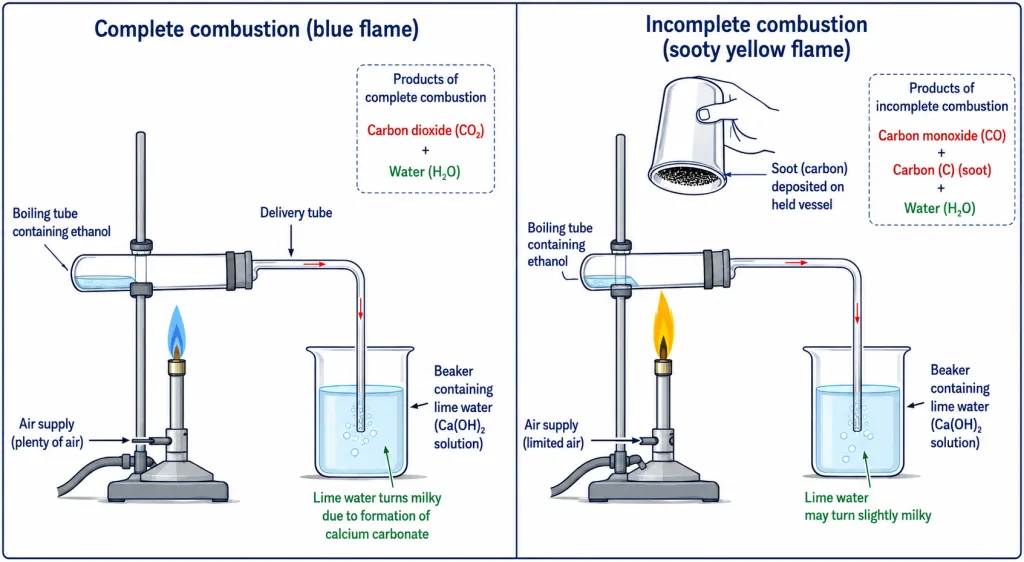
Complete vs Incomplete Combustion
Complete Combustion
Plenty of oxygen → CO₂ + H₂O. Clean blue flame. Maximum heat released.
Example: gas stove with proper air supply.
Incomplete Combustion
Insufficient oxygen → CO + H₂O + soot (carbon). Yellow/sooty flame. Less heat released. Produces poisonous CO.
Example: gas stove with restricted air.
Reaction (Incomplete):
Why Saturated vs Unsaturated Burn Differently
Saturated (alkanes):
- More H per C.
- Burn cleanly with blue flame.
- Less soot.
- Used as good fuels.
Unsaturated (alkenes, alkynes):
- Less H per C.
- Burn with yellow/sooty flame.
- More soot (incomplete combustion).
- Need more O₂.
Why It Matters
Understanding combustion:
- Choose right fuels (LPG, CNG, natural gas).
- Design efficient engines.
- Avoid CO poisoning.
- Reduce pollution.
2. Oxidation
'Oxidation' = adding oxygen OR losing hydrogen.
Different from combustion — oxidation can be controlled and partial.
Oxidation of Alcohols
Alcohols can be oxidised to acids using oxidising agents.
Mild Oxidation (Step 1)
Alcohol → Aldehyde
Example:
Strong Oxidation (Step 2)
Alcohol → Acid (skipping aldehyde, or going through it)
Example:
Common Oxidising Agents
Used to oxidise alcohols and aldehydes:
1. Acidified KMnO₄ (potassium permanganate):
- Purple solution.
- Decolourises during oxidation.
- Strong oxidiser.
2. Acidified K₂Cr₂O₇ (potassium dichromate):
- Orange solution.
- Turns green during oxidation.
- Strong oxidiser.
3. Alkaline KMnO₄:
- For mild oxidation.
Reaction with KMnO₄:
[O] indicates oxygen from oxidising agent.
A Famous Reaction — Wine Souring
Wine = solution of ethanol in water. Ethanol + O₂ (from air) → acetic acid (using bacteria as catalyst).
This is why wine 'turns to vinegar' — ethanol is slowly oxidised to acetic acid.
Industrial Significance
Vinegar Production
Industrial process: ethanol + O₂ → acetic acid (vinegar). Uses bacteria as catalyst. Worldwide production: millions of tonnes annually.
Aldehyde to Acid
Aldehydes are intermediates. Easily oxidised to acids. Acetaldehyde → acetic acid (industrial route).
Body Metabolism
Our bodies oxidise alcohol to acid:
- Ethanol (drink) → acetaldehyde → acetic acid → CO₂ + H₂O.
- Liver enzymes do this.
- Hangover symptoms come from acetaldehyde (toxic intermediate).
Oxidation State Changes
During oxidation:
- Alcohol carbon: C with -OH = lower oxidation state.
- Acid carbon: C with -COOH = higher oxidation state.
Each oxidation step adds an oxygen or removes a hydrogen.
Why Functional Groups Matter Here
Different functional groups oxidise differently:
| Functional Group | Oxidation Behaviour |
|---|---|
| Alcohol (-OH) | → Aldehyde → Acid |
| Aldehyde (-CHO) | → Acid |
| Ketone (>C=O) | Generally not oxidised easily |
| Acid (-COOH) | Maximum oxidation state (mostly) |
Alcohols are 'starting points' for many oxidation reactions.
Practical Significance
1. Industrial chemistry:
- Making acids from alcohols (e.g., vinegar).
- Pharmaceutical manufacturing.
2. Biology:
- Body metabolism of alcohols.
- Many natural processes involve oxidation.
3. Lab tests:
- KMnO₄/K₂Cr₂O₇ tests for alcohols and aldehydes.
- Distinguishing between functional groups.
3. Addition Reactions
'Addition reaction' = atoms from one molecule are added across a multiple bond (double or triple).
Characteristic of unsaturated compounds (alkenes, alkynes).
General Pattern
The double bond breaks; A and B add to either side.
Hydrogenation — Most Important
'Hydrogenation' = adding hydrogen across a double or triple bond.
Catalyst: Nickel (Ni), Platinum (Pt), or Palladium (Pd).
Example: Ethene + H₂
Ethene → Ethane.
Example: Ethyne + 2H₂
Ethyne → Ethane.
Triple bond can take 2 H₂ molecules → fully saturated.
Industrial Use — Hydrogenation of Vegetable Oils
Vegetable oils have C=C double bonds (unsaturated fats). Hydrogenation converts them to saturated fats (no C=C).
Why?
- Saturated fats are solids at room temperature.
- Easier to store, transport.
- Longer shelf life.
Example:
Vanaspati ghee = hydrogenated vegetable oil. Margarine = similar process.
Health Concerns of Hydrogenation
Hydrogenation also creates trans fats (a type of unhealthy fat).
Trans fats:
- Raise bad cholesterol (LDL).
- Lower good cholesterol (HDL).
- Linked to heart disease.
Many countries are now restricting trans fats in food.
Modern guidance:
- Use natural unsaturated oils (mustard, sunflower, olive).
- Avoid heavily-hydrogenated 'vanaspati' or 'shortening'.
Other Addition Reactions
Addition of Halogens
This is the basis of the bromine water test.
Addition of Hydrogen Halides
Addition of Water
Industrial production of ethanol from ethene.
Why Addition Happens
Multiple bonds (double, triple) have 'extra' electrons (π electrons). These are reactive — easy targets for attack. New atoms add → multiple bond becomes single bond.
Significance
1. Industrial:
- Hydrogenation (vanaspati, margarine).
- Plastic production (polymerisation).
- Drug synthesis.
2. Biological:
- Vegetable oils — unsaturated, healthy.
- Saturated fats — less healthy.
- Unsaturated fatty acids (omega-3, etc.) essential nutrients.
3. Lab:
- Bromine water test for unsaturation.
- Identifying unknown compounds.
4. Substitution Reactions
'Substitution reaction' = an atom or group is replaced by another atom or group.
Characteristic of saturated compounds (alkanes).
General Pattern
R-H + X-Y → R-X + H-Y
Here, H is replaced by X.
Substitution in Alkanes
Alkanes are unreactive — they don't add (no double bonds to break). But they undergo substitution under specific conditions.
Reaction with Halogens (Photochemical)
Methane + chlorine → chloromethane + HCl (in sunlight).
Note: 'sunlight' or UV light is the catalyst — initiates the reaction.
Why UV needed?
- Cl-Cl bond breaks under UV.
- Free Cl• atoms attack methane.
- One H replaced by Cl.
Multiple Substitution
If excess Cl₂ is used, more H atoms can be replaced:
(dichloromethane)
(trichloromethane / chloroform)
(tetrachloromethane / carbon tetrachloride)
Substitution Products and Their Uses
| Compound | Common Name | Use |
|---|---|---|
| CH₃Cl | Methyl chloride | Refrigerant, solvent |
| CH₂Cl₂ | Dichloromethane (DCM) | Solvent, paint stripper |
| CHCl₃ | Chloroform | Anaesthetic (historic), solvent |
| CCl₄ | Carbon tetrachloride | Solvent, fire extinguisher (banned) |
Famous Substitution — CFCs
Carbon-Fluorine-Chlorine compounds. Made by substituting H with F and Cl in alkanes.
Examples: CFC-11 (CCl₃F), CFC-12 (CCl₂F₂).
Used as:
- Refrigerants (in fridges, AC).
- Aerosol propellants (spray cans).
- Foam blowing agents.
But CFCs damaged the ozone layer — banned in 1987 (Montreal Protocol). Replaced by HFCs (less harmful).
Reactivity Compared
Alkanes — substitution only:
- Need UV light or high temperature.
- Slow reaction.
- Multiple products possible.
Alkenes/Alkynes — addition (preferred):
- Fast, at room temperature.
- Single product.
- More controllable.
This is why alkanes are 'unreactive' fuels and alkenes/alkynes are 'reactive' raw materials.
Substitution vs Addition
| Property | Substitution | Addition |
|---|---|---|
| Bond type | Single bonds | Multiple bonds |
| Compound | Alkane | Alkene, Alkyne |
| Conditions | UV light, heat | Catalyst |
| Speed | Slow | Fast |
| Product | One H replaced | Atoms added across bond |
Practical Significance
1. Industrial:
- Production of CFCs, halocarbons.
- Plastic precursors.
- Drug synthesis.
2. Daily Life:
- Chloroform — used as anaesthetic historically.
- Solvents in paints, glues.
- Refrigerants.
3. Environment:
- CFCs harmful to ozone — banned.
- Replacing with safer compounds.
- Lesson: chemistry has consequences for environment.
Summary of Reactions — Key Patterns
Reactions Based on Compound Type
Alkanes (Saturated)
Less reactive. Few reaction types:
- Combustion (burns easily).
- Substitution (with halogens, under UV).
Alkenes (Double Bond)
Reactive — many reactions:
- Combustion (burns).
- Addition — H₂, X₂, HX, H₂O.
- Polymerisation (makes plastics).
Alkynes (Triple Bond)
Most reactive:
- Combustion (very hot flame).
- Addition — twice (2 molecules add).
- Acidic hydrogen (terminal alkynes).
Alcohols (-OH)
Several reactions:
- Combustion (burn cleanly).
- With Na → release H₂.
- Oxidation → aldehyde → acid.
- Esterification → ester (with acid).
- Dehydration → alkene.
Aldehydes (-CHO)
Reactive:
- Oxidation → acid (easy).
- Reduction → alcohol.
- Addition (less common).
Ketones (>C=O)
Less reactive than aldehydes:
- Reduction → alcohol.
- Generally don't oxidise easily.
Carboxylic Acids (-COOH)
Several reactions:
- With base → salt + water.
- With alcohol → ester (esterification).
- With metal → salt + H₂.
Key Reaction Examples — Summary
Combustion (general):
Hydrogenation (alkene/alkyne):
Bromination test (alkene):
Substitution (alkane):
Oxidation of alcohol:
Esterification:
Each is a 'tool' in the organic chemist's toolkit.
Why These Reactions Matter
In Industry:
- Polymerisation: makes plastics from alkenes.
- Hydrogenation: makes vanaspati from oils.
- Substitution: makes drugs, refrigerants.
- Oxidation: makes vinegar.
In Biology:
- Combustion: respiration in cells.
- Oxidation: metabolism.
- Reduction: photosynthesis.
- Addition/substitution: enzyme reactions.
In Daily Life:
- Burning fuels: heat, cooking.
- Vinegar production: food.
- Plastic manufacture: materials.
- Refrigeration: household appliances.
Mastering these reactions = understanding most of organic chemistry.
🧠 Memory Capsule
A quick glance just before the board exam.
1. Main Reaction Types
| Type | Description | Compound |
|---|---|---|
| Combustion | Burning in O₂ | All |
| Oxidation | Adding O / losing H | Alcohols, aldehydes |
| Addition | Across multiple bond | Alkenes, alkynes |
| Substitution | Replace one atom | Alkanes (with halogens) |
2. Combustion
Hydrocarbon + O₂ → CO₂ + H₂O + heat.
Examples:
3. Oxidation of Alcohol
Alcohol → Aldehyde → Carboxylic acid
Catalyst: KMnO₄ or K₂Cr₂O₇.
4. Addition
Industrial example: hydrogenation of vegetable oils → vanaspati.
5. Substitution
Multiple substitution possible: CH₄ → CH₃Cl → CH₂Cl₂ → CHCl₃ → CCl₄
6. Combustion: Complete vs Incomplete
Complete (excess O₂): CO₂ + H₂O, blue flame, max heat. Incomplete (limited O₂): CO + soot, yellow flame, less heat.
CO is poisonous!
7. Important Industrial Reactions
1. Hydrogenation: Oils + H₂ → vanaspati ghee
2. Vinegar production: Ethanol + O₂ (bacteria) → acetic acid
3. Soap making: Fatty acid + NaOH → soap + glycerol
8. Bromine Water Test
Distinguishes saturated from unsaturated:
- Saturated: no change.
- Unsaturated: decolourises.
Reaction (alkene):
9. Board's 'Golden' Questions
- Combustion of methane — equation.
- Oxidation of ethanol to ethanoic acid.
- Hydrogenation reaction with example.
- Why CFCs are banned?
- Substitution vs addition — difference.
Final Formula: Reactions show what compounds DO. Combustion = burn; Oxidation = add O; Addition = across multiple bonds; Substitution = replace one atom.
Solved Examples
Example 1: NCERT — Combustion
Write balanced equations for combustion of: (a) methane (b) ethanol
Solution:
(a) Combustion of Methane
Methane (CH₄) burns in excess oxygen.
Reactants: methane + oxygen Products: CO₂ + H₂O + heat
Balancing:
Carbon: 1 = 1 ✓ Hydrogen: 4 = 2 ⇒ 2 H₂O. Oxygen: 4 = 4 ⇒ 2 O₂.
Balanced Equation:
Heat released: 891 kJ/mol.
(b) Combustion of Ethanol
Ethanol (C₂H₅OH) burns in oxygen.
Reactants: ethanol + oxygen Products: CO₂ + H₂O + heat
Balancing:
Carbon: 2 = 2 ⇒ 2 CO₂. Hydrogen: 6 = 2 ⇒ 3 H₂O. Oxygen: 7 (in products: 4 from CO₂ + 3 from H₂O = 7). Oxygen on left: from C₂H₅OH = 1, plus from O₂. Need: 7 - 1 = 6 from O₂ ⇒ 3 O₂.
Balanced Equation:
Heat released: ~1370 kJ/mol.
Comparison
| Compound | Equation | Heat (kJ/mol) |
|---|---|---|
| Methane | 891 | |
| Ethanol | 1370 |
Why Both Burn Cleanly?
Both have:
- Sufficient H atoms (more H per C).
- Burn with blue flame.
- Complete combustion in plenty of O₂.
Practical Significance
Methane:
- Main component of natural gas, LPG.
- Cooking fuel.
- Highly efficient burner.
Ethanol:
- Used as fuel additive (E10, E20 petrol).
- Burns cleanly.
- Renewable (made from sugarcane, corn).
Both are good fuels — but methane is cheaper.
What If Insufficient O₂?
Incomplete combustion produces CO (carbon monoxide):
CO is poisonous — can be deadly. This is why gas stoves should have proper air supply.
[NCERT — important]
Example 2: NCERT — Oxidation of Alcohol to Acid
How can ethanol be converted to ethanoic acid? Write the equations and conditions.
Solution:
Conversion: Ethanol → Ethanoic Acid
This is an oxidation reaction.
Method 1: Using Strong Oxidising Agent
Common oxidising agents:
- Acidified KMnO₄ (potassium permanganate) — purple, decolourises.
- Acidified K₂Cr₂O₇ (potassium dichromate) — orange, turns green.
Reaction:
Conditions:
- Acidified or alkaline KMnO₄.
- Heated.
Or:
Both methods work.
Method 2: Through Aldehyde Intermediate
Sometimes oxidation happens in two steps:
Step 1: Mild oxidation of alcohol to aldehyde:
Step 2: Further oxidation of aldehyde to acid:
Combined: ethanol → ethanal → acetic acid.
Method 3: Industrial — Acetobacter Bacteria
Bacteria can oxidise ethanol to acetic acid.
This is how vinegar is made commercially:
Bacteria use enzymes as catalysts. Slow process, but produces vinegar at low cost.
Visual Indicator
During the reaction with KMnO₄:
- Initial: purple solution.
- During: purple decolourises.
- End: clear (Mn²⁺ ions are colourless).
During reaction with K₂Cr₂O₇:
- Initial: orange solution.
- End: green (Cr³⁺ ions are green).
These colour changes are diagnostic for alcohol oxidation.
Why This Reaction Matters
1. Industrial production of vinegar. Acetic acid (vinegar) is a major commercial product.
2. Wine to vinegar. If wine is exposed to air, ethanol gets oxidised to acetic acid → wine sours.
3. Pharmaceutical synthesis. Acetic acid is precursor for many drugs.
4. Body metabolism. Body converts alcohol to acetaldehyde to acetic acid (via enzymes).
Detailed Step Mechanism (Optional)
Step 1 (oxidation): -OH group: H-O-CH₂- → CH₂=O + H+ (oxidised; loses H) Then aldehyde forms.
Step 2: -CHO + [O] → -COOH
Each oxidation = +1 oxidation state on carbon.
Summary
Ethanol can be converted to ethanoic acid by:
- Strong oxidising agents (KMnO₄ or K₂Cr₂O₇) + heat.
- Bacterial fermentation (Acetobacter) — used in industry.
Reaction:
[NCERT — important, every year]
Example 3: NCERT — Hydrogenation
What is hydrogenation? Why is it important industrially?
Solution:
Hydrogenation — Definition
'Hydrogenation' = a reaction where hydrogen is added across a multiple bond.
Used to convert:
- Alkenes (with C=C) to alkanes (saturated).
- Alkynes (with C≡C) to alkanes.
Conditions Required
Hydrogen + alkene/alkyne + catalyst → alkane.
Catalysts: Nickel (Ni), Platinum (Pt), or Palladium (Pd). Conditions: heat, pressure.
Reactions
Hydrogenation of Ethene (Alkene)
Ethene → Ethane.
Hydrogenation of Ethyne (Alkyne)
Triple bond can take up to 2 H₂:
(intermediate)
Or in one step:
Industrial Applications
1. Vanaspati Ghee Production
Vegetable oils have C=C double bonds (unsaturated fats).
Hydrogenation:
Why:
- Vegetable oil = liquid (unsaturated).
- Vanaspati = solid at room temperature (saturated).
- Easier to store, transport, use.
- Longer shelf life.
This was a revolutionary discovery — replaced expensive cow ghee with cheap vegetable substitute.
2. Margarine
Similar to vanaspati — hydrogenated vegetable oil + colouring + flavouring. Used as butter substitute in cooking.
3. Industrial Production of Saturated Compounds
Many industrial chemicals start from unsaturated compounds (cheaper). Hydrogenation converts to saturated forms.
4. Hydrogen Storage
Hydrogenation is reversible. Used as a way to store hydrogen for fuel cells.
The Health Story — Trans Fats
Hydrogenation isn't always perfect. Sometimes creates trans fats (unhealthy form of saturated fats).
Trans fats:
- Raise LDL ('bad') cholesterol.
- Lower HDL ('good') cholesterol.
- Linked to heart disease.
Modern guidance:
- Limit hydrogenated fats (vanaspati, margarine).
- Prefer natural unsaturated fats (mustard oil, olive oil, sunflower).
- Many countries have banned trans fats.
Indian health organizations (FSSAI) regulate trans fats in food.
Benefits vs Concerns
Benefits of Hydrogenation:
- Industrial efficiency: solid fats easier to handle.
- Longer shelf life.
- Cheaper than animal fats.
- Various industrial uses.
Concerns:
- Trans fats are unhealthy.
- Less nutritious than natural oils.
- Need careful regulation.
Why It's Important to Understand
Hydrogenation is one of the most important industrial reactions in chemistry. It changes the physical and chemical properties of compounds dramatically. Affects health and food industry globally.
Understanding hydrogenation:
- Helps make informed food choices.
- Useful in industrial chemistry careers.
- Connects chemistry to daily life.
[NCERT — important]
Example 4: NCERT — Substitution
What is a substitution reaction? Give an example with methane and chlorine.
Solution:
Substitution Reaction — Definition
'Substitution reaction' = a chemical reaction where an atom or group is replaced by another atom or group.
Characteristic of saturated compounds (alkanes).
Why Alkanes Undergo Substitution?
Alkanes have only single bonds (saturated). No double/triple bonds for addition. Cannot 'add' atoms across a bond. Instead, they 'swap' atoms.
Example: Methane + Chlorine (Photochemical Reaction)
Reaction:
Methane + chlorine → chloromethane + hydrogen chloride.
What Happens:
One H atom of methane is replaced by Cl. Cl atom of Cl₂ goes to make HCl. UV light starts the reaction (breaks Cl-Cl bond).
Detailed Mechanism (Optional)
Step 1: UV light breaks Cl-Cl: Cl₂ → Cl• + Cl• (free radicals). Step 2: Cl• attacks methane: Cl• + CH₄ → HCl + CH₃• (methyl radical). Step 3: Methyl radical attacks Cl₂: CH₃• + Cl₂ → CH₃Cl + Cl•.
Chain reaction — once started, continues until reactants run out.
Multiple Substitution
If excess chlorine is used, more H atoms are replaced:
First substitution:
Chloromethane formed.
Second substitution:
Dichloromethane (DCM) formed.
Third substitution:
Trichloromethane (chloroform) formed.
Fourth substitution:
Tetrachloromethane (carbon tetrachloride) formed.
Industrial Importance
All four products are useful:
| Product | Use |
|---|---|
| CH₃Cl | Refrigerant, methyl group source |
| CH₂Cl₂ (DCM) | Solvent, paint stripper |
| CHCl₃ (chloroform) | Anaesthetic (historical), solvent |
| CCl₄ | Solvent, fire extinguisher (banned now) |
Fluorination — A Special Case
F substitution is even more important industrially.
Example: CFC-12 manufacture
Methane → fluorinated/chlorinated → CCl₂F₂ (CFC-12).
CFCs were used in:
- Refrigerators.
- Aerosol sprays.
- Foam production.
But CFCs damage the ozone layer in the atmosphere. Banned by the Montreal Protocol (1987). Replaced by HFCs (less harmful).
Substitution vs Addition
| Property | Substitution | Addition |
|---|---|---|
| Compounds | Alkanes | Alkenes, alkynes |
| Bond type | Single bonds only | Multiple bonds |
| Conditions | UV light, heat | Catalyst |
| Product | One H replaced | Atoms added |
| Example | CH₄ → CH₃Cl | CH₂=CH₂ → CH₃-CH₃ |
Practical Importance
1. Industrial chemistry:
- Production of solvents (chloroform, DCM).
- Plastic precursors.
- Drugs.
2. Environment:
- CFCs damaged ozone — important lesson.
- New 'safer' chemicals being developed.
3. Daily life:
- Used in many products around us.
A Reflection
Substitution reactions show how alkanes — though 'unreactive' — can be turned into useful compounds.
The challenge: control the conditions to get the right product. Modern chemistry can selectively make any of CH₃Cl, CH₂Cl₂, CHCl₃, CCl₄ as desired.
This is the art of organic chemistry — turning simple compounds into complex useful materials.
[NCERT — important]
Example 5: A Concluding Question
(a) Define the four main types of reactions of carbon compounds. (b) Give one example each. (c) Why does ethanol react with sodium? (d) What is the bromine water test?
Solution:
(a) Four Main Reaction Types
1. Combustion
'Combustion' = burning in oxygen, producing CO₂, H₂O, and heat.
Examples: cooking gas burning, petrol burning.
2. Oxidation
'Oxidation' = adding oxygen or losing hydrogen.
Different from full combustion — controlled, partial.
Examples: alcohol → aldehyde → acid.
3. Addition
'Addition reaction' = atoms add across a multiple bond (C=C or C≡C).
Characteristic of unsaturated compounds.
Examples: hydrogenation, halogenation.
4. Substitution
'Substitution reaction' = atom/group replaced by another atom/group.
Characteristic of saturated compounds.
Examples: methane + chlorine.
(b) One Example of Each
Combustion:
Methane (cooking gas) burning in air.
Oxidation:
Ethanol oxidised to acetic acid.
Addition:
Hydrogenation of ethene.
Substitution:
Methane + chlorine in sunlight.
(c) Why Does Ethanol React with Sodium?
Ethanol has -OH group. The H of -OH is slightly acidic (loosely held). Sodium is reactive and can replace this H.
Reaction:
Ethanol + sodium → sodium ethoxide + hydrogen gas.
This is similar to acid + metal: HCl + Na → NaCl + H₂
But ethanol is much weaker than HCl. Hence reaction is slow.
Why This Matters
This reaction is a test for alcohols:
- Add small piece of Na to alcohol.
- If it reacts (bubbling, gas): alcohol present.
- Use to identify -OH groups.
Also used in dehydration of alcohol: Ethanol → ethene (with concentrated H₂SO₄, hot).
(d) Bromine Water Test
Setup
Bromine dissolved in water = orange-brown 'bromine water'.
Procedure
Add bromine water to the unknown organic compound.
Observations
If saturated (alkane, alcohol with no C=C): Bromine water remains orange-brown. No reaction.
If unsaturated (alkene, alkyne): Bromine water becomes colourless. Br₂ adds across the double/triple bond.
Reaction (alkene example)
1,2-dibromoethane (colourless).
Why This Test Works
Br₂ is reddish-brown due to its electronic structure. When Br₂ adds across a multiple bond, both Br atoms get attached to the molecule. New molecule is colourless.
Practical Use
Quality Control
Industrial test for unsaturated oils. Margarine producers monitor bromine water reaction to track hydrogenation progress.
Identifying Compounds
Distinguish saturated from unsaturated easily. Quick lab test.
Distinguishing Examples
Cyclohexane vs hex-1-ene (both C₆H₁₂):
- Cyclohexane: no change.
- Hex-1-ene: decolourises bromine water.
Summary
The bromine water test is:
- Simple.
- Visual (colour change).
- Quick.
- Reliable for identifying unsaturation.
It's one of the most useful tests in organic chemistry.
Even in advanced research, scientists still use this principle.
[Board: 5-mark mixed]