
Why Same Formula but Different Compounds?
Two compounds can have the same molecular formula but different structures.
This is one of the wonders of carbon chemistry — and the reason there are so many compounds!
A Simple Example — Butane (C₄H₁₀)
Both have formula C₄H₁₀:
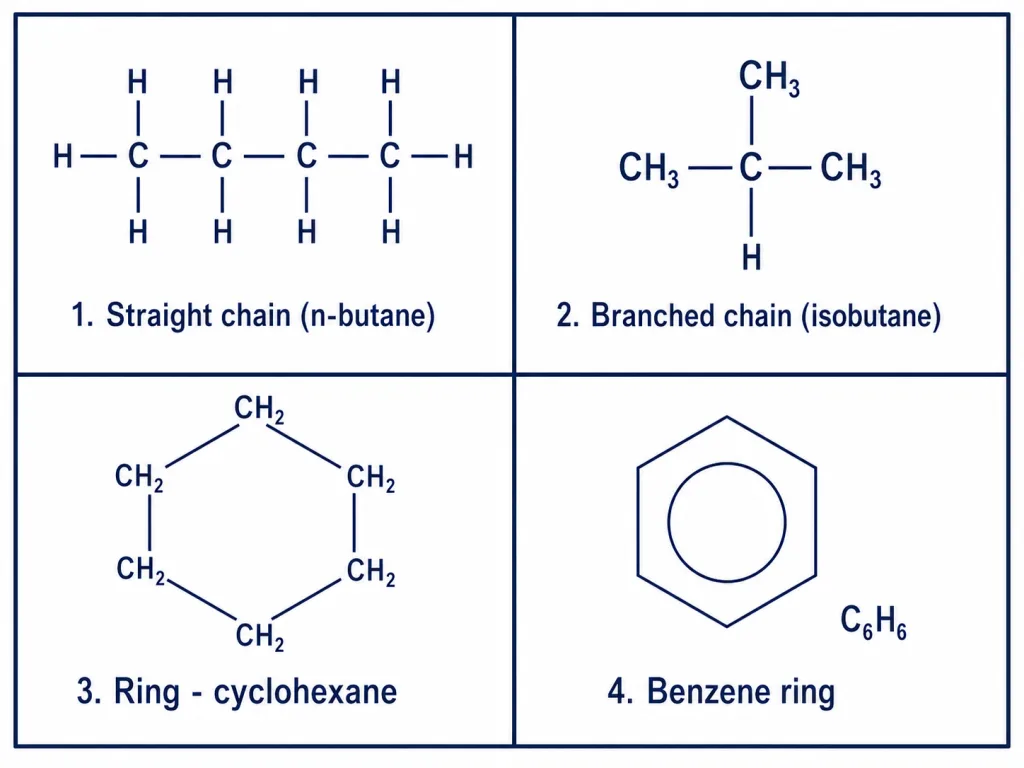
Compound 1: n-Butane (straight chain)
    H   H   H   H
    |   |   |   |
H — C — C — C — C — H
    |   |   |   |
    H   H   H   H
4 C in a single line.
Compound 2: Iso-butane (branched chain)
        H
        |
    H — C — H
        |
  H — C — C — H
        |   |
        H   H
        |
        H
Wait, let me show this better:
    CH₃
     |
CH₃ — CH — CH₃
3 C in a chain + 1 C as branch.
Both: same C₄H₁₀, but different structures! Different compounds — different physical properties.
Definition — Structural Isomerism
Structural isomers: Compounds with the same molecular formula but different structural arrangements.
'Iso' = same; 'mer' = part. Same parts, different arrangement.
Three Types of Carbon Skeletons
Carbon can connect in three ways:
1. Straight chain — all C in a single line. 2. Branched chain — main chain with side branches. 3. Ring (cyclic) — C atoms form a closed ring.
Straight Chains
Simplest type. C atoms linked in a line.
Examples:
- n-butane (C₄H₁₀): C-C-C-C
- n-pentane (C₅H₁₂): C-C-C-C-C
- n-hexane (C₆H₁₄): C-C-C-C-C-C
Branched Chains
Main chain has 'branches' (side groups).
Examples (all C₅H₁₂):
n-pentane (straight): C-C-C-C-C
Iso-pentane (one branch):
C-C-C-C
  |
  C
Neo-pentane (two branches at one C):
     C
     |
C — C — C
     |
     C
All have C₅H₁₂ — but 3 different compounds!
Importance
Different isomers:
- Have different physical properties (m.p., b.p., density).
- Have different chemical reactivity.
- Have different uses.
Example: n-pentane (straight) — petrol component. Iso-pentane (branched) — better petrol (less knocking).
This is why petrol companies make branched alkanes — to improve fuel quality.
Counting Isomers
As number of C atoms increases, the number of possible isomers increases dramatically.
Number of Possible Isomers
| C atoms | Isomers (alkanes only) |
|---|---|
| 1 | 1 (methane) |
| 2 | 1 (ethane) |
| 3 | 1 (propane) |
| 4 | 2 (n-butane, iso-butane) |
| 5 | 3 (n-pentane, iso-pentane, neo-pentane) |
| 6 | 5 |
| 7 | 9 |
| 8 | 18 |
| 10 | 75 |
| 20 | 366,319 |
| 30 | 4,111,846,763 |
Astonishing! With just 30 C atoms, there are over 4 billion possible isomers.
Isomers of Butane (C₄H₁₀)
Isomer 1: n-Butane
Straight chain of 4 C atoms.
CH₃ — CH₂ — CH₂ — CH₃
Or in detail:
    H   H   H   H
    |   |   |   |
H — C — C — C — C — H
    |   |   |   |
    H   H   H   H
Properties:
- Boiling point: -1°C
- Melting point: -138°C
- Found in LPG.
Isomer 2: Iso-Butane (2-methylpropane)
3 C in chain + 1 C as branch on middle C.
         CH₃
         |
CH₃ — CH — CH₃
Or in detail:
         H
         |
         C
        /|\
       H H H
         |
    H — C — H
         |
        /|\
       H H H
Wait, let me draw this clearer:
Structure:
  H₃C — CH — CH₃
         |
         CH₃
Properties:
- Boiling point: -12°C (lower than n-butane!)
- Melting point: -160°C
- Same formula but different b.p.
Reason for difference:
- Branched molecules are more compact → less surface area → weaker forces between molecules → lower b.p.
- Straight molecules are more elongated → larger surface area → stronger forces → higher b.p.
Isomers of Pentane (C₅H₁₂)
Isomer 1: n-Pentane (straight)
CH₃ — CH₂ — CH₂ — CH₂ — CH₃
5 C in line. b.p. 36°C.
Isomer 2: Iso-Pentane (2-methylbutane)
CH₃ — CH — CH₂ — CH₃
      |
      CH₃
4 C main chain + 1 C branch on C-2. b.p. 28°C.
Isomer 3: Neo-Pentane (2,2-dimethylpropane)
          CH₃
          |
CH₃ — C — CH₃
          |
          CH₃
3 C main chain + 2 C branches on middle C. b.p. 9°C (lowest among isomers).
A Pattern
For C₅H₁₂ isomers:
- More branching → lower b.p.
- More compact → weaker forces.
Why Isomerism Matters
1. Physical Properties:
- Different m.p., b.p., density, solubility.
2. Chemical Properties:
- Different reactions possible.
- Different drug effects in human body.
3. Industrial Significance:
- Branched alkanes — better fuels.
- Different isomers used for different purposes.
4. Biology:
- Some isomers are essential for life.
- Other isomers are useless or harmful (with same formula!).
Cyclic (Ring) Compounds
Carbon atoms can also form rings (cyclic structures).
This adds another dimension to organic chemistry.
Definition
'Cyclic compound' = compound where carbon atoms form a closed ring.
'Cyclo-' = ring (Greek).
Examples of Carbon Rings
Cyclopropane (C₃H₆)
3-C ring.
      C
     / \
    C — C
Each C has 4 bonds: 2 to other C + 2 to H.
Highly strained (small ring) — reactive.
Cyclobutane (C₄H₈)
4-C ring (square).
    C — C
    |   |
    C — C
Cyclopentane (C₅H₁₀)
5-C ring (pentagon).
Cyclohexane (C₆H₁₂)
6-C ring (hexagon).
        C — C
       /     \
      C       C
       \     /
        C — C
Each C bonded to 2 other C + 2 H. Common in nature.
Important — Comparing Formulas
Notice the formulas:
- Open chain alkene C₆H₁₂ — has 1 double bond.
- Cyclohexane C₆H₁₂ — has 6-C ring with all single bonds.
Same formula, but different structures! Both are isomers.
Cyclic alkanes follow — same as alkenes!
Aromatic Compounds — Benzene
A special class of ring compounds.
Benzene (C₆H₆)
6-C ring with alternating single and double bonds.
Structure (Kekulé form):
        C = C
       /     \
      C       C
      ||      ||
      C       C
       \     /
        C = C
Each C: 1 single C-C + 1 double C=C + 1 C-H bond. 6 C, 6 H.
Modern depiction (with circle for shared electrons):
⬡ (with circle inside representing delocalised electrons)
Properties of Benzene
- Liquid at room temperature.
- Sweet smell.
- Highly stable.
- Found in petroleum, used as solvent.
- Carcinogenic (cancer-causing) — handle carefully.
Aromatic Compounds in Daily Life
Many medicines and chemicals contain benzene rings:
- Aspirin.
- Paracetamol (acetaminophen).
- Caffeine (in coffee, tea).
- Many dyes, perfumes.
- Plastics (polystyrene).
Cyclic Compounds in Biology
Many essential biological molecules are cyclic:
1. Glucose (sugar): A 6-membered ring with O.
2. DNA bases: Adenine, guanine, cytosine, thymine — all have rings.
3. Amino acids: Some (like phenylalanine, tryptophan) have ring side chains.
4. Vitamins: Vitamin B, vitamin K — contain rings.
5. Cholesterol, hormones: Steroid hormones — 4 fused rings.
Without rings, life as we know it would not exist!
Three Types of Structural Isomerism
1. Chain Isomerism
Different arrangements of the carbon skeleton (chain or branches).
Example: butane
- n-butane: CH₃-CH₂-CH₂-CH₃ (straight)
- iso-butane: (CH₃)₃CH (branched)
Same formula, different chain shape.
2. Position Isomerism
Same skeleton, but the functional group (or double bond) is in a different position.
Example: butene (C₄H₈)
- but-1-ene: CH₂=CH-CH₂-CH₃ (double bond at position 1)
- but-2-ene: CH₃-CH=CH-CH₃ (double bond at position 2)
Same skeleton (4 C), but double bond at different position.
3. Functional Group Isomerism
Same formula but different functional groups.
Example: C₂H₆O
- Ethanol: CH₃-CH₂-OH (alcohol)
- Dimethyl ether: CH₃-O-CH₃ (ether)
Same atoms, different functional group → different chemistry.
(More on functional groups in Section 5!)
Examples of Isomerism
Example A: Butane (C₄H₁₀) — 2 isomers
1. n-Butane (chain): CH₃-CH₂-CH₂-CH₃
2. Iso-butane (chain isomer): (CH₃)₃CH
Example B: Pentane (C₅H₁₂) — 3 isomers
1. n-Pentane (straight): CH₃-CH₂-CH₂-CH₂-CH₃
2. Iso-pentane (one branch): CH₃-CH(CH₃)-CH₂-CH₃
3. Neo-pentane (two branches): C(CH₃)₄ or CH₃-C(CH₃)(CH₃)-CH₃
Example C: Butene (C₄H₈) — 4 isomers
1. But-1-ene: CH₂=CH-CH₂-CH₃ 2. But-2-ene: CH₃-CH=CH-CH₃ 3. Iso-butene: CH₂=C(CH₃)₂ 4. Cyclobutane: ring of 4 C
Drawing Different Isomers — Tips
Step 1: Count the carbons. Step 2: Draw the longest possible straight chain. Step 3: Then try arrangements with shorter chain + branch. Step 4: For each, check H count matches molecular formula. Step 5: Make sure each C has exactly 4 bonds.
Applications of Isomerism
1. In drugs:
- One isomer of a drug may cure disease.
- Another isomer may cause side effects.
- Famous case: Thalidomide — one isomer cured morning sickness, the other caused birth defects.
2. In food and flavours:
- Limonene — one isomer smells like orange, other smells like lemon.
- Same formula, different smell!
3. In fuels:
- Branched alkanes — better octane (less knocking).
- Straight chains — worse for engines.
4. In nature:
- Glucose has many isomers — only specific ones used in biology.
- D-glucose: used by living organisms.
- L-glucose: not metabolised.
Drawing Structural Formulas
Different Ways to Show the Same Molecule
A chemist may show the same molecule in many ways.
Example: n-Butane (C₄H₁₀)
Way 1: Detailed (with all H atoms):
    H   H   H   H
    |   |   |   |
H — C — C — C — C — H
    |   |   |   |
    H   H   H   H
Way 2: Condensed: CH₃-CH₂-CH₂-CH₃
Way 3: Skeletal (line drawing):
╱╲╱╲
(Each line bend represents a C atom, each end is a C with H atoms implied)
All three show the same molecule.
Skeletal Formulas
Used by chemists to draw quickly:
- Each line endpoint and bend = a C atom.
- H atoms not shown (assumed to fill remaining bonds).
- Atoms other than C and H are shown.
Examples:
Methane (CH₄): can't draw — too small. Ethane: small line. Propane: /\ shape. Pentane: /\/\/ shape.
Practice — Identifying Compounds
Looking at a structure, you should be able to:
- Count carbons: number of bends + endpoints.
- Count hydrogens: fill in to complete each C's 4 bonds.
- Identify type: alkane/alkene/alkyne.
- Name the compound: (covered in Section 6).
Common Mistakes to Avoid
1. Forgetting H atoms: Each C must have 4 bonds total. Add H atoms where needed.
2. Adding extra bonds: Don't add more than 4 bonds per C atom.
3. Confusing structural isomers: Same formula doesn't always mean same compound.
4. Ignoring rings: A ring closes back on itself.
Summary of Structural Possibilities
With just C and H, we can have:
- Straight chain alkanes (CₙH₂ₙ₊₂)
- Branched chain alkanes (same formula, different structure)
- Straight chain alkenes (CₙH₂ₙ)
- Branched chain alkenes
- Position isomers of alkenes (double bond at different positions)
- Straight chain alkynes (CₙH₂ₙ₋₂)
- Branched alkynes
- Cyclic alkanes (CₙH₂ₙ — same formula as alkenes!)
- Cyclic alkenes
- Aromatic rings (like benzene)
- Combinations of multiple rings
And we haven't even added O, N, S, halogens yet!
This is why organic chemistry has millions of compounds — and why it's so fascinating.
🧠 Memory Capsule
A quick glance just before the board exam.
1. Structural Isomerism — Definition
Compounds with the same molecular formula but different structural arrangements.
2. Three Types of Carbon Skeletons
Straight chains: all C in a line. n-butane, n-pentane, n-hexane.
Branched chains: main chain + branches. iso-butane, iso-pentane, neo-pentane.
Ring (cyclic) compounds: C forms a closed ring. Cyclohexane, benzene, glucose ring.
3. Isomers of Common Alkanes
| Molecular Formula | Isomers |
|---|---|
| C₃H₈ | 1 |
| C₄H₁₀ | 2 (n, iso) |
| C₅H₁₂ | 3 (n, iso, neo) |
| C₆H₁₄ | 5 |
| C₇H₁₆ | 9 |
| C₈H₁₈ | 18 |
4. Three Types of Structural Isomerism
1. Chain isomerism: Different arrangements of carbon chain. Ex: n-butane vs iso-butane.
2. Position isomerism: Same skeleton, double bond/group at different position. Ex: but-1-ene vs but-2-ene.
3. Functional group isomerism: Same formula but different functional group. Ex: ethanol (C₂H₅OH) vs dimethyl ether (CH₃OCH₃).
5. Cyclic Compounds
Important rings:
- Cyclopropane (C₃H₆)
- Cyclobutane (C₄H₈)
- Cyclopentane (C₅H₁₀)
- Cyclohexane (C₆H₁₂)
- Benzene (C₆H₆) — aromatic
Cyclic alkanes: (same formula as alkenes!)
6. Benzene
A special aromatic ring. 6 C in ring with alternating single + double bonds. Highly stable. Found in petroleum. In medicines, perfumes, dyes.
7. Importance of Isomerism
- Different physical properties (m.p., b.p.).
- Different chemical properties.
- Different uses.
- Different effects in biology (one isomer may cure, another harm).
8. Drawing Tips
Each C must have 4 bonds. Show H atoms (or use skeletal formula). Identify chain length first. Then add branches.
9. Board's 'Golden' Questions
- Define structural isomerism. Examples.
- Draw 3 isomers of pentane (C₅H₁₂).
- What is benzene? Structure.
- Cyclohexane vs hexene — same formula?
- Why are branched alkanes preferred for petrol?
Final Formula: Same atoms + different arrangement = different compound. Carbon's gift to creation.
Solved Examples
Example 1: NCERT — Structural Isomerism
What is structural isomerism? Give example.
Solution:
Definition
'Structural Isomerism' = phenomenon where two or more compounds have the same molecular formula but different structural arrangements (different connectivity of atoms).
'Iso' = same; 'mer' = part.
Why It Happens
Carbon's tetravalency + catenation:
- C can form long chains.
- C can branch.
- C can form rings.
With same atoms, multiple arrangements are possible.
Example — Butane (C₄H₁₀)
Both compounds have same formula C₄H₁₀ but different structures:
Isomer 1: n-Butane (Normal Butane)
Straight chain of 4 C atoms.
CH₃ — CH₂ — CH₂ — CH₃
Properties:
- Boiling point: -1°C
- Common in LPG.
Isomer 2: Iso-Butane (2-methylpropane)
3 C chain + 1 C branch on middle C.
         CH₃
          |
CH₃ — CH — CH₃
Properties:
- Boiling point: -12°C
- Different molecular shape than n-butane.
Why Different Properties?
Same molecular formula. But:
- Different shape.
- Different intermolecular forces.
- Different physical properties.
Example: branched isomer (iso-butane) has lower b.p. because:
- More compact molecule.
- Less surface area for intermolecular contact.
- Weaker van der Waals forces.
- Lower b.p.
Other Examples
Pentane (C₅H₁₂) — 3 isomers
- n-Pentane (straight): C-C-C-C-C
- Iso-pentane (1 branch).
- Neo-pentane (2 branches on one C).
Hexane (C₆H₁₄) — 5 isomers!
Key Insight
This is why carbon has so many compounds:
One molecular formula can correspond to many different actual compounds. Each has different properties and uses.
Important in:
- Drugs.
- Fuels.
- Plastics.
- Biology.
[NCERT — important]
Example 2: NCERT — Isomers of Pentane
Draw all 3 isomers of pentane (C₅H₁₂).
Solution:
Pentane has 3 Structural Isomers
Isomer 1: n-Pentane (Normal Pentane)
Straight chain of 5 C atoms.
CH₃ — CH₂ — CH₂ — CH₂ — CH₃
Detailed:
    H   H   H   H   H
    |   |   |   |   |
H — C — C — C — C — C — H
    |   |   |   |   |
    H   H   H   H   H
Boiling point: 36°C.
Isomer 2: Iso-Pentane (2-methylbutane)
4 C main chain + 1 CH₃ branch on C-2.
CH₃ — CH — CH₂ — CH₃
      |
      CH₃
Detailed:
    H   CH₃ H   H
    |    |  |   |
H — C — C — C — C — H
    |    |  |   |
    H   H   H   H
Boiling point: 28°C.
Isomer 3: Neo-Pentane (2,2-dimethylpropane)
3 C main chain + 2 CH₃ branches on middle C.
        CH₃
         |
CH₃ — C — CH₃
         |
        CH₃
Boiling point: 9°C (lowest among the three).
Verification — All Have C₅H₁₂
n-Pentane:
5 C in chain. H count: 3+2+2+2+3 = 12 ✓
Iso-Pentane:
4 C in main chain + 1 C in branch = 5 C total. H count: 3+1+2+3+3 (branch) = 12 ✓
Neo-Pentane:
3 C in main chain + 2 C in branches = 5 C total. H count: 3+0+3 (main) + 3+3 (branches) = 12 ✓
All three have the same C and H count → isomers!
Pattern in Properties
| Isomer | B.P. (°C) | Compactness |
|---|---|---|
| n-Pentane (straight) | 36 | Less compact |
| Iso-Pentane (1 branch) | 28 | More compact |
| Neo-Pentane (2 branches) | 9 | Most compact |
Pattern:
- More branching → more compact molecule.
- More compact → less surface area for intermolecular forces.
- Less surface forces → easier to vapourise → lower b.p.
Practical Use
All three are used in:
- Petrol blending.
- Natural gas.
- Industrial solvents.
Different boiling points allow them to be separated by fractional distillation.
[NCERT — every year]
Example 3: NCERT — Cyclic Compounds
What are cyclic compounds? Draw cyclohexane and benzene.
Solution:
Cyclic Compounds
Compounds where carbon atoms form a closed ring.
'Cyclo-' = ring (Greek).
Cyclohexane (C₆H₁₂)
6 C atoms in a hexagonal ring with all single bonds.
        C — C
       /     \
      C       C
       \     /
        C — C
With H atoms shown:
          H₂C — CH₂
         /        \
      H₂C          CH₂
         \        /
          H₂C — CH₂
Each C is bonded to 2 other C atoms + 2 H atoms.
Properties:
- Liquid at room temperature.
- B.P.: 80.7°C.
- Found in petroleum.
- Used as a non-polar solvent.
Note: Cyclohexane has formula C₆H₁₂ — same as hexene (open-chain alkene)! They are isomers.
Benzene (C₆H₆)
A special aromatic ring compound.
6 C in a hexagonal ring with alternating single and double bonds.
Kekulé form (showing alternating bonds):
        C = C
       /     \
      C       C
      ||      ||
      C       C
       \     /
        C = C
Or in modern notation (showing delocalised π electrons):
⬡ (with circle inside)
Each C is bonded to:
- 1 single bond to adjacent C.
- 1 double bond (alternating).
- 1 single bond to H.
All 6 C atoms have only 1 H each.
Properties:
- Sweet-smelling liquid.
- B.P.: 80°C (similar to cyclohexane).
- Highly stable due to alternating π bonds.
- Found in petroleum (5-7%).
- Carcinogenic (cancer-causing) — handle carefully.
- Used as solvent and chemical raw material.
Comparison — Cyclohexane vs Benzene
| Property | Cyclohexane | Benzene |
|---|---|---|
| Formula | C₆H₁₂ | C₆H₆ |
| Bonds | All single | Alternating single/double |
| H atoms | 12 | 6 |
| Saturation | Saturated | Aromatic (special) |
| Reactivity | Less reactive | Stable but undergoes substitution |
| Smell | Faint | Sweet, distinctive |
Other Carbon Rings
Cyclopentane (C₅H₁₀)
5-C ring.
Cyclopropane (C₃H₆)
3-C ring (triangular). Highly strained, reactive.
Cyclobutane (C₄H₈)
4-C ring (square). Strained, reactive.
Why Rings Matter
Many essential biological molecules are cyclic:
- Glucose (sugar) — 6-membered ring with O.
- DNA bases — purines, pyrimidines.
- Amino acids — phenylalanine (with benzene ring).
- Cholesterol, steroid hormones.
- Vitamins.
- Drugs (aspirin, paracetamol).
Without rings, life as we know it would not exist.
Cyclic vs Open Chain
Cyclic alkanes follow formula — same as open-chain alkenes!
This is functional isomerism:
- Cyclohexane (C₆H₁₂): 6-C ring, all single bonds.
- Hexene (C₆H₁₂): 6-C straight chain, 1 double bond.
Same formula, different structures, different chemistry.
[NCERT — important]
Example 4: NCERT — Difference between n-Butane and Iso-Butane
Compare the two isomers of butane (C₄H₁₀).
Solution:
Both are C₄H₁₀
Same molecular formula, different structures.
Isomer 1: n-Butane (Normal Butane)
Straight chain.
CH₃ — CH₂ — CH₂ — CH₃
Structural details:
- 4 C in a single line.
- Each end C has 3 H, each middle C has 2 H.
- Total H: 3+2+2+3 = 10.
Isomer 2: Iso-Butane (2-methylpropane)
Branched chain.
         CH₃
          |
CH₃ — CH — CH₃
Structural details:
- 3 C main chain.
- 1 C as branch on C-2.
- Each terminal CH₃ has 3 H.
- Middle CH has 1 H.
- Total H: 3+1+3+3 = 10.
Comparison Table
| Property | n-Butane | Iso-Butane |
|---|---|---|
| Formula | C₄H₁₀ | C₄H₁₀ |
| Carbon arrangement | Straight chain | Branched (Y-shape) |
| Boiling point | -1°C | -12°C |
| Melting point | -138°C | -160°C |
| Density | 0.59 g/mL | 0.55 g/mL |
| Octane number | 91 | 102 (better!) |
| Use | LPG, fuel | LPG, refrigerant |
Why Different Boiling Points?
n-Butane:
- Linear, elongated shape.
- More surface area available for intermolecular contact.
- Stronger van der Waals forces.
- Higher b.p.
Iso-Butane:
- More compact, ball-like shape.
- Less surface area.
- Weaker van der Waals forces.
- Lower b.p.
Industrial Significance
Iso-butane is preferred for:
- Refrigerant gases (used in fridges, AC).
- Higher octane petrol (less knocking).
- Aerosol propellants (in spray cans).
n-Butane is found in:
- LPG cylinders.
- Lighter fluid.
A Real-World Reflection
Just by rearranging atoms, we get a compound with:
- 11°C lower boiling point.
- Better fuel quality.
- Different industrial uses.
This is the power of structural isomerism.
One reason petroleum companies use cracking and reforming — to convert straight-chain alkanes to branched ones.
[NCERT — important]
Example 5: NCERT — Drawing Isomers of Hexane
Draw all 5 structural isomers of hexane (C₆H₁₄).
Solution:
5 Isomers of Hexane (C₆H₁₄)
Isomer 1: n-Hexane (straight chain)
CH₃ — CH₂ — CH₂ — CH₂ — CH₂ — CH₃
6 C in line. B.P.: 69°C.
Isomer 2: 2-Methylpentane (Iso-hexane)
5 C main chain + 1 CH₃ on C-2.
CH₃ — CH — CH₂ — CH₂ — CH₃
      |
      CH₃
B.P.: 60°C.
Isomer 3: 3-Methylpentane
5 C main chain + 1 CH₃ on C-3.
CH₃ — CH₂ — CH — CH₂ — CH₃
             |
             CH₃
B.P.: 64°C.
Isomer 4: 2,3-Dimethylbutane
4 C main chain + 2 CH₃ (one each on C-2 and C-3).
CH₃ — CH — CH — CH₃
      |    |
      CH₃  CH₃
B.P.: 58°C.
Isomer 5: 2,2-Dimethylbutane (Neo-hexane)
4 C main chain + 2 CH₃ both on C-2.
          CH₃
           |
CH₃ — C — CH₂ — CH₃
           |
          CH₃
B.P.: 50°C.
Verification
All 5 have C₆H₁₄.
For each, count H atoms:
Isomer 1 (n-hexane):
- Each end CH₃: 3 H × 2 = 6 H
- Each middle CH₂: 2 H × 4 = 8 H
- Total: 14 H ✓
Isomer 2 (2-methylpentane):
- 5 C in main chain (3+1+2+2+3 H) + 1 CH₃ branch (3 H) = 14 H ✓
Similar checks for others.
Boiling Point Pattern
| Isomer | Branching | B.P. (°C) |
|---|---|---|
| 1. n-Hexane (straight) | None | 69 |
| 2. 2-Methylpentane | 1 branch (end) | 60 |
| 3. 3-Methylpentane | 1 branch (middle) | 64 |
| 4. 2,3-Dimethylbutane | 2 branches (different C) | 58 |
| 5. 2,2-Dimethylbutane (neo) | 2 branches (same C) | 50 |
Pattern:
- More branching → lower b.p.
- More compact = less surface = weaker forces.
Industrial Significance
Each isomer used differently:
- n-Hexane: common solvent (extracts oil from seeds).
- 2-Methylpentane: in gasoline (octane booster).
- Neo-hexane: high-octane gasoline.
A Reflection
From C₆H₁₄ alone — 5 different molecules, 5 different chemicals, 5 different uses.
Carbon's flexibility = endless variety.
[Board: 5-mark, advanced]
Example 6: NCERT — Cyclohexane vs Hexene
Both cyclohexane and hexene have formula C₆H₁₂. How are they different?
Solution:
Same Molecular Formula
Both are C₆H₁₂. But different structures → functional isomers.
Cyclohexane (Cyclic Alkane)
6 C atoms forming a closed ring with all single bonds.
        C — C
       /     \
      C       C
       \     /
        C — C
Each C bonds to: 2 other C + 2 H.
Type: Cyclic alkane (saturated).
Properties:
- Liquid.
- B.P.: 80.7°C.
- All single bonds.
- Less reactive.
- Found in petroleum.
Hexene (Open-Chain Alkene)
6 C atoms in a straight chain with 1 double bond.
CH₂=CH-CH₂-CH₂-CH₂-CH₃
(This is hex-1-ene; double bond at position 1.)
Type: Acyclic (open-chain) alkene (unsaturated).
Properties:
- Liquid.
- B.P.: 63°C.
- Has 1 C=C double bond.
- More reactive.
- Decolourises bromine water.
Key Differences
| Property | Cyclohexane | Hex-1-ene |
|---|---|---|
| Formula | C₆H₁₂ | C₆H₁₂ |
| Structure | Cyclic (ring) | Open chain |
| Bonds | All single | 1 double + rest single |
| Saturation | Saturated | Unsaturated |
| Bromine water | No reaction | Decolourises |
| Reactivity | Low | High |
| Geometry | Hexagonal ring | Linear chain |
Bromine Water Test
This is a great way to distinguish:
Cyclohexane + Bromine water:
- Bromine water remains brown.
- No reaction.
Hexene + Bromine water:
- Bromine water becomes colourless.
- Br₂ adds across double bond.
Reaction (for hexene):
Why Same Formula Possible?
Look at the math:
- Open-chain alkane: . For n=6: C₆H₁₄.
- Open-chain alkene: 2 fewer H = C₆H₁₂.
- Cyclic alkane: the ring 'replaces' the 2 H needed for end groups = C₆H₁₂.
Both lose 2 H from the alkane, but for different reasons:
- Alkene: 2 H lost to form double bond.
- Cyclic alkane: 2 H lost because the ends are joined in a ring.
Significance
This shows:
- Same formula doesn't mean same compound.
- Need to look at bonds and arrangement.
- Tests like bromine water help distinguish.
This kind of isomerism — where compounds differ in functional group or arrangement of bonds — is called functional isomerism.
[NCERT + Board]
Example 7: NCERT — Importance of Benzene
What is benzene? Why is it important? Mention 3 uses.
Solution:
Benzene
Benzene is the simplest aromatic compound.
Molecular formula: .
Structure
6 C atoms in a hexagonal ring with alternating single and double bonds:
Kekulé structure:
        C = C
       /     \
      C       C
      ||      ||
      C       C
       \     /
        C = C
Modern depiction (with circle representing delocalised π electrons):
⬡
Why It's Special — Aromaticity
Benzene's 6 π electrons are delocalised across the entire ring. No single fixed double bond. This makes benzene highly stable — much more stable than expected.
This special stability is called 'aromaticity'.
Aromatic rings (benzene-like) are:
- Highly stable.
- Don't easily undergo addition (unlike alkenes).
- Tend to undergo substitution reactions.
Properties
- Liquid at room temperature.
- Sweet, distinctive smell (used to be added to gasoline).
- Insoluble in water (non-polar).
- Highly soluble in organic solvents.
- Volatile (evaporates easily).
- B.P.: 80°C.
Importance
Benzene rings are everywhere in chemistry:
1. Medicines:
- Aspirin (analgesic).
- Paracetamol (fever reducer).
- Many antibiotics.
- Painkillers.
2. Plastics:
- Polystyrene (Styrofoam).
- Phenol resins.
- Nylon (with benzene-based monomers).
3. Dyes and Pigments:
- Most synthetic dyes contain benzene rings.
- Fabric colours, paints.
4. Perfumes:
- Most synthetic and natural fragrances contain benzene rings.
- Vanilla, almond, mint flavours.
5. Fuels:
- Benzene + similar aromatics in petrol.
- Improve octane rating.
6. Industrial chemicals:
- Solvent for paints, glues.
- Raw material for many other chemicals.
3 Specific Uses
1. As a solvent:
- Used in industries for cleaning, dissolving.
- Found in some glues, paint thinners.
2. Manufacture of polystyrene:
- Polystyrene = polymer used for packaging foam, cups, insulation.
- Made from styrene (vinyl benzene), which comes from benzene.
3. Aspirin manufacture:
- Aspirin (acetylsalicylic acid) is one of the world's most-used medicines.
- Has benzene ring in its structure.
- Reduces pain and inflammation.
Health Concerns
Benzene is known to be carcinogenic (cancer-causing):
- Causes leukaemia (blood cancer) with prolonged exposure.
- Banned or restricted in many products.
- Petrol contains <1% benzene now (regulated).
Always handle benzene-containing products with care.
A Curious History
Benzene's structure was a mystery for years. In 1865, Friedrich August Kekulé proposed the cyclic structure (legend says he dreamed of a snake biting its tail!). Nobel Prizes have been awarded for understanding aromaticity.
A Lesson
Benzene shows:
- Cyclic compounds can be very stable (more than chains).
- Aromaticity is a special type of stability.
- Even 'simple' molecules have surprising properties.
Benzene rings are the building blocks of much of modern chemistry — from medicines to materials.
[NCERT + General Knowledge]
Example 8: NCERT — Three Types of Isomerism
Explain three types of structural isomerism with examples.
Solution:
Three Types
1. Chain Isomerism
Different arrangements of the carbon chain (different chain length or branching).
Example: Butane (C₄H₁₀)
Isomer A — n-Butane: Straight 4-C chain.
CH₃ — CH₂ — CH₂ — CH₃
Isomer B — Iso-Butane (2-methylpropane): 3-C chain + 1 branch.
    CH₃
     |
CH₃ — CH — CH₃
Same formula, different chain shape → chain isomers.
2. Position Isomerism
Same skeleton, but functional group or double bond is in different position.
Example: Butene (C₄H₈)
Isomer A — But-1-ene: Double bond between C-1 and C-2.
CH₂ = CH — CH₂ — CH₃
Isomer B — But-2-ene: Double bond between C-2 and C-3.
CH₃ — CH = CH — CH₃
Same C skeleton (4 C in a row), but double bond at different positions.
3. Functional Group Isomerism
Same formula, but different functional groups (different chemistry).
Example: C₂H₆O
Isomer A — Ethanol: Alcohol (-OH group).
CH₃ — CH₂ — OH
Isomer B — Dimethyl Ether: Ether (C-O-C).
CH₃ — O — CH₃
Same atoms, different functional group → completely different chemistry.
Other Examples:
C₃H₆O:
- Propanal (aldehyde): CH₃-CH₂-CHO
- Acetone (ketone): CH₃-CO-CH₃
C₃H₆O₂:
- Propanoic acid (carboxylic acid).
- Methyl formate (ester).
Comparison Table
| Type | What's Different? | Example |
|---|---|---|
| Chain | Carbon skeleton (chain or branch) | n-butane vs iso-butane |
| Position | Position of double bond/group | but-1-ene vs but-2-ene |
| Functional | Functional group | ethanol vs dimethyl ether |
Why Each Matters
Chain isomers:
- Different physical properties (b.p., m.p., density).
- Different industrial uses.
- Same chemical reactions.
Position isomers:
- Slightly different physical properties.
- Same/similar chemical reactions.
- Different reactivity locations.
Functional isomers:
- Very different physical and chemical properties.
- Different uses entirely.
- Different drug effects (in case of medicines).
A Real-World Example
Glucose has multiple isomers:
- D-Glucose: sweet sugar, used by body for energy.
- L-Glucose: same formula, but body can't use it.
- Fructose: same formula (C₆H₁₂O₆), different structure (functional isomer).
Same formula → very different biology!
Why Isomerism Matters in Daily Life
From medicines to fuel to food, isomers shape our world:
- One isomer cures disease, another might cause harm.
- One isomer makes an effective fuel, another wastes energy.
- One isomer tastes sweet, another bitter or no taste.
Carbon's gift of isomerism = endless variety in nature and industry.
[Board: 5-mark]
Example 9: Practical — Isomers in Real Life
Give examples of isomers in: (a) Medicines (b) Fuels (c) Food/Flavours (d) Biology
Solution:
(a) Medicines — Critical Importance!
Famous Example: Thalidomide
Thalidomide had two isomers:
- (R)-Thalidomide: effective for morning sickness in pregnancy.
- (S)-Thalidomide: caused severe birth defects.
Drug was prescribed without separating isomers — leading to one of the worst medical disasters. Lesson: Drug isomers must be carefully tested!
Example: Ibuprofen
Two isomers:
- S-Ibuprofen: the active painkiller.
- R-Ibuprofen: essentially inactive.
Body slowly converts R → S. Modern drugs use only the active isomer.
Example: Aspartame (Artificial Sweetener)
Two isomers:
- S-Aspartame: sweet (used in diet sodas).
- R-Aspartame: bitter (not used).
(b) Fuels — Octane Number
Different isomers of C₈H₁₈ have very different fuel quality:
| Isomer | Octane Number |
|---|---|
| n-Octane (straight) | 0 (knocks badly) |
| 2-methylheptane | 22 |
| 2,2-dimethylhexane | 86 |
| Iso-octane (2,2,4-trimethylpentane) | 100 (reference) |
Branched isomers are much better fuels. This is why petroleum companies convert straight chains to branched (cracking, reforming).
(c) Food and Flavours
Limonene
Two isomers (mirror images):
- D-Limonene (R): smells like orange.
- L-Limonene (S): smells like lemon.
Same molecular formula, totally different smells!
Sugars
Glucose vs Fructose (both C₆H₁₂O₆):
- Glucose: sweetness 70 (compared to sucrose).
- Fructose: sweetness 173 (much sweeter!).
Same formula, different structures, different sweetness.
Citrus and Spice
Many flavour molecules have isomers — different scents/tastes. Used in artificial flavours, perfumes.
(d) Biology
Glucose Stereoisomers
D-Glucose and L-Glucose:
- Same formula C₆H₁₂O₆.
- Mirror images of each other.
- D-Glucose: used by all living organisms (in our blood, food).
- L-Glucose: not metabolised by humans (would be useless as food).
Amino Acids
Most amino acids exist in 2 isomeric forms (L and D).
- L-amino acids: used in proteins of life.
- D-amino acids: found in some bacteria.
DNA
Even DNA has isomerism:
- A right-handed double helix (B-DNA — common form).
- Left-handed Z-DNA (rare).
Why So Important?
Living organisms are highly selective about isomers:
- Receptors fit one specific isomer.
- Enzymes work on one specific shape.
- The 'wrong' isomer might be useless or harmful.
This is called chirality — the property of having mirror images. Most biological molecules are chiral.
Real-World Implication
Modern pharmaceutical industry:
- Spends huge resources to separate isomers.
- Or uses 'asymmetric synthesis' to make only one isomer.
- Better drugs, fewer side effects.
Summary
Isomers are everywhere:
- Medicines: one heals, another harms.
- Fuels: branched is better.
- Flavours: subtle isomer changes give different tastes.
- Biology: life uses specific isomers.
From the morning coffee to the evening medicine — isomers shape our daily life.
Carbon's gift of structural variety underlies all of this.
[General Knowledge + Board]
Example 10: A Concluding Question
(a) Define structural isomerism. (b) Draw 2 isomers of butane. (c) Difference between cyclohexane and hexene. (d) Why does iso-pentane have lower b.p. than n-pentane?
Solution:
(a) Structural Isomerism
'Structural Isomerism' = phenomenon where compounds have:
- Same molecular formula.
- Different structural arrangements.
Different connectivity of atoms → different compounds with different properties.
Three types:
- Chain isomerism (different chain).
- Position isomerism (different position of group).
- Functional isomerism (different functional group).
(b) 2 Isomers of Butane (C₄H₁₀)
Isomer 1: n-Butane
Straight chain.
CH₃ — CH₂ — CH₂ — CH₃
Or in detail:
    H   H   H   H
    |   |   |   |
H — C — C — C — C — H
    |   |   |   |
    H   H   H   H
B.P.: -1°C.
Isomer 2: Iso-Butane (2-methylpropane)
Branched chain.
         CH₃
          |
CH₃ — CH — CH₃
B.P.: -12°C.
Both have C₄H₁₀ but different structures and properties.
(c) Cyclohexane vs Hexene
Both have formula C₆H₁₂ but different structures:
Cyclohexane
6-C ring with all single bonds. Saturated cyclic alkane. B.P.: 80.7°C. Doesn't decolourise bromine water.
Hex-1-ene
6-C straight chain with 1 double bond. Unsaturated open-chain alkene. B.P.: 63°C. Decolourises bromine water (test for unsaturation).
Distinguishing Test
Bromine water test:
- Cyclohexane: No change (orange remains).
- Hex-1-ene: Decolourised.
This is functional isomerism.
(d) Why Iso-Pentane has Lower B.P. than n-Pentane?
n-Pentane
Straight chain. Long, elongated shape. Boiling point: 36°C.
Iso-Pentane (2-methylbutane)
Branched chain. More compact, ball-like shape. Boiling point: 28°C.
Why difference?
Intermolecular Forces: Both molecules attract via van der Waals forces (dipole-induced dipole and London forces).
These forces depend on surface area of contact:
- Long molecules → more surface → stronger forces → harder to separate → higher b.p.
- Compact molecules → less surface → weaker forces → easier to vapourise → lower b.p.
Visualising:
- n-Pentane: like a long piece of spaghetti — easy to align side-by-side, lots of contact.
- Iso-Pentane: like a short stick with a branch — harder to align, less contact.
Hence iso-pentane has lower b.p.
Pattern in Pentane Isomers
| Isomer | Branching | B.P. (°C) |
|---|---|---|
| n-Pentane (straight) | None | 36 |
| Iso-Pentane (1 branch) | 1 | 28 |
| Neo-Pentane (2 branches) | 2 (compact) | 9 |
More branching → more compact → lower b.p.
A Universal Rule
For isomers:
- Linear molecules — higher b.p.
- Branched molecules — lower b.p.
This applies to all alkane isomers (and most hydrocarbons in general).
Used in industry to separate components of petrol by fractional distillation.
Summary
Structural isomerism is one of the most important concepts in organic chemistry. It explains:
- Why so many compounds exist.
- Why same-formula compounds can have different properties.
- Why proper drug development requires care with isomers.
- Why fuel quality varies with structure.
Carbon's gift of variety — from one formula, many compounds.
[Board: 5-mark mixed]
Example 11: Counting Isomers
How many structural isomers does have? Draw and name them.
Solution:
C₄H₁₀ has 2 Structural Isomers
Isomer 1: n-Butane (Normal Butane)
All 4 C in a single line.
CH₃ — CH₂ — CH₂ — CH₃
Or:
    H   H   H   H
    |   |   |   |
H — C — C — C — C — H
    |   |   |   |
    H   H   H   H
Properties:
- Boiling point: -1°C.
- Found in LPG.
Isomer 2: Iso-Butane (2-Methylpropane)
3 C in main chain + 1 C branch on middle C.
         CH₃
          |
CH₃ — CH — CH₃
Or:
         H
         |
     H — C — H
         |
     H — C — H
         |
     H — C — H
         |
         H
Wait, let me redraw clearly:
            CH₃
             |
   CH₃ ——— CH ——— CH₃
The middle CH is connected to 3 CH₃ groups.
Properties:
- Boiling point: -12°C.
- Used as refrigerant, propellant, fuel.
Why Only 2 Isomers?
With 4 C atoms, only 2 unique arrangements exist:
Arrangement 1: All 4 in a row.
C — C — C — C
Arrangement 2: 3 in a row + 1 branch.
C — C — C
     |
     C
Other 'arrangements' are actually the same:
- 2 in a row + 2 branches? But 2 branches on adjacent C₂ = different molecule.
- Wait, can we have just 'iso-butane'? Yes, one specific structure.
If you try to draw a third arrangement, you'll find it's identical to one of the above (just rotated or flipped).
Verification
n-Butane:
4 C, 10 H. Each terminal CH₃: 3 H × 2 = 6 H. Each middle CH₂: 2 H × 2 = 4 H. Total: 10 H ✓
Iso-Butane:
4 C, 10 H. 3 terminal CH₃: 3 H × 3 = 9 H. 1 middle CH (connected to 3 CH₃): 1 H × 1 = 1 H. Total: 10 H ✓
Note on Naming
In old systems:
- n- (normal) for straight chain.
- iso- for one branch on second C.
- neo- for two branches on second C.
Modern IUPAC names:
- n-butane = butane (no prefix needed).
- iso-butane = 2-methylpropane.
Comparing Properties
| Property | n-Butane | Iso-Butane |
|---|---|---|
| Boiling point | -1°C | -12°C |
| Compactness | Less | More |
| Octane number | 91 | 102 |
| Common use | LPG | Refrigerant, aerosol |
Practical Significance
Both are used commercially:
- n-Butane: primarily in LPG (cooking gas).
- Iso-Butane: used in refrigerants (replacing CFCs), aerosol propellants, high-octane petrol.
The chemical industry separates them by fractional distillation (different b.p.).
Summary
C₄H₁₀ has exactly 2 structural isomers:
- n-Butane (straight chain).
- Iso-Butane (2-methylpropane, branched).
Despite same formula, they have different properties and uses.
[NCERT — important]
Example 12: Identifying Isomers
Which of the following are isomers of each other? (i) C₄H₁₀ (ii) C₅H₁₂ (iii) (CH₃)₂CH-CH₃ (iv) CH₃-CH₂-CH₂-CH₃ (v) CH₃-CH₂-CH₂-CH₂-CH₃
Solution:
Step 1: Identify Each Compound
Find molecular formula of each:
(i) C₄H₁₀
Just a molecular formula — could be n-butane or iso-butane.
(ii) C₅H₁₂
Just a molecular formula — could be any of 3 pentane isomers.
(iii) (CH₃)₂CH-CH₃
This is iso-butane (2-methylpropane):
    CH₃
     |
CH₃ — CH — CH₃
Molecular formula: 4 C + (3+1+3+3) H = 4 C + 10 H = C₄H₁₀.
(iv) CH₃-CH₂-CH₂-CH₃
This is n-butane (straight chain): Molecular formula: 4 C + (3+2+2+3) H = 4 C + 10 H = C₄H₁₀.
(v) CH₃-CH₂-CH₂-CH₂-CH₃
This is n-pentane (straight chain). Molecular formula: 5 C + (3+2+2+2+3) H = 5 C + 12 H = C₅H₁₂.
Step 2: Group by Molecular Formula
Group A — C₄H₁₀:
- (i) C₄H₁₀
- (iii) (CH₃)₂CH-CH₃ (iso-butane)
- (iv) CH₃-CH₂-CH₂-CH₃ (n-butane)
Group B — C₅H₁₂:
- (ii) C₅H₁₂
- (v) CH₃-CH₂-CH₂-CH₂-CH₃ (n-pentane)
Step 3: Identify Isomers
Isomers = compounds with same formula, different structures.
From Group A:
- (iii) Iso-butane and (iv) n-butane are structural isomers of each other.
- Both have formula C₄H₁₀.
- Different structures.
(i) just states the formula — can be either, but as a description not a specific isomer.
From Group B:
- Only (v) is shown.
- (ii) is just the formula, doesn't specify structure.
Answer
(iii) and (iv) are structural isomers of each other.
(iii) iso-butane and (iv) n-butane:
- Both C₄H₁₀.
- Different structures (branched vs straight).
- Different properties (b.p. -12 vs -1°C).
- Different uses.
Comparison
| Compound | Structure | Type |
|---|---|---|
| (iii) iso-butane | Branched | Isomer of (iv) |
| (iv) n-butane | Straight | Isomer of (iii) |
| (v) n-pentane | Different formula | Not an isomer of (iii) or (iv) |
Key Insight
To check if compounds are isomers:
- Calculate molecular formulas.
- If formulas match → could be isomers.
- Check if structures differ → confirmed isomers.
- Same structure (just drawn differently) → same compound, not isomer.
Common Mistake
'CH₃-CH₂-CH₃' and 'CH₃-CH₂-CH₃' (drawn from different ends) are the same compound, not isomers. They look different but are actually identical molecules.
Summary
From the given list:
- (iii) and (iv) are isomers of each other.
- (v) is not an isomer of (iii) or (iv) — different formula.
This kind of analysis is essential in organic chemistry to identify true isomerism vs same compound drawn differently.
[Board: 3-5 mark]
Example 13: Why Isomers Have Different Properties
Explain why isomers, despite having the same molecular formula, have different physical properties.
Solution:
Why Isomers Differ
Although isomers have the same atoms, how those atoms are connected matters.
This affects:
1. Molecular Shape
Different connections → different 3D shape.
Example: butane
- n-butane: extended, zig-zag chain.
- Iso-butane: compact, ball-like.
2. Surface Area
Linear molecules have larger surface area. Compact (branched) molecules have smaller surface area.
This affects how much molecules can interact with each other.
3. Intermolecular Forces
All hydrocarbons are non-polar — only weak van der Waals forces between molecules.
These forces depend on surface contact:
- More surface contact → stronger forces.
- Less surface contact → weaker forces.
Linear isomers:
- Larger surface contact.
- Stronger forces.
- Higher boiling point.
Branched isomers:
- Smaller surface contact.
- Weaker forces.
- Lower boiling point.
4. Boiling and Melting Points
Boiling point depends on intermolecular forces:
- Stronger forces → harder to vapourise → higher b.p.
- Weaker forces → easier to vapourise → lower b.p.
Hence:
- n-Butane (straight): b.p. -1°C.
- Iso-Butane (branched): b.p. -12°C (lower).
A 11°C difference!
5. Density
Compact molecules pack tighter → higher density (sometimes). Or, branched might be lower density (depends on shape).
Generally not a huge difference for alkane isomers.
6. Solubility
Both isomers similarly insoluble in water (non-polar). Both soluble in organic solvents. Slight differences in solubility based on shape, but minor.
7. Chemical Reactivity (Sometimes)
For alkanes — both isomers are similarly unreactive. For other compounds (with double bonds or functional groups) — reactivity can vary.
Position isomers (different position of double bond) — different products can form.
8. Industrial/Biological Effects
This is where isomerism becomes critical:
Drugs
- Different shapes fit different receptors.
- One isomer can be a medicine, another can be inert or harmful.
- Example: Thalidomide (one isomer cured, another caused birth defects).
Fuels
- Branched alkanes are better fuels (octane number).
- Used in high-octane petrol.
Tastes/Smells
- Limonene: D-isomer smells like orange, L-isomer like lemon.
- Receptors in tongue/nose are shape-specific.
Biology
- L-amino acids in proteins, D-amino acids in some bacteria.
- D-glucose used by life, L-glucose isn't.
Visual Analogy
Imagine isomers as two different LEGO buildings:
- Same number of bricks (atoms).
- Different shape (structure).
- Different functions (properties).
A LEGO car uses the same bricks differently than a LEGO house — same parts, different functions.
Why This is Important
Understanding isomerism is essential for:
1. Pharmacy: Drug designers must consider isomers carefully. 2. Petroleum: Refining converts straight to branched alkanes. 3. Plastics: Different polymer structures have different properties. 4. Food: Sugar isomers have different sweetness. 5. Biology: Life is stereoselective — uses specific isomers.
A Final Insight
Carbon's structural variety is one of the most important features of organic chemistry.
Same formula → many compounds → many possibilities. This is why life — based on carbon — has such infinite variety.
From the LPG in your kitchen to the medicines in your bottle, isomers are everywhere — each playing its specific role.
[Board: 5-mark]
Example 14: A Concluding Question
(a) What are isomers? Three types. (b) Draw isomers of butane and pentane. (c) Cyclic and aromatic compounds. (d) Why does branching reduce boiling point?
Solution:
(a) Isomers
'Isomers' = compounds with same molecular formula but different structures.
Three types:
1. Chain Isomers: Different chain skeletons (straight vs branched). Example: n-butane vs iso-butane.
2. Position Isomers: Same skeleton, but functional group/double bond at different positions. Example: but-1-ene vs but-2-ene.
3. Functional Isomers: Same formula, but different functional groups. Example: ethanol (C₂H₅OH) vs dimethyl ether (CH₃OCH₃).
(b) Butane (C₄H₁₀) and Pentane (C₅H₁₂) Isomers
Butane — 2 isomers
1. n-Butane:
CH₃ — CH₂ — CH₂ — CH₃
2. Iso-Butane (2-methylpropane):
    CH₃
     |
CH₃ — CH — CH₃
Pentane — 3 isomers
1. n-Pentane:
CH₃ — CH₂ — CH₂ — CH₂ — CH₃
2. Iso-Pentane (2-methylbutane):
CH₃ — CH — CH₂ — CH₃
      |
      CH₃
3. Neo-Pentane (2,2-dimethylpropane):
          CH₃
          |
CH₃ — C — CH₃
          |
          CH₃
(c) Cyclic and Aromatic Compounds
Cyclic Compounds
Compounds where carbon atoms form a closed ring.
Examples:
- Cyclopropane (C₃H₆): 3-C ring.
- Cyclohexane (C₆H₁₂): 6-C ring with all single bonds.
- Glucose: 6-membered ring with 1 O atom.
Properties of cyclic alkanes:
- Saturated.
- Don't decolourise bromine water.
- Used as solvents.
Aromatic Compounds
Special class with alternating single and double bonds in a ring. Highly stable due to delocalised π electrons.
Example: Benzene (C₆H₆)
        C = C
       /     \
      C       C
      ||      ||
      C       C
       \     /
        C = C
Or modern depiction:
⬡
Properties:
- Highly stable.
- Sweet smell.
- Carcinogenic.
- Found in petroleum.
- Used in dyes, plastics, medicines.
Other aromatic compounds:
- Toluene (C₇H₈) — methylbenzene.
- Naphthalene (C₁₀H₈) — moth balls.
- Many drugs contain benzene rings.
(d) Why Branching Reduces Boiling Point
Key Concept: Intermolecular Forces
Hydrocarbons attract each other via van der Waals forces (also called London dispersion forces).
These forces are stronger when surface contact is more.
Linear Molecules (Straight Chains)
Long, snake-like shape. Can align side-by-side with each other. High surface contact. Strong intermolecular forces. High b.p.
Branched Molecules
More compact, ball-like shape. Hard to align efficiently. Less surface contact. Weaker intermolecular forces. *Lower b.p.
Visual Analogy
Linear molecules: like long pieces of spaghetti — easy to pile together, lots of contact. Branched molecules: like compact balls — hard to align, less contact.
Quantitative Examples
| Pentane Isomer | Branching | B.P. (°C) |
|---|---|---|
| n-Pentane | None | 36 |
| Iso-Pentane | 1 branch | 28 |
| Neo-Pentane | 2 branches | 9 |
Pattern: More branching → more compact → lower b.p.
A Universal Rule
'For isomers of the same molecular formula:' 'Linear → higher b.p.' 'Branched → lower b.p.'
This rule helps:
- Predict b.p. of unknown isomers.
- Separate isomers by distillation.
- Design fuels with desired properties.
Summary
Carbon's structural flexibility allows:
- Multiple isomers of same formula.
- Cyclic compounds.
- Aromatic compounds.
- Different physical properties.
This is why organic chemistry is so vast and varied — millions of compounds, each with unique properties and uses.
From medicines to fuels to materials, structural variety in carbon compounds shapes our world.
[Board: 5-mark mixed]
Example 15: NCERT — Drawing Hexane Isomers
Draw n-hexane and 2-methylpentane. How are they related?
Solution:
n-Hexane (C₆H₁₄)
Straight chain of 6 C atoms.
CH₃ — CH₂ — CH₂ — CH₂ — CH₂ — CH₃
Or detailed:
    H   H   H   H   H   H
    |   |   |   |   |   |
H — C — C — C — C — C — C — H
    |   |   |   |   |   |
    H   H   H   H   H   H
Verifies: 6 C + 14 H = C₆H₁₄.
Properties:
- Boiling point: 69°C.
- Used as solvent (extracts oil from soybeans).
2-Methylpentane
5 C in main chain + 1 CH₃ branch on C-2.
CH₃ — CH — CH₂ — CH₂ — CH₃
      |
      CH₃
Or detailed:
    H   CH₃ H   H   H
    |    |  |   |   |
H — C — C — C — C — C — H
    |    |  |   |   |
    H   H   H   H   H
Verifies: 6 C + 14 H = C₆H₁₄.
Properties:
- Boiling point: 60°C.
Relationship
They are STRUCTURAL ISOMERS of each other.
Same molecular formula: C₆H₁₄. Different structures:
- n-Hexane: straight chain.
- 2-Methylpentane: branched chain.
Specifically: chain isomers — different arrangements of carbon skeleton.
Verification of Both
n-Hexane:
- 4 middle CH₂ groups: 4 × 2 = 8 H
- 2 end CH₃ groups: 2 × 3 = 6 H
- Total: 14 H ✓
- Total C: 6 ✓
- Formula: C₆H₁₄ ✓
2-Methylpentane:
- 1 CH₃ end + 1 CH (with branch) + 2 CH₂ + 1 CH₃ end + 1 CH₃ branch
- H count: 3 + 1 + 2 + 2 + 3 + 3 = 14 ✓
- C count: 1 + 1 + 1 + 1 + 1 + 1 = 6 ✓
- Formula: C₆H₁₄ ✓
Differences in Properties
| Property | n-Hexane | 2-Methylpentane |
|---|---|---|
| Boiling point | 69°C | 60°C |
| Density | 0.66 g/mL | 0.66 g/mL |
| Octane rating | 25 | 73 |
| Use | Solvent | Petrol additive |
Why Different Boiling Points?
n-Hexane (straight):
- Long, extended molecule.
- Lots of surface area for van der Waals contact.
- Stronger intermolecular forces.
- Higher b.p. (69°C).
2-Methylpentane (branched):
- More compact molecule.
- Less surface area.
- Weaker intermolecular forces.
- Lower b.p. (60°C).
A 9°C difference, just from rearranging atoms!
Industrial Significance
Hexane:
- Used to extract vegetable oils (soybean, sunflower).
- Common laboratory solvent.
- Some types found in glues (causes harm if inhaled).
2-Methylpentane:
- Component of petrol (improves octane).
- Used as fuel additive.
A Beautiful Lesson
From the same molecular formula C₆H₁₄, we get:
- 5 different structural isomers (n-hexane and 4 branched ones).
- Each with slightly different properties.
- Each useful in different applications.
This is the magic of isomerism.
Carbon's flexibility = endless variety of compounds.
Other Hexane Isomers (C₆H₁₄)
Total 5 isomers:
- n-Hexane (straight)
- 2-Methylpentane
- 3-Methylpentane
- 2,2-Dimethylbutane
- 2,3-Dimethylbutane
Each chain isomer has unique properties.
[Board: 3-5 marks]
Example 16: An Application — Cyclopentane vs Pentene
Both cyclopentane and pent-1-ene have formula C₅H₁₀. How can you distinguish them?
Solution:
Both Have Formula C₅H₁₀
Same atoms, different structure.
Cyclopentane (Cyclic Alkane)
5-C ring with all single bonds.
          CH₂
         /    \
      CH₂    CH₂
         \    /
          CH₂
         /
      CH₂  ← this one closes the ring
Let me redraw more clearly:
⬠ (5-membered ring)
Each C: 2 bonds to neighbouring C in ring + 2 to H.
Type: Cyclic alkane (saturated). Bonds: All single C-C bonds.
Pent-1-ene (Open-Chain Alkene)
5-C straight chain with 1 double bond at C-1.
CH₂=CH-CH₂-CH₂-CH₃
Type: Acyclic (open-chain) alkene (unsaturated). Bonds: 1 C=C double bond + rest single.
Test 1: Bromine Water (Best Test!)
Cyclopentane: No reaction. Bromine water remains brown.
Reason: cyclopentane has all single bonds — no C=C to react.
Pent-1-ene: Bromine water becomes colourless. Br₂ adds across the double bond.
This is the standard test for unsaturation.
Test 2: KMnO₄ (Alternative)
Dilute purple KMnO₄ solution:
Cyclopentane: No reaction. Purple remains. Pent-1-ene: Decolourised (purple → colourless).
KMnO₄ oxidises double/triple bonds.
Test 3: Combustion Pattern
Cyclopentane:
- Burns with mostly clean blue flame.
- C:H ratio = 5:10 = 1:2.
Pent-1-ene:
- Burns with slightly smokier flame.
- Same C:H ratio = 5:10 = 1:2.
Combustion test isn't very different — bromine water test is much better.
Comparison Summary
| Test | Cyclopentane | Pent-1-ene |
|---|---|---|
| Bromine water | No change | Colourless |
| KMnO₄ | No change | Colourless |
| Burning | Blue flame | Slightly yellow |
| Reactivity | Low | High |
Why Same Formula?
Open-chain alkene loses 2 H from alkane (CₙH₂ₙ₊₂ → CₙH₂ₙ). Cyclic alkane loses 2 H to form a ring (also CₙH₂ₙ₊₂ → CₙH₂ₙ).
Both lose 2 H but for different reasons → same formula.
Practical Use
Cyclopentane:
- Used as a refrigerant (replaces CFCs).
- Solvent in industry.
- Component of motor fuel.
Pent-1-ene:
- Industrial chemical.
- Used in plastics manufacturing.
- Fuel additive.
Key Insight
Same molecular formula but completely different chemistry:
- Cyclopentane: stable, like alkane.
- Pent-1-ene: reactive, like alkene.
This is functional isomerism.
Bromine water test is the simplest and best way to distinguish them in lab.
A Reflection
This kind of isomerism is common:
- C₃H₆: cyclopropane vs propene.
- C₄H₈: cyclobutane, methylcyclopropane, but-1-ene, but-2-ene, iso-butene, etc.
- C₆H₁₂: cyclohexane, hexenes (multiple), methylcyclopentane, etc.
Each formula → multiple possible compounds. Each compound → unique properties.
Carbon's structural flexibility — the foundation of organic chemistry's vast diversity.
[Board: 3-5 marks]