
Why is Carbon So Versatile?
Carbon — only 0.02% of Earth's crust, 0.03% of atmosphere. Yet it forms more than 10 million compounds — more than all other elements combined!
What Makes Carbon Special?
Three unique properties:
1. Tetravalency — forms 4 bonds. 2. Catenation — bonds with itself extensively. 3. Small atomic size — strong, stable bonds.
Combined → carbon's enormous variety of compounds.
1. Tetravalency — Recap
Carbon has 4 valence electrons. Forms 4 covalent bonds.
These can be:
- 4 single bonds (CH₄)
- 2 single + 1 double bond (CH₂=CH₂)
- 1 single + 1 triple bond (HC≡CH)
- 2 double bonds (CO₂)
This versatility — only carbon has it to this extent.
2. Catenation
Definition: The ability of an element to form long chains by bonding with its own atoms is called catenation.
From Latin: 'catena' = chain.
Carbon — king of catenation.
Why? C-C bond is very strong (348 kJ/mol). Stable in long chains, branched chains, rings. Doesn't break easily.
Examples of catenation:
- Methane: CH₄ (1 carbon)
- Ethane: CH₃-CH₃ (2 carbons in chain)
- Propane: CH₃-CH₂-CH₃ (3 carbons in chain)
- Long polymers: hundreds or thousands of C atoms (-CH₂-CH₂-…).
Some hydrocarbons have chains of 50-70 carbons in them!
3. Small Atomic Size
Carbon is in Period 2 (second period) of the periodic table. Atomic radius: ~77 pm (small).
This means:
- Nucleus is close to the bonding electrons.
- Strong electrostatic pull on shared electrons.
- Very stable covalent bonds.
Other elements like Si (silicon) — same group, larger size, weaker bonds → less catenation.
Si vs C — Why C Wins?
Si (silicon) is in same group (14) as C, also has 4 valence electrons.
But:
- Si-Si bond: 222 kJ/mol (weaker than C-C 348 kJ/mol).
- Si chains: 7-8 atoms maximum.
- C chains: hundreds of atoms.
Hence carbon — uniquely versatile.
What Versatility Allows
Combining tetravalency + catenation + strong bonds:
- Long straight chains.
- Branched chains.
- Rings (cyclic structures).
- Multiple bonds (double, triple).
- Combinations with H, O, N, S, halogens.
Result: millions of different molecules.
This is why life is carbon-based — only carbon offers this complexity.
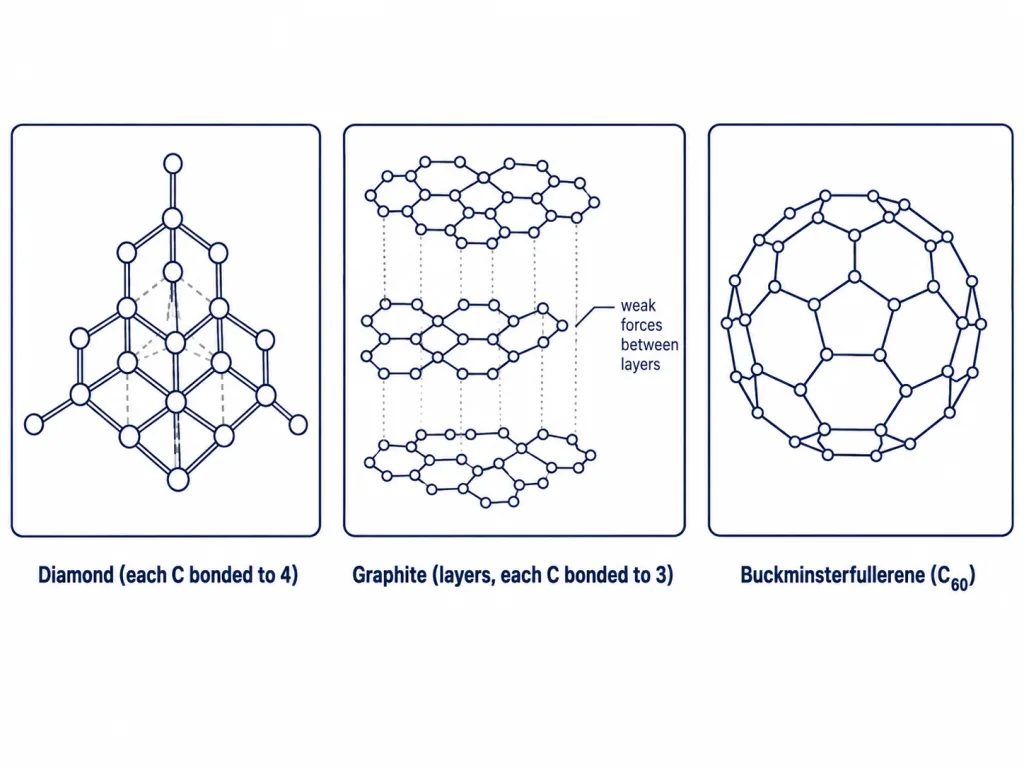
Allotropes of Carbon
Definition: Different physical forms of the same element are called allotropes.
Same chemical composition, different physical properties.
Why Allotropes Exist?
Same element atoms can be arranged differently → different properties.
Carbon has multiple allotropes — each with its own structure and uses.
Three Main Allotropes of Carbon
- Diamond — 3D rigid network.
- Graphite — 2D layered structure.
- Fullerene (Buckminsterfullerene) — football-like cage structure.
Plus modern discoveries: graphene (single layer of graphite), carbon nanotubes, etc.
Comparison Overview
| Allotrope | Structure | Hardness | Conductivity |
|---|---|---|---|
| Diamond | 3D network | Hardest | None |
| Graphite | 2D layers | Soft, slippery | Yes (electrical) |
| Fullerene | Cage | Variable | Variable |
Key Concept
Same atoms — different arrangement → completely different properties. This is why:
- Diamond is hard, graphite is soft.
- Diamond doesn't conduct, graphite does.
- Diamond is transparent, graphite is opaque.
Yet both are pure carbon!
Diamond — The Hardest Substance
Structure
Each C atom is bonded to 4 other C atoms in a tetrahedral arrangement. Bond angle: 109.5°. All 4 valence electrons are used in covalent bonds. Forms a 3D giant network.
No free electrons.
Properties of Diamond
1. Hardness:
- Hardest natural substance.
- Mohs scale: 10 (highest). Why? 3D rigid network with strong C-C bonds in all directions.
2. High melting point:
- ~3550°C.
- All bonds must break to melt.
- One of the highest melting points known.
3. Insulator (no electrical conduction):
- All electrons are in localised bonds.
- No free electrons.
4. Transparent:
- Pure diamond doesn't absorb visible light.
- Refractive index very high → sparkles brilliantly.
5. High density: ~3.5 g/cm³.
6. Non-reactive:
- Doesn't react with most chemicals at room temperature.
- Inert.
Uses of Diamond
1. Jewellery:
- Most famous use — engagement rings, necklaces.
- Sparkles due to refraction of light.
2. Cutting tools:
- Diamond-tipped drills (cutting glass, hard rocks).
- Diamond saws (cutting concrete, marble).
3. Polishing tools:
- Diamond powder for grinding wheels.
4. Surgical instruments:
- Sharp, sterile, doesn't corrode.
5. Heat sinks:
- High thermal conductivity (despite being electrical insulator).
- Used in electronics for cooling.
Synthetic Diamonds
Diamonds can be made artificially:
- High pressure + high temperature (HPHT method).
- Industrial use: cutting tools, electronics.
- Cheaper than natural — same chemical composition.
A Famous Fact
The famous 'Kohinoor' diamond — once part of India. Now in British Crown Jewels. Weight: 105.6 carats (1 carat = 200 mg).
Graphite — The Slippery Conductor
Structure
Each C atom is bonded to only 3 other C atoms in a flat hexagonal (planar) arrangement. Bond angle: 120°. The 4th valence electron is delocalised (free) — moves between atoms. Forms layers (sheets) of hexagons. Layers held together by weak van der Waals forces.
Free electrons → conductivity. Weak inter-layer forces → softness.
Properties of Graphite
1. Soft and Slippery:
- Layers slide over each other easily.
- Like sliding two sheets of paper. Reason: weak inter-layer forces.
2. Good Conductor of Electricity:
- Free (delocalised) electrons.
- Conducts along the layers. The only allotrope of carbon that conducts!
3. Lower density: ~2.2 g/cm³ (less than diamond).
4. Black and Opaque: Absorbs visible light.
5. Greasy to touch: Layers slip.
6. High melting point: ~3500°C (similar to diamond — strong intra-layer bonds).
Uses of Graphite
1. Pencils ('Lead' pencils):
- Despite name, pencils contain graphite, not lead.
- When you write, layers of graphite slip onto paper.
- Mixing with clay: HB, 2B, 4B etc. (more clay = harder, lighter).
2. Lubricants:
- In machines, locks, hinges.
- Layers slide easily — reduce friction.
- Solid lubricant — no liquid mess.
3. Electrodes:
- In dry cells, electrolytic cells, electric arc furnaces.
- Conducts electricity, withstands high temperature.
4. Carbon brushes in electric motors.
5. As a moderator in nuclear reactors (slows down neutrons).
Diamond vs Graphite — A Striking Contrast
| Property | Diamond | Graphite |
|---|---|---|
| Bonds per C atom | 4 | 3 |
| Structure | 3D tetrahedral | 2D hexagonal layers |
| Free electrons | 0 | 1 per C |
| Hardness | Hardest | Soft, slippery |
| Conductivity | None (insulator) | Yes (good conductor) |
| Density | 3.5 g/cm³ | 2.2 g/cm³ |
| Appearance | Transparent, sparkling | Black, opaque |
| Use | Jewellery, cutting | Pencils, electrodes, lubricant |
Same element (C), same chemical composition — vastly different properties due to arrangement.
Fullerene and Modern Carbon Allotropes
Fullerene () — 'Buckyball'
Discovered in 1985 by Kroto, Curl, and Smalley. Earned them the Nobel Prize in Chemistry (1996).
Structure
60 carbon atoms arranged in the shape of a football (soccer ball). 12 pentagons + 20 hexagons. Each C atom bonds to 3 others. Forms a closed cage (sphere).
Looks exactly like a soccer ball — that's why it's called 'buckyball' (after Buckminster Fuller, an architect who designed similar geodesic domes).
Properties
- Hollow cage structure.
- Stable.
- Soluble in some organic solvents (unlike diamond and graphite).
- Can encapsulate other atoms inside the cage.
Uses (Emerging Technology)
- Drug delivery (medicines inside cage, released at target).
- Solar cells.
- Lubricants.
- Superconductors.
- Catalysts.
Still being researched — many future applications.
Other Modern Allotropes
Graphene
A single 2D layer of graphite. One atom thick. Strongest known material (200× stronger than steel). Discovered in 2004 — Nobel Prize 2010. Excellent conductor. Used in: future electronics, batteries, materials.
Carbon Nanotubes
Cylindrical structures of carbon (rolled-up graphene). Very strong, very light. Used in: nanomedicine, electronics, sports equipment.
Other Forms
Lonsdaleite (hexagonal diamond), carbon foam, glassy carbon, etc.
Why So Many Allotropes?
Carbon's ability to bond with itself (catenation) + tetravalency = many possible structures.
Each structure → different properties.
Other elements: only 1-3 allotropes typically. Carbon: many — and counting!
A Glimpse of Carbon Allotropes
Carbon (C)
   |
   ├── Diamond (3D tetrahedral)
   ├── Graphite (2D hexagonal layers)
   ├── Fullerene C₆₀ (cage, 'buckyball')
   ├── Graphene (single layer)
   ├── Carbon nanotubes (cylindrical)
   └── ...other modern forms
All — same atoms, different arrangements.
🧠 Memory Capsule
A quick glance just before the board exam.
1. Why is Carbon Versatile?
Three reasons:
- Tetravalency (4 bonds)
- Catenation (long chains)
- Small atomic size (strong bonds)
2. Catenation
Ability of an element to form long chains by bonding with its own atoms.
Carbon — king of catenation. C-C bond strength: 348 kJ/mol.
Si (silicon) — same group but Si-Si only 222 kJ/mol → much less catenation.
3. Allotropes — Definition
Different physical forms of the same element. Same composition, different properties.
4. Three Main Allotropes of Carbon
Diamond
- Each C: 4 bonds.
- 3D tetrahedral network.
- Hardest substance.
- Insulator.
- Used: jewellery, cutting tools.
Graphite
- Each C: 3 bonds (1 free electron).
- 2D hexagonal layers.
- Soft, slippery, conductor.
- Used: pencils, lubricant, electrodes.
Fullerene (C₆₀ — Buckyball)
- Cage of 60 C atoms (12 pentagons + 20 hexagons).
- Football shape.
- Modern uses: drug delivery, electronics.
5. Diamond vs Graphite
| Property | Diamond | Graphite |
|---|---|---|
| Bonds per C | 4 | 3 |
| Free e⁻ | 0 | 1 |
| Conductivity | None | Yes |
| Hardness | Hardest | Soft |
6. Modern Allotropes
- Graphene — single layer of graphite, ultra-strong.
- Carbon nanotubes — rolled graphene cylinders.
- C₆₀ — buckyball.
7. Key Insight
Same element, same composition — different arrangement → different properties.
8. Board's 'Golden' Questions
- What is catenation? Why is C the king?
- Compare diamond and graphite.
- Define allotropes. Three allotropes of C.
- Why is graphite a conductor?
- Why is C versatile? Three reasons.
Final Formula: Tetravalency + catenation + small size = millions of carbon compounds = life itself.
Solved Examples
Example 1: NCERT — Catenation
What is catenation? Why is carbon the king of catenation?
Solution:
Definition
'Catenation' = property of an element to form long chains by bonding with its own atoms (covalently).
From Latin 'catena' = chain.
Carbon — Why the King?
1. Strong C-C bond:
- C-C bond energy: 348 kJ/mol.
- Stable in long chains.
- Doesn't break easily.
2. Small atomic size:
- C atomic radius: ~77 pm.
- Nucleus close to bonding electrons.
- Strong attraction → stable bonds.
3. Tetravalency:
- C forms 4 bonds.
- Allows complex chains, branches, rings.
Examples of Carbon Chains
Carbon can form:
- Linear chains: CH₃-CH₂-CH₂-… (alkane series)
- Branched chains: with side groups
- Ring (cyclic) compounds: like benzene, cyclohexane
- Long polymers: hundreds of C atoms
Examples:
- Methane (1 C), Ethane (2 C), Hexane (6 C), Decane (10 C), Cetane (16 C, in diesel)…
- Polythene: thousands of C atoms in a chain.
Comparison — Why Other Elements Can't?
Si (silicon) — same group:
- Si-Si bond: 222 kJ/mol (weaker).
- Si chains: 7-8 atoms max.
- Limited variety.
Other elements:
- N-N: weak
- O-O: weak (so peroxides are unstable)
- S-S: medium (some catenation in S₈)
- P-P: medium
None come close to carbon.
Result of Catenation
Carbon's catenation + tetravalency = >10 million compounds. All other elements combined: <1 million compounds.
This is why life is carbon-based.
[NCERT — fundamental]
Example 2: NCERT — Allotropes
What are allotropes? Give three allotropes of carbon with their properties.
Solution:
Definition
'Allotropes' = different physical forms of the same element. Same chemical composition, different physical properties.
Difference comes from arrangement of atoms.
Three Allotropes of Carbon
1. Diamond
Structure:
- Each C bonded to 4 others.
- 3D tetrahedral network.
- Bond angle 109.5°.
Properties:
- Hardest natural substance.
- M.P. ~3550°C.
- Insulator (no free electrons).
- Transparent.
- Density: 3.5 g/cm³.
Uses:
- Jewellery.
- Cutting tools.
- Drilling rocks.
2. Graphite
Structure:
- Each C bonded to 3 others.
- 2D hexagonal layers.
- Bond angle 120°.
- 1 electron per C is free.
- Layers held by weak van der Waals forces.
Properties:
- Soft, slippery.
- Good electrical conductor.
- Black, opaque.
- Density: 2.2 g/cm³.
- M.P. ~3500°C.
Uses:
- Pencils ('lead' pencils).
- Lubricant in machines.
- Electrodes (dry cells, electrolysis).
- Carbon brushes in motors.
3. Fullerene (C₆₀ — Buckyball)
Structure:
- 60 C atoms.
- Football shape (12 pentagons + 20 hexagons).
- Hollow cage.
Properties:
- Soluble in some organic solvents.
- Can encapsulate other atoms.
- Stable.
Uses:
- Drug delivery.
- Solar cells.
- Superconductors.
Other Modern Allotropes
- Graphene (single graphite layer)
- Carbon nanotubes
- Lonsdaleite (hexagonal diamond)
Key Insight
Same element, same atoms, different arrangement → drastically different properties.
This is the beauty of allotropy.
[NCERT — important, every year]
Example 3: NCERT — Diamond vs Graphite
Compare diamond and graphite — structure, properties, and uses.
Solution:
Comparison Table
| Property | Diamond | Graphite |
|---|---|---|
| Bonds per C atom | 4 | 3 |
| Structure | 3D rigid network | 2D hexagonal layers |
| Bond angle | 109.5° | 120° |
| Free electrons | None (all in bonds) | 1 per C atom (delocalised) |
| Hardness | Hardest natural substance | Soft, slippery |
| Density | 3.5 g/cm³ | 2.2 g/cm³ |
| Appearance | Transparent, sparkling | Black, opaque |
| Conductivity (electric) | None (insulator) | Good conductor |
| Conductivity (thermal) | Excellent | Good |
| Melting point | ~3550°C | ~3500°C |
| Refractive index | High (sparkles) | Low |
Reason for Difference — Same Element!
Both are pure carbon. Difference comes from how atoms are arranged.
Diamond
- Each C uses all 4 electrons in tetrahedral bonds.
- 3D network — bonds in all directions.
- Result: rigid, hard, no free electrons.
Graphite
- Each C uses only 3 electrons in flat hexagonal bonds.
- 1 electron free per atom — delocalised.
- 2D layers held weakly together.
- Result: soft, conducting, slippery.
Uses Comparison
Diamond
- Jewellery (sparkles).
- Cutting tools (hardness).
- Drilling rocks.
- Polishing.
- Surgical instruments.
Graphite
- Pencils (slides on paper).
- Lubricant (in machines).
- Electrodes (conductivity).
- Carbon brushes (motors).
- Moderator in nuclear reactors.
Common Properties
Despite differences:
- Both have very high melting points (strong C-C bonds).
- Both are pure carbon.
- Both are stable allotropes.
- Both are non-reactive at room temperature.
A Beautiful Lesson
Same element, same atoms — yet completely different properties. A perfect example of how structure determines function in chemistry.
'You can't make diamonds from coal' — but you CAN! Both are carbon, just different arrangements.
[NCERT — every year]
Example 4: NCERT — Why Carbon is Versatile
Give three reasons why carbon forms a large number of compounds.
Solution:
Three Main Reasons
1. Tetravalency
Carbon has 4 valence electrons. Forms exactly 4 covalent bonds.
These bonds can be:
- 4 single bonds.
- 2 single + 1 double.
- 1 single + 1 triple.
- 2 double bonds.
This flexibility allows many bond arrangements.
Examples:
- (4 single bonds with H)
- (2 double bonds with O)
- (1 double bond with C, 2 single with H)
- (1 triple bond with C, 1 single with H)
2. Catenation
Carbon can bond with its own atoms to form long chains. Forms straight chains, branched chains, rings.
Why?
- C-C bond very strong (348 kJ/mol).
- Stable even in long chains.
Examples:
- Methane (1 C)
- Ethane (2 C)
- Octane (8 C, in petrol)
- Polymers (thousands of C atoms)
Cyclic compounds:
- Benzene (6 C ring)
- Cyclohexane (6 C ring)
3. Small Atomic Size
Carbon is a small atom (radius ~77 pm).
Result:
- Nucleus close to bonding electrons.
- Strong attraction → stable bonds.
- Bonds don't break easily.
Other group 14 elements (Si, Ge, Sn, Pb):
- Larger atoms.
- Weaker bonds.
- Less catenation.
- Fewer compounds.
Combined Effect
Tetravalency + catenation + small size = enormous variety of compounds.
Carbon forms:
- 10+ million different compounds.
- More than all other elements combined.
Result
This versatility makes carbon the basis of all life on Earth.
Every living thing — from bacteria to humans — is built on carbon's framework.
Hence the term: organic chemistry = chemistry of carbon compounds.
[NCERT — every year, important]
Example 5: Fullerene (C₆₀)
What is fullerene? Describe its structure and uses.
Solution:
Discovery
Fullerene was discovered in 1985 by:
- Harold Kroto (UK)
- Robert Curl (USA)
- Richard Smalley (USA)
They received Nobel Prize in Chemistry (1996) for this discovery.
Naming
Named 'Buckminsterfullerene' after Buckminster Fuller, an architect who designed similar geodesic domes.
Often called 'buckyball' for short.
Structure
60 carbon atoms arranged like a football (soccer ball):
- 12 pentagons (5-sided)
- 20 hexagons (6-sided)
- Total: 32 faces, 60 vertices, 90 edges.
Each C atom bonds to 3 other C atoms.
Forms a hollow cage (sphere) — like a soccer ball.
Diameter: ~1 nanometre (10⁻⁹ m).
Properties
- Soluble in some organic solvents (unlike diamond and graphite).
- Stable.
- Cage-like structure can hold other atoms inside.
- Crystalline; soft.
- Black solid.
Uses (Cutting-Edge)
1. Drug Delivery
Medicines can be encapsulated inside the cage. Released at target location in body. Used in cancer therapy research.
2. Solar Cells
Used as electron acceptor in organic solar cells. Improves efficiency.
3. Lubricants
Spherical shape — rolls smoothly between surfaces. Used as 'molecular ball bearings'.
4. Superconductors
Some fullerene compounds are superconductors at low temperatures.
5. Catalysts
Used in chemical reactions to speed them up.
Other Fullerenes
Apart from , other fullerenes exist:
- …up to thousands of C atoms.
Each — slightly different shape.
A Modern Allotrope
Fullerene is a third major allotrope of carbon (after diamond and graphite).
Discovered very recently (1985) — shows that even today, new things are discovered about carbon!
This led to discovery of:
- Carbon nanotubes (1991)
- Graphene (2004)
Carbon — still surprising us.
[NCERT — important]
Example 6: Why Catenation is Limited in Other Elements
Why can't elements like Si, N, S form long chains like carbon?
Solution:
Bond Energy Comparison
Bond strength determines if catenation is feasible:
| Bond | Energy (kJ/mol) |
|---|---|
| C-C | 348 (strong) |
| Si-Si | 222 (medium-weak) |
| N-N | 163 (weak) |
| O-O | 146 (very weak) |
| S-S | 268 (medium) |
| P-P | 213 (medium) |
Higher energy = more stable chain.
Carbon — Strongest Self-Bond
C-C bond is the strongest among same-element bonds. Hence carbon chains are stable. Long chains form without breaking.
Silicon — Why Not?
Si is in same group (14) as C. Has 4 valence electrons. Si-Si bond: 222 kJ/mol (weaker).
Why weaker?
- Si is larger atom.
- Bonding electrons farther from nucleus.
- Weaker attraction.
- Weaker bond.
Result: Si chains break after 7-8 atoms. No silicon-based life can exist (theoretically) — chains too short.
Nitrogen and Oxygen — Why Not?
N and O atoms have lone pairs (unbonded electrons). Lone pairs repel each other. Weakens N-N and O-O bonds.
Result:
- N₂H₄ (hydrazine) — only 2 N.
- H₂O₂ (hydrogen peroxide) — only 2 O, unstable.
- N or O chains beyond 2-3 atoms — rare.
Sulphur — Some Catenation
Sulphur can form S₈ ring (8 atoms). S-S bond is medium strength. S₈ is the most common form of sulphur.
But still — much less than carbon.
Why Carbon is Unique
Three factors combine:
1. Strong C-C bond (348 kJ/mol). 2. No lone pairs to weaken bonds. 3. Small atomic size for strong overlap. 4. Tetravalency — forms many directions of bonds.
No other element has all four properties together.
Conclusion
Catenation is limited in:
- Si: bond too weak (atom too large).
- N, O: lone pair repulsion.
- Other elements: various reasons.
Carbon: king of catenation — unmatched.
This uniqueness is why organic chemistry exists as a separate branch — carbon's diversity is just too large to ignore.
[Board: 5-mark]
Example 7: NCERT — Why Graphite Conducts but Diamond Doesn't
Why is graphite a good conductor of electricity, but diamond is not?
Solution:
The Fundamental Difference
Conduction needs: free charge carriers (electrons or ions).
Diamond Structure
Each C atom uses all 4 valence electrons in covalent bonds with 4 other C atoms.
All electrons are localised in C-C bonds. No free electrons. Hence: no conduction.
Diamond is one of the best electrical insulators known.
Graphite Structure
Each C atom uses only 3 valence electrons in covalent bonds.
The 4th valence electron is free (delocalised). This electron moves between atoms freely (like electrons in metals). Result: electric current can flow.
Hence graphite is a good conductor.
Visualising It
Diamond:                Graphite:
    C                       C
   /|\                     /|
  C C C                   C-C-C    + free e⁻
   \|/                     \|       (between layers)
    C                       C

All 4 e⁻ bonded         3 e⁻ bonded, 1 free
No conduction           Yes conduction
Quantitative Comparison
| Property | Diamond | Graphite |
|---|---|---|
| Bonded e⁻ per C | 4 | 3 |
| Free e⁻ per C | 0 | 1 |
| Resistance | ~10²⁰ Ω·cm | ~10⁻⁵ Ω·cm |
| Conduction | Insulator | Conductor |
Practical Demonstration
Connect a battery and bulb to:
Diamond:
- Bulb does not glow.
- No current flows.
Graphite (e.g., pencil lead):
- Bulb glows.
- Current flows.
Practical Uses Linked to Conductivity
Graphite's conductivity is exploited:
- Electrodes in batteries, fuel cells, electrolysis.
- Carbon brushes in motors and dynamos.
- Moderator in nuclear reactors (slows neutrons).
- Lightning protection.
Diamond's insulating property:
- Cooling layer in some electronics (high thermal conductivity, no electrical).
The Key Insight
Same element, same atoms — but arrangement changes everything.
This is one of the most beautiful examples in chemistry of how structure determines function.
[NCERT — every year]
Example 8: Calculating Bonds in Allotropes
In 1 mole of diamond and 1 mole of graphite, how many C-C bonds are there?
Solution:
Setup
1 mole of any allotrope has C atoms (Avogadro's number).
Diamond
Each C has 4 bonds with other C atoms. But each bond is counted twice (once from each atom).
Total bonds = .
Bonds in 1 mole = bonds.
Graphite
Each C has 3 bonds with other C atoms (the 4th electron is free). Each bond counted twice.
Total bonds = .
Bonds in 1 mole = bonds.
Comparison
| Allotrope | Bonds per C | Total bonds (1 mol) |
|---|---|---|
| Diamond | 4 | |
| Graphite | 3 |
Diamond has more total bonds → more bond energy → harder.
Bond Energy Calculation
Bond energy of C-C = 348 kJ/mol
1 mole of diamond:
- 1.2 × 10²⁴ bonds = 2 mol of bonds = kJ
This is the energy needed to break all C-C bonds in 1 mole of diamond.
1 mole of graphite:
- 9.03 × 10²³ bonds = 1.5 mol of bonds = kJ
Why Diamond Stronger?
Per C atom:
- Diamond: 4 bonds → more total bond energy.
- Graphite: 3 bonds → less total bond energy.
But graphite has layers — these are held by very weak forces, so graphite breaks at the layer level (soft).
Diamond — no weak point — hardest.
A Reflection
Diamond has the most C-C bonds. Hence the hardest. Hence prized as the symbol of strength and permanence.
'Diamonds are forever' — true at the molecular level too.
[Board: 3-5 mark numerical]
Example 9: NCERT — Pencils Have 'Lead'?
Why do we say pencils have 'lead' when they actually contain graphite? What is in pencils?
Solution:
A Historical Confusion
Long ago, people thought a soft, dark mineral they used for writing was lead (the metal). Hence the name 'lead pencil'.
In 1564, in Borrowdale, England, a large deposit of soft black mineral was found. People used it for writing. Called it 'plumbago' or 'black lead'.
The Truth
Later (1779), it was identified as a form of carbon — graphite.
Despite the discovery, the name 'lead pencil' stuck.
Even today: pencils contain graphite, not lead (no lead at all!).
What's in Pencils?
Pencil 'lead' is actually:
- Graphite (gives the dark mark).
- Clay (binder, also adjusts hardness).
- Wax (smooth gliding).
Hardness Grades
Different grades of pencils — different ratios of graphite : clay:
| Grade | Graphite | Clay | Hardness |
|---|---|---|---|
| 6B | More | Less | Very soft, very dark |
| 4B | More | Less | Soft, dark |
| 2B | More | Some | Soft, dark |
| HB | Equal | Equal | Medium (most common) |
| 2H | Less | More | Hard, lighter |
| 4H | Less | More | Very hard, very light |
| 6H | Less | More | Extreme hard |
'B' = soft (Bold), 'H' = hard, 'F' = fine. '2B' = softer than 'B'. '2H' = harder than 'H'.
How Does a Pencil Write?
When you press the pencil on paper:
- Friction breaks weak inter-layer bonds in graphite.
- Layers slide off and stick to paper.
- Visible mark.
This is possible because graphite layers are held by weak van der Waals forces.
Why Not Diamond Pencils?
If we made pencils of diamond:
- Diamond is the hardest substance.
- It would scratch the paper, not leave a mark.
- Plus, diamond is too expensive!
A Lesson
The same element (carbon), in two different allotropic forms:
- Diamond: hardest substance, scratches everything.
- Graphite: soft, slides off on paper.
A perfect lesson — structure decides function.
[Board + General Knowledge]
Example 10: Properties of Different Allotropes
Fill in the blanks with the right allotrope (diamond, graphite, fullerene):
(a) Used in jewellery: _ (b) Used in pencils: (c) Used in lubricants: (d) Hardest natural substance: (e) Has free electrons: (f) Used as electrodes: (g) Football-shaped molecule: (h) Used for cutting glass: (i) Has 60 carbon atoms: (j) Insulator (non-conductor): _
Solution:
(a) Used in jewellery: Diamond
Sparkling, transparent, hard.
(b) Used in pencils: Graphite
Soft, slides on paper.
(c) Used in lubricants: Graphite
Layers slide easily — reduces friction.
(d) Hardest natural substance: Diamond
3D rigid network.
(e) Has free electrons: Graphite
1 free electron per C — delocalised.
(f) Used as electrodes: Graphite
Conducts electricity.
(g) Football-shaped molecule: Fullerene (C₆₀)
60 atoms, 12 pentagons + 20 hexagons.
(h) Used for cutting glass: Diamond
Hardness allows it to scratch glass.
(i) Has 60 carbon atoms: Fullerene (C₆₀)
Buckminsterfullerene.
(j) Insulator (non-conductor): Diamond
All electrons in bonds — no free electrons.
Summary Table
| Allotrope | Key uses |
|---|---|
| Diamond | Jewellery, cutting, drilling, polishing |
| Graphite | Pencils, lubricants, electrodes, brushes |
| Fullerene | Drug delivery, solar cells, electronics |
Key Insight
Each allotrope has unique uses based on its structure-property relationship.
[Board: 3-5 mark MCQ-style]
Example 11: NCERT — How Diamond and Graphite Are Made (Synthesis)
How are synthetic diamonds and graphite made?
Solution:
Synthetic Diamond
HPHT Method (High Pressure High Temperature)
Mimics conditions deep underground where natural diamonds form.
Conditions:
- Pressure: very high (50,000-100,000 atm).
- Temperature: very high (~1500°C).
Process:
- Take graphite (or other carbon source).
- Apply high pressure and temperature.
- Carbon atoms rearrange from graphite (2D layers) into diamond (3D tetrahedral).
- Cool slowly.
Result: synthetic diamond — chemically identical to natural.
CVD Method (Chemical Vapour Deposition)
Modern method (less expensive).
Process:
- Carbon-rich gas (methane).
- Heated to plasma.
- C atoms deposit on a surface, forming diamond layer.
Used for industrial diamonds and high-tech applications.
Industrial Use of Synthetic Diamonds
Most diamonds used in cutting tools and drilling are synthetic (cheaper, controllable size).
Natural diamonds are mostly for jewellery.
Synthetic Graphite
Made from carbon-rich materials (coal, petroleum coke).
Process:
- Petroleum coke is heated to ~3000°C.
- Carbon atoms rearrange into graphite layers.
- Forms 'electrographite' — high-purity graphite.
Uses:
- Electrodes for steel-making (electric arc furnaces).
- Battery electrodes.
- Pencils (with clay added).
Diamond ↔ Graphite Conversion
Theoretically possible:
Graphite → Diamond:
- Needs very high pressure + temperature.
- HPHT method.
Diamond → Graphite:
- Needs only high temperature (~1500°C).
- Diamond is metastable at normal conditions.
- But the conversion is so slow that diamonds last millions of years!
A famous saying: 'Diamonds are forever.' Technically false — they slowly convert to graphite. But practically true — at normal temperatures, the conversion is incredibly slow.
Cost Comparison
Natural diamond (1 carat = 200 mg): ₹50,000+. Synthetic diamond (1 carat): ₹20,000-30,000. Industrial diamond grit: ₹500-1000 for grams.
Natural is more expensive only because of marketing — chemically and physically, they're identical.
[Board + General Knowledge]
Example 12: NCERT — Tetravalency Allows Variety
How does tetravalency of carbon contribute to its versatility?
Solution:
Carbon's Tetravalency
4 valence electrons → 4 covalent bonds.
Possible Bond Combinations
1. Four single bonds
Each bond connects to a different atom or group.
Examples:
- : 4 C-H single bonds.
- : 4 C-Cl single bonds.
- : 3 C-H + 1 C-Cl.
- : 2 C-H + 2 C-Cl.
- : 3 C-H + 1 C-O.
This allows different atoms to attach.
2. Multiple bonds with one atom
Carbon can form double or triple bonds.
Double bond examples:
- : O=C=O (2 double bonds).
- (ethene): 1 C=C double + 4 C-H singles.
- (formaldehyde): 1 C=O.
Triple bond examples:
- (ethyne): 1 C≡C triple + 2 C-H singles.
- (carbon monoxide): 1 C≡O.
3. Combinations of single + multiple
Many possibilities by combining different bond types.
Example: vinyl chloride — has C=C double + C-H singles + C-Cl single.
Variety of Compounds Formed
With Hydrogen
, , , … (alkane series) , , … (alkene series) , , … (alkyne series)
With Oxygen
Alcohols (-OH): , Aldehydes (-CHO): , Ketones (>C=O): Acids (-COOH): , Ethers (-O-): Esters (-COO-): used in flavours, perfumes
With Nitrogen
Amines (-NH₂) Amides (-CONH₂) Nitriles (-C≡N) Proteins (long N-containing chains)
With Sulphur
Thiols (-SH) In garlic, onion compounds.
With Halogens
Chlorides, bromides, iodides. Refrigerants, plastics, anaesthetics.
The Power of Tetravalency
Combining tetravalency + catenation:
- Methane only: 1 compound.
- 2 carbon compounds: dozens.
- 3 carbon compounds: hundreds.
- Long chains: millions of compounds!
And we haven't even touched on rings yet (Section 4).
Why So Many?
Each different combination of:
- Number of C atoms.
- Bond types (single, double, triple).
- Other elements attached (H, O, N, S, halogens).
- Arrangements (straight, branched, ring).
→ different compound.
Result: >10 million carbon compounds.
And this number keeps growing — chemists discover/synthesise new ones every day!
Conclusion
Tetravalency = unlimited possibility for carbon. This is the reason carbon is so versatile.
[NCERT — important]
Example 13: An Interesting — Why Diamond Burns
Is diamond a fuel? Can it burn?
Solution:
Yes, Diamond CAN Burn!
Despite being so hard and stable, diamond is also pure carbon. And carbon burns in oxygen to form CO₂.
The Combustion Reaction
Same reaction as burning coal.
What Conditions Are Needed?
Diamond ignition temperature: ~700-900°C. In pure oxygen: it burns relatively easily. In air (only 21% O₂): needs higher temperature, slower.
Practical Demonstration
Heat a diamond to a very high temperature in oxygen-rich environment. It will glow and burn — eventually disappearing as CO₂.
This experiment was first done by Antoine Lavoisier in 1772 — he proved diamond is just carbon.
Why Doesn't Diamond Burn at Normal Conditions?
At room temperature:
- Diamond is metastable — it can theoretically burn, but the activation energy is very high.
- The C-C bonds are very strong.
- Reaction with O₂ is very slow at low temperature.
Hence: practically, diamonds last forever (at room temperature).
Comparison: Diamond vs Graphite vs Coal
All are pure carbon. All can burn. But:
| Substance | Ignition temp | Why |
|---|---|---|
| Coal/charcoal | ~400-500°C | Loose, porous structure |
| Graphite | ~600-700°C | Layered structure |
| Diamond | ~700-900°C | Tightly packed 3D network |
Practical Implications
1. Diamonds are not used as fuel — they're too valuable!
2. But scientifically, the lesson is:
- Form (diamond, graphite, coal) doesn't change chemistry.
- Only rate of reaction differs.
3. Lavoisier's experiment proved that allotropes are chemically identical — just physically different.
A Beautiful Idea
A diamond, the symbol of permanence and beauty, is just carbon — same as coal in your stove. The difference: arrangement of atoms.
This shows that structure matters more than composition in determining properties.
[Board + General Knowledge]
Example 14: A Comparative — Allotropes of Other Elements
Does any other element have allotropes? Compare with carbon.
Solution:
Other Elements with Allotropes
1. Oxygen
Two main allotropes:
Dioxygen (O₂):
- Common atmospheric oxygen.
- Essential for life.
- Molecular formula: O₂.
Ozone (O₃):
- Found in the upper atmosphere (ozone layer).
- Protects us from UV radiation.
- Molecular formula: O₃.
- Different chemical properties from O₂.
2. Sulphur
Several allotropes:
- Rhombic sulphur (S₈ rings, yellow crystals)
- Monoclinic sulphur (S₈ rings, but different crystal arrangement)
- Plastic sulphur (long chains, formed when molten S is cooled rapidly)
3. Phosphorus
White phosphorus (P₄):
- Reactive, glows in dark.
- Used in matches.
- Tetrahedral P₄ molecules.
Red phosphorus:
- Less reactive, more stable.
- Used in matches, fireworks.
Black phosphorus:
- Layered structure (like graphite).
- Conducts electricity.
4. Tin
White tin (β-tin):
- Common form, metallic.
- Used in tin cans.
Grey tin (α-tin):
- Brittle, semiconductor.
- Forms below 13°C. Causes 'tin pest' — old tin objects crumble in cold.
Comparison with Carbon
| Element | Major Allotropes | Key Variety |
|---|---|---|
| Carbon | Diamond, graphite, fullerene, graphene, nanotubes, etc. | >10 forms |
| Oxygen | O₂, O₃ | 2 |
| Sulphur | Rhombic, monoclinic, plastic, etc. | ~6 |
| Phosphorus | White, red, black | 3 |
| Tin | White, grey | 2 |
Carbon is unique — has the most allotropes of any element.
Why Carbon Has So Many?
Three reasons:
1. Tetravalency: 4 bonds → many possible 3D arrangements.
2. Catenation: long chains, rings, networks possible.
3. Strong bonds: stable in many configurations.
Combined: many stable arrangements → many allotropes.
Implications
Each allotrope of each element has different properties.
This shows:
- Composition (what atoms) is one factor.
- Structure (how arranged) is another, equally important factor.
This is why structure-property relationship is a fundamental theme in chemistry.
From simple molecules to complex materials — structure determines function.
[Board + General Knowledge]
Example 15: A Concluding Question
(a) Define catenation. (b) State three reasons for carbon's versatility. (c) Compare diamond and graphite (table). (d) What is fullerene?
Solution:
(a) Catenation
'Catenation' = property of an element to form long chains by bonding with its own atoms (covalently).
Carbon — king of catenation:
- C-C bond: very strong (348 kJ/mol).
- Stable chains, rings, branches.
Examples: methane, ethane, propane, … long polymers.
(b) Three Reasons for Carbon's Versatility
1. Tetravalency 4 valence electrons → 4 covalent bonds. Bonds can be single, double, or triple. Allows variety in bond combinations.
2. Catenation Carbon bonds with itself extensively. Forms straight chains, branched chains, rings. Stable C-C bonds.
3. Small atomic size Carbon is in Period 2 — small. Strong nucleus pull on bonding electrons. Stable, strong bonds.
Combined: >10 million carbon compounds.
(c) Diamond vs Graphite
| Property | Diamond | Graphite |
|---|---|---|
| Bonds per C | 4 | 3 |
| Free electrons | 0 | 1 per C |
| Structure | 3D tetrahedral | 2D hexagonal layers |
| Hardness | Hardest | Soft |
| Conductivity | None | Yes |
| Density | 3.5 g/cm³ | 2.2 g/cm³ |
| Appearance | Transparent, sparkling | Black, opaque |
| Use | Jewellery, cutting | Pencils, lubricant, electrodes |
Same element, different structure → different properties.
(d) Fullerene
A modern allotrope of carbon — discovered 1985 (Nobel 1996).
Structure:
- 60 C atoms (most common: ).
- Football shape (12 pentagons + 20 hexagons).
- Hollow cage.
- Each C bonded to 3 others.
Properties:
- Soluble in some organic solvents.
- Can encapsulate other atoms.
- Stable.
Uses:
- Drug delivery.
- Solar cells.
- Superconductors.
- Catalysts.
Named after Buckminster Fuller (architect of geodesic domes). Often called 'buckyball'.
Final Insight
Carbon is uniquely versatile because of its:
- Bonding (tetravalent, covalent)
- Self-bonding (catenation)
- Structure (small atom, strong bonds)
- Allotropic variety (diamond, graphite, fullerene, etc.)
This is why organic chemistry (study of carbon compounds) is one of the largest branches of chemistry.
[Board: 5-mark mixed]
Example 16: Application — Carbon in Everyday Life
Give examples of how each carbon allotrope is used in daily life.
Solution:
Diamond — Daily and Professional Uses
1. Jewellery
Engagement rings, necklaces, earrings. Worth lakhs of rupees per piece. Symbol of luxury, love, permanence.
2. Cutting and Drilling
Diamond-tipped tools cut concrete, glass, marble. Used in construction, manufacturing. Diamond saws cut through hard rocks.
3. Surgical Tools
Sharp diamond scalpels for delicate eye surgery. Sterile, precise.
4. Polishing
Diamond paste/powder used to polish other diamonds, gemstones, metals.
5. Heat Sinks (electronics)
High thermal conductivity helps remove heat from chips. Used in some high-end electronics.
Graphite — Everyday Uses
1. Pencils
The most common use! From schoolchildren to artists. Different grades (HB, 2B, 4B…) for different needs.
2. Lubricants
In machine oil, gear boxes. In locks (graphite powder). In hinges, doors. Good because it's solid (no liquid mess).
3. Dry Cell Batteries
Central electrode of zinc-carbon battery is graphite rod. Conducts electricity well.
4. Carbon Brushes
In electric motors (washing machines, fans, mixers, drills). Conducts electricity to spinning parts. Replaces brushes when worn.
5. Electrodes
In electrolysis (industrial processes like aluminium extraction). In electric arc furnaces (steel-making).
6. Graphite Sheets
Used in heat shields (e.g., spacecraft). In fuel cells.
Fullerene — Modern Uses
Still mostly experimental, but growing applications:
1. Medicine
Drug delivery — wrapping medicines in fullerene cages, releasing at target. Cancer therapy research.
2. Electronics
In some experimental solar cells. In organic LEDs.
3. Materials
Strengthening agent in some plastics. Lubricants (rolls smoothly).
Carbon Nanotubes (Modern Allotrope)
Cutting-edge applications:
- Sports equipment (tennis rackets, bike frames).
- Bulletproof vests.
- Nanomedicine.
- Future electronics.
Graphene (Modern Allotrope)
Single-layer graphite:
- Future flexible electronics.
- Fast-charging batteries.
- Water filtration.
- Super-strong materials.
A Lesson in Material Science
Each allotrope has unique uses based on its structure.
From the pencil in a schoolchild's hand to the diamond on a queen's crown — all are carbon.
The arrangement makes all the difference.
This is why material science is so exciting — discovering new arrangements creates new possibilities.
[Practical Application]