
Ethanol — A Most Important Alcohol
Ethanol () is one of the most important organic compounds — used as drink, fuel, solvent, and disinfectant.
Physical Properties
- Colourless liquid.
- Sweet smell.
- Boiling point: 78°C (low — easy to vaporise).
- Highly soluble in water (any ratio).
- Volatile (evaporates easily).
- Density: 0.789 g/mL (less than water).
Sources of Ethanol
1. Fermentation
Sugars + yeast → ethanol + CO₂ (alcoholic beverages).
Reaction:
Used to make:
- Wine (from grapes).
- Beer (from malted barley).
- Whisky, vodka (from grains).
Process called 'fermentation' — bacteria/yeast convert sugars to alcohol.
2. Industrial Method (from Ethene)
Ethene + water → ethanol (with sulphuric acid catalyst).
Used for industrial-grade ethanol.
Chemical Reactions of Ethanol
1. Combustion
Burns with blue flame, releases heat. Used as fuel additive (E10, E20 petrol).
2. Reaction with Sodium
Ethanol's -OH H is slightly acidic.
Sodium ethoxide + hydrogen gas. Slow reaction — small bubbles. Used as test for alcohols.
3. Oxidation to Ethanoic Acid
Strong oxidising agents convert ethanol to acetic acid. Industrial method for vinegar.
4. Dehydration to Ethene
With concentrated at 170°C:
Acid removes water → ethene. Reverse of industrial method!
Uses of Ethanol
1. Alcoholic beverages. Beer, wine, spirits — industrial production worldwide.
2. Solvent. Dissolves many organic compounds. Used in cosmetics, perfumes, drugs.
3. Disinfectant. 70% ethanol kills bacteria. Used in hand sanitisers, hospital cleaning.
4. Fuel. Mixed with petrol (E10, E20). Brazil produces ethanol from sugarcane on large scale. Renewable, cleaner than petrol.
5. Antifreeze. In some applications (mostly using ethylene glycol now).
6. Synthesis. Starting material for many chemicals.
Health and Social Effects
While ethanol has many uses, drinking it has serious effects:
Short-term (drunkenness):
- Slowed reflexes.
- Impaired judgment.
- Slurred speech.
- Loss of coordination.
Long-term (alcoholism):
- Liver damage.
- Heart disease.
- Mental health issues.
- Social problems.
Many countries regulate alcohol consumption — India: limits, age restrictions.
Drinking pure ethanol or methanol is lethal. Methanol especially dangerous — causes blindness or death.
A Note on Methanol
Methanol (CH₃OH) is NOT safe to drink — it's toxic! Causes blindness, even death. 'Wood alcohol' — historical name from production from wood distillation. Used as industrial solvent, fuel additive.
Ethanoic Acid (Acetic Acid)
Ethanoic acid () — the second most important organic compound after ethanol.
Common name: acetic acid. Found in vinegar (5-8% solution in water).
Physical Properties
- Colourless liquid.
- Pungent, sharp smell (vinegar smell).
- Sour taste (used in food).
- Boiling point: 118°C (higher than ethanol due to H-bonding).
- Melting point: 16.6°C (freezes in cold weather → 'glacial acetic acid').
- Highly soluble in water.
Why 'Glacial Acetic Acid'?
Pure ethanoic acid (no water) freezes at 16.6°C. In cold winters, pure acetic acid forms ice-like crystals. Hence called 'glacial' (ice-like) acetic acid.
Sources of Acetic Acid
1. From Ethanol (Industrial)
Most common method.
Used to make vinegar — bacteria oxidise ethanol.
2. From Ethyne
Industrial chemical method.
Multi-step.
3. From Methanol (Modern)
With CO and a catalyst.
Most modern industrial route — efficient and cheap.
Chemical Reactions of Acetic Acid
1. Acidic Properties
Releases H⁺ in water:
pKa = 4.76 (weakly acidic). Sour taste, turns blue litmus red.
2. With Bases — Neutralisation
Produces sodium acetate (used in food, leather industry).
3. With Metals
Like other acids, reacts with active metals.
4. With Carbonates and Bicarbonates
Produces CO₂ — like with HCl.
This is why vinegar + baking soda → fizzing (CO₂ bubbles)!
5. Esterification (Important!)
Acetic acid + alcohol → ester + water.
Product: ethyl acetate (an ester) — sweet smell.
Esters are responsible for fragrances:
- Banana smell.
- Apple smell.
- Rose perfume.
Used in flavours, perfumes, paints, glues.
Uses of Acetic Acid
1. Vinegar. Food preservation, salad dressing, cooking, pickling.
2. Industrial. Production of:
- Plastics (PVA, cellulose acetate).
- Pharmaceuticals (aspirin).
- Solvents.
- Dyes.
3. Photography. Used to fix photos (now historical).
4. Rubber industry. Coagulating latex.
5. Laboratory. Buffer solutions. Reagent.
Why Vinegar in Food?
Vinegar (5-8% acetic acid):
- Adds sour taste.
- Acts as preservative (kills bacteria).
- Used in pickles, sauces.
- Helps in tenderising meat.
A Comparison
| Property | Ethanol | Acetic Acid |
|---|---|---|
| Smell | Mild, sweet | Pungent, sharp |
| Taste | (Pure: tasteless) | Sour |
| Acidic? | No | Yes (weak) |
| With Na | Reacts (slow) | Reacts (faster) |
| With NaOH | No | Reacts (neutralisation) |
| pH | ~7 (neutral) | ~3 (acidic) |
| With Na₂CO₃ | No | CO₂ released |
Same elements (C, H, O), but very different chemistry due to functional groups. Ethanol: -OH (alcohol). Acetic acid: -COOH (carboxylic acid).
Soaps — Cleaning Power of Chemistry
Soaps are sodium salts of long-chain fatty acids.
A soap molecule has two parts — a fundamental insight!
Structure of a Soap Molecule
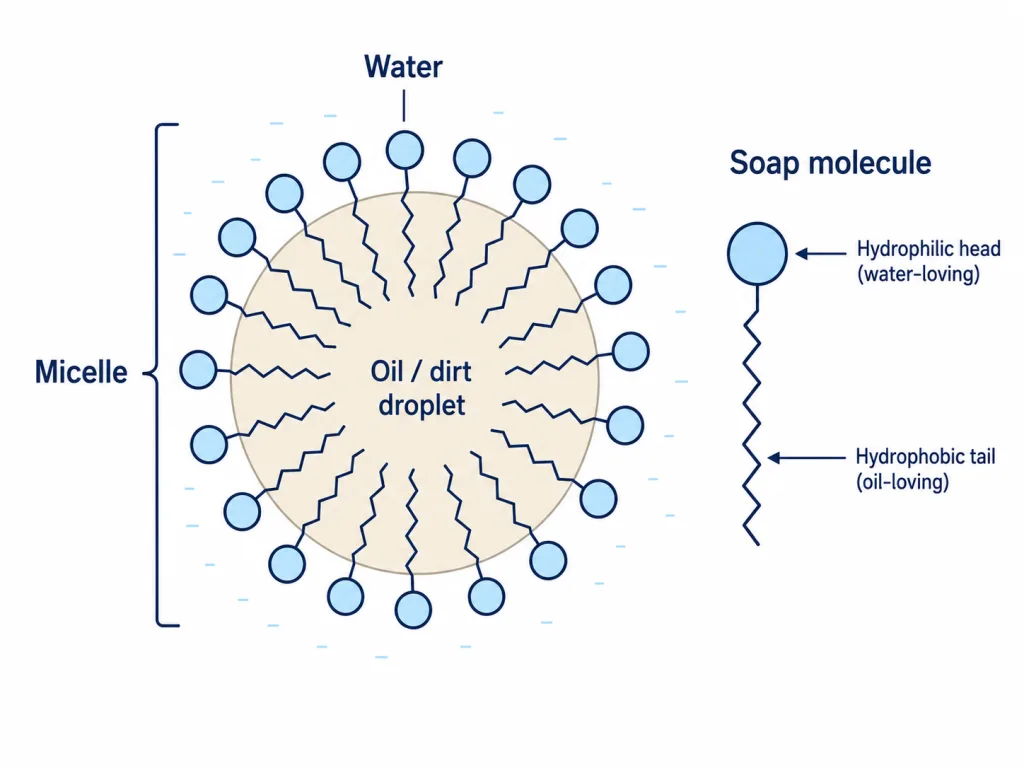
A soap has two distinct ends:
1. Hydrophilic Head (water-loving):
- -COO⁻Na⁺ end.
- Polar, charged.
- Soluble in water.
2. Hydrophobic Tail (water-fearing):
- Long hydrocarbon chain (15-17 C atoms).
- Non-polar.
- Soluble in oils/greases.
A soap molecule looks like:
Long C chain (hydrophobic) — COO⁻Na⁺ (hydrophilic)
Example: sodium stearate (a common soap): C₁₇H₃₅-COO⁻Na⁺ = 17 C in chain + COO⁻Na⁺ end.
How Soap Cleans — Micelles
Dirt is mostly oily/greasy — won't dissolve in water.
Soap solves this by forming micelles:
Step 1: Soap molecules surround dirt droplet
- Hydrophobic tails dissolve in oily dirt.
- Hydrophilic heads point outward (towards water).
Step 2: Micelle forms
- A spherical structure.
- Inside: oily dirt.
- Outside: hydrophilic heads in water.
This 'traps' the dirt.
Step 3: Micelle dispersed in water
- Many micelles in water = dirty water.
- Easily washed away.
- Clothes/skin clean!
Visualising a Micelle
          ⌒⌒⌒
         (    )
        ( DIRT )    ← oily dirt inside
         (    )
          ⌒⌒⌒
         |||||      ← hydrophobic tails
     ▲▲▲▲▲▲▲     ← hydrophilic heads (-COO⁻Na⁺)
  W A T E R       ← outside in water
Hundreds of soap molecules form one micelle. Many micelles dissolved in water → 'dirty water' that washes off.
Manufacture of Soap
Soap is made by saponification — reaction of fat with alkali.
Saponification Reaction:
A simplified equation:
Fat = ester of glycerol and 3 fatty acids. NaOH breaks it apart, replacing glycerol with Na.
Soap Manufacturing — Steps
1. Heat fat (e.g., palm oil) with NaOH solution. 2. Reaction produces soap (insoluble in salt water) + glycerol (in water). 3. Add salt to separate soap from solution. 4. Soap floats and is collected. 5. Mix in scent, colour, texture additives. 6. Mould into bars or flakes.
Glycerol — Useful By-product
Glycerol (C₃H₈O₃) — a useful chemical. Uses:
- Cosmetics (moisturisers).
- Food (sweetener, preservative).
- Pharmaceuticals.
- Explosives (nitroglycerin).
Hard Water Problem
Soap doesn't lather well in hard water (water with Ca²⁺, Mg²⁺ ions).
Reason: Soap + Ca²⁺ → insoluble calcium soap (curd). This 'scum' wastes soap and stains clothes.
Reaction:
To overcome this:
- Soften the water (remove Ca²⁺, Mg²⁺).
- OR use detergents (don't form scum).
Detergents
Detergents are sodium salts of sulphonic acids (or similar) instead of fatty acids.
Difference from Soap
Both have the same basic structure:
- Hydrophobic tail (long C chain).
- Hydrophilic head.
But the head is different:
- Soap: -COO⁻Na⁺ (carboxylate)
- Detergent: -SO₃⁻Na⁺ (sulphonate) or similar
Why Detergents Are Better in Hard Water
The sulphonate group:
- Doesn't form insoluble salt with Ca²⁺/Mg²⁺.
- Lathers well in hard water.
- More effective cleaning.
This is why synthetic detergents are used in:
- Washing powders (Surf, Tide, etc.).
- Dishwashing liquids.
- Shampoos.
- Industrial cleaners.
A Common Detergent
Sodium dodecyl benzene sulphonate Long C chain + SO₃⁻Na⁺.
Modern detergents are biodegradable to reduce environmental impact.
Comparison — Soap vs Detergent
| Property | Soap | Detergent |
|---|---|---|
| Source | Animal fats / vegetable oils | Petroleum-based or fats |
| Head group | -COO⁻Na⁺ | -SO₃⁻Na⁺ |
| In hard water | Forms scum, poor lather | Lathers well |
| Biodegradable | Yes (mostly) | Some are; some aren't |
| Use | Bath bars | Washing powders, dishwashing |
Why Detergents Sometimes Pollute Water
Old detergents:
- Branched chain (highly stable).
- Resistant to biodegradation.
- Cause foam in rivers, lakes.
- Disrupt aquatic ecosystems.
Modern detergents:
- Straight chain (biodegradable).
- Break down naturally.
- Less environmental impact.
How Soap/Detergent Cleans (Detailed)
Step-by-step process:
1. Wet the fabric: Water alone doesn't dissolve oily dirt.
2. Apply soap: Soap molecules surround oily dirt particles. Tails embed in oil; heads extend into water.
3. Mechanical action (rubbing): Loosens dirt from fabric. Soap molecules wrap around dirt droplets.
4. Micelles form: Dirt is now suspended in water (as micelles). No longer attached to fabric.
5. Rinse: Water carries away micelles (containing dirt). Fabric becomes clean!
A Practical Demonstration
Try this at home: Take dirty hands (with oil or grease).
Without soap:
- Water alone won't remove the oil.
- Hands stay greasy.
With soap:
- Soap surrounds oil droplets.
- Forms micelles.
- Water washes them away.
- Hands clean.
This is the magic of micelles — turning oil into something water can carry away.
Esters — The Sweet Smells
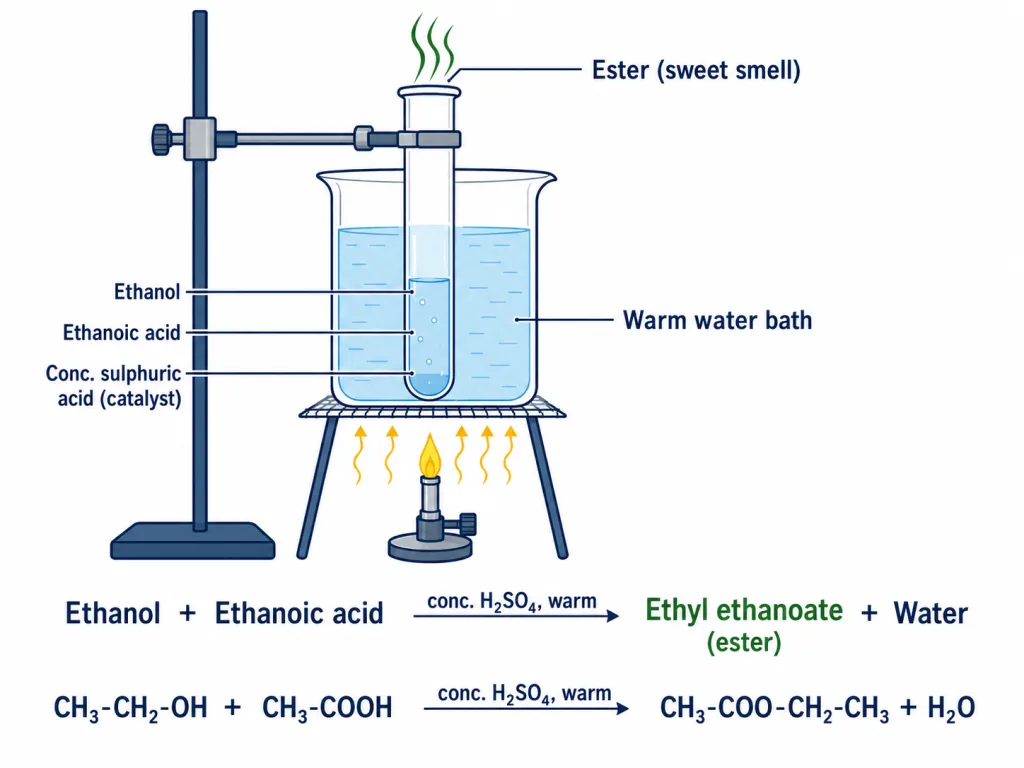
Esters are formed by reaction of carboxylic acid + alcohol.
Have sweet fruity smells — used in flavours, perfumes.
Esterification Reaction
General reaction:
Specifically:
Acetic acid + ethanol → ethyl ethanoate (ethyl acetate).
Conditions
Catalyst: concentrated (sulphuric acid). Heat: gentle warming. Reaction is reversible (note ⇌ symbol).
Common Esters and Their Smells
| Ester | Smell |
|---|---|
| Methyl butyrate | Apple |
| Ethyl acetate | Pear/banana |
| Ethyl butyrate | Pineapple |
| Methyl salicylate | Wintergreen |
| Pentyl acetate | Banana |
| Octyl acetate | Orange |
Saponification — Reverse of Esterification
Esters can be hydrolysed back to alcohol + acid:
This is saponification — used in soap making (where ester is fat).
Where Esters Are Found
1. Fruit smells. Most fruit smells are esters. Banana, apple, orange — natural esters.
2. Perfumes. Both natural and synthetic. Rose, jasmine, lavender — esters present.
3. Flavour additives. Artificial fruit flavours in candies, drinks.
4. Solvents. Ethyl acetate — common solvent. Used in nail polish removers.
5. Pharmaceuticals. Many drugs are esters. Aspirin (acetylsalicylic acid) is an ester.
6. Polyester fabrics. Polyester = polymer of esters. Used in clothing, plastics, bottles.
A Lab Test for Esters
Smell the compound — sweet fruity smell suggests an ester.
Or:
- Treat with NaOH → forms salt of acid + alcohol.
- Recover original components.
- Identifies the ester.
Industrial Production
Many esters made industrially:
- Pharmaceuticals.
- Plastics.
- Solvents.
- Lubricants.
- Plasticisers.
Summary — A Beautiful Cycle
Cycle of carbon compounds:
Alkane → Alkene/Alkyne (cracking)
Alkene + H₂O → Alcohol
Alcohol → Aldehyde → Acid (oxidation)
Acid + Alcohol → Ester + Water (esterification)
Ester + NaOH → Soap + Alcohol (saponification)
Each transformation:
- Changes functional group.
- Changes properties.
- Has industrial significance.
This is the organic chemistry of life and industry.
🧠 Memory Capsule
A quick glance just before the board exam.
1. Ethanol ()
- Colourless liquid, sweet smell, B.P. 78°C.
- Soluble in water.
- Made by: fermentation, ethene + water.
2. Reactions of Ethanol
1. Combustion: 2. With Na: 3. Oxidation to acid: 4. Dehydration:
3. Acetic Acid (CH₃COOH)
- Colourless liquid, pungent smell, B.P. 118°C.
- Sour taste — vinegar (5-8%).
- 'Glacial acetic acid' = pure (frozen at 16.6°C).
4. Reactions of Acetic Acid
1. With base: 2. With carbonate: 3. With bicarbonate: 4. Esterification:
5. Soap
Sodium salt of long-chain fatty acid. General formula: .
Two parts:
- Hydrophobic tail (long C chain).
- Hydrophilic head (-COO⁻Na⁺).
6. Saponification
Fat + NaOH → Soap + Glycerol
Reverse of esterification.
7. Micelle Formation
Soap molecules surround oily dirt:
- Tails inside (in oil).
- Heads outside (in water). = Micelle.
This carries dirt away in water.
8. Detergents vs Soaps
| Property | Soap | Detergent |
|---|---|---|
| Head | -COO⁻Na⁺ | -SO₃⁻Na⁺ |
| Hard water | Forms scum | Lathers well |
| Biodegradable | Yes | Modern: yes |
| Examples | Bath bars | Washing powders |
9. Esterification & Saponification
Esterification: acid + alcohol → ester + water. Saponification: ester + NaOH → salt + alcohol.
Esters have sweet fruity smell.
10. Board's 'Golden' Questions
- Esterification reaction with example.
- Cleaning action of soap (micelles).
- Why soap doesn't lather in hard water?
- Test for acetic acid (vinegar).
- Difference between soap and detergent.
Final Formula: Ethanol + acid = ester (smell). Ethanol + Na = H₂. Acid + base = salt + water. Fat + NaOH = soap. Soap forms micelles to clean.
Solved Examples
Example 1: NCERT — Reactions of Ethanol
Write reactions of ethanol with: (a) sodium (b) acetic acid (esterification) (c) oxidation by KMnO₄ (d) dehydration
Solution:
(a) Ethanol + Sodium
Products: sodium ethoxide + hydrogen gas.
Observations:
- Bubbles of H₂ gas.
- Sodium dissolves slowly.
- Test: H₂ confirmed by 'pop' test.
(b) Esterification (Ethanol + Acetic Acid)
Product: ethyl ethanoate (ethyl acetate) — sweet smell.
Conditions:
- Concentrated H₂SO₄ as catalyst.
- Gentle heat.
(c) Oxidation of Ethanol
Acidified or alkaline KMnO₄ + heat.
Observations:
- Purple KMnO₄ becomes colourless.
- Ethanol is oxidised to acetic acid.
(d) Dehydration of Ethanol
Product: ethene + water.
Conditions:
- Concentrated H₂SO₄.
- High temperature (170°C).
Why These Reactions Matter
With Na: test for alcohols. Esterification: makes esters (perfumes, flavours). Oxidation: industrial vinegar production. Dehydration: industrial ethene production.
All four use the -OH group of ethanol. Different conditions lead to different products.
[NCERT — important]
Example 2: NCERT — Reactions of Acetic Acid
Write the reactions of acetic acid with: (a) sodium hydroxide (NaOH) (b) sodium carbonate (Na₂CO₃) (c) sodium bicarbonate (NaHCO₃) (d) ethanol
Solution:
(a) Acetic Acid + Sodium Hydroxide (Neutralisation)
Products: sodium acetate + water.
Type: Neutralisation reaction. Acid + base → salt + water.
Sodium acetate uses: food (E261), leather industry, dyeing.
(b) Acetic Acid + Sodium Carbonate
Products: sodium acetate + water + carbon dioxide.
Observations:
- Effervescence (bubbles).
- CO₂ gas evolved.
- Acid + carbonate → salt + water + CO₂.
(c) Acetic Acid + Sodium Bicarbonate
Products: sodium acetate + water + carbon dioxide.
Observations:
- Effervescence.
- CO₂ gas.
- This is why vinegar + baking soda fizz!
(d) Acetic Acid + Ethanol (Esterification)
Products: ethyl ethanoate (ester) + water.
Type: Esterification. Conditions: concentrated H₂SO₄ + heat.
Ethyl ethanoate has sweet fruity smell.
Tests Differentiating from Other Compounds
Acetic acid can be distinguished from ethanol:
Test 1: Litmus paper.
- Acetic acid: turns blue litmus red.
- Ethanol: no change.
Test 2: With Na₂CO₃ or NaHCO₃.
- Acetic acid: effervescence (CO₂).
- Ethanol: no change.
Test 3: Smell.
- Acetic acid: pungent (vinegar smell).
- Ethanol: sweet (alcoholic smell).
Why Acetic Acid Acts as Acid
The -COOH group:
- Releases H⁺ in water.
- Makes solution sour.
- Reacts with bases, metals.
This is fundamental — same as HCl, H₂SO₄ (other acids).
Real-World Significance
Vinegar uses:
- Food preservation (pickles).
- Salad dressings.
- Cleaning agent (mild acid).
- Some medicinal uses.
Industrial uses:
- Production of acetate plastics.
- Pharmaceutical (aspirin).
- Photography (historical).
[NCERT — important]
Example 3: NCERT — Cleaning Action of Soap
Explain the cleaning action of soap with diagrams. Why doesn't soap work well in hard water?
Solution:
Soap Structure
A soap molecule has two parts:
- Hydrophilic head (-COO⁻Na⁺): polar, water-loving.
- Hydrophobic tail (long C chain): non-polar, oil-loving.
  Long C chain — COO⁻Na⁺
  (hydrophobic)   (hydrophilic)
Example: (sodium stearate).
Cleaning Process — Step by Step
Step 1: Soap molecules in water
Soap dissolves; molecules dispersed in water.
Step 2: Encounter dirt
Dirt is mostly oily/greasy — hydrophobic. Soap molecules approach dirt particle.
Step 3: Tails embed in dirt
Hydrophobic tails dissolve in oily dirt. Hydrophilic heads point outward (towards water).
Step 4: Micelle forms
Several soap molecules surround the dirt. Form a spherical structure called micelle:
          ⌒⌒⌒
         (    )
        ( DIRT )    ← oily dirt inside
         (    )
          ⌒⌒⌒
         |||||      ← hydrophobic tails
     ▲▲▲▲▲▲▲     ← hydrophilic heads (-COO⁻Na⁺)
  W A T E R       ← outside in water
Step 5: Mechanical action (washing)
Rubbing helps loosen dirt particles from the fabric/skin. Soap+dirt micelles disperse in water.
Step 6: Rinse with water
Water (now containing many micelles) is rinsed away. Dirt goes with the water. Surface becomes clean!
The Magic of Micelles
Why are micelles so effective?
1. Trap oily dirt: which water alone can't dissolve. 2. Suspend in water: as charged particles. 3. Move with water: rinse away easily.
Without soap, water and oil don't mix. With soap, they form micelles → washable!
Hard Water Problem
'Hard water' = water with dissolved and ions. Found in many regions in India, especially rural areas.
Soap reacts with these ions:
Calcium soap is insoluble — forms a sticky white scum on:
- Clothes (white residue).
- Sinks, bathtubs.
- Hands.
Why Soap Doesn't Lather in Hard Water
Three problems:
1. Wasted soap: soap reacts with Ca²⁺/Mg²⁺ before working on dirt. 2. Scum: insoluble calcium soap stains and clogs. 3. Less foam: lather is reduced.
Result: more soap needed; less effective cleaning; clothes don't get fully clean.
Solutions
1. Soften water first. Use ion-exchange or chemicals to remove Ca²⁺/Mg²⁺. Common in industries.
2. Use detergents. Detergents have -SO₃⁻Na⁺ heads. This doesn't form scum with Ca²⁺/Mg²⁺. Lathers in hard water! This is why synthetic detergents are widely used in modern washing powders.
Why Detergents Are Superior
Modern detergents (like Surf, Tide):
- Lather in hard water.
- More effective for clothes.
- Cheaper to produce.
- Many additives possible (bleach, fragrance, brighteners).
Environmental Concern
Old detergents:
- Branched chains.
- Resistant to biodegradation.
- Caused foam in rivers, lakes.
- Disrupted aquatic life.
Modern detergents:
- Straight-chain (biodegradable).
- More environment-friendly.
Summary
Soap cleans by forming micelles around oily dirt — the dirt is trapped and washed away.
In hard water, soap loses effectiveness due to forming insoluble Ca/Mg salts (scum).
Detergents solve this — they're modern alternatives that work in hard water.
[NCERT — every year, important]
Example 4: A Concluding Question
(a) Define esterification. (b) Write reaction of ethanol + acetic acid. (c) What is saponification? (d) Why does vinegar fizz with baking soda?
Solution:
(a) Esterification
'Esterification' = a chemical reaction where an acid + alcohol react to form an ester + water.
General reaction:
Conditions:
- Catalyst: concentrated .
- Heat: gentle warming.
- Reaction is reversible.
Esters typically have sweet, fruity smells — used in perfumes and flavours.
(b) Ethanol + Acetic Acid Reaction
This is a typical esterification:
Acetic acid + ethanol → ethyl ethanoate (ethyl acetate) + water.
Properties of ethyl acetate:
- Colourless liquid.
- Pleasant fruity smell (banana/pear).
- Used as a solvent (nail polish remover).
- Found naturally in some fruits.
(c) Saponification
'Saponification' = the reverse of esterification — an ester + alkali → salt + alcohol.
General reaction:
Specifically (for soap making):
Where R = long C chain.
This is the reaction used to make soap commercially!
Why Saponification Matters
1. Soap manufacturing. Industrial process to make soap from fats and oils.
2. Glycerol byproduct. Useful in cosmetics, food, pharmaceuticals.
3. Industrial chemistry. Many industrial soaps and surfactants made this way.
(d) Why Does Vinegar Fizz with Baking Soda?
Vinegar = acetic acid (CH₃COOH). Baking soda = sodium bicarbonate (NaHCO₃).
Reaction:
Products: sodium acetate + water + carbon dioxide.
The fizz comes from CO₂ gas bubbling out!
Why This Happens
All carboxylic acids (like acetic acid) react with carbonates and bicarbonates:
Acid + (Bi)carbonate → Salt + Water + CO₂↑
Just like: HCl + NaHCO₃ → NaCl + H₂O + CO₂
Acetic acid behaves the same way — confirming it's an acid.
Practical Demonstrations
1. Lab Test for Acid:
Add NaHCO₃ to unknown solution. If fizzes (CO₂) → acidic.
2. Volcano Experiment (Children's Science):
Vinegar + baking soda → 'erupts' with CO₂ bubbles. Fun science demonstration.
3. Cleaning:
Vinegar removes lime deposits in kettles, etc. Lime = CaCO₃ (limestone). Acetic acid + CaCO₃ → calcium acetate + H₂O + CO₂. Lime breaks down → cleaned.
A Reflection
Vinegar is a weak acid, but acts like other acids:
- Sour taste.
- Reacts with bases and carbonates.
- Releases H⁺ in water.
This shows acetic acid (CH₃COOH) is truly an acid — its functional group -COOH defines its chemistry.
From morning vinegar to chemistry lab, the same chemistry applies.
A Linked Idea — Why Esterification is Important
Just as acid + base = salt + water, Acid + alcohol = ester + water.
Both are similar — H replaces, water forms. Both are reversible.
This pattern (acid + something = something + water) is a general theme in chemistry.
[Board: 5-mark mixed]