
Why Do We Need Chemical Equations?
Think about it — in the previous section, we described the burning of magnesium like this:
"When magnesium burns in air, it reacts with oxygen to form magnesium oxide."
That's a long sentence. Imagine writing 100 reactions this way! That's why scientists invented a short, universal language — the chemical equation.
Word Equation
The simplest method — just use the names of the substances with an arrow between them:
Here —
- Reactants are written on the LHS of the arrow ()
- Products are written on the RHS
- A '+' sign separates substances on each side
- The arrowhead points toward the products
Equation Using Chemical Formulae
Replace the names with chemical formulae — even more concise:
This is called a skeletal equation — because the number of atoms on the two sides may not yet match.
Key Point: A word equation uses substance names; a chemical equation uses chemical formulae.
[Board Tip] Only the formula version is officially called a 'chemical equation'. A word-only equation is incomplete in board exams.
The Law of Conservation of Mass
This law from Class IX is the foundation of equation balancing —
Law: In a chemical reaction, mass can neither be created nor destroyed.
This means — the number of atoms of each element must be the same before and after the reaction. Not even a single atom can simply 'disappear' or 'appear from nowhere'.
Now Check the Skeletal Equation
| Element | Atoms on LHS | Atoms on RHS |
|---|---|---|
| Mg | 1 | 1 |
| O | 2 | 1 |
Oxygen atoms are not equal — so this equation is unbalanced. We must balance it.
A Properly Balanced Example
| Element | LHS | RHS |
|---|---|---|
| Zn | 1 | 1 ✓ |
| H | 2 | 2 ✓ |
| S | 1 | 1 ✓ |
| O | 4 | 4 ✓ |
Every element matches — this is a balanced equation.
[Looking Ahead — JEE/NEET Level] All of stoichiometry — calculations like how many grams of product form from a given mass of reactant — flows directly from this single law of mass conservation.
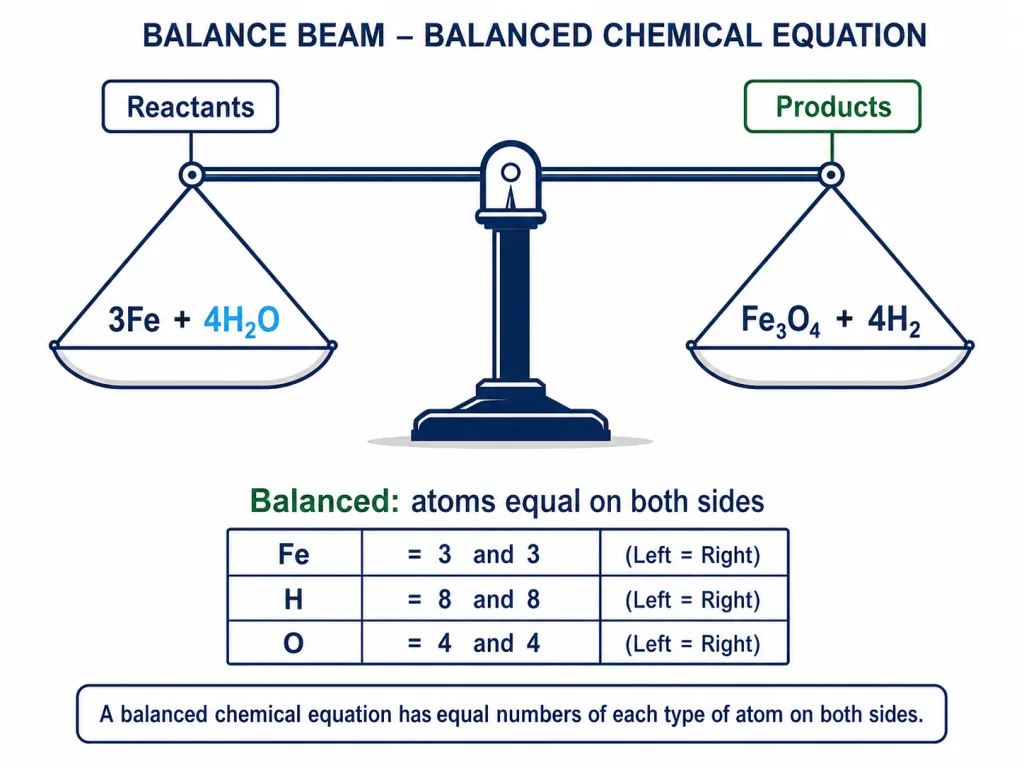
The Hit-and-Trial Method — Balancing an Equation
Let us balance this unbalanced equation step by step:
Step 1 — Count the atoms
| Element | LHS | RHS |
|---|---|---|
| Fe | 1 | 3 |
| H | 2 | 2 |
| O | 1 | 4 |
Step 2 — Start with the most complex compound
Pick the compound with the most atoms — here, — and start with the element appearing most in it: oxygen.
Balance oxygen: RHS has 4, LHS has 1 → put coefficient 4 on in LHS:
Step 3 — Balance hydrogen
Now LHS has H = , but RHS has H = 2 → put coefficient 4 on :
Step 4 — Balance iron
LHS has Fe = 1, RHS has Fe = 3 → put coefficient 3 on Fe in LHS:
Step 5 — Verify
| Element | LHS | RHS |
|---|---|---|
| Fe | 3 | 3 ✓ |
| H | 8 | 8 ✓ |
| O | 4 | 4 ✓ |
The equation is now balanced. This method is called the hit-and-trial method.
Crucial Rule: Never change the chemical formulae while balancing — only the coefficients in front of substances can be changed. So must never be written as .
State Symbols and Reaction Conditions
To make a balanced equation more informative, we add symbols for the physical states of substances.
State Symbols
| Symbol | Meaning | Example |
|---|---|---|
| Solid | ||
| Liquid | ||
| Gas | , | |
| Aqueous (dissolved in water) | , |
When a substance is dissolved in water, we write .
Example — fully balanced with state symbols:
Here tells us water is being used as steam, not as a liquid.
Reaction Conditions — Above/Below the Arrow
Sometimes the temperature, pressure, or catalyst is also written on the arrow. Example —
Photosynthesis needs sunlight and chlorophyll —
Special Symbols Used in Equations
- (up arrow): A gas is evolved
- (down arrow): A precipitate forms (insoluble solid)
- : Heat is supplied (heating)
[Board Tip] State symbols are required almost every year. Equations without do not get full marks.
The Complete Workflow — At a Glance
When given a word statement and asked to write a balanced equation, follow these 5 steps:
Step 1 — Write the word equation
Reactants on the left, products on the right — using full names.
Step 2 — Convert to chemical formulae
Write the correct chemical formula for each substance. Some essential formulae —
| Substance | Formula | Substance | Formula |
|---|---|---|---|
| Water | Ammonia | ||
| Oxygen gas | Carbon dioxide | ||
| Hydrogen gas | Sulphuric acid | ||
| Nitrogen gas | Hydrochloric acid | ||
| Chlorine gas | Sodium hydroxide |
Step 3 — Check the skeletal equation
Count the atoms of each element on the LHS and RHS.
Step 4 — Balance using hit-and-trial
A recommended order — start with the most complex compound, then balance metals → non-metals → hydrogen → oxygen.
Step 5 — Add state symbols
Add as required.
A Full Example — Step by Step
Statement: "Solutions of barium chloride and sodium sulphate in water react to give an insoluble precipitate of barium sulphate and a solution of sodium chloride."
Step 1 — Word equation: Barium chloride + Sodium sulphate → Barium sulphate + Sodium chloride
Step 2 — With formulae:
Step 3 — Atom count: LHS: Ba=1, Cl=2, Na=2, S=1, O=4 RHS: Ba=1, S=1, O=4, Na=1, Cl=1 → Na and Cl unbalanced
Step 4 — Balance:
Step 5 — Add state symbols:
[Board Important] This 5-step format directly applies to many 3- and 5-mark questions.
🧠 Memory Capsule
A one-glance recap to revisit just before the board exam — every key idea about chemical equations and balancing in one place.
1. Skeletal vs. Balanced Equation
- Skeletal: Formulae are correct, but atoms are not equal (e.g., ).
- Balanced: Atoms of every element are equal on both sides (e.g., ).
2. Law of Conservation of Mass
This is the basis of all balancing.
3. Hit-and-Trial — Golden Order
- Start with the most complex compound (the one with the most atoms).
- Within that compound, start with the element having the highest atom count.
- Then follow the order — metal → non-metal → H → O.
- Only change coefficients — never the formulae.
4. State Symbols — One-Minute Recap
| Symbol | Meaning |
|---|---|
| Solid | |
| Liquid | |
| Gas | |
| Dissolved in water | |
| Gas evolved | |
| Precipitate formed | |
| Heat supplied |
5. Formulae You Must Memorise
- — diatomic gases
- Acids —
- Bases —
- Oxides —
6. Five-Point Final Check on a Balanced Equation
- Are atoms of each element equal? ✓
- Are formulae correct? ✓
- Charges balanced (for ionic equations)? ✓
- State symbols added? ✓
- Special conditions (, catalyst) shown on the arrow? ✓
7. Common Pitfalls
- 'Coefficient' goes outside — 2 H₂O; 'subscript' is inside the formula — H₂O.
- Never write or — the correct form is .
- Coefficients should be the smallest whole numbers.
The Bottom Line: Not a single atom missing on either side — only then is the equation balanced.
Solved Examples
Example 1: Balancing a Simple Equation
Balance the following equation:
Solution:
- Atom count:
- LHS: H = 2, Cl = 2
- RHS: H = 1, Cl = 1
- Imbalance: Both elements appear half on the right.
- Balance: Put coefficient 2 on :
- Recheck: LHS — H=2, Cl=2; RHS — H=2, Cl=2 ✓
- Final answer:
Example 2: Balancing the Combustion of Magnesium
Write the balanced chemical equation for the burning of magnesium ribbon in air.
Solution:
- Word equation: Magnesium + Oxygen → Magnesium oxide
- Skeletal equation:
- Atom count:
- LHS: Mg=1, O=2
- RHS: Mg=1, O=1 → oxygen unbalanced
- Balance oxygen: put coefficient 2 on :
- Now check Mg: LHS=1, RHS=2 → put coefficient 2 on Mg:
- Recheck: Mg=2=2 ✓, O=2=2 ✓
- Final answer with state symbols:
[Repeatedly asked in Board — typically 2 marks]
Example 3: NCERT Textbook Question (Activity 1.3)
Write the balanced equation for: Barium chloride + Aluminium sulphate → Barium sulphate + Aluminium chloride
Solution:
- With formulae:
- Atom count:
- LHS: Ba=1, Cl=2, Al=2, S=3, O=12
- RHS: Ba=1, S=1, O=4, Al=1, Cl=3
- Start with the complex compound :
- Balance Al: put coefficient 2 on
- Balance S: put coefficient 3 on
- Now check Ba and Cl:
- Ba: RHS=3 → put coefficient 3 on :
- Verify: Ba=3=3 ✓, Cl=6=6 ✓, Al=2=2 ✓, S=3=3 ✓, O=12=12 ✓
- Final answer:
Example 4: Sodium and Water Reaction
Sodium reacts with water to produce sodium hydroxide and hydrogen gas. Write the balanced equation.
Solution:
- Skeletal:
- Atom count:
- LHS: Na=1, H=2, O=1
- RHS: Na=1, O=1, H=3 → H unbalanced
- Issue: RHS has 3 H, LHS has 2 H — odd numbers cause trouble.
- Trick: Bring H atoms to a common multiple (4) on both sides.
- Multiply by 2 on LHS:
- Now: LHS — Na=1, H=4, O=2; RHS — Na=1, H=3, O=1 → still unbalanced
- Multiply NaOH by 2:
- Now: LHS — Na=1, H=4, O=2; RHS — Na=2, H=4, O=2 → Na unbalanced
- Multiply Na by 2:
- Verify: Na=2=2 ✓, H=4=4 ✓, O=2=2 ✓
- Final answer:
Example 5: Conservation of Mass — Find the Unknown
When 5.0 g of calcium carbonate is heated, 2.8 g of calcium oxide and some carbon dioxide are formed. Find the mass of evolved and verify the law of conservation of mass.
Solution:
- Reaction:
- Law of conservation of mass:
- Given:
- Mass of = 5.0 g
- Mass of = 2.8 g
- Calculation:
- Verification:
- Answer: Mass of evolved = 2.2 g, and the law of conservation of mass is verified.
[Board Important — 3-mark question]
Example 6: Numerical — Formation of Ammonia
Write the balanced equation for the formation of ammonia (). If 14 g of nitrogen reacts completely, find the mass of ammonia formed. (Atomic masses: N=14, H=1)
Solution:
- Skeletal equation:
- Balance: Start with N atoms —
- has N = 2 → put coefficient 2 on :
- has H = 6 → put coefficient 3 on :
- Verify: N=2=2 ✓, H=6=6 ✓
- Final balanced equation:
- Mass calculation:
- Molar mass of = g
- Molar mass of = g
- Ratio: 28 g → 34 g
- Given — 14 g :
- Answer: 17 g of ammonia is formed.
Example 7: NCERT — Combustion of Hydrogen Sulphide
Hydrogen sulphide gas burns in air to give water and sulphur dioxide. Write the balanced chemical equation.
Solution:
- Skeletal:
- Atom count:
- LHS: H=2, S=1, O=2
- RHS: H=2, O=3, S=1
- Oxygen unbalanced — RHS has 3, LHS has 2.
- Trick: First multiply by 2 — this neatly cascades:
- Now: LHS — H=4, S=2, O=2; RHS — H=2, O=3, S=1
- Multiply and by 2:
- Now: LHS — H=4, S=2, O=2; RHS — H=4, S=2, O=6 → O unbalanced
- Multiply by 3:
- Verify: H=4=4 ✓, S=2=2 ✓, O=6=6 ✓
- Final answer:
Example 8: Skeletal vs. Balanced
Which of the following is a skeletal equation and which is balanced? Justify. (i) (ii)
Solution:
For (i):
- LHS: N=1, H=3
- RHS: N=2, H=2
- Atoms are not equal — this is a skeletal equation.
- Correct balanced version:
For (ii):
- LHS: K=2, Cl=2, O=6
- RHS: K=2, Cl=2, O=6
- All atoms are equal — this is a balanced equation.
Lesson: Just because an equation uses formulae does not mean it's balanced. Always count atoms to verify.
Example 9: NCERT Textbook Question
Balance the following chemical equation:
Solution:
- Atom count:
- LHS: H=3, N=1, O=5, Ca=1
- RHS: Ca=1, N=2, O=7, H=2
- Start with N: LHS=1, RHS=2 → put coefficient 2 on :
- Now: LHS — H=4, N=2, O=8, Ca=1; RHS — Ca=1, N=2, O=7, H=2
- Balance H: put coefficient 2 on :
- Verify:
- LHS: H=4, N=2, O=8, Ca=1
- RHS: Ca=1, N=2, O=8, H=4 ✓
- Final answer:
This is a neutralisation reaction (acid + base → salt + water).
Example 10: NCERT — Sodium Chloride + Silver Nitrate
When silver nitrate solution is added to sodium chloride solution, an insoluble white precipitate of silver chloride and a solution of sodium nitrate are formed. Write the balanced chemical equation with state symbols.
Solution:
- Skeletal:
- Atom count:
- LHS: Na=1, Cl=1, Ag=1, N=1, O=3
- RHS: Ag=1, Cl=1, Na=1, N=1, O=3
- Already balanced! ✓
- Add state symbols:
- — dissolved in water,
- — dissolved in water,
- — insoluble precipitate,
- — stays in solution,
- Final answer:
[Board Important] This is a famous precipitation reaction — the white precipitate.
Example 11: Conservation of Mass — Statement Verification
A student heated 7 g of iron with sulphur and obtained 11 g of iron sulphide (FeS). Calculate the mass of sulphur used.
Solution:
- Reaction:
- By conservation of mass:
- Calculation:
- Answer: Mass of sulphur used = 4 g.
- Verification: Atomic masses — Fe=56, S=32, FeS=88. Theoretical ratio , and observed ratio ✓
A perfect match — the law of conservation of mass is verified.
Example 12: Balancing Multiple Equations
Balance the following equations: (a) (b)
Solution:
For (a):
- Skeletal: LHS — Na=1, O=5, H=3, S=1; RHS — Na=2, S=1, O=5, H=2
- Balance Na: put coefficient 2 on
- Balance H: put coefficient 2 on
- Verify: Na=2=2 ✓, O=6=6 ✓, H=4=4 ✓, S=1=1 ✓
For (b):
- Skeletal: LHS — Ba=1, Cl=2, H=2, S=1, O=4; RHS — Ba=1, S=1, O=4, H=1, Cl=1
- Both Cl and H halved — put coefficient 2 on :
- Verify: Ba=1=1 ✓, Cl=2=2 ✓, H=2=2 ✓, S=1=1 ✓, O=4=4 ✓
Final answers with state symbols:
Example 13: Aluminium and Copper Chloride
Aluminium displaces copper from copper chloride solution. Write the balanced equation.
Solution:
- Word equation: Aluminium + Copper chloride → Aluminium chloride + Copper
- Skeletal:
- Atom count:
- LHS: Al=1, Cu=1, Cl=2
- RHS: Al=1, Cl=3, Cu=1
- Cl unbalanced — LHS has 2, RHS has 3. Take LCM = 6:
- put coefficient 3 on (Cl = 6):
- put coefficient 2 on (Cl = 6):
- Now: LHS — Al=1, Cu=3, Cl=6; RHS — Al=2, Cl=6, Cu=1
- Balance Al and Cu:
- put coefficient 2 on Al in LHS:
- put coefficient 3 on Cu in RHS:
- Verify: Al=2=2 ✓, Cu=3=3 ✓, Cl=6=6 ✓
- Final answer:
Example 14: Combustion of Methane
Natural gas (mainly methane) burns to produce carbon dioxide and water. Write the balanced equation.
Solution:
- Skeletal:
- Atom count:
- LHS: C=1, H=4, O=2
- RHS: C=1, O=3, H=2
- Balance H: put coefficient 2 on :
- Now: LHS — C=1, H=4, O=2; RHS — C=1, O=4, H=4 → O unbalanced
- Balance O: put coefficient 2 on :
- Verify: C=1=1 ✓, H=4=4 ✓, O=4=4 ✓
- Final answer with state symbols:
This is an exothermic reaction — the same reaction occurs when LPG burns in your kitchen.
Example 15: NCERT — Potassium and Water
Potassium reacts with water to give potassium hydroxide and hydrogen gas. Write the balanced equation.
Solution:
- Skeletal:
- Atom count:
- LHS: K=1, H=2, O=1
- RHS: K=1, O=1, H=3 → H unbalanced
- Bring H to LCM = 4:
- multiply by 2:
- multiply by 2:
- Now: LHS — K=1, H=4, O=2; RHS — K=2, O=2, H=4 → K unbalanced
- Multiply K by 2:
- Verify: K=2=2 ✓, H=4=4 ✓, O=2=2 ✓
- Final answer:
Caution: Potassium reacts with water so vigorously that the hydrogen evolved often catches fire instantly — it is an extremely reactive metal.
Example 16: A Trickier Organic Equation
Write the balanced equation for the complete combustion of ethane ().
Solution:
- Skeletal:
- Atom count:
- LHS: C=2, H=6, O=2
- RHS: C=1, O=3, H=2
- Balance C: put coefficient 2 on .
- Balance H: put coefficient 3 on :
- Now: LHS — C=2, H=6, O=2; RHS — C=2, O=, H=6 → O = 2 vs 7 (an odd number!)
- Trick: Multiply the entire equation by 2 so the oxygen coefficient becomes a whole number:
- Now: LHS — C=4, H=12, O=2; RHS — C=4, O=, H=12
- Balance O: put coefficient 7 on :
- Verify: C=4=4 ✓, H=12=12 ✓, O=14=14 ✓
- Final answer:
Lesson: When you hit an odd-vs-even conflict in oxygen, multiply the entire equation by 2. This trick comes up repeatedly in organic combustion equations.