
What is a Double Displacement Reaction?
In the previous section we saw that in displacement, one element kicks another out. Double displacement is a little different — two compounds exchange their ions (or groups of atoms) with each other.
Definition: A reaction in which the ions of two reactants exchange places to form two new compounds is called a double displacement reaction.
General Form
Explanation:
- Reactant 1 — A and B are paired
- Reactant 2 — C and D are paired
- After reaction — A is now paired with D, and C with B
- The ions have 'changed partners'.
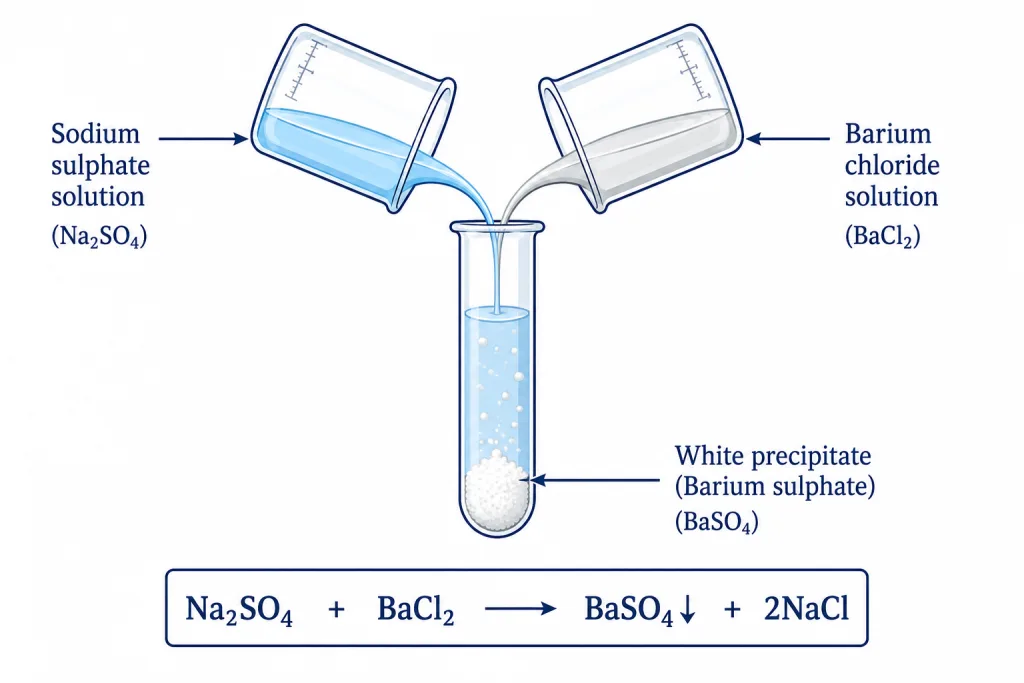
Activity 1.10 — A Famous NCERT Experiment
Procedure:
- Take 3 mL of sodium sulphate solution () in a test tube.
- Take 3 mL of barium chloride solution () in another test tube.
- Mix the two solutions.
Observation:
- Instantly, a white precipitate is formed.
- This precipitate is insoluble in water.
Reaction:
Analysis:
- and ions swapped partners.
- now joins to form (insoluble = white precipitate).
- now joins to form (stays in solution).
Visual rule: A double displacement reaction always has two reactants → two products.
What is a Precipitate?
When mixing two solutions produces an insoluble solid that settles at the bottom, that solid is called a precipitate. The reaction in which a precipitate forms is called a precipitation reaction.
How Does Precipitation Happen?
When ions meet in solution —
- If the new pair is soluble → no precipitate.
- If the new pair is insoluble → a precipitate forms (settles down).
Example:
Not Every Double Displacement is a Precipitation
This is an important distinction.
- Double displacement + precipitate forms = Precipitation reaction
- Double displacement + both products soluble = simple double displacement (no precipitate)
Colours of Common Precipitates — Essential Board List
| Precipitate | Colour | How it forms |
|---|---|---|
| White | ||
| White | ||
| Pale yellow | ||
| Yellow | ||
| Bright yellow | ||
| White (soluble in hot water) | ||
| Blue | ||
| Brown | ||
| White |
[Board Important] Memorise these colours — questions like "What is the colour of the precipitate of …?" are common.
Sub-types of Double Displacement Reactions
Double displacement reactions come in three sub-types —
1. Precipitation Reactions
When one of the products is insoluble (a precipitate).
Examples:
(white AgCl precipitate)
(yellow PbI₂ precipitate — the 'Golden Rain' experiment)
2. Neutralisation Reactions
When acid and base combine to form salt and water.
General form:
Examples:
All neutralisation reactions are a special case of double displacement.
3. Gas-Evolution Reactions
When one of the products escapes as a gas.
Examples:
(Here is unstable and immediately decomposes to — that's what causes the gas evolution.)
A Summary Table
| Sub-type | Feature | Symbol |
|---|---|---|
| Precipitation | One product is solid | |
| Neutralisation | Acid + Base → Salt + Water | |
| Gas evolution | One product is a gas |
Displacement vs. Double Displacement — A Comparison
This distinction is asked very often in board exams. Pay close attention.
| Aspect | Displacement | Double Displacement |
|---|---|---|
| Participants | One element + one compound | Two compounds |
| What happens? | An element displaces another element | Two ion-groups swap partners |
| General form | ||
| Driver | Activity series | Solubility / precipitate / gas / water formation |
| Example | ||
| Visual cue | Metallic deposit | Precipitate / gas / water |
| Products | One free element (Cu) | Two compounds |
A Simple Identification Rule
If the reaction has any free element (a single element on its own), it is a displacement. If all reactants and all products are compounds, it is a double displacement.
Example:
→ Zn and Cu appear as free elements → displacement
→ all are compounds → double displacement
A Special Note
The formation of a precipitate in a double displacement is just as 'spectacular' as the colour change in displacement — both give visible proof that a reaction has occurred.
Daily Life Applications of Double Displacement and Precipitation
1. Identification of Ions in the Lab
In chemistry labs, specific precipitation tests are used to identify what ion a solution contains.
Examples:
- Test for — adding produces a white precipitate
- Test for — adding produces a white precipitate ()
- Test for — adding produces effervescence
2. Water Purification
Impurities in drinking water are removed by precipitation —
- Adding alum () causes fine clay particles to settle out.
- This technique is widely used in chemical purification industries.
3. Digestion
Our stomach contains . When we take (an antacid) with food, neutralisation occurs —
This relieves acidity — a burp is a sign of the released .
4. Kidney Stones
A precipitate of calcium oxalate, , can form in the kidneys — that is what a kidney stone is.
5. Cement and Marble
The shiny coating that forms on a whitewashed wall is also a precipitate (we saw this in Section 3).
6. The Lime-Water Test (for )
If passing a gas through lime water turns it milky, the gas is .
[Board Important] Precipitation-based questions appear regularly in experimental, identification, or real-life contexts.
🧠 Memory Capsule
A one-glance recap to revisit just before the board exam — every key idea about double displacement and precipitation in one place.
1. Double Displacement Formula
(two compounds → two compounds; ions swap partners)
2. Precipitate Formula
When two ions combine to form an insoluble solid —
3. Must-Memorise Reactions
| Reaction | Precipitate | Colour |
|---|---|---|
| White | ||
| White | ||
| Yellow | ||
| Blue | ||
| Brown |
4. Three Sub-types of Double Displacement
| Type | Feature | Example |
|---|---|---|
| Precipitation | Insoluble product | |
| Neutralisation | Acid + base → salt + water | |
| Gas evolution | Gas product |
5. Displacement vs Double Displacement — At a Glance
- Displacement: A free element appears ()
- Double Displacement: All are compounds ()
6. Repeatedly Asked Board Questions
- What is a double displacement reaction? Explain Activity 1.10.
- What is a precipitation reaction? Give an example.
- What is the difference between displacement and double displacement?
- Write the reaction of lead nitrate + potassium iodide. Name and state the colour of the precipitate.
- Give one example of a neutralisation reaction.
7. A Trick
- When a question asks about precipitate colour, mentally run through the table above — Ba/Ag/Pb-Cl white, Ag/PbI yellow, blue, brown.
The Bottom Line: Two pairs swap partners → double displacement. A solid drops out → precipitation.
Solved Examples
Example 1: NCERT — Activity 1.10
What are the observations when sodium sulphate solution is added to barium chloride solution? Write the balanced reaction.
Solution:
Observations:
- A white precipitate is formed instantly.
- The precipitate is insoluble in water.
Reaction:
Explanation:
- Before mixing — the solutions contain ions.
- and combine to form insoluble (white).
- and remain in solution as soluble .
- Type of reaction:
- Double displacement — ions swap partners.
- Precipitation — white is formed.
Name of the precipitate: Barium sulphate ().
[NCERT textbook experiment — frequently asked]
Example 2: NCERT — Lead Nitrate and Potassium Iodide
In Activity 1.2, you mixed solutions of lead (II) nitrate and potassium iodide. (i) What was the colour of the precipitate? Name the compound formed. (ii) Write the balanced chemical equation for this reaction. (iii) Is this a double displacement reaction?
Solution:
(i) Colour of the precipitate — bright yellow. The compound formed is lead (II) iodide ().
(ii) Balanced equation:
(iii) Is this a double displacement reaction?
Yes — it is clearly a double displacement reaction, because —
- and ions swap their 'partners' (counter-ions).
- After the reaction, is paired with and with .
- All reactants and products are compounds (no free element) — so it is double displacement, not displacement.
Bonus: The bright yellow is famous — that is why this experiment is also called the 'Golden Rain'.
[Board Important — 3-mark question]
Example 3: Definition of Precipitation Reaction
What do you understand by a precipitation reaction? Explain with an example.
Solution:
Definition: A reaction in which mixing two solutions forms an insoluble solid (a precipitate) is called a precipitation reaction.
Features:
- It is always a kind of double displacement reaction.
- One product must be an insoluble solid that settles at the bottom of the solution.
- The precipitate is shown with a symbol.
Two examples:
(1) Formation of BaSO₄:
(2) Formation of AgCl:
Daily-life uses:
- Identifying ions in the laboratory.
- Water purification.
- Some diseases (e.g., kidney stones).
[Board Important — 3-mark question]
Example 4: NCERT — Sodium Hydroxide and Hydrochloric Acid
A solution of sodium hydroxide reacts with hydrochloric acid solution to form sodium chloride solution and water. Write the balanced equation. What kind of reaction is this?
Solution:
- Reaction:
- Type of reaction:
- Neutralisation reaction — acid and base combine to form salt and water.
- A special case of double displacement — Na and H exchanged 'partners' (Na took Cl, H took OH → H₂O).
- At the ionic level:
This is the essential ionic form of any neutralisation.
- Visible observations:
- No precipitate (NaCl is soluble).
- Slight rise in temperature (neutralisation is exothermic).
- Daily life: Antacids like neutralise stomach in this same way.
[NCERT textbook question]
Example 5: Which Are Double Displacement Reactions?
Which of the following are double displacement reactions? (i) (ii) (iii) (iv) (v)
Solution:
Quick rule: If a reaction contains a free element (on either side) → displacement or combination. If everything is a compound → double displacement.
| # | Reaction | Type | Reason |
|---|---|---|---|
| (i) | Displacement | Zn is a free element | |
| (ii) | Double displacement ✓ | All compounds; ion exchange | |
| (iii) | Combination | Free element, single product | |
| (iv) | Double displacement (neutralisation) ✓ | Acid + base | |
| (v) | Double displacement (precipitation) ✓ | precipitate |
Answer: (ii), (iv), and (v) are double displacement reactions.
Example 6: Identification of Silver Chloride
A student added solution to solution. What are the observations? Write the reaction.
Solution:
- Reaction:
- Observations:
- A white milky precipitate appears at once — silver chloride ().
- It settles at the bottom of the solution.
- Special test:
- If this white precipitate is exposed to sunlight, it turns grey/black (photochemical decomposition — see Section 4):
- Type of reaction:
- Double displacement (Ag and Na swapped partners)
- Precipitation (white precipitate)
- Use: This is the easiest test for the ion.
Lesson: A famous identification test — add to an unknown solution and see whether a white precipitate forms.
Example 7: Numerical — Mass of Precipitate
From the complete reaction of and , 23.3 g of precipitate is formed. Find the mass of used. (, )
Solution:
- Reaction:
- Mole ratio: 1 mol → 1 mol
- Mass ratio: 208 g → 233 g
- Given: g
- Calculation:
- Answer: Mass of used = 20.8 g.
Lesson: In stoichiometry, the mass of a precipitate ties directly to the mole ratio.
Example 8: NCERT — One Question, Three Reactions
Write balanced equations for the following and identify the type of each reaction. (a) Potassium bromide (aq) + Barium iodide (aq) → Potassium iodide (aq) + Barium bromide (s) (b) Zinc carbonate (s) → Zinc oxide (s) + Carbon dioxide (g) (c) Hydrogen (g) + Chlorine (g) → Hydrogen chloride (g) (d) Magnesium (s) + Hydrochloric acid (aq) → Magnesium chloride (aq) + Hydrogen (g)
Solution:
(a):
- Type: Double displacement (precipitation) reaction.
(b):
- Type: Decomposition (thermal) reaction.
(c):
- Type: Combination reaction.
(d):
- Type: Displacement reaction (Mg displaced H).
[NCERT textbook question — frequently asked in board]
Example 9: Copper Sulphate and Sodium Hydroxide
What happens when sodium hydroxide solution is added to copper sulphate solution? Write the reaction.
Solution:
- Reaction:
- Observation:
- A blue precipitate is formed — copper hydroxide.
- Type of reaction:
- Double displacement — Cu and Na swapped partners.
- Precipitation — blue .
- Analysis:
- Initial solution had ions.
- and combine to form insoluble .
- and remain in solution as .
- Special note: This is one method of testing for a base — ion is identified by adding (blue precipitate).
Example 10: The Lime-Water Test
Lime water turns milky on passing a particular gas through it. Which gas is it? Write the reaction.
Solution:
- Identification of the gas: Carbon dioxide ().
- Reaction:
- Type of reaction:
- Double displacement (precipitation) — white precipitate.
- Why milky? is insoluble — it disperses as fine particles in the solution, making it appear 'milky' (turbid).
- Curious fact — passing more :
- With excess , the precipitate dissolves to form (calcium hydrogen carbonate, which is soluble):
(This reaction explains the formation of stalactites and stalagmites in caves — Class 11 level reference.)
- Use: This is the most famous test for — for example, to verify the gas exhaled during respiration.
[Board Important — 3-mark question]
Example 11: A Neutralisation Example
Doctors prescribe magnesium hydroxide (milk of magnesia) to neutralise stomach acid. Write its reaction with .
Solution:
- Reaction:
- Type of reaction:
- Neutralisation reaction — base () + acid () → salt () + water.
- A special case of double displacement.
- Daily-life use:
- Treating acidity: Milk of magnesia is a popular antacid.
- When the stomach produces excess (heartburn/discomfort), neutralises it.
- Other famous antacids:
- Baking soda () —
- Calcium carbonate () — found in tablets.
- Note: This is a preview of Class 10 Chapter 2 (Acids, Bases and Salts).
[Board + Daily-Life]
Example 12: A Challenging Question — Identification by Precipitate Colour
A lab has four solutions — . How would you identify each solution based only on the colour of the precipitate formed?
Solution:
Reactions and precipitates:
1. To identify — add :
White milky precipitate.
2. To identify — add :
White precipitate (insoluble in acid — different from ).
3. To identify — add :
Bright yellow precipitate — most distinctive.
4. To identify — no common reagent gives a precipitate. So the absence of a precipitate is itself the identifier for .
Summary table:
| Solution | Reagent | Precipitate | Colour |
|---|---|---|---|
| NaCl | White | ||
| White | |||
| KI | Yellow | ||
| (none) | — | — |
[Lab-based question — Board Important]
Example 13: NCERT — A Concise Question
Give an example of a double displacement reaction other than the one in Activity 1.10.
Solution:
Activity 1.10 was:
Other examples:
(1) Silver nitrate + sodium chloride:
White precipitate — test for ions.
(2) Lead nitrate + potassium iodide:
Bright yellow precipitate.
(3) Copper sulphate + sodium hydroxide:
Blue precipitate.
(4) Sodium hydroxide + hydrochloric acid:
Neutralisation — no precipitate, but it is double displacement.
[NCERT textbook question]
Example 14: Numerical — Silver Chloride Precipitate
How much precipitate will be formed by reacting 170 g of with excess solution? (, )
Solution:
- Reaction:
Mole ratio: 1 mol → 1 mol
Mass ratio: 170 g → 143.5 g
Given: 170 g
Calculation: Direct from the ratio — g
Verification: Since 170 g = 1 mol of AgNO₃, and per mole 143.5 g of AgCl is produced.
Answer: 143.5 g of silver chloride precipitate will be formed.
Lesson: In a 1:1 stoichiometry, the ratios are immediate from the molar masses — no calculator needed.
Example 15: Sodium Carbonate and Hydrochloric Acid
What happens when is added to a sodium carbonate solution? Write the reaction. What kind of reaction is it?
Solution:
- Reaction:
- Observations:
- Brisk effervescence ( gas).
- If passed through lime water, it turns milky.
- Type of reaction:
- Double displacement — Na and H swapped partners.
- Gas evolution — one product () leaves as gas.
- Analysis:
- First — (with limited acid).
- Then — .
- Combined as the equation above.
- Daily life:
- Washing soda: is used in laundry.
- Food industry: Baking soda/ has many uses.
- Identification: This reaction is the famous test for the carbonate ion ().
[Board Important]
Example 16: A Tabular Question — Identifying All Reaction Types
Classify the following equations into combination, decomposition, displacement, or double displacement. Give a reason for each —
(a) (b) (c) (d) (e) (f)
Solution:
| # | Reaction | Type | Reason |
|---|---|---|---|
| (a) | Combination | Two reactants → one product | |
| (b) | Decomposition | One → two products | |
| (c) | Displacement | Mg displaced H | |
| (d) | Double displacement (precipitation) | Ion exchange; yellow AgI precipitate | |
| (e) | Combination | Two → one | |
| (f) | Decomposition (thermal) | One → two |
Summary table — five types of reactions covered so far:
| Type | Form | Famous Example |
|---|---|---|
| Combination | ||
| Decomposition | ||
| Displacement | ||
| Double displacement | ||
| Neutralisation | Acid + Base → Salt + Water |
[Board exam 5-mark question]