
What is a Decomposition Reaction?
In the previous section, we saw that in combination, two reactants combine to form one product. Decomposition is exactly the reverse — one substance breaks down into two or more substances.
Definition: A reaction in which a single reactant breaks down into two or more products is called a decomposition reaction.
General Form
This is exactly the reverse of combination () — that is why the two are sometimes called 'opposite reactions'.
Where Does the Energy to Break the Reactant Come From?
A stable substance does not break down on its own — energy must be supplied from outside. This energy is provided in three main forms —
- Heat → Thermal Decomposition
- Electricity → Electrolytic Decomposition
- Light → Photochemical Decomposition
We will study each in detail below.
[Board Tip] Most decomposition reactions are endothermic — because energy must be supplied to break the bonds.
Thermal Decomposition
When a reaction is driven by heat, it is called thermal decomposition. The arrow is marked with or 'heat' to indicate this.
Activity 1.5 — Decomposition of Ferrous Sulphate
Take 2 g of ferrous sulphate crystals () — they are green in colour — in a dry boiling tube. Heat them on a burner.
Observations:
- The green crystals turn brown.
- A pungent, choking smell of sulphur is released.
Reaction:
(First the crystals lose water: , then the decomposition above.)
Decomposition of Limestone
The most important reaction in the cement industry —
(quick lime) is the key ingredient in cement. Note that this reaction provides the starting material for the combination reaction we saw in Section 3 — it is the reverse direction.
Activity 1.6 — Decomposition of Lead Nitrate
Take 2 g of lead nitrate powder in a boiling tube and heat it over a flame.
Observations:
- A brown gas ( — nitrogen dioxide) is evolved from the tube.
- After a while, lead oxide (yellow) and oxygen are also formed.
Reaction:
Caution: is toxic — point the open end of the tube away from yourself and others during this experiment.
Electrolytic Decomposition
When decomposition is driven by passing electric current, it is called electrolysis (electrolytic decomposition).
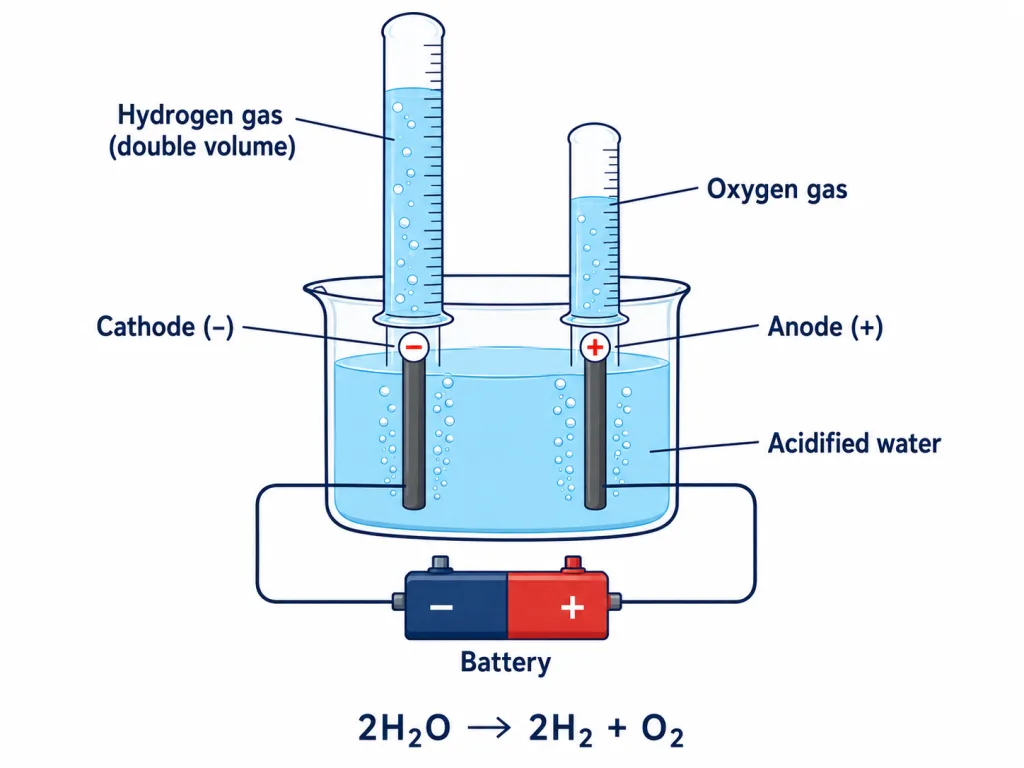
Activity 1.7 — Electrolysis of Water
Procedure:
- Make two holes in the bottom of a plastic mug and fit rubber stoppers.
- Insert carbon electrodes through these stoppers.
- Connect the electrodes to a 6V battery.
- Fill the mug with water (so that the electrodes are submerged) and add a few drops of dilute (to make water conduct).
- Place two graduated test tubes filled with water upside-down over the electrodes.
- Switch on the current for a while.
Observations:
- Bubbles (gases) form at both electrodes.
- The volume of gas in one test tube is double that in the other.
- Gas at cathode = hydrogen (), larger volume.
- Gas at anode = oxygen (), smaller volume.
Reaction:
Why is the Volume of Hydrogen Twice that of Oxygen?
Look at the equation: 2 molecules of → 2 molecules of + 1 molecule of — so hydrogen : oxygen = 2 : 1. The same ratio applies to gas volumes (Avogadro's law).
How to Identify the Gases
- Hydrogen test: Bring a burning matchstick close — the gas burns with a 'pop' sound.
- Oxygen test: Bring a glowing splinter close — it bursts into a bright flame.
Another Important Example
Electrolysis of molten sodium chloride:
This is the industrial method for producing sodium metal and chlorine gas (Down's Process).
Photochemical Decomposition
When the reaction occurs in the presence of sunlight, it is called photochemical decomposition.
Activity 1.8 — Decomposition of Silver Chloride
Take 2 g of silver chloride (white) in a china dish and leave it in sunlight for a while.
Observations:
- The white turns grey.
- Reason — in the presence of light, decomposes into (metallic silver, grey) and .
Reaction:
Similarly, silver bromide also —
The Principle of Black-and-White Photography
The old black-and-white film was coated with a thin layer of . When light fell on it, decomposed in proportion to light intensity into metallic silver (black) — the brighter areas became darker on the film, producing the photograph. This is photochemical decomposition put to industrial use.
Today, with digital cameras, film photography is rare — but the principle remains historically significant.
The Three Types of Decomposition — Summary Table
| Energy Source | Name of Reaction | Example |
|---|---|---|
| Heat | Thermal decomposition | |
| Electricity | Electrolytic decomposition | |
| Light | Photochemical decomposition |
[Board Important] Memorise one example of each — this is a very common question.
Endothermic Reactions
In the previous section we saw exothermic reactions in which heat is released. Endothermic is the opposite.
Definition: Reactions in which heat/energy is absorbed from the surroundings are called endothermic reactions.
Symbolic Form
Energy is written on the left side because it acts like a 'reactant' — it is being taken in.
A Striking Experiment
Take 2 g of barium hydroxide in a test tube. Add 1 g of ammonium chloride and stir with a glass rod.
Observation: Touching the bottom of the test tube with your palm feels cold.
Reaction:
This is a remarkable demonstration — mixing two solids drops the temperature so much that water vapour from the surroundings can condense as droplets on the outside of the tube.
Other Examples of Endothermic Reactions
| Reaction | Type |
|---|---|
| Decomposition + Endothermic | |
| Decomposition + Endothermic | |
| Decomposition + Endothermic | |
| Photosynthesis: | Endothermic |
The Connection between Decomposition and Endothermic
Most decomposition reactions are endothermic. The reason — energy must be supplied to break the bonds. That is why decomposition requires heat, electricity, or light to proceed.
[NEET/JEE hint] is positive () for endothermic reactions — to be studied in Class 11.
🧠 Memory Capsule
A one-glance recap to revisit just before the board exam — every key idea about decomposition and endothermic reactions in one place.
1. Decomposition Formula
2. Endothermic Formula
3. Three Types of Decomposition — Must-Know Table
| Energy | Type | Famous Example |
|---|---|---|
| Heat () | Thermal | |
| Electricity | Electrolysis | |
| Light | Photochemical |
4. NCERT's Four Famous Activities
- Activity 1.5: (green → brown)
- Activity 1.6: (brown smoke)
- Activity 1.7: (H₂ : O₂ = 2 : 1)
- Activity 1.8: (white → grey)
5. Exothermic vs. Endothermic
| Aspect | Exothermic | Endothermic |
|---|---|---|
| Heat | Released | Absorbed |
| Temperature | Rises | Falls |
| Example | ||
| Connection | Most combinations | Most decompositions |
| (Class 11) |
6. Repeatedly Asked Board Questions
- What is a decomposition reaction? Give examples of all three types.
- Why is the volume of hydrogen twice that of oxygen in the electrolysis of water?
- Why is decomposition called the opposite of combination?
- Why does silver chloride change colour in sunlight?
- Give one example of an endothermic reaction.
7. One-Liners to Remember
- Decomposition = breaking apart
- Endothermic = energy IN
- Most decompositions are endothermic
- Three types: heat / electricity / light
The Bottom Line: One breaks, many form → decomposition. Energy in → endothermic.
Solved Examples
Example 1: Identifying Decomposition Reactions
Which of the following are decomposition reactions? (i) (ii) (iii) (iv) (v)
Solution:
- Test: single reactant → multiple products
- Analysis:
- (i) NaCl → Na + Cl₂ — one reactant, two products → Decomposition ✓
- (ii) two reactants → one product → Combination ✗
- (iii) CaCO₃ → CaO + CO₂ → Decomposition ✓
- (iv) two reactants → two products → Displacement ✗
- (v) H₂O₂ → H₂O + O₂ → Decomposition ✓
- Answer: (i), (iii), and (v) are decomposition reactions.
Example 2: NCERT — Explanation of Ferrous Sulphate Decomposition
What are the observations when ferrous sulphate crystals are heated? Write the balanced reaction.
Solution:
Observations:
- The green crystals turn brown.
- A pungent smell is released (sulphur oxides).
- The crystals first lose their water of crystallisation, then decompose.
Reactions — Step by step:
Step 1 — Loss of water of crystallisation:
Step 2 — Decomposition:
Where — (ferric oxide, brown), (pungent smell), (pungent smell).
Type of reaction:
- Decomposition reaction (one reactant → three products)
- Endothermic (heat is absorbed)
Example 3: NCERT — Why is the Volume of Gas Doubled in Activity 1.7?
In Activity 1.7, why is the volume of gas collected in one test tube double that in the other? Name that gas.
Solution:
Reaction:
Analysis:
- Mole ratio: 2 molecules of are formed and 1 molecule of .
- Volume ratio: By Avogadro's law, at the same temperature and pressure, volumes are proportional to molecular numbers — so .
- The doubled gas: Hydrogen () — produced at the cathode (negative electrode).
- Test: Bringing a burning matchstick close — it burns with a 'pop' sound.
Answer: The gas with double the volume is hydrogen, because the molar ratio of to in the reaction is 2:1.
[Board Important — asked every year]
Example 4: Colour Change of Silver Chloride
Why does silver chloride change from white to grey in sunlight? Write the balanced reaction.
Solution:
- Reaction:
- Reason for the colour change:
- Original substance is white.
- In the presence of light, decomposes to form metallic silver (), which is grey/black.
- gas is also evolved (and dissipates into the atmosphere).
- Type of reaction:
- Photochemical decomposition
- Endothermic — light energy is absorbed.
- Use: This principle is used in black-and-white photography. The film is coated with , which decomposes in proportion to the intensity of light, producing black metallic silver in the brighter regions.
[Board Important — 3-mark question]
Example 5: Endothermic Reaction Demo
A student mixed 2 g of and 1 g of in a test tube. Holding the bottom of the tube with the palm felt cold. What kind of reaction is this? Explain.
Solution:
- Reaction:
- What kind of reaction?
- The cold sensation means — the test tube absorbed heat from its surroundings.
- So this is an endothermic reaction.
- Type:
- Double Displacement — Ba and NH₄ swap places.
- Endothermic — heat is absorbed.
- Special note: This reaction absorbs so much heat that water vapour from the surrounding air can condense on the outside of the test tube as droplets — direct, visible evidence of its endothermic nature.
Answer: This is an endothermic chemical reaction.
Example 6: NCERT — Types of Decomposition by Energy Source
Which kinds of energy — heat, light, or electricity — bring about the decomposition of the following? Give balanced equations. (i) (ii) (iii)
Solution:
(i) Calcium carbonate — Thermal decomposition:
This is the key reaction in the cement industry.
(ii) Water — Electrolytic decomposition (Electrolysis):
A few drops of are added to water and current is passed using a 6V battery.
(iii) Silver chloride — Photochemical decomposition:
White turns grey.
Summary of all three:
| Energy | Reaction | Outcome |
|---|---|---|
| Heat | Quick lime forms | |
| Electricity | Gases evolved | |
| Light | Colour change |
[Board 5-mark question]
Example 7: A Curious Question — Sparkle of Firecrackers
What happens when potassium chlorate () is heated? How is it used in firecrackers?
Solution:
- Reaction:
( is a catalyst that speeds up the reaction.)
- Type of reaction:
- Decomposition — one reactant → two products
- Endothermic — heat is absorbed
- Use in firecrackers:
- releases oxygen on heating.
- This oxygen burns the metal powders (Al, Mg, etc.) mixed in the firecracker.
- That's why firecrackers burn with a brilliant flame and a loud sound.
- A curious note: This is the simplest way to prepare oxygen gas in the laboratory.
Answer: Decomposition of — an endothermic decomposition reaction that releases oxygen.
Example 8: Numerical — Gas Production from Electrolysis
In the electrolysis of water, 36 g of water is fully decomposed. Find the masses of and produced. (H=1, O=16)
Solution:
- Reaction:
- Molecular masses:
- g
- g
- g
- Verifying mass conservation: 36 = 4 + 32 ✓
- From the given water: Since 36 g is exactly given, the ratio applies directly —
- Mass of = 4 g
- Mass of = 32 g
- Verification: ratio is (by mass), but by volume (because Avogadro's law works on molecular numbers).
Lesson: Mass ratio and volume ratio are different — the volume ratio depends on the number of molecules.
Example 9: NCERT — Difference Between Combination and Decomposition
Why is decomposition called the reverse of combination? Write equations for each.
Solution:
General forms of both:
| Reaction | General form | Nature |
|---|---|---|
| Combination | Joining | |
| Decomposition | Breaking |
Why opposite?
- In combination, two/more combine to form one.
- In decomposition, one breaks into two/more.
- Combinations are mostly exothermic (heat released); decompositions are mostly endothermic (heat absorbed).
Paired examples:
(1) Calcium hydroxide ↔ Calcium oxide:
Combination:
Decomposition (on heating):
(2) Mercuric oxide ↔ Mercury:
Combination:
Decomposition:
Conclusion: Combination and decomposition are opposite reactions to each other.
[Board 3-mark question]
Example 10: NCERT — Three Types of Decomposition by Energy Source
Write one equation each for decomposition reactions in which energy is supplied as heat, light, and electricity.
Solution:
(i) By heat (Thermal decomposition):
Lead nitrate releases brown smoke on heating.
(ii) By electricity (Electrolytic decomposition):
The electrolysis of water is a famous classroom experiment.
(iii) By light (Photochemical decomposition):
This is the principle behind black-and-white photography.
[Board 3-5 mark question]
Example 11: Real-Life — The Cement Industry
What is the key reaction of the cement industry? What kind of reaction is it?
Solution:
Reaction (decomposition of limestone):
Classification:
- Decomposition — one reactant → two products ✓
- Thermal decomposition — driven by heat ✓
- Endothermic — heat is absorbed ✓
Importance in the cement industry:
- (quick lime) = the main ingredient of cement.
- Limestone is heated in kilns at 1000–1400°C.
- Mixed with clay, silica, and alumina to make the final cement.
Daily-Life Importance:
- Construction of buildings.
- Roads and bridges.
- The Indian cement industry is the world's second-largest.
Environmental concern: The release of adds to atmospheric pollution and the greenhouse effect.
Example 12: Comparing Exothermic and Endothermic
Differentiate between exothermic and endothermic reactions. Give one example of each.
Solution:
Comparison Table:
| Aspect | Exothermic | Endothermic |
|---|---|---|
| Heat flow | Released | Absorbed |
| Surrounding temp. | Rises | Falls |
| Equation form | Reactants → Products + Heat | Reactants + Energy → Products |
| Bond energy | Bond-forming energy > Bond-breaking energy | Bond-breaking > Bond-forming |
| (Class 11) | Negative () | Positive () |
| Connection | Most combinations | Most decompositions |
Examples:
Exothermic:
Endothermic:
Notice — both involve , but in one is a reactant (and reacts), while in the other is a product (formed by breaking ).
[Board 3-5 mark question]
Example 13: A Trick Question — Identification of Specific Gases
For each of the following, name the gas evolved and write the test for it — (a) Heating (b) Heating (c) Electrolysis of water (at the cathode) (d) Sunlight on
Solution:
| Case | Reaction | Gas | Test |
|---|---|---|---|
| (a) | Turns lime water milky | ||
| (b) | (brown), | — brown colour; — relights a glowing splinter | |
| (c) | (at cathode) | Burns with a 'pop' sound near a flame | |
| (d) | Pungent smell, greenish-yellow colour |
Lesson: Exam questions often ask — "Which gas is evolved in _ reaction and how is it identified?" — memorise all four answers.
Example 14: NCERT — Decomposition of Hydrogen Peroxide
Write the balanced equation for the decomposition of hydrogen peroxide. What kind of reaction is it? Give one daily-life use.
Solution:
- Reaction:
- Catalyst: or speeds up this reaction.
- Classification:
- Decomposition — one reactant → two products
- Exothermic — interestingly, this decomposition is exothermic (unlike most decompositions).
- Daily-life uses:
- Antiseptic: Cleaning wounds — kills germs because the released oxygen kills bacteria.
- Hair bleaching: Used in hair dyes.
- Rocket fuel: High-purity as an oxidiser.
- Curious fact: The reaction is slow without a catalyst. In our body, the enzyme catalase speeds it up — that's why bubbles appear when is poured on a wound.
Example 15: NCERT — Decomposition of Sodium Hydrogen Carbonate
What happens when sodium hydrogen carbonate is heated? Write the balanced equation. Give a daily-life use.
Solution:
- Reaction:
- Classification:
- Decomposition reaction — one reactant → three products
- Thermal decomposition — driven by heat
- Endothermic — heat is absorbed
- Daily-Life Use — Baking Soda:
- = baking soda
- Used in cakes and biscuits — heating releases , which causes the dough to rise.
- That is why cakes become spongy and soft.
- Curious fact: Baking powder contains + a mild acid (like tartaric acid) that releases on contact with water.
- Use in fire extinguishers: The helps put out fires.
[Board + Daily-Life question]
Example 16: A Quick Classification Summary
Classify the following reactions on the basis of (a) reaction type and (b) energy type — (i) (ii) (iii) (iv) (respiration)
Solution:
| # | Reaction Type | Energy Type |
|---|---|---|
| (i) | Decomposition (thermal) | Endothermic |
| (ii) | Combination (combustion) | Exothermic |
| (iii) | Decomposition (electrolytic) | Endothermic |
| (iv) | — (large; many bonds break and form; technically combustion/oxidation) | Exothermic |
Detailed explanation:
- (i) is 'mercuric oxide' — heating breaks the red powder into metallic mercury (Hg) and oxygen.
- (ii) Burning of coal — two reactants → one product, hence combination.
- (iii) Molten NaCl decomposes on passing electricity into sodium metal and chlorine gas.
- (iv) Respiration — although multiple products form (so not combination), it is oxidation and exothermic.
Lesson: A single reaction can belong to multiple categories — reaction type (combination/decomposition/…) and energy type (exothermic/endothermic) — these are independent classifications.