
What is a Displacement Reaction?
Imagine you are sitting in a bus, and suddenly a 'more powerful' person gets in — and you have to give up your seat. Exactly this happens in chemistry — a more reactive element kicks out a less reactive element from its compound. This is called a displacement reaction.
Definition: A chemical reaction in which a more reactive element displaces a less reactive element from its compound is called a displacement reaction.
General Form
Where — A is more reactive (entering the compound), and B is less reactive (kicked out).
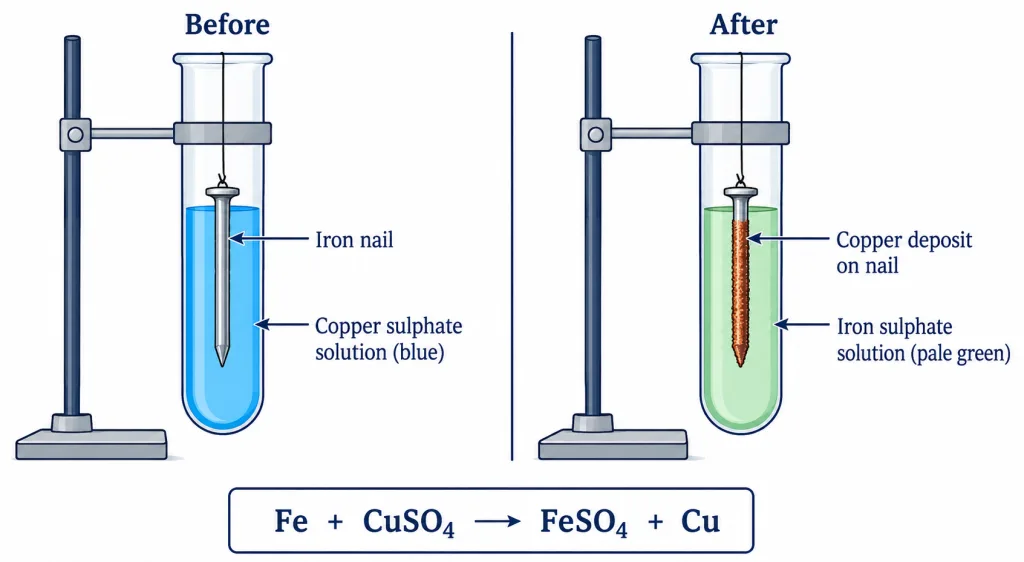
Activity 1.9 — Iron Nail in Copper Sulphate
This is NCERT's most famous displacement experiment.
Procedure:
- Take three iron nails and clean them with sandpaper.
- Take 10 mL of blue copper sulphate solution in test tubes A and B.
- Tie two nails with a thread and dip them in test tube B (for 20 minutes).
- Keep one nail aside (for comparison).
Observations (after 20 minutes):
- The blue colour of the solution in tube B has faded (turned pale green).
- A brown coating has formed on the nails (deposited copper).
- Tube A is unchanged.
Reaction:
Explanation:
- Iron (Fe) is more reactive than copper (Cu).
- So iron displaces copper from and forms itself.
- Metallic copper deposits on the surface of the nail.
Why the colour change? (blue) → (pale green); plus brown copper on the nail.
The Activity Series (Reactivity Series)
To know how reactive each metal is, scientists have arranged the metals in order of reactivity. This list is called the activity series.
Activity Series (most reactive at top, least at bottom)
Helpful mnemonic: "Please Stop Calling Me A Zebra; Instead, Let's Have Cold Hot Salty Gold"
(Potassium-Sodium-Calcium-Magnesium-Aluminium-Zinc-Iron-Lead-Hydrogen-Copper-Mercury-Silver-Gold)
The Main Rule
A metal higher in the series can displace a metal lower in the series — but not vice versa.
Examples:
- Zn (above) can displace Cu (below) ✓
- Cu (below) cannot displace Zn (above) ✗
More Examples of Displacement Reactions
(i) Zinc + Copper sulphate:
(Zn is above Cu)
(ii) Lead + Copper chloride:
(Pb is above Cu)
(iii) Iron + Copper sulphate:
(Fe is above Cu)
(iv) Refining of silver — using copper:
(Cu is above Ag)
[Board Tip] Whether displacement happens or not — always check the activity series.
A Question — Which Displacement Will Not Happen?
If you put a copper nail in solution, what will happen?
Possible reaction:
Analysis: Check the activity series — Fe is above, Cu is below. So Cu (below) cannot displace Fe (above).
Conclusion: This reaction will not happen. Putting a copper nail in solution causes no change.
Another Important Question — Refining of Silver
Crude silver often contains impurities. To extract pure silver, copper is used —
This is a very important industrial reaction. NCERT mentions it specifically.
Displacement of H₂ by Active Metals
Metals above hydrogen in the activity series can displace gas from acids —
(i) Zinc + acid:
(ii) Magnesium + acid:
(iii) Iron + dilute acid:
But — copper does not displace H₂ from acids, because Cu is below H.
[Board Important] Remember the position of H in the activity series — below Pb, above Cu.
Sub-types of Displacement
Displacement reactions are mainly of two kinds —
Type 1 — Displacement of a Metal by Another Metal
When one metal displaces another metal from a salt solution.
Example:
Type 2 — Displacement of Hydrogen by a Metal
When a metal displaces from an acid.
Example:
Type 3 — Displacement Among Non-metals (Halogens)
Halogens (Cl, Br, I, F) also have a reactivity order:
(i) Chlorine displaces bromide:
(ii) Chlorine displaces iodide:
(A purple-black colour of iodine is seen — this is a famous identification test.)
General Rule of Displacement
| Situation | What happens? |
|---|---|
| More reactive + (compound of less reactive) | Displacement happens |
| Less reactive + (compound of more reactive) | Displacement does not happen |
| Both equally reactive | Reaction is slow or negligible |
Daily Life and Industrial Applications
1. Metal Extraction
Many metals are extracted from their ores using displacement.
(i) Thermite Reaction:
- Aluminium displaces iron.
- So much heat is released that the iron melts.
- Use: Welding broken railway tracks and machine parts.
2. Active Metals for Reduction
Very active metals like can displace other metals from their compounds — but reactions involving them are dangerous.
3. Refining of Silver
As we saw — copper is used to obtain pure silver.
4. Cathodic Protection (Sacrificial Protection)
A layer of zinc is coated on iron pipes to prevent rusting — because Zn corrodes first (more reactive) while Fe stays safe.
A Curious Real-Life Example
What happens if milk is stored in a copper vessel?
- Cu does not react with (milk has lactic acid). So copper vessels are generally fine with milk.
- But when milk goes sour (more acidic), copper can dissolve a little — that's why sour milk should not be stored in copper vessels for long.
- Iron utensils, on the other hand, can release iron when used to cook acidic foods — this is how traditional cooking made foods 'iron-rich'.
[Board Important] Questions based on the activity series come up almost every year.
🧠 Memory Capsule
A one-glance recap to revisit just before the board exam — every key idea about displacement reactions in one place.
1. Displacement Formula
(A more reactive, B less reactive)
2. The Activity Series — Memorise This Order
Higher = more reactive — can displace those lower down.
3. Must-Memorise Reactions
| Reaction | Note |
|---|---|
| NCERT Activity 1.9 | |
| Zn > Cu | |
| Pb > Cu | |
| Silver refining | |
| Displacement of H₂ from acid | |
| Thermite — railway track welding |
4. Visual Clues — How to Spot a Displacement
- Colour change: Blue → pale green
- Metallic deposit: Brown copper on the nail
- Gas evolution: Acid + active metal → bubbles of
5. Examples Where Displacement Will Not Happen
- → no change (Cu less reactive than Fe)
- → no change (Cu less reactive than H)
- → no change
6. Repeatedly Asked Board Questions
- What is a displacement reaction? Explain Activity 1.9.
- What happens when an iron nail is dipped in solution? Explain the colour change.
- Can Cu displace Fe from ? Why or why not?
- How is copper used in refining silver?
- What is the thermite reaction? State its use.
7. A Trick
- When a question asks about a possible displacement, mentally jot down a quick mini-version of the activity series — K, Na, Ca, Mg, Al, Zn, Fe, Pb, H, Cu, Hg, Ag, Au.
The Bottom Line: The bully of reactivity wins — the weaker is kicked out. Direction is always top-down.
Solved Examples
Example 1: NCERT — Iron Nail in Copper Sulphate
When an iron nail is dipped in copper sulphate solution, why does the colour of the solution change?
Solution:
- Reaction:
- Reason for the colour change:
- Initially, solution is blue (due to Cu²⁺ ions).
- Iron is more reactive than copper, so Fe displaces Cu and itself forms .
- solution is pale green (due to Fe²⁺ ions).
- Metallic copper (brown) deposits on the surface of the nail.
- Visible observations:
- Solution colour changes from blue to pale green.
- Brown deposit on the nail.
- Type of reaction: Displacement reaction (Fe displaced Cu).
[NCERT textbook question — repeatedly asked in board]
Example 2: NCERT — Refining of Silver
In the refining of silver, the recovery of silver from a silver nitrate solution is achieved by using copper. Write the equation for this process.
Solution:
- Reaction:
- Analysis:
- In the activity series, Cu is above Ag — so Cu can displace Ag.
- In the process, a thin copper plate is dipped in solution.
- Pure metallic silver () deposits on the copper plate.
- Solution colour:
- Initially — colourless solution.
- Finally — pale blue solution.
- Industrial significance: This is a simple method for refining silver.
What kind of reaction is this? Displacement reaction.
Example 3: Can Cu Displace Fe from FeSO₄?
If a copper nail is dipped in solution, what will happen? Explain on the basis of the activity series.
Solution:
- Question's framework:
- Activity series:
- Analysis: Fe is above, Cu is below.
- Rule: A metal below cannot displace one above.
- So Cu cannot displace Fe from .
- Answer: This reaction will not happen. A copper nail in solution shows no change.
- Compare: The opposite — does happen (because Fe is above Cu).
Lesson: The direction of displacement is always more reactive → less reactive.
Example 4: Reaction of Zinc with Acid
What happens when granulated zinc is treated with dilute ? What kind of reaction is it?
Solution:
- Reaction:
- Observations:
- Bubbles of gas (hydrogen) are evolved.
- The flask becomes warm (exothermic).
- Zinc gradually dissolves.
- Type of reaction:
- Displacement reaction — Zn displaces H from .
- Exothermic — heat is released.
- Activity series proof: Zn is above H, so displacement is possible.
- Test for hydrogen: Burns with a 'pop' sound near a flame.
[Board Important — recurring question]
Example 5: Thermite Reaction
What is the thermite reaction? What is its daily-life use?
Solution:
- Reaction:
- Features:
- Displacement reaction — Al displaces Fe (since Al is above Fe).
- Highly exothermic — so much heat is released that iron melts to a liquid.
- Daily-life uses:
- Welding railway tracks: Thermite powder is sprinkled on broken tracks and ignited — molten iron joins them.
- Joining broken iron parts in machinery.
- Field repairs in rockets and similar applications.
- Special note: This reaction generates temperatures up to about 2500°C locally — it is considered the most effective method of railway track welding.
[Board Important — 3-mark question]
Example 6: NCERT — Three Examples of Displacement
Give three examples of displacement reactions and show that the more reactive element displaces the less reactive one.
Solution:
Example 1:
Fe is more reactive than Cu (above in series) — so Fe displaces Cu.
Example 2:
Zn is more reactive than Cu — so Zn displaces Cu.
Example 3:
Pb is more reactive than Cu — so Pb displaces Cu.
General principle: In all three reactions, the higher metal in the activity series displaced the lower metal (copper) from its salt.
Reverse proof: — Cu cannot displace Fe because it is less reactive.
Example 7: Displacement Among Halogens
Identify the type of the following reaction and explain how it works —
Solution:
- Reaction:
- Observation:
- Adding to colourless solution turns it purple-black (colour of iodine).
- Type of reaction:
- Displacement reaction — among halogens.
- Cl displaces I from .
- Reactivity order (halogens):
- Cl is above, I is below — so displacement is possible.
- Reverse question: Can happen?
- No — because I is less reactive than Cl.
- Use: This reaction is a laboratory test for iodine.
Lesson: Displacement is not limited to metals — non-metals (halogens) also undergo displacement.
Example 8: Essential Question — Why Doesn't Copper React with Acid?
Why does copper not react with dilute or dilute ? Explain.
Solution:
- Analysis: In the activity series, Cu is below H.
- Rule: A metal can displace from an acid only if it is above H in the activity series.
- Conclusion: Cu is below H — so Cu cannot displace from acid.
- Direct evidence: If you put a copper piece in dilute , no reaction is observed — no bubbles.
- Exception: Concentrated or concentrated can react with copper — but those are redox reactions, not simple displacement. Here the acid acts as an oxidising agent.
- Consequence in daily life: This is why copper utensils can hold mildly acidic foods (lemon, vinegar) without violent reaction.
[Board Important — 3-mark question]
Example 9: Numerical — How Much Product from Displacement?
5.6 g of Fe is added to excess solution. Find the mass of copper obtained. (Fe = 56, Cu = 63.5)
Solution:
- Reaction:
- Mole ratio: 1 mol Fe gives 1 mol Cu.
- Mass ratio: 56 g Fe → 63.5 g Cu
- Given: 5.6 g Fe
- Calculation:
- Answer: 6.35 g of copper will be obtained.
Lesson: Stoichiometry — in displacement, the mass ratio of reactant to product follows the mole ratio.
Example 10: NCERT — Displacement vs. Double Displacement
What is the difference between displacement and double-displacement reactions? Give one example of each.
Solution:
Comparison Table:
| Aspect | Displacement | Double Displacement |
|---|---|---|
| Formula | ||
| Participants | One element + one compound | Two compounds |
| What happens? | One element displaces another | Two compounds exchange ions |
| Ions involved | One metal ion (or H) is displaced | Cations swap places between compounds |
| Example |
Detailed examples:
Displacement:
Here Zn displaced Cu (depending on reactivity).
Double Displacement:
Here Ag and Na swapped 'partners' (forming new pairs Ag-Cl and Na-NO₃).
Key difference: Displacement depends on reactivity; double displacement involves ion exchange and often forms a precipitate.
[Board Important — 3-mark question]
Example 11: Magnesium and Water
Magnesium reacts slowly with cold water and quickly with hot water. Write these reactions and state what type they are.
Solution:
With cold water (slow):
With hot water/steam (fast):
Analysis:
- Both are displacement reactions — Mg displaces H₂ from H₂O.
- Mg is above H in the activity series, so displacement is possible.
- Effect of temperature: Higher temperature → faster reaction (general rule).
- Difference in product: in cold water, but directly in hot water/steam.
- Comparison with other metals:
- Na, K — react explosively even with cold water.
- Ca, Mg — moderately reactive.
- Fe — reacts only with steam.
- Cu, Ag, Au — do not react with water.
[A preview of Class 10 Chapter 3 — Metals and Non-metals]
Example 12: A Question — Why Does Silver Stay Shiny?
Why do silver (Ag) ornaments not corrode even after a long time, while iron (Fe) rusts within a few days? Explain using the activity series.
Solution:
- Activity series:
- Analysis:
- Fe is above H — readily reacts with atmospheric moisture and oxygen to rust.
- Ag and Au are far down (less reactive) — barely react with atmospheric agents.
- Special note — black tarnish on silver:
- Over time, silver can develop a black coating (Ag₂S, silver sulphide) — formed by reaction with traces of atmospheric (hydrogen sulphide).
- The story of gold (Au):
- Au is so unreactive it is called a 'noble metal'.
- That is why gold ornaments remain unchanged for thousands of years.
- Daily-life implications:
- Au, Ag are used in jewellery.
- Cu — corrodes more slowly, used in statues.
- Fe — cheap, but must be protected from rust by paint, galvanisation, etc.
[Board + Real-Life]
Example 13: A Challenging Question — Which Displacement Will Happen?
In which of the following mixtures will displacement happen? Give reasons — (i) Cu + AgNO₃ (ii) Ag + CuSO₄ (iii) Zn + FeSO₄ (iv) Fe + ZnSO₄ (v) Mg + AlCl₃
Solution:
Required activity series fragment:
| # | Mixture | More reactive | Outcome |
|---|---|---|---|
| (i) | Cu + AgNO₃ | Cu (above Ag) | Displacement happens ✓ |
| (ii) | Ag + CuSO₄ | Cu (above Ag) | Displacement does not ✗ |
| (iii) | Zn + FeSO₄ | Zn (above Fe) | Displacement happens ✓ |
| (iv) | Fe + ZnSO₄ | Zn (above Fe) | Displacement does not ✗ |
| (v) | Mg + AlCl₃ | Mg (above Al) | Displacement happens ✓ |
Reactions (where they happen):
Rule summary: Displacement happens only when the free element on the left is more reactive than the bound element on the right.
Example 14: NCERT — Numerical on Hydrogen Displacement
13 g of zinc reacts with excess dilute . Find the volume of liberated at STP. (Zn = 65, molar volume at STP = 22.4 L)
Solution:
- Reaction:
- Mole ratio: 1 mol Zn → 1 mol H₂
- Moles of Zn:
- Moles of produced: 0.2 mol
- Volume at STP:
- Answer: 4.48 L of hydrogen is liberated at STP.
Lesson: In stoichiometry, the mole ratio determines gas volumes too (assuming ideal gas).
[NEET/JEE — introduction to mole concept]
Example 15: Write Equations and Identify Type
Write the balanced equation and state the type for each: (a) Zinc metal is added to silver nitrate solution. (b) A magnesium wire is dropped in dilute . (c) An iron nail is dipped in solution.
Solution:
(a) Zn + AgNO₃:
- Zn is more reactive than Ag — displacement reaction.
- Metallic silver is deposited.
(b) Mg + HCl:
- Mg is more reactive than H — displacement reaction.
- Brisk bubbles of H₂ gas.
(c) Fe + CuSO₄:
- Fe is more reactive than Cu — displacement reaction.
- Blue solution turns pale green; brown coating on the nail.
All three are displacement reactions.
Example 16: A Curious Question — Practical Conclusions from the Activity Series
Consider the activity series —
(a) Between Mg and Zn, which displaces copper from faster? (b) Can either Cu or Ag displace Zn from ? (c) If Fe is dipped in , what will happen?
Solution:
(a) Mg vs. Zn — which is faster?
- Mg is more reactive than Zn (Mg is higher in the series).
- So Mg will displace copper faster.
- Reaction:
(b) Can Cu or Ag displace Zn?
- Both are below Zn in the series.
- Neither can.
- No reaction will occur.
(c) Fe + AgNO₃:
- Fe is above Ag — displacement happens.
- Reaction:
- Shiny silver crystals deposit on the iron nail.
[Board Important — 3 or 5 mark question]
Lesson: Practical use of the activity series — many problems can be solved by reading the series alone, without doing balancing arithmetic.