
What is a Combination Reaction?
The simplest kind of chemical reaction — when two or more reactants combine to form a single product, it is called a combination reaction.
General Form
Things are joining together, not splitting apart — the very word combination means 'coming together'.
Activity 1.4 — Calcium Oxide + Water
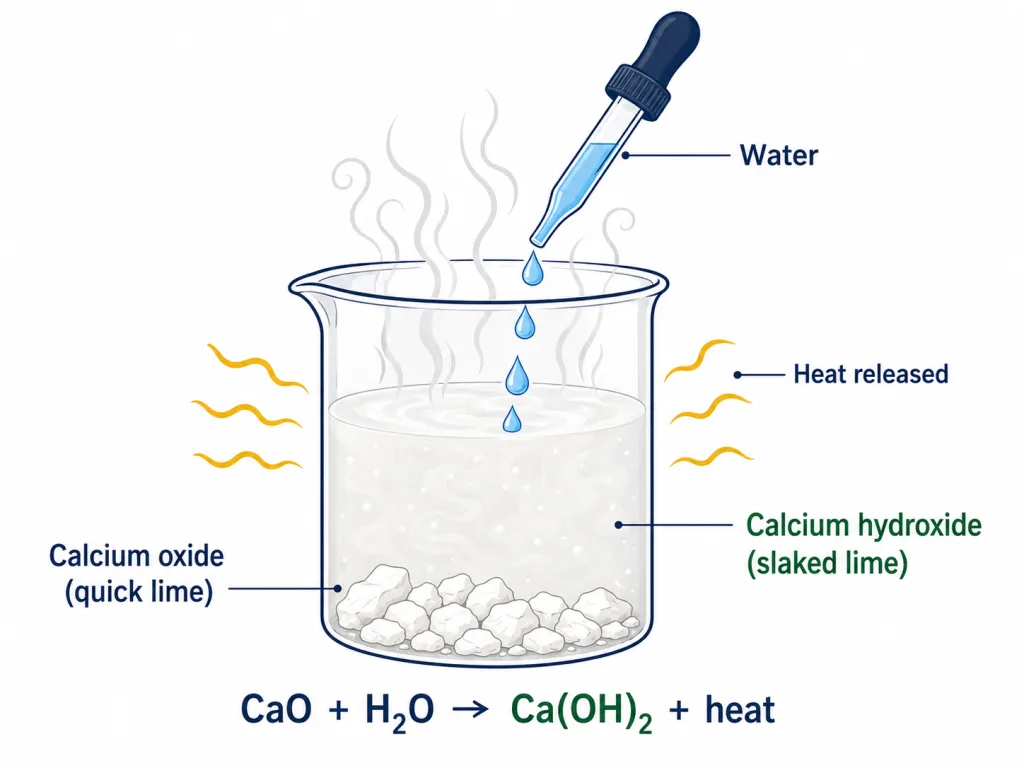
Take a small quantity of calcium oxide (quick lime, ) in a beaker and slowly add water.
Observations:
- The beaker becomes very hot (you can feel it on touching).
- The white powder mixes with water to form a thick slurry.
Reaction:
Here, two substances ( and ) combine to form a single product (slaked lime / calcium hydroxide) — this is a combination reaction.
Use of Calcium Hydroxide for Whitewashing
The solution of slaked lime is used to whitewash walls. After 2–3 days of whitewashing, the walls develop a shine — why?
slowly reacts with from the air to form (calcium carbonate), which forms a glossy white coating.
Interesting Fact: Marble has the same chemical formula — . That's why a freshly whitewashed wall develops a slight marble-like sheen.
More Examples of Combination Reactions
Combination reactions can occur in three ways —
1. Element + Element → Compound
(i) Burning of coal:
(ii) Formation of water from hydrogen:
(iii) Burning of magnesium:
(iv) Formation of ammonia from nitrogen:
2. Compound + Compound → Compound
(i) The whitewashing reaction:
3. Element + Compound → Compound
(i) Conversion of sulphur dioxide to sulphur trioxide:
Easy Identification
If a reaction has more than one reactant but only one product, it is a combination reaction. Remember the rule:
[Board Tip] "Two combine to form one" — the simplest rule of combination reactions.
Exothermic Reactions
In Activity 1.4, you saw that the reaction made the beaker hot — heat was released. Such reactions are called exothermic reactions.
Definition: Reactions in which heat is also released along with the formation of products are called exothermic reactions.
Symbolic Form
('+ Heat' implies that heat is being released as a kind of 'product')
Major Examples of Exothermic Reactions
(i) Burning of natural gas (methane) — LPG in your kitchen:
(ii) Respiration — happening inside our body:
The glucose that comes from our food reacts with oxygen in our cells to release energy.
(iii) Decomposition of vegetable matter into compost:
Vegetable matter slowly decomposes into manure — this process also releases heat. The interior temperature of a large compost heap can reach 60–70°C.
(iv) Slaking of lime:
[Looking Ahead — NEET/JEE] In an exothermic reaction, is negative () — a concept you will study in Class 11.
The Connection Between Combination and Exothermic
A very important point — not every combination reaction is exothermic, but most combination reactions are exothermic.
Why? — From the Bond-Energy Perspective
When atoms form bonds, energy is released. In combination reactions, new and stable bonds form — and so energy is released.
Classification of Activity 1.1
Burning of magnesium —
- Combination? Yes — two reactants form one product.
- Exothermic? Yes — a dazzling flame is produced.
Both at once — a single reaction can fall into more than one class.
Physical Processes vs. Chemical Reactions
Some exothermic processes are not chemical at all:
- Freezing of water is an exothermic physical change (latent heat is released) — but no new substance is formed.
- So to call something an exothermic reaction, both a new substance and the release of heat are required.
A Quick Table — Easy Identification
| Example | Combination? | Exothermic? |
|---|---|---|
| Yes | Yes | |
| Yes | Yes | |
| No (multiple products) | Yes | |
| Respiration | No | Yes |
| Freezing of water | — (Physical) | Yes (latent heat) |
Be Careful! Not every exothermic process is a chemical reaction. Only when a new substance forms it is chemical.
Importance in Daily Life
At Home
- Cooking: LPG (mainly ) burns to provide heat.
- Maintaining body temperature: Energy from food is released by respiration.
- Whitewashing walls: + atmospheric → — a glossy white coating.
In Industry
- Cement industry: is a key ingredient.
- Haber Process: — making ammonia for fertilisers. This is an industrially crucial exothermic combination reaction.
- Metallurgy: — supplies heat in furnaces.
- Sulphuric acid production: (part of the contact process).
In Nature
- Combustion (fire): Burning of fuels.
- Biological processes: Decomposition of vegetables = compost = manure for agriculture.
- Animal metabolism: The energy source for all living beings.
A Curious Question — Why Are We Warm?
Respiration (an exothermic reaction) goes on continuously in our bodies. A healthy adult produces about 80 calories per hour — that's what keeps us at 37°C even in cold weather.
[Board Important] Why is respiration called an exothermic reaction? — A nearly annual question. Standard 3-mark answer:
- In respiration, glucose + oxygen → CO₂ + H₂O (new substance — chemical)
- Energy is released (exothermic)
- This energy keeps us alive.
🧠 Memory Capsule
A one-glance recap to revisit just before the board exam — every key idea about combination and exothermic reactions in one place.
1. Combination Reaction Formula
2. Exothermic Formula
3. Must-Memorise Reactions
| Reaction | Type |
|---|---|
| Combination + Exothermic | |
| Combination + Exothermic | |
| Combination + Exothermic | |
| Combination + Exothermic | |
| Combination (whitewash shine) | |
| Exothermic (but not combination) | |
| Respiration: | Exothermic |
4. Key Facts — One Liners
- = Quick lime (unslaked)
- = Slaked lime — used in whitewashing
- = Calcium carbonate = limestone / marble
- Reason for the wall's shine = formation of from atmospheric
5. Five Sure-Shot Board Questions
- What is a combination reaction? Give examples.
- What is an exothermic reaction? Give three examples.
- Why does a wall painted with slaked lime develop a shine after 2–3 days?
- Why is respiration considered an exothermic reaction?
- Identify the type of reaction shown in Activity 1.4.
6. Watch Out!
- Not every combination is exothermic — but most are.
- Not every exothermic reaction is combination — combustion and respiration are exothermic but not combination (multiple products).
- For an exothermic reaction, a new substance must form — heat alone is not enough.
The Bottom Line: Two combine, one forms → combination. Heat released → exothermic.
Solved Examples
Example 1: Identifying Combination Reactions
Which of the following are combination reactions? (i) (ii) (iii) (iv) (v)
Solution:
- Test: more than one reactant → single product.
- Analysis:
- (i) Mg + O₂ → MgO — two reactants, one product → Yes, combination ✓
- (ii) one reactant, two products → decomposition ✗
- (iii) one reactant, two products → decomposition ✗
- (iv) N₂ + H₂ → NH₃ — two reactants, one product → Yes, combination ✓
- (v) two reactants, but two products → displacement ✗
- Answer: (i) and (iv) are combination reactions.
Example 2: NCERT Question — The Whitewashing Mystery
A solution of substance 'X' is used for whitewashing. (i) Name 'X' and write its formula. (ii) Write the reaction of X with water. (iii) Why does the wall develop a shine 2–3 days after whitewashing?
Solution:
(i) Substance 'X' is calcium oxide (quick lime), formula = .
(ii) Reaction of X with water:
This is an exothermic combination reaction. The (slaked lime) so formed is what gets applied to the wall.
(iii) Reason for the shine:
slowly reacts with the in the atmosphere —
A thin coating of (calcium carbonate) builds up on the wall over 2–3 days. Marble also has the formula — which is why the wall ends up with a slight marble-like shine.
[Repeatedly asked in Board — 3 marks]
Example 3: Definition of Exothermic Reaction
Define an exothermic reaction. Give three examples.
Solution:
Definition: Chemical reactions in which heat is released along with the formation of products are called exothermic reactions.
Three examples:
(i) Burning of natural gas (methane):
(ii) Respiration:
(iii) Slaking of lime:
[Board Important — 3-mark question]
Example 4: Why is Respiration an Exothermic Reaction?
Why is respiration considered an exothermic reaction? Explain.
Solution:
The respiration reaction:
It is an exothermic reaction because —
- It is a chemical reaction: Glucose and oxygen combine to form new substances ( and ).
- Energy is released: The reaction releases energy, stored as ATP and used for various body functions.
- Bodily evidence: Running or exercise makes the body feel warm — a direct sign of the heat released by faster respiration.
- This same energy keeps us alive — it maintains body temperature at 37°C, drives muscle contraction, and powers the brain.
Conclusion: Respiration produces new substances and releases energy — both conditions met, hence it is an exothermic chemical reaction.
[Repeatedly asked in Board — almost every year — 3 marks]
Example 5: Combination + Exothermic Combined Question
Consider the reaction: (a) What type of reaction is this? (b) Is it exothermic? Give a reason. (c) State one daily-life use of the product.
Solution:
(a) Type: This is a combination reaction because two reactants ( and ) combine to form a single product, .
(b) Exothermic? Yes, this is an exothermic reaction because heat is released along with the reaction — the beaker becomes warm to the touch.
(c) Use: The product (slaked lime) is used for whitewashing walls. After 2–3 days, it reacts with in the air to form a shiny white coating of .
Lesson: A single reaction can belong to more than one type — both combination and exothermic at the same time.
Example 6: Composting — A Chemical Analysis
What type of reaction is the composting of vegetable matter? Explain.
Solution:
- Process: Vegetables (containing carbohydrates, proteins and other organic compounds) slowly break down by the action of microorganisms into humus (manure).
- Chemical Nature:
- It is a chemical reaction — new substances are produced.
- It is exothermic — the interior temperature of a compost heap can reach 60–70°C, clear evidence of heat being released.
- Overall: It is an exothermic reaction (a kind of decomposition) where complex organic matter breaks into smaller molecules and minerals.
- Daily-Life Importance:
- Compost is a natural fertiliser for agriculture.
- An eco-friendly way to manage waste.
- Very large compost heaps can sometimes catch fire from the heat generated inside.
Answer: Composting is an exothermic chemical reaction.
Example 7: Synthesis of Ammonia — The Haber Process
What type of reaction is the formation of ammonia from nitrogen and hydrogen? Write the balanced equation and explain its classification.
Solution:
Balanced equation:
Classification:
- Combination reaction? Yes — two reactants ( and ) form a single product ().
- Exothermic? Yes — heat is released (interestingly, the industrial process still uses high temperature, because the reaction proceeds very slowly otherwise).
Importance of the Haber Process:
- It is the foundation of the ammonia industry.
- Ammonia is used to make fertilisers (urea, ammonium sulphate).
- Critically important for agriculture — about half the world's population is fed using fertilisers from the Haber process.
[NEET/JEE hint] You will revisit the Haber process in Class 12 in the context of chemical equilibrium.
Example 8: NCERT — Burning of Magnesium
Identify the type of reaction in Activity 1.1, in which heat is released along with the formation of a single product.
Solution:
Reaction:
Analysis:
- Reactants: Mg (atoms combined) and (one molecule) — two reactants.
- Product: Only — single product.
- Released: Heat and light.
Classification:
- Combination reaction — two reactants → one product ✓
- Exothermic reaction — heat is released ✓
Answer: This is a combination + exothermic chemical reaction.
A note: Burning magnesium produces such intense light that it was once used in flash photography. Even today it is used in fireworks and certain emergency flares.
Example 9: Burning of Coal
Write the balanced equation for the burning of coal and state which classes of reaction it belongs to.
Solution:
- Reaction:
- Atom check: C=1=1 ✓, O=2=2 ✓ — already balanced.
- Classification:
- Combination? Yes — two reactants (C and ) → one product ().
- Exothermic? Yes — combustion releases a lot of energy.
- Daily-life: Most of India's electricity is generated by burning coal in thermal power plants.
- Environmental note: is a greenhouse gas, so burning coal contributes to global warming.
Answer: Burning of coal is a combination + exothermic reaction.
Example 10: Formation of Water from Hydrogen
Write the balanced equation for the formation of water from hydrogen and oxygen. What kind of reaction is it?
Solution:
- Unbalanced:
- Balancing:
- Balance O: coefficient 2 on → RHS O = 2
- Balance H: coefficient 2 on → LHS H = 4
- Verify: H=4=4 ✓, O=2=2 ✓
- Classification:
- Two reactants → one product = Combination
- Heat released = Exothermic
- An interesting fact: A mixture of hydrogen and oxygen is explosive — that's the principle behind the 'hydrogen bomb' name. In controlled combustion, however, this reaction is used as a rocket fuel.
Answer: This is a combination + exothermic reaction.
Example 11: True/False
State whether each of the following is true or false, with reasons — (a) All combination reactions are exothermic. (b) All exothermic reactions are combination reactions. (c) Respiration is an exothermic reaction. (d) The reaction of lime with water is endothermic.
Solution:
(a) False — Most combination reactions are exothermic, but not all. Some can be endothermic, e.g., (which absorbs heat).
(b) False — Respiration and combustion of methane are exothermic but not combination reactions (they yield multiple products).
(c) True — In respiration: , energy is released.
(d) False — The reaction of lime with water is exothermic (), since the beaker becomes hot.
Example 12: Identification by Temperature Change
A student does two experiments — (A) adds water to in a beaker. (B) dissolves sodium chloride in water in another beaker. Based on the temperature change in each, identify which is a chemical reaction.
Solution:
(A) :
- Temperature rises sharply (beaker becomes very hot).
- New substance is formed.
- This is a chemical reaction — specifically an exothermic combination reaction.
(B) NaCl + water (solution):
- Practically negligible change in temperature.
- No new substance — NaCl is still NaCl, just dissolved.
- This is only a physical change, not a chemical reaction.
Conclusion:
- (A) Chemical reaction (exothermic combination).
- (B) Only a physical change (dissolution).
Lesson: A large temperature change is a sign of a chemical reaction, but temperature alone is not decisive — always check whether a new substance has formed.
Example 13: Applications of Exothermic Reactions
Give three major daily-life applications of exothermic reactions.
Solution:
1. Cooking (combustion of LPG / natural gas):
The heat released cooks our food.
2. Transportation (combustion of fuel in vehicles):
(Petrol is mainly a mixture of octane.) The energy released drives engines.
3. Power generation (from coal or natural gas):
Most thermal power plants in India work on this principle.
Other applications:
- Energy from respiration in our bodies.
- Furnaces in cement manufacture.
- Composting for agriculture.
- Combustion of rocket fuels.
[Board 5-mark question]
Example 14: Sub-classes of Combination Reactions
Classify the following combination reactions into the three sub-classes — element+element, compound+compound, element+compound: (i) (ii) (iii) (iv) (v)
Solution:
| Reaction | Type of Reactants | Sub-class |
|---|---|---|
| (i) | element + element | Element + Element |
| (ii) | compound + compound | Compound + Compound |
| (iii) | compound + element | Element + Compound |
| (iv) | element + element | Element + Element |
| (v) | compound + compound | Compound + Compound |
Note: The number of products (single) decides whether it is a combination reaction; the nature of the reactants decides the sub-class.
Example 15: Numerical — Quantity of Heat
If 1 mol of and 1 mol of react to release 65 kJ of heat, how much heat will be released by the complete reaction of 5.6 g of ? (Ca = 40, O = 16)
Solution:
- Reaction:
- Ratio: 1 mol = g — 65 kJ heat.
- Given: 5.6 g .
- Calculation:
- Answer: 6.5 kJ of heat will be released by the complete reaction of 5.6 g .
Lesson: This numerical gives an early taste of mass, mole concept, and thermodynamics — concepts you will study in detail in Class 11.
Example 16: Application — A Kitchen Question
What reaction takes place when LPG burns in your kitchen? How is it classified? What is required for complete combustion?
Solution:
LPG is mainly a mixture of butane () and propane (). Let's take butane as the example —
- Unbalanced:
- Balancing:
- C: coefficient 4 on (4 C atoms)
- H: coefficient 5 on (10 H atoms)
- O: RHS now has → coefficient 13/2 on
- Multiply the entire equation by 2 (the odd-vs-even trick):
- Classification:
- Combustion — Yes
- Exothermic — Yes (the flame heats your kitchen)
- Combination — No (multiple products)
- Oxidation — Yes (O is being added to )
- Required for complete combustion:
- Sufficient oxygen — with insufficient oxygen, incomplete combustion forms toxic CO and soot (carbon particles).
- This is why kitchens must always be well-ventilated — burning LPG in a closed room can produce poisonous CO that may be fatal.
[Board + Real-Life] This question is also important from the environmental-awareness perspective.