
Introduction — What is a Chemical Reaction?
Think for a moment — milk left out in summer turns sour, an iron nail left in the rain develops a brown coating, grape juice ferments into wine, and the food we eat gets digested in our body. These look like very different things, yet they all share one common feature: the nature and identity of the starting substance changes.
When the chemical composition and properties of a substance change, and a new substance is formed, we say a chemical reaction has taken place.
Key Point: A chemical change always produces a new substance. A physical change only alters the state, shape, or appearance — the substance itself remains the same.
Physical vs. Chemical Change — At a Glance
| Aspect | Physical Change | Chemical Change |
|---|---|---|
| New substance | Not formed | Always formed |
| Reversibility | Usually reversible | Usually irreversible |
| Energy change | Very small | Often noticeable |
| Examples | Melting of ice, boiling of water | Rusting of iron, souring of milk |
[Board Important] A frequently asked question is — Which of the following is a chemical change? The simplest test is to ask: has a new substance been formed? If yes, it is a chemical change.
Signs of a Chemical Reaction — How Do We Know?
To decide whether a chemical reaction has occurred, we look for observable signs. If you notice any one or more of the following changes, a chemical reaction has likely taken place —
1. Change in State
If the state of matter changes along with formation of new substances — for example, wood burning to ash and smoke.
2. Change in Colour
The most easily observable sign. For example, green ferrous sulphate turns brown on heating, silver objects develop a black tarnish, and copper develops a green patina.
3. Evolution of a Gas
When bubbles (effervescence) appear during a reaction, a gas is being released. For example, granulated zinc reacting with dilute sulphuric acid releases hydrogen gas:
4. Change in Temperature
Some reactions release heat (the container becomes warm) — for example, adding water to quick lime. Others absorb heat (the container becomes cool) — for example, mixing barium hydroxide with ammonium chloride.
5. Formation of a Precipitate
When mixing two solutions produces an insoluble solid that settles down, this solid is called a precipitate. Example — lead nitrate and potassium iodide form a yellow precipitate.
Memory Trick (for the board exam): "S-C-G-T-P" — State, Colour, Gas, Temperature, Precipitate. Remember these five signs.
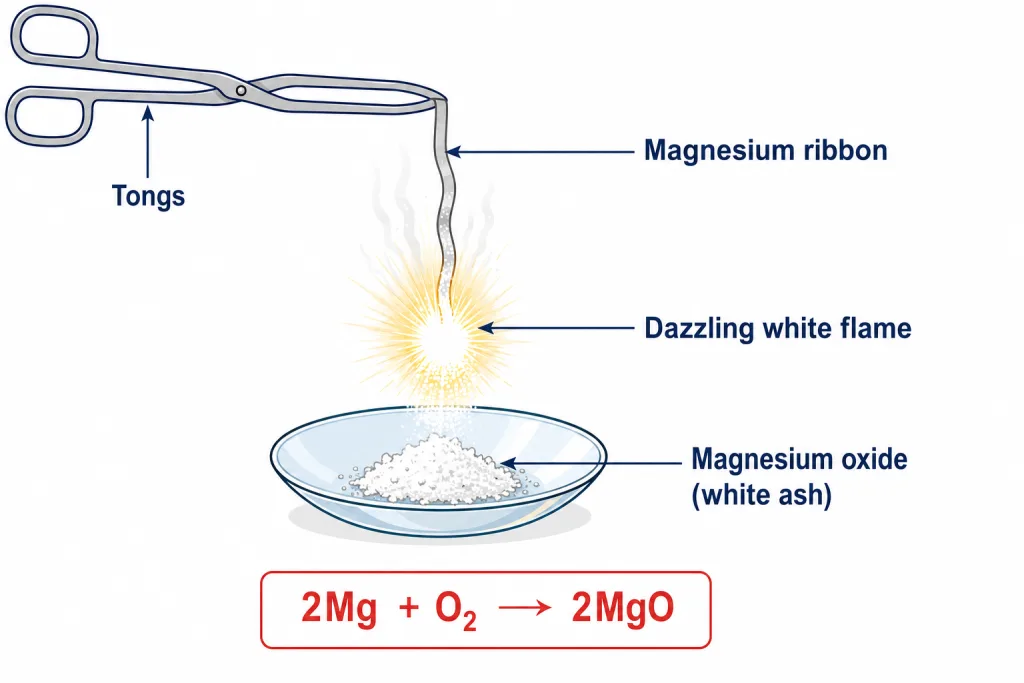
Activity 1.1 — Burning of a Magnesium Ribbon
This is the most famous classroom demonstration of a chemical reaction. Let's see what happens:
Procedure:
- Take a 3–4 cm piece of magnesium ribbon and clean it by rubbing with sandpaper.
- Hold it with a pair of tongs and burn it in the flame of a burner.
- Collect the ash that forms in a watch-glass.
Observations:
- The magnesium ribbon burns with a dazzling white flame.
- A white powder (magnesium oxide) is left behind.
Chemical Reaction:
Caution: Magnesium burns with very intense light that can damage the eyes. Always use safety goggles.
Why is the magnesium ribbon cleaned with sandpaper? When exposed to air, magnesium develops a thin layer of magnesium oxide (MgO) on its surface. This oxide layer prevents direct contact between magnesium metal and oxygen, hindering combustion. Rubbing with sandpaper removes this layer so that the pure magnesium can react directly with oxygen.
[Frequently Asked in Board] This question appears in nearly every board exam paper.
Activities 1.2 and 1.3 — Two More Important Experiments
Activity 1.2 — Zinc + Dilute Sulphuric Acid
Procedure: Take granulated zinc in a conical flask and add dilute to it.
Observations:
- Bubbles appear around the zinc granules (hydrogen gas is being evolved).
- The flask becomes warm (temperature rises).
Reaction:
Activity 1.3 — Lead Nitrate + Potassium Iodide
Procedure: Take lead (II) nitrate solution in a test tube and add potassium iodide solution to it.
Observation:
- A bright yellow precipitate forms instantly (lead iodide, ).
Reaction:
Remember the colours (for the board):
- — Yellow
- — White
- — White
- — Blue
- — Green
These three activities cover different signs of chemical reactions — combustion in 1.1 (colour change and white ash), zinc-acid in 1.2 (gas evolution and temperature rise), and lead-iodide in 1.3 (precipitate formation).
Reactants and Products
Every chemical reaction involves two kinds of substances —
Reactants: The starting substances that undergo chemical change. These are written on the left-hand side (LHS) of the equation.
Products: The new substances formed as a result of the reaction. These are written on the right-hand side (RHS) of the equation.
General form:
The arrow () shows the direction of the reaction — that is, reactants are being converted into products.
Example
When magnesium burns in air:
Here, Mg and are the reactants, and MgO is the product.
Some Chemical Reactions in Daily Life
| Situation | Reactants | Products |
|---|---|---|
| Souring of milk | Milk sugar (lactose) | Lactic acid |
| Rusting of iron | Iron + Oxygen + Water | Hydrated ferric oxide (rust) |
| Respiration | Glucose + Oxygen | + Water + Energy |
| Cooking of food | Various proteins/starch | Simpler molecules |
| Photosynthesis | + Water | Glucose + Oxygen |
[Board Tip] A common question asks — Identify the reactants and products in the given equation. Always remember: left of arrow = reactants, right of arrow = products.
🧠 Memory Capsule
A one-glance recap to revisit just before the board exam — every key idea from this section in one place.
Key Definitions
- Chemical Reaction: A process in which atomic bonds in the reactants break and new bonds form, producing new substances (products).
- Reactants: Substances on the LHS of the arrow that initiate the reaction.
- Products: New substances on the RHS formed as a result of the reaction.
The 5 Signs of a Reaction — Remember "S-C-G-T-P"
| Letter | Sign | Example |
|---|---|---|
| S | Change in State | Wood → ash + smoke |
| C | Change in Colour | green → brown |
| G | Evolution of Gas | |
| T | Change in Temperature | (hot) |
| P | Formation of Precipitate |
Must-Know Reactions
- Burning of magnesium (white flame):
- Zinc + dilute acid:
- Precipitation (yellow ppt.):
- Respiration (exothermic):
Precipitate Colours — Quick List
- → Yellow
- , → White
- → Blue
- → Green
State Symbols
= Solid | = Liquid | = Gas | = Aqueous solution
Law of Conservation of Mass
Why Clean Magnesium Ribbon with Sandpaper?
→ To remove the MgO layer that forms on its surface, so that pure Mg can react directly with oxygen. (Asked in nearly every board paper)
The Bottom Line: If a new substance is formed, it's chemical. If not, it's physical. That's all you need to ask.
Solved Examples
Example 1: Identifying Chemical Changes
Which of the following are chemical changes? (i) Melting of wax (ii) Burning of a candle (iii) Boiling of water to steam (iv) Rusting of iron (v) Formation of curd from milk
Solution:
- Test: A chemical change always produces a new substance; a physical change does not.
- Analysis:
- Melting of wax → solid to liquid; same substance. Physical change.
- Burning of a candle → wax heat; new substances form. Chemical change.
- Boiling of water → remains . Physical change.
- Rusting → ; new substance. Chemical change.
- Curd formation → lactic acid is produced. Chemical change.
- Answer: (ii), (iv), and (v) are chemical changes.
Example 2: Why Clean a Magnesium Ribbon?
Why should a magnesium ribbon be cleaned before burning in air?
Solution:
- Problem: Magnesium is a highly reactive metal.
- Cause: When left in air, magnesium reacts with atmospheric oxygen to form a thin layer of magnesium oxide (MgO) on its surface.
- Why this is a problem: This MgO layer prevents direct contact between the magnesium metal and oxygen. The layer itself does not burn easily, so combustion is hindered.
- Solution: Rubbing with sandpaper removes this oxide layer and exposes the pure magnesium metal, which can then react directly with oxygen.
Answer: A magnesium ribbon is cleaned with sandpaper to remove the MgO layer formed on its surface, so that it can burn freely in air.
[Repeatedly asked in Board — typically 2 marks]
Example 3: Identify Reactants and Products
In the following reaction, identify the reactants and products. State which signs confirm that a chemical reaction has occurred.
Solution:
- Reactants: (zinc) and (hydrochloric acid) — on the LHS.
- Products: (zinc chloride) and (hydrogen gas) — on the RHS.
- Signs of reaction:
- Evolution of gas: gas escapes as bubbles.
- Rise in temperature: The reaction is exothermic; the mixture warms up.
- Disappearance of zinc: Zinc dissolves slowly into the solution.
- Answer: Reactants — Zn and HCl; Products — and .
Example 4: Identify the Precipitate by its Colour
When lead nitrate solution is added to potassium iodide solution, what is the colour of the precipitate formed? Name the compound and write the chemical equation.
Solution:
- Observation: A bright yellow precipitate forms.
- Compound: Lead (II) iodide ().
- Balanced equation:
- Type of reaction: This is a double displacement (precipitation) reaction, since and ions exchange partners.
[Board Important] The brilliant yellow is easy to spot — this experiment is also called the "Golden Rain" experiment.
Example 5: Identification by Temperature Change
A student performed three experiments — (A) Added water to slaked lime (calcium oxide). (B) Mixed barium hydroxide with ammonium chloride in a test tube. (C) Dissolved sugar in water in a beaker.
Using the temperature change observed, classify each as a chemical or physical change, and identify its type.
Solution:
- (A) The beaker becomes very hot. This is a chemical change — an exothermic reaction.
- (B) The test tube feels cold to the touch. This is a chemical change — an endothermic reaction.
- (C) Sugar dissolving in water — no new substance forms. This is only a physical change.
Answer: (A) Exothermic chemical reaction, (B) Endothermic chemical reaction, (C) Physical change.
Example 6: Define Chemical Reaction
Define a chemical reaction. Give three examples from daily life.
Solution:
Definition: A process in which one or more substances (reactants) change their chemical composition and properties to form one or more new substances (products) is called a chemical reaction.
Key features:
- A new substance is always formed.
- Bonds between atoms of reactants are broken and new bonds form.
- The law of conservation of mass is obeyed.
Three examples from daily life:
- Rusting of iron:
- Souring of milk: Lactose → Lactic acid (fermentation)
- Digestion of food: Starch, proteins, and fats are broken down into simpler molecules.
[Board Important — 3-mark question]
Example 7: Identification by Colour Change
An iron nail is dipped in blue copper sulphate solution. After 30 minutes, what observations are made? What kind of change is this?
Solution:
- Observations:
- The blue colour of copper sulphate solution fades gradually (turns pale green).
- A brown deposit of copper forms on the iron nail.
- Reason: Iron is more reactive than copper, so it displaces copper from the solution:
- Why the colour change?
- (blue) decreases → (pale green) increases.
- Brown copper deposits on the nail.
- Answer: This is a chemical change (a displacement reaction). Signs — colour change and deposit on the nail.
Example 8: Identification by Gas Evolution
When dilute is added to limestone (), what happens? Which gas is released? How can it be tested?
Solution:
- Observation: Brisk effervescence — a colourless, odourless gas is released.
- Reaction:
- Gas evolved: Carbon dioxide ().
- Test for the gas (asked in board exams):
- Pass the gas through lime water ().
- Lime water turns milky (turbid) due to the formation of insoluble :
- Answer: gas is evolved, which turns lime water milky.
Example 9: Multiple Signs in One Reaction
When granulated zinc is added to dilute , which of the following signs are observed — (i) colour change (ii) gas evolution (iii) temperature change (iv) precipitate formation?
Solution:
- Write the reaction:
- Check each sign:
- (i) Colour change: is colourless, is also colourless — No clear colour change.
- (ii) Gas evolution: Bubbles of — Yes.
- (iii) Temperature change: The reaction is exothermic; flask becomes warm — Yes.
- (iv) Precipitate: All products are soluble (or gaseous); no precipitate — No.
- Answer: Two signs are clearly visible — gas evolution and temperature rise.
Lesson: A single reaction can show more than one sign at the same time.
Example 10: All Signs in Magnesium Combustion
Which signs of a chemical reaction are observed when a magnesium ribbon burns in air? Describe each in order.
Solution:
Signs observed:
- Emission of light: A dazzling white flame is produced.
- Change in colour: The shiny silvery magnesium ribbon turns into a white powder (MgO).
- Change in state: The solid metallic ribbon converts to solid oxide powder.
- Rise in temperature: The flame is very hot (exothermic reaction).
- Formation of new substance: Magnesium oxide (MgO) is formed.
Conclusion: This reaction shows almost every major sign of a chemical reaction at once — which is why NCERT chose it as the very first activity in the textbook.
[Board Important — typically a 5-mark question]
Example 11: Prove that Respiration is a Chemical Reaction
Prove that respiration is a chemical reaction. Write its equation.
Solution:
The reaction in respiration:
Why is this a chemical reaction?
- A new substance is formed: Glucose () and oxygen () combine to form carbon dioxide () and water () — these are new substances.
- Energy is released: Energy is liberated from the reaction (in the form of ATP) — a clear sign of temperature change.
- Gas exchange: is consumed and is released — gas evolution sign.
- Irreversible: Once formed, does not turn back into glucose.
Conclusion: Respiration produces new substances, releases energy, and is irreversible — so it is clearly a chemical (exothermic) reaction.
[Board Important] This question appears in nearly every board exam paper.
Example 12: Reactants, Products and States
Identify the reactants and products in the following reaction and state the physical state of each:
Solution:
| Role | Substance | Physical state |
|---|---|---|
| Reactant | (iron) | Solid (s) |
| Reactant | (water vapour) | Gas (g) |
| Product | (ferroso-ferric oxide) | Solid (s) |
| Product | (hydrogen gas) | Gas (g) |
Note: Here is written with — this means water is being used as steam, not as a liquid. This detail is crucial.
[Board Tip] Always remember the state symbols — solid, liquid, gas, aqueous solution.
Example 13: Reversible vs. Irreversible Changes
Classify the following changes as physical/chemical and reversible/irreversible — (i) Burning of paper (ii) Freezing of water (iii) Dissolving sugar in water (iv) Boiling an egg
Solution:
| Change | Type | Reversibility | Reason |
|---|---|---|---|
| (i) Burning of paper | Chemical | Irreversible | , ash, form — paper cannot be recovered |
| (ii) Freezing of water | Physical | Reversible | remains ; melting reverses it |
| (iii) Sugar dissolving | Physical | Reversible | Evaporating water gives sugar back |
| (iv) Boiling an egg | Chemical | Irreversible | Permanent structural change in the protein |
Key Lesson: Not all chemical changes are irreversible, but most are. Most physical changes are reversible.
Example 14: Verifying Conservation of Mass
In an experiment, 6 g of carbon was burnt in sufficient oxygen and 22 g of carbon dioxide was produced. Find the mass of oxygen used and verify the law of conservation of mass.
Solution:
- Reaction:
- By the law of conservation of mass:
- Given:
- Mass of carbon = 6 g
- Mass of = 22 g
- Calculation:
- Verification:
Answer: The mass of oxygen used is 16 g, and the law of conservation of mass is verified.
[Board Important] Numericals based on conservation of mass appear every year.
Example 15: All Signs in Combination
A student mixed an unknown solution A with another unknown solution B and noted: (i) a white precipitate formed instantly (ii) no gas was evolved (iii) only a slight temperature change (iv) no colour change. Did a chemical reaction occur? If yes, what type?
Solution:
- Did a chemical reaction occur?
- The formation of a precipitate alone is sufficient evidence — a new insoluble substance has formed. So yes, a chemical reaction has occurred.
- What type?
- It is a double displacement / precipitation reaction.
- Likely examples:
or
- Analysis:
- Even one sign (a or white precipitate) is enough to confirm a reaction.
- Not every reaction has to show all five signs.
Answer: Yes, a chemical reaction has taken place — a precipitation (double displacement) reaction.
Example 16: Application — Examples from the Kitchen
Give three examples of chemical changes and two examples of physical changes that occur in a kitchen.
Solution:
Three chemical changes (a new substance is formed):
- Cooking of chapati/bread: The protein and starch in the dough are converted into new compounds when heated. This changes the taste and aroma.
- Souring of milk into curd: Lactobacillus bacteria convert lactose to lactic acid.
- Caramelisation of sugar: Sugar turns brown on heating because caramel — a new chemical compound — is formed.
Two physical changes (the substance does not change):
- Melting of ice into water: remains ; only the state changes.
- Dissolving salt or sugar in water: Evaporation can give the substance back.
[Board Tip] When asked for daily-life examples, always state why it is chemical/physical along with the example.