
What is Oxidation?
In chemistry, 'oxidation' and 'reduction' are two crucial concepts. They are opposites of each other, and almost every chemical reaction has them hidden somewhere.
Activity 1.11 — Oxidation of Copper
Take 1 g of copper powder in a china dish and heat it on a burner.
Observation: A black coating forms on the surface of the shiny brown copper powder.
What is this black coating?
This is copper oxide () — black in colour. Copper combined with oxygen.
Oxidation — Definition 1: When a substance gains oxygen, it is being oxidised.
Here, Cu gained O → Cu was oxidised.
Another Definition
Oxidation — Definition 2: When a substance loses hydrogen, it is being oxidised.
We will see an example of this shortly.
Other Examples of Oxidation
(i) Burning of magnesium — oxidation of Mg: (O is added to Mg)
(ii) Burning of coal — oxidation of C: (O is added to C)
(iii) Formation of water from hydrogen — oxidation of H₂: (O is added to H₂)
[Board Tip] Remember — in oxidation, O is added or H is removed.
What is Reduction?
Reduction is exactly the opposite of oxidation.
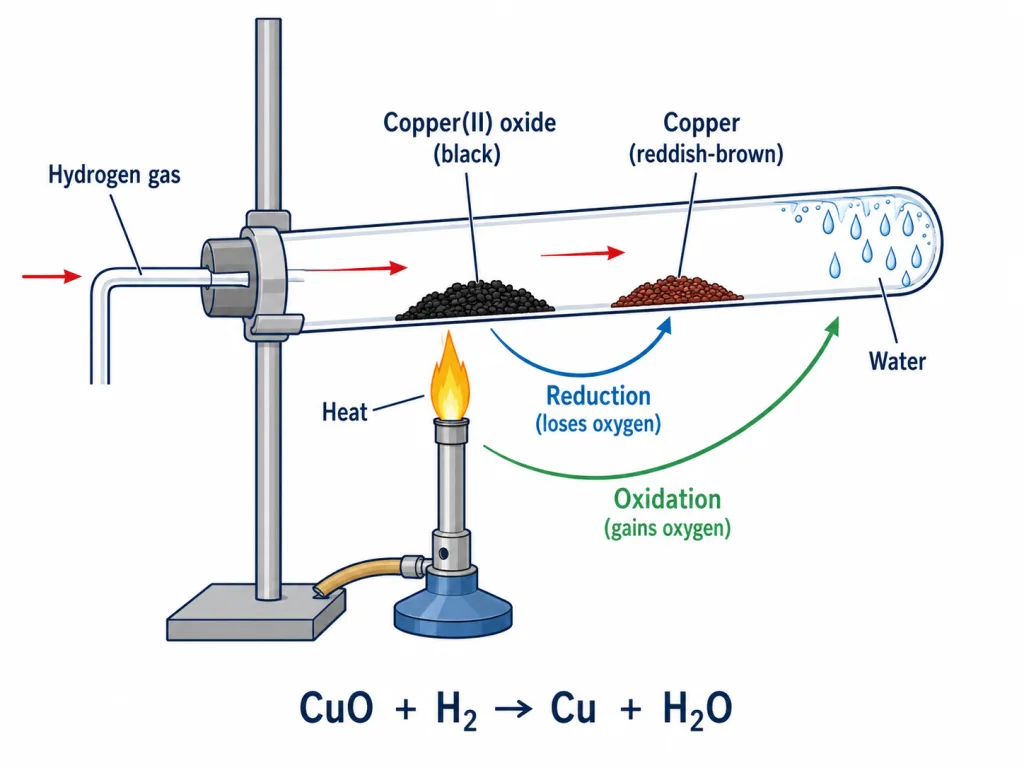
A Clear Example — Copper Oxide + Hydrogen
If hydrogen gas is passed over hot copper oxide, the black coating turns brown — copper is recovered.
Analysis:
- lost its O → was reduced.
- gained O → was oxidised.
- (Both happen at the same time!)
Reduction — Definition 1: When a substance loses oxygen, it is being reduced.
Reduction — Definition 2: When a substance gains hydrogen, it is being reduced.
Other Examples of Reduction
(i) Reduction of chlorine — by hydrogen: (H is added to Cl₂ → Cl₂ is reduced)
(ii) Reduction of nitrogen — formation of ammonia: (H is added to N₂ → N₂ is reduced)
A Quick-Reference Table
| When… | What is happening? |
|---|---|
| O is added | Oxidation |
| O is removed | Reduction |
| H is added | Reduction |
| H is removed | Oxidation |
Memory trick: "OilRig" — Oxidation Is Loss (of electrons), Reduction Is Gain — but at Class 10 level, this becomes: oxidation = gain of O / loss of H; reduction = loss of O / gain of H.
What is a Redox Reaction?
A crucial point — oxidation and reduction always occur together. If one substance is gaining oxygen, another must be losing it.
Redox Reaction: A chemical reaction in which the oxidation of one reactant and the reduction of another happen simultaneously is called a redox reaction.
The word 'redox' is short for Reduction + Oxidation.
Pictorial Form
Worked Example — 1
- CuO is reduced (O removed → Cu formed)
- H₂ is oxidised (O added → H₂O formed)
- This is a redox reaction.
Worked Example — 2
- ZnO is reduced (O removed → Zn formed)
- C is oxidised (O added → CO formed)
- This is a redox reaction.
Worked Example — 3 (popular in board exams)
- HCl is oxidised (H removed → Cl₂ formed)
- MnO₂ is reduced (O removed → MnCl₂ formed)
- This is a redox reaction.
[Board Important] In every redox reaction, clearly state which substance is oxidised and which is reduced — this is the most essential skill.
Oxidising and Reducing Agents
In redox reactions, two special roles appear —
Oxidising Agent (Oxidant)
The substance that causes the oxidation of another — but is itself reduced.
Behaviour: An oxidising agent gives oxygen (or takes hydrogen).
Reducing Agent (Reductant)
The substance that causes the reduction of another — but is itself oxidised.
Behaviour: A reducing agent takes oxygen (or gives hydrogen).
Clarifying with an Example
- CuO gave O to H₂ → CuO oxidised H₂ → CuO is the oxidising agent
- CuO itself lost O → CuO was reduced
- H₂ took O from CuO → H₂ reduced CuO → H₂ is the reducing agent
- H₂ itself gained O → H₂ was oxidised
A Summary Table — Everything at a Glance
| Role | What it does | What happens to it |
|---|---|---|
| Oxidising agent | Gives O (or takes H) | Reduced (itself decreases) |
| Reducing agent | Takes O (or gives H) | Oxidised (itself increases) |
Some Famous Oxidising and Reducing Agents
Oxidising agents: (concentrated),
Reducing agents:
A Curious Question — Can One Substance Play Both Roles?
(hydrogen peroxide) can act as both — sometimes oxidising, sometimes reducing — depending on the situation. This is a deeper Class 11 topic.
How to Identify a Redox Reaction — A Step-by-Step Approach
When given a reaction and asked whether it is redox, follow these steps —
Step 1 — Count O and H atoms in each substance
Think separately for the LHS and RHS.
Step 2 — Spot which substance gains/loses O or H
- O added → oxidation
- O removed → reduction
- H added → reduction
- H removed → oxidation
Step 3 — If both happen, it's redox
If one substance is being oxidised AND another reduced — both at once — then it is a redox reaction.
A Full Example
Reaction:
Analysis:
- had no O before; has O → H₂ is oxidised
- had no H before; has H → O₂ is reduced (O accepted H)
- Both at once → this is a redox reaction
Oxidising agent: (oxidised H₂; itself reduced) Reducing agent: (reduced O₂; itself oxidised)
Some More Important Redox Reactions
(i) Metal extraction from coal:
Zn is reduced, C is oxidised.
(ii) Decomposition of mercury oxide — a curious case:
HgO is reduced (O released), O₂ — here oxygen alone forms.
(iii) Silver chloride in sunlight:
AgCl is reduced (Ag formed — charge decreased); Cl is oxidised (Cl₂ formed).
[Board Important] This is one of the most essential question types in this section — given a reaction, you must clearly state what is oxidised/reduced.
🧠 Memory Capsule
A one-glance recap to revisit just before the board exam — every key idea about oxidation, reduction, and redox reactions in one place.
1. Oxidation and Reduction — Definitions Together
| Situation | What is happening? |
|---|---|
| O added | Oxidation |
| O removed | Reduction |
| H added | Reduction |
| H removed | Oxidation |
2. Definition of Redox
Oxidation and reduction together → redox reaction.
3. Oxidising vs. Reducing Agent
| Substance | Role | Itself |
|---|---|---|
| Gives O | Oxidising agent | Reduced |
| Takes O | Reducing agent | Oxidised |
4. Must-Memorise Redox Reactions
| Reaction | Oxidised | Reduced |
|---|---|---|
| H₂ | CuO | |
| C | ZnO | |
| HCl | MnO₂ | |
| H₂ | O₂ | |
| C | O₂ |
5. Famous Oxidising and Reducing Agents
- Oxidising: (conc.)
- Reducing:
6. Memorable Experiment from Activity 1.11
- (black coating)
- (black to brown)
- Both are redox reactions.
7. Repeatedly Asked Board Questions
- Define oxidation and reduction.
- What is a redox reaction? Give an example.
- Identify the oxidising and reducing agent in this reaction.
- Why is a black coating formed in Activity 1.11?
- Explain oxidation and reduction in terms of gain/loss of oxygen.
8. A Trick
- To identify oxidation/reduction in a reaction, just count O and H atoms in each substance and see what increased/decreased.
The Bottom Line: O up = oxidation, O down = reduction. Both at once = redox.
Solved Examples
Example 1: NCERT — Identification of Copper Oxidation
Identify the substances oxidised and reduced in the following reaction —
Solution:
- Analysis:
- Na had no O initially; now in it does → Na gained O → Na is oxidised
- gave its O to Na → went into — therefore underwent reduction (in the sense of gaining 'partners' of metal).
- Answer:
- Substance oxidised: Na (sodium)
- Substance reduced: (oxygen)
- Why is this redox? Both — oxidation and reduction — happen simultaneously.
[Board Important — NCERT textbook question]
Example 2: NCERT — Second Example
Identify the substances oxidised and reduced in —
Solution:
Analysis:
| Substance | Initial | Final | Change | Conclusion |
|---|---|---|---|---|
| Cu | in , with O | — O removed | O lost | Reduction |
| H₂ | alone | in , with O | O gained | Oxidation |
Answer:
- Oxidised substance: (hydrogen)
- Reduced substance: (copper oxide)
Oxidising and reducing agents:
- — oxidising agent (oxidised )
- — reducing agent (reduced )
What kind of reaction? Redox reaction.
Visible observation: The black coating turns brown ().
[Repeatedly asked in board]
Example 3: Definition of a Redox Reaction
Define a redox reaction. Give two examples.
Solution:
Definition: A chemical reaction in which the oxidation of one reactant and the reduction of another happen simultaneously is called a redox reaction.
The word 'redox' is short for Reduction + Oxidation.
Key features
- One substance gains O (or loses H) — oxidation.
- The other substance loses O (or gains H) — reduction.
- These two changes happen together.
Two examples
(i) Copper oxide + hydrogen:
- is oxidised (gains O in )
- is reduced (loses O, formed)
(ii) Reduction of zinc oxide:
- is oxidised (gains O to form )
- is reduced (loses O, formed)
[Board Important — 3-mark question]
Example 4: Decomposition of Mercury Oxide
Analyse the reaction —
Solution:
- Analysis:
- In , Hg was bonded to oxygen; the final product is pure metal (no O) → HgO is reduced
- The oxygen in leaves to form — it goes from a 'bonded' state to free → in simple terms, this is not just an oxidation of O₂ (this is a special case of decomposition where oxygen is liberated).
- A more detailed view:
- This is a decomposition reaction (one → two products).
- Hg²⁺ is reduced — it becomes Hg⁰.
- O²⁻ (in oxide) is oxidised — it becomes O⁰ (in ).
- (Here we have implicitly used the language of oxidation states — fully clarified in Class 11.)
- Class 10 level answer:
- This is a decomposition reaction.
- Mercury () was reduced (from to ).
- Technically a redox decomposition.
- Special note: This reaction is historically tied to the discovery of oxygen by Priestley.
Lesson: Not every decomposition is redox (e.g., is not redox). But the decomposition of is a redox decomposition.
Example 5: NCERT Class 10 — A Short Question
Identify the substances oxidised and reduced in the following reactions: (i) (ii)
Solution:
For (i):
- Na gained O (Na → Na₂O) → Na is oxidised
- O₂ gave O to Na, itself reduced → O₂ is reduced
For (ii):
- CuO lost O (CuO → Cu) → CuO is reduced
- H₂ gained O (H₂ → H₂O) → H₂ is oxidised
Table:
| Reaction | Oxidised | Reduced |
|---|---|---|
| Na | ||
| CuO |
Both are redox reactions.
[NCERT textbook question — verbatim answer]
Example 6: Identifying the Oxidising and Reducing Agent
Identify the oxidising and reducing agent in —
Solution:
- Analysis of substances:
- had Mn bonded to oxygen; in , Mn now has chloride; O has been removed → MnO₂ is reduced
- had H; the final is pure chlorine, with H now in ; HCl lost H → HCl is oxidised
- Roles:
- oxidised → is the oxidising agent
- reduced → is the reducing agent
- It is a redox reaction, because oxidation and reduction happen simultaneously.
- Daily-life use: This reaction is an old laboratory method for producing gas.
[Board Important]
Example 7: Extraction of Zinc Using Coal
When zinc oxide is heated with carbon, zinc metal is obtained. Write the balanced reaction and identify the oxidising/reducing agent.
Solution:
- Reaction:
- Analysis:
- ZnO lost O → ZnO is reduced → ZnO is the oxidising agent (gave O to C)
- C gained O (to form CO) → C is oxidised → C is the reducing agent (reduced ZnO)
- Type of reaction:
- Redox reaction
- Also a kind of displacement (C displaced Zn)
- Industrial significance:
- This is the famous method for extracting zinc.
- Using coal as a 'reducing agent' is an old and inexpensive technique.
- The same principle is used to extract iron in a blast furnace:
[Board + Preview of Class 10 Chapter 3]
Example 8: Numerical — Quantities in a Redox Reaction
8 g of is reduced by gas. Find the masses of Cu and formed. (Cu=63.5, O=16, H=1)
Solution:
- Reaction:
- Molecular masses:
- g
- g
- g
- Mole ratio: 1 mol → 1 mol Cu and 1 mol H₂O
- Moles of :
- Products:
- Cu = g
- = g
- Verify mass conservation: g; g ✓
Answer:
- Mass of Cu ≈ 6.39 g
- Mass of ≈ 1.81 g
Lesson: Conservation of mass applies to redox reactions as well.
Example 9: A Famous Board Question
A shiny, brown-coloured element 'X' becomes black when heated in air. Name 'X' and the black compound.
Solution:
This refers to the famous Activity 1.11.
- Identification of 'X': A shiny brown element that turns black when heated in air — this is copper (Cu).
- Identification of the black compound: Copper (II) oxide, i.e., — black in colour.
- Reaction:
- Type of reaction:
- Combination reaction (two → one)
- Oxidation / redox (Cu gained O)
- Visible observation:
- Initially — shiny brown copper powder.
- Finally — a black coating () on the surface.
- Bonus: This also explains the principle behind the corrosion of copper — although in atmospheric conditions a green coating of tends to form instead.
[NCERT textbook question Q.17 — frequently asked]
Example 10: The 'Dual' Nature of Redox
Why must one substance always be oxidised and another reduced in a redox reaction?
Solution:
The Principle:
- Oxygen can only move from one place to another — it cannot disappear.
- When one substance loses oxygen (reduced), that oxygen must go to some other substance (oxidised).
- This is a direct consequence of conservation of mass.
Illustrating with an example:
- If is being reduced, is giving its O to something else.
- That 'something else' is — it took the O and became .
- Hence the oxidation of is necessary.
An analogy from real life: Like a game where if one team passes the ball, another team must catch it. Similarly — if one substance loses oxygen, another must take it.
Conclusion: This is why oxidation and reduction always happen together — and that combined reaction is what we call redox.
[Board conceptual question]
Example 11: Oxidation/Reduction by Loss/Gain of H
Which substance is oxidised/reduced in — ?
Solution:
Notice — there is no oxygen here, so we must reason in terms of H.
- Analysis of :
- was alone; now in , H is paired with Cl.
- H itself didn't change quantity; but Cl gained an H bond.
- Switch viewpoint: → — H₂ now has a 'partner' (Cl).
- Alternative view: → — H is oxidised (will be clearer in Class 11 — based on charge).
- Analysis of :
- had no H; in , H is now bonded.
- gained H → Cl₂ is reduced
- Answer (Class 10 level):
- is reduced (H added)
- is oxidised (technically — based on charge)
- This is a redox reaction.
- Special note: Redox reactions can occur even without oxygen — just gain/loss of H is enough.
Lesson: Oxidation/reduction is not limited to oxygen — also look at gain/loss of hydrogen.
Example 12: Identifying Five Redox Reactions
In the following reactions, state which substances are oxidised and reduced: (i) (ii) (iii) (iv) (v)
Solution:
| # | Reaction | Oxidised | Reduced |
|---|---|---|---|
| (i) | (gains O) | ||
| (ii) | C (gains O) | ||
| (iii) | (gains O → CO₂) | (loses O → Fe) | |
| (iv) | (in KI) → — (Class 11 — change in charge) | → | |
| (v) | Al (gains O) |
Special significance of reaction (iii):
- This is the reaction in the Blast Furnace (iron extraction).
- ore + as reducing agent → pure Fe.
- This is the foundation of industrial steel production.
[Board + JEE/NEET level]
Example 13: Oxidising and Reducing Agents — A Concise List
Give two examples each of oxidising and reducing agents, and state one use of each.
Solution:
Oxidising agents (two examples):
(i) Oxygen ():
- The most common oxidising agent.
- The basis of all combustion.
- Use: Fuel combustion (LPG, petrol), respiration (in our body), rocket engines.
(ii) Potassium permanganate ():
- Deep purple, a strong oxidising agent.
- Use: Standard solution in titrations, water treatment, antiseptic for wounds.
Reducing agents (two examples):
(i) Hydrogen ():
- The most common reducing agent.
- Use: → Cu (lab demonstration), metal extraction, ammonia synthesis ().
(ii) Carbon (coal, C):
- Cheap, very powerful.
- Use: Extraction of iron/zinc/copper (), thermite-like reactions.
[Board Important — practical context]
Example 14: A Challenging Question — Respiration and Combustion
Respiration and combustion are both redox reactions. Explain.
Solution:
(1) Combustion (of methane):
Analysis:
- C in gained O (to form CO₂) → C is oxidised
- H in gained O (to form H₂O) → H is oxidised
- gave O → O₂ is reduced
- It is a redox + exothermic reaction.
(2) Respiration (in the body):
Analysis:
- C in glucose gained O → C is oxidised
- gave O → O₂ is reduced
- It is also a redox + exothermic reaction.
Similarities:
- Both are redox reactions.
- Both release energy.
- The final products in both are and .
Differences:
- Combustion — fast, at high temperature.
- Respiration — slow, at body temperature, with the help of enzymes.
Lesson: Life is essentially a controlled combustion — a beautiful intersection of biology and chemistry.
[Board Important — science-philosophy question]
Example 15: Identify the Oxidising Agent — A Challenging Question
Identify the oxidising agent in: (i) (ii) (iii) (iv)
Solution:
(i) :
- O leaves to combine with H, forming → reduced.
- 's → (lost H) → HCl oxidised.
- Oxidising agent: (oxidised HCl)
(ii) :
- → (lost electron) → Br oxidised.
- → (gained electron) → Cl reduced.
- Oxidising agent:
(iii) :
- Mg gained O → Mg oxidised.
- O₂ took electrons from Mg → O₂ reduced.
- Oxidising agent:
(iv) :
- Fe → Fe²⁺ (lost electron) → Fe oxidised.
- Cu²⁺ → Cu (gained electron) → Cu²⁺ reduced.
- Oxidising agent: (Cu²⁺ took electrons from Fe)
[Board + entrance level]
Remark: The language of charge change becomes clearer in Class 11, but at this level you can resolve such questions just by tracking gain/loss of O or H.
Example 16: A Tabular Question — All Types of Reactions
Classify the following reactions by 'type of reaction' and 'is it redox?':
(a) (b) (c) (d) (e) (f)
Solution:
| # | Reaction | Type | Redox? |
|---|---|---|---|
| (a) | Combination | No (O attaches but CaO didn't 'lose' O in oxidation sense) | |
| (b) | Decomposition | Yes () | |
| (c) | Double displacement | No | |
| (d) | Displacement | Yes (Zn oxidised, Cu reduced) | |
| (e) | Combination | Yes (C oxidised) | |
| (f) | Double displacement (neutralisation) | No |
Main conclusions:
- Double displacement and neutralisation reactions are usually not redox (only ion exchange).
- Displacement reactions are always redox.
- Combustion and many combinations/decompositions are redox.
- Some combinations (like ) are not redox — because no element's oxidation state truly changed.
[A short version of a 5-mark board question]