
Effects of Oxidation in Daily Life
In the previous section we learned the principle of oxidation-reduction. Now we look at the problematic effects of oxidation on nature and daily life — two major effects are —
- Corrosion — slow deterioration of metals
- Rancidity — going stale of food items
Both are consequences of oxidation — just on different substances.
Corrosion
Definition: When a metal slowly deteriorates chemically by reacting with surrounding acids, moisture, or air, that process is called corrosion.
A Famous Example — Rusting of Iron
Any new iron object is shiny. But after some time, a reddish-brown layer coats it — this is rust.
Reaction:
(Hydrated ferric oxide = rust)
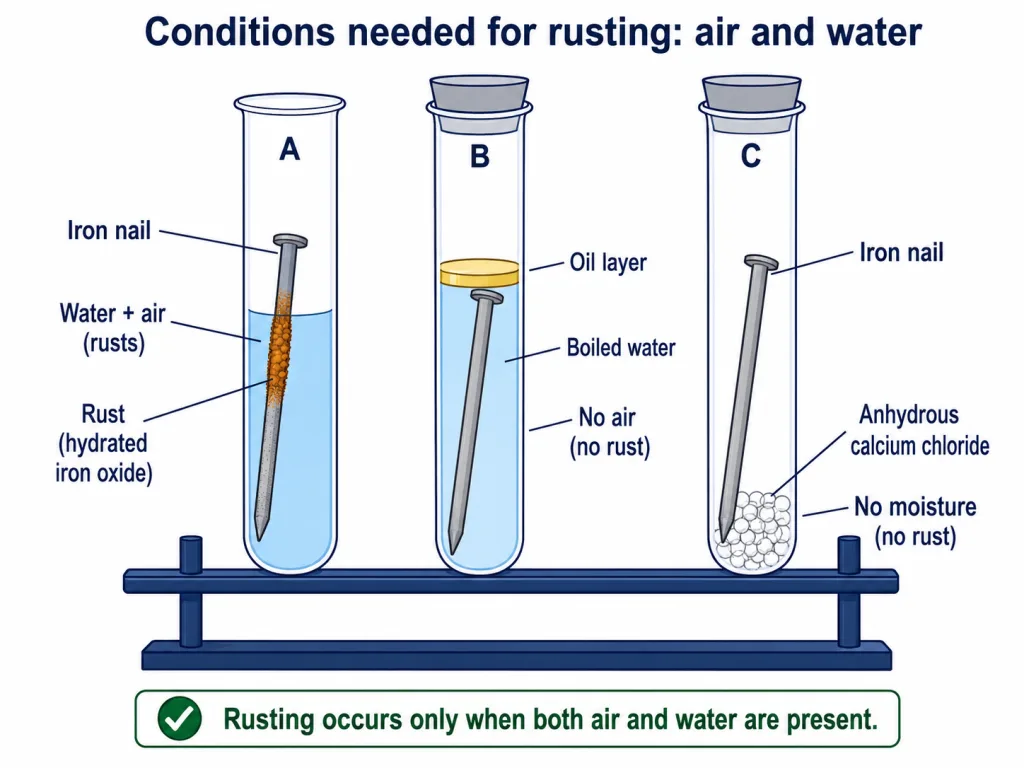
Conditions Required for Rusting
For rusting, both of the following are necessary —
- Oxygen (atmospheric)
- Water/moisture
If even one is missing — there will be no rust. That is why —
- In dry deserts, iron rusts very slowly.
- In humid coastal regions, rust forms quickly (moisture + salt-laden air).
Corrosion of Other Metals
(i) Black tarnish on silver (Ag):
Reaction with atmospheric :
(silver sulphide) forms a black coating.
(ii) Green coating on copper (Cu):
Reaction with atmospheric :
A green corrosion product. Old copper statues display this.
[Board Important] Red rust on iron, black tarnish on silver, green coating on copper — all three are examples of corrosion.
Damage Caused by Corrosion
Corrosion isn't just an aesthetic issue — it's a major economic problem.
Major Damages
- Decay of car/vehicle frames — engines, bodies, chassis all affected.
- Bridges weakening — a structural safety concern.
- Iron railings, gates, windows — must be replaced every few years.
- Marine ships — rust faster in salt water.
- Machine parts — become unusable.
Economic Impact
It is said that India loses around **₹1 lakh crore (about 12 billion) every year** just to iron corrosion. Globally, it costs about 3-4% of GDP. ### Methods to Prevent Corrosion #### 1. Painting or Oiling - The simplest method. - Paint isolates iron from air and moisture. - Doors, windows, bridges, gates — all painted. #### 2. Greasing or Oiling - For machine parts. - Prevents moisture from reaching the metal. #### 3. Chrome Plating - A thin layer of chromium. - Used on car bumpers, taps, bicycle parts. #### 4. Galvanization - Coating iron with a layer of zinc. - You will study this in detail in Class 10 Chapter 3. - *Why zinc?* Because Zn is more reactive than Fe — so Zn corrodes first, protecting Fe (cathodic protection). #### 5. Making Alloys - Mixing pure iron with carbon and nickel/chromium produces **steel** or **stainless steel**. - Stainless steel does not rust — used for kitchenware, knives, furniture. #### 6. Cathodic Protection - For underground pipes — a more reactive metal (Mg, Zn$) is connected as a 'sacrificial anode'.
- That metal corrodes first.
[Board Important] Why are iron objects painted? — To protect them from rust, because paint isolates the iron from air and moisture.
Rancidity
Food items also 'go bad' — what is this?
Have You Noticed?
- Oil or ghee kept for a long time develops a strange smell.
- Fried snacks (namkeen, chips) deteriorate after a few days.
- Butter that has gone stale has a sharp smell.
All of this is due to rancidity.
Definition: When fat-containing or oily food items get oxidised and change their taste and smell, that process is called rancidity.
What Happens Chemically?
- Oils/fats contain unsaturated fatty acids.
- These slowly react with atmospheric oxygen to form smaller compounds — especially aldehydes and ketones.
- These new compounds give the sharp smell and bitter taste.
Signs of Rancidity
- Sharp, sour, or unpleasant smell
- Colour change (yellowing/browning)
- Bitter or sour taste
- Change in texture
Health Effects
Consuming rancid oil is harmful because —
- Difficulty in digestion
- Some products can be toxic
- Destruction of fat-soluble vitamins
That's why old oil should not be reused for repeated frying (a common practice in shops, but harmful to health).
[Board Important] Rancidity is an oxidation reaction.
How to Prevent Rancidity
1. Adding Antioxidants
Antioxidants are substances that themselves react quickly with oxygen — thereby protecting the food.
Common antioxidants:
- Vitamin E (tocopherol) — natural
- Vitamin C (ascorbic acid) — natural
- BHA (Butylated Hydroxyanisole) — synthetic
- BHT (Butylated Hydroxytoluene) — synthetic
You'll see 'BHA' or 'BHT' codes on packaged food labels — those are antioxidants.
2. Air-Tight Packaging
- Don't let oxygen reach the food.
- Tightly sealed packets.
3. Filling with Nitrogen Gas
This is the most interesting technique.
- Have you seen chip packets? They look puffy.
- That puffiness isn't air — it's nitrogen gas ().
- is chemically inert — does not affect chips.
- This way is kept out, and the chips stay fresh.
4. Refrigeration
- Lower temperature → slower chemical reactions.
- Oil/ghee in the fridge ranches more slowly.
5. Protection from Light
- Storing oils in dark-coloured bottles.
- UV rays from sunlight accelerate oxidation.
Comparison Table — Corrosion vs. Rancidity
| Aspect | Corrosion | Rancidity |
|---|---|---|
| On what? | On metals | On fat-containing foods |
| Cause | + | |
| Examples | Rust, silver tarnish | Stale oil/ghee, off-smell of chips |
| Prevention | Paint, galvanisation | Antioxidants, packing |
| Chemical nature | Oxidation | Oxidation |
[Board Important] Why is nitrogen gas filled in chip packets? — To prevent rancidity — is inert and keeps out.
Summary Context — Corrosion and Rancidity
Both are the Same Kind of Process — Consequences of Oxidation
| In daily life | Substance | What oxidation does |
|---|---|---|
| On metal | Iron, silver, copper | Corrosion (rust, etc.) |
| On food | Oil, ghee, butter | Rancidity |
| On skin | Skin | Wrinkles, ageing (partly) |
| In life | Cells | Antioxidants protect us |
The Other Side of Oxidation — Positive Uses
Though oxidation has these negative effects, it has many positive uses too — which we saw in the previous section —
- Combustion (cooking, transportation)
- Respiration (our energy source)
- Metal extraction (iron/zinc from coal)
- Electrochemistry (batteries)
So oxidation is a 'double-edged sword' — sometimes helpful, sometimes harmful.
A Curious Question
Are rust and silver tarnish — both redox reactions?
Yes, both are redox.
- In rust: Fe → Fe³⁺ (Fe oxidised); reduced (becomes oxide).
- In silver tarnish: Ag → Ag⁺ (Ag oxidised); S²⁻ doesn't change but in electron-counting it is redox.
This becomes clearer in Class 11.
Key Board Questions
- Why are iron objects painted?
- Why are fatty/oily foods packed with nitrogen?
- Describe and give examples of corrosion and rancidity.
- Methods of preventing rancidity.
- Conditions for rusting.
[Almost every year in board] These questions carry 3-5 marks.
🧠 Memory Capsule
A one-glance recap to revisit just before the board exam — every key idea about corrosion and rancidity in one place.
1. Corrosion — In One Line
Slow chemical destruction of a metal by air, moisture, and chemicals.
2. Rancidity — In One Line
Oxidative deterioration of oily/fatty foods, changing their taste and smell.
3. Famous Examples of Corrosion
| Metal | Corrosion product | Colour |
|---|---|---|
| Fe | (rust) | Reddish-brown |
| Ag | Black | |
| Cu | Green |
4. Two Conditions for Rusting (Both Required)
- Oxygen
- Water/moisture
If even one is missing — no rust.
5. Methods to Prevent Corrosion — At a Glance
- Painting
- Oiling/greasing
- Galvanisation (Zn coat)
- Chrome plating
- Using stainless steel
- Cathodic protection (Mg/Zn sacrificial)
6. Methods to Prevent Rancidity
- Antioxidants (Vitamin E, C, BHA, BHT)
- Air-tight packaging
- Nitrogen gas filling (chip packets)
- Refrigeration
- Protection from light
7. Essential Board Questions
- Why are iron objects painted? → To protect from rust (preventing air+moisture).
- Why is nitrogen gas in chip packets? → To prevent rancidity (keeping out).
- What is the chemical formula of rust? → (hydrated ferric oxide).
- What is the black tarnish on silver? → Silver sulphide ().
- What is the green coat on copper? → Copper hydroxide carbonate.
8. A Trick
- Corrosion = O₂ + H₂O on metal
- Rancidity = O₂ on fat
- Both = consequences of oxidation
The Bottom Line: Save metal from oxidation with paint, and food with nitrogen.
Solved Examples
Example 1: NCERT — Why Are Iron Objects Painted?
Why do we paint iron articles?
Solution:
- Problem: Iron, when in contact with air and moisture, undergoes corrosion — i.e., it rusts.
- Chemical form of rust:
- Why rust is a problem:
- The iron weakens.
- The surface becomes ugly.
- Structural safety is compromised.
- What painting does:
- Paint is a 'physical barrier'.
- It isolates the iron surface from air and moisture.
- Without contact with and moisture — no rust.
- Daily-life examples:
- Doors, windows, gates — all painted.
- Marine ships — with special water-resistant paint.
- Answer: Iron objects are painted so that they do not come into contact with air and moisture, which would cause them to rust.
[NCERT textbook question Q.18 — repeatedly asked]
Example 2: NCERT — Why Are Foods Packed with Nitrogen?
Why are oil and fat-containing foods flushed with nitrogen?
Solution:
- Problem: Oil/fat-containing foods react with atmospheric oxygen and become oxidised — this leads to rancidity (taste and smell change).
- Solution: Prevent from reaching the food.
- Why nitrogen?
- is an inert gas — does not chemically interact with food.
- Inexpensive and abundant (78% of the atmosphere).
- Does not affect taste or smell.
- Method: Air is removed from the chip packet first, then it is filled with .
- Daily proof: Chip packets look 'puffy' — that's nitrogen, not air.
- Answer: Oils and fatty foods are flushed with nitrogen to keep them from contact with atmospheric oxygen, so that rancidity does not occur.
[NCERT textbook question Q.19 — repeatedly asked]
Example 3: NCERT — Describe Corrosion and Rancidity
Describe each of the terms below and give one example of each — (a) Corrosion (b) Rancidity
Solution:
(a) Corrosion:
Definition: When a metal slowly deteriorates chemically in contact with air, moisture, acids, and salts, that process is called corrosion.
Main features:
- The metal loses its shine.
- A coating forms on the surface.
- The metal weakens.
Example: Rusting of iron
Other examples: black tarnish on silver (), green coat on copper ().
(b) Rancidity:
Definition: When fat-containing or oily food items are oxidised and change their taste and smell, the process is called rancidity.
Main features:
- Sharp, sour smell.
- Bitter taste.
- Change in colour.
Example: Long-stored ghee/oil/butter develops an off-smell; old fried snacks turn stale.
[NCERT textbook question Q.20 — repeatedly asked, 5-mark question]
Example 4: Conditions for Rusting
Which two conditions are necessary for rusting? Prove it.
Solution:
The two required conditions:
- Oxygen (atmospheric)
- Water/moisture
If even one is missing, no rust.
A Three-Tube Experiment to Prove It
Tube A — Only water (no air):
- Put an iron nail in a tube and fill with boiled water (to expel dissolved air).
- Add a thin layer of oil on top to keep air out.
- Observation: No rust even after several days.
- Conclusion: Water alone does not rust iron.
Tube B — Only air (no water):
- Dry tube with an iron nail.
- Add anhydrous calcium chloride (drying agent) to absorb any moisture.
- Observation: No rust even after several days.
- Conclusion: Air alone does not rust iron either.
Tube C — Both available:
- Ordinary tube where the nail has access to both air and moisture.
- Observation: Rusts in a few days.
- Conclusion: Both together cause rust.
Conclusion
Both oxygen and moisture are necessary for rusting.
Practical proof:
- Iron in dry desert areas rusts very slowly.
- In humid coastal areas, it rusts quickly.
- Iron stored in a fridge corrodes less (lower temperature).
[Board Important — 5-mark question]
Example 5: Black Tarnish on Silver
Why does a black coat develop on silver objects over time? Write the chemical reaction.
Solution:
- Cause: A trace amount of (hydrogen sulphide) gas is present in the atmosphere. It slowly reacts with silver.
- Reaction:
(Ag₂S = silver sulphide = black coating)
- Type of process:
- An example of corrosion.
- An oxidation reaction (Ag → Ag⁺).
- Curious fact: Silver kept near milk, eggs, or onions turns black faster — because these foods contain natural sulphur compounds.
- How to clean:
- Rub with toothpaste.
- A baking-soda solution on aluminium foil — a curious redox reaction removes .
- Cultural practice: Many Indian households have special rules for washing silver utensils — exactly because of this reason.
[Board Important]
Example 6: Green Coating on Copper
Why do old copper statues or wires develop a green coat? Write the chemical reaction.
Solution:
- Cause: Copper slowly reacts with atmospheric CO₂, O₂, and water.
- Reaction (simplified):
(green coat = copper hydroxide carbonate = chemical form of the natural mineral 'malachite')
- Type of process:
- An example of corrosion.
- It involves multiple chemical steps — the simplified form is shown above.
- Famous examples:
- Statue of Liberty (USA) — copper statue, now turned green.
- Old religious copper statues — in temples.
- Old copper electrical wiring.
- Curious fact: This green layer protects the copper underneath from further corrosion. That's why copper monuments last for thousands of years.
- Prevention: Apply a lacquer or transparent polish.
Lesson: Not all corrosion is harmful — sometimes it acts as a protective shield.
Example 7: Methods to Prevent Corrosion
Describe any four methods used to prevent the corrosion of iron.
Solution:
1. Painting or Polishing:
- The simplest and cheapest method.
- Paint forms a physical barrier between iron and /.
- Doors, windows, bridges, gates — all painted.
2. Greasing/Oiling:
- For machine parts that are constantly rubbing.
- Prevents moisture from reaching the metal.
3. Galvanisation:
- A layer of zinc is coated on iron.
- How does it work? Zn is more reactive than Fe — Zn corrodes first, protecting Fe.
- Even if the Zn layer is scratched, Zn protects Fe electrochemically.
- Use: Tin cans, roof sheets, water pipes.
4. Alloying:
- Pure iron is mixed with carbon (0.1-1%) and nickel/chromium.
- Stainless steel = Fe + 18% Cr + 8% Ni — does not rust.
- Used in kitchenware, knives, furniture.
Other methods:
- Chrome plating (on car bumpers)
- Cathodic protection (on underground pipes)
- Tinning (on food cans)
[Board 5-mark question]
Example 8: Chemical Nature of Rancidity
What is rancidity? Describe how it occurs chemically.
Solution:
Definition: When fat-containing or oily food items are oxidised by atmospheric oxygen and change their taste, smell, and colour, that process is called rancidity.
The Chemical Process
- Structure of oils/fats: Esters of long-chain unsaturated fatty acids (like oleic acid, linoleic acid).
- C=C double bonds in unsaturated fatty acids:
- Oxygen attacks these C=C bonds:
- Products:
- Small aldehydes (stale smell — hexanal, heptanal)
- Small ketones
- Free fatty acids (sour taste)
- What changes?
- Smell: fresh to stale.
- Taste: normal to bitter/sour.
- Colour: light yellow to deep brown.
Influencing Factors
- Temperature: Faster at higher temperatures.
- Light: UV rays speed up oxidation.
- Amount of oxygen: More air contact, faster the process.
- Metal ions: Iron/copper act as catalysts — that's why oil should not be stored in copper vessels.
Lesson: Rancidity is an oxidation reaction — that's why preventing it requires keeping oxygen away.
Example 9: Five Ways to Prevent Rancidity
Describe five effective ways to prevent rancidity.
Solution:
1. Adding Antioxidants:
- Small amounts of antioxidants are added to food.
- They themselves react with quickly, protecting the food.
- Examples: Vitamin E, Vitamin C, BHA, BHT.
- Look for 'BHA' or 'BHT' on packet labels.
2. Air-Tight Packaging:
- Keep food sealed from .
- Examples: glass bottles, tin cans, sealed packets.
3. Filling with Nitrogen Gas:
- is inert — does no harm to food.
- Filling with pushes out.
- Example: chip packets (those puffy bags).
4. Refrigeration:
- Lower temperature → slower chemical reactions.
- Example: keeping ghee, butter, oil in the fridge.
5. Protection from Light:
- UV rays accelerate oxidation.
- Example: dark-coloured oil bottles, storage in dim places.
Other measures:
- Vacuum packaging — removes all air.
- Low-oxygen packaging — for some foods.
[Board Important — 3 or 5-mark question]
Example 10: A Challenging Question — Similarities Between Corrosion and Rancidity
Both corrosion and rancidity cause damage in daily life. What are their similarities and differences?
Solution:
Similarities
- Both are oxidation reactions.
- Corrosion = oxidation of metal.
- Rancidity = oxidation of fats/oils.
- Both occur due to oxygen.
- Both are harmful.
- Both happen slowly.
- Both can be prevented.
Differences
| Aspect | Corrosion | Rancidity |
|---|---|---|
| On what? | On metals | On fat-containing foods |
| Cause | + + (sometimes acid/salt) | Only |
| Products | Metal oxide/sulphide/carbonate | Small aldehydes, ketones, fatty acids |
| Visible signs | Coating forms, colour changes | Smell, taste, colour change |
| Examples | Rust, silver tarnish | Stale oil, ghee, chips |
| Prevention | Paint, galvanisation, alloying | Antioxidants, , refrigeration |
| Economic impact | Very large | Major in food industry |
A Curious Aside
Our bodies also undergo oxidative stress — linked to ageing and many diseases. Natural antioxidants (in fruits, vegetables) protect us from this — that's the basis of antioxidant diets.
[Board + General awareness]
Example 11: NCERT — Difference Between Corrosion and Rancidity
Differentiate between corrosion and rancidity.
Solution:
| Property | Corrosion | Rancidity |
|---|---|---|
| What is it? | Slow chemical destruction of metals | Spoilage of fat-containing foods |
| Occurs on | Metal | Food (oil, ghee, butter) |
| Chemical nature | Oxidation | Oxidation |
| Required factors | and | |
| Products | Metal oxide/sulphide/carbonate | Small aldehydes, ketones |
| Visible result | Coating on metal, loss of shine | Change in smell, stale taste |
| Example | (rust) | Oil/ghee going stale |
| Prevention | Paint, galvanisation | Antioxidants, packing |
[NCERT textbook question Q.20]
Example 12: A Practical Question — Use of Tin
In India, many food cans are tin-plated steel. Why is tin used? Does it help prevent rusting?
Solution:
- What is tinning?
- A thin layer of tin (Sn) is coated on iron cans.
- Called 'tin-plated steel' or 'tin plate'.
- Why tin?
- Food-safe: Sn is less reactive than Fe — does not react with food.
- Non-toxic: safe for health.
- Shiny and aesthetic.
- Does it prevent rusting?
- Yes — but to a limit.
- As long as the tin layer is intact, no rust.
- Problem: if the layer is scratched, the iron rusts faster — because Sn is less reactive than Fe.
- Comparison with galvanisation:
- Galvanisation uses Zn (more reactive than Fe).
- Even if scratched, Zn corrodes first (cathodic protection).
- This doesn't happen with tin.
- Applications: Food cans (fruit cans, fish cans), oil cans, etc.
[Board + application question]
Example 13: The Mystery of Chip Packets
Why are chip packets puffy? Which gas is in them? What problem does this prevent?
Solution:
- Why puffy?
- After making chips, air (mainly ) is removed and nitrogen gas () is filled in.
- The pressure of keeps the packet puffy.
- Which gas? Nitrogen () — 78% of the atmosphere.
- Why nitrogen?
- Inert: does not interact chemically with chips.
- Cheap: widely and inexpensively available.
- Safe: no health hazards.
- Colourless and odourless: no effect on chip flavour.
- Which problem does it prevent?
- Rancidity.
- Chips are fried in oil — oil is easily oxidised and turns rancid.
- Filling with keeps out — chips stay fresh for months.
- Bonus benefit: The puffy packet also cushions the chips from breaking.
- Curious fact: Even if a packet isn't visibly puffy, may still be present in small amounts.
A daily-life question: The next time you open a chip packet, notice how puffy it is. This is a direct application of oxidation chemistry.
[Board + practical context]
Example 14: A Curious Numerical
If 56 g of iron rusts completely (full oxidation), how many grams of rust (, with x=3) are formed? (Fe=56, =160, =18)
Solution:
- Reaction (simplified):
(taking x=3)
- Molecular masses:
- g
- 4 Fe = g
- 2 molecules of = g
- Ratio: 224 g Fe → 428 g rust
- From 56 g of Fe given:
- Answer: 107 g of rust.
- Curious note: Iron's mass increased from 56 g to 107 g — almost doubled. That's why rusted objects look 'swollen' and the original iron is gradually weakened.
Lesson: Corrosion doesn't just remove shine — it changes the volume and mass of the object, leading to structural problems.
Example 15: A Combined Board-Level Question
(a) NCERT — Why paint? (b) NCERT — Why N₂? — Write combined answers for both.
Solution:
(a) Why are iron objects painted?
Answer: Iron objects are painted to keep them from contact with atmospheric oxygen and moisture — thus preventing rusting.
Reaction (rust formation):
Explanation:
- Paint is a 'physical barrier'.
- It isolates the iron surface from and .
- Without contact — no corrosion.
(b) Why are oils/fatty foods flushed with nitrogen gas?
Answer: Oils and fatty foods are flushed with nitrogen so that they are not in contact with atmospheric oxygen — thereby preventing rancidity.
Explanation:
- Oil/fat reacts with atmospheric to turn rancid — that is what rancidity is.
- is inert — does not interact with food.
- Filling with keeps out — food stays fresh.
Common principle in both: To protect from oxidation — keep the substance away from oxygen.
[NCERT textbook two questions — often asked together]
Lesson: These two questions are the simplest and most important examples of practical oxidation prevention. Almost every board exam includes them.
Example 16: A Concise Question — Whole Section in a Table
Give brief tabular answers to the following: (a) What is the formula of rust? (b) What is the black coat on silver? (c) What is the green coat on copper? (d) What two conditions are required for rusting? (e) Which gas is filled in chip packets? (f) Name two antioxidants. (g) Which metal is used in galvanisation?
Solution:
| Question | Answer |
|---|---|
| (a) Formula of rust | (hydrated ferric oxide) |
| (b) Black coat on silver | (silver sulphide) |
| (c) Green coat on copper | (copper hydroxide carbonate) |
| (d) Conditions for rusting | (i) Oxygen (ii) Water/moisture |
| (e) Gas in chip packets | Nitrogen () |
| (f) Antioxidants | Vitamin E, Vitamin C, BHA, BHT |
| (g) Galvanisation metal | Zinc (Zn) |
Quick board-level explanations:
- Why Zn for galvanisation? → because Zn is more reactive than Fe, so Zn corrodes first (cathodic protection).
- Why N₂ in chip packets? → inert, cheap, safe, colourless and odourless.
- Why does iron rust? → air + moisture + iron = .
[Board 'short notes' style 5-mark question]
Lesson: Memorise these one-line answers — they are the most frequently asked 1- and 2-mark questions in board exams.