
Heating Effect of Electric Current
A source (cell/battery) spends energy to keep a current flowing. If the circuit is purely resistive (only resistors), all this energy is dissipated as heat. This is the heating effect of electric current, used in heaters, irons, toasters and geysers.
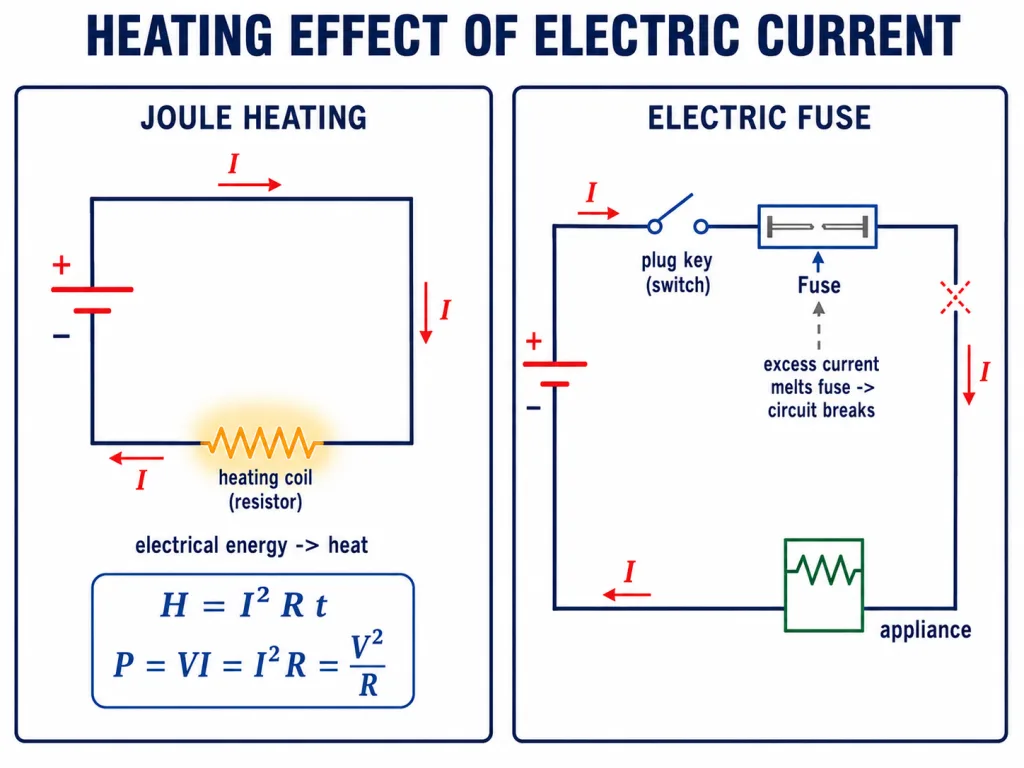
Consider a current through a resistor with potential difference , for time . The work done to move charge through is , so the power supplied is:
The energy supplied in time is , and it all appears as heat:
Joule's Law of Heating
Using Ohm's law (), the heat produced becomes:
This is Joule's law of heating. The heat produced in a resistor is:
- directly proportional to the square of the current () for a given resistance,
- directly proportional to the resistance () for a given current, and
- directly proportional to the time () for which current flows.
[Exam Tip] Because , doubling the current makes four times the heat.
Electric Power and Its Unit
Electric power is the rate at which electrical energy is consumed or dissipated:
The SI unit of power is the watt (W): . A bigger unit is the kilowatt ().
Since energy = power × time, the commercial unit of electrical energy is the kilowatt-hour (kW h), commonly called a "unit":
Practical Applications: Bulbs and Fuses
- Electric bulb: the filament (tungsten, m.p. 3380°C) gets white-hot and emits light; bulbs are filled with inert nitrogen/argon to prolong filament life. Most energy appears as heat, a small part as light.
- Electric fuse: a safety device placed in series with an appliance. It is a short piece of wire of low melting point. If the current exceeds a safe value, the fuse wire heats up, melts and breaks the circuit, protecting the appliance. Domestic fuses are rated 1 A, 2 A, 3 A, 5 A, 10 A, etc.
Example: a 1 kW iron on 220 V draws A, so a 5 A fuse is used.
[Exam Tip] Remember all three power forms: . Cost of energy = (power in kW) × (hours) × (rate per unit).
Solved Examples
Example 1: Current and resistance of an iron (NCERT 11.10)
An electric iron consumes 840 W at maximum and 360 W at minimum, on 220 V. Find the current and resistance in each case.
Solution: Using , . Max: ; . Min: ; .
Example 2: Potential difference from heating (NCERT 11.11)
100 J of heat is produced each second in a 4 Ω resistor. Find the potential difference across it.
Solution: J, , s. From : .
Example 3: Power of a bulb (NCERT 11.12)
An electric bulb on a 220 V supply draws 0.50 A. Find its power.
Solution:
Example 4: Cost of running a refrigerator (NCERT 11.13)
A 400 W refrigerator runs 8 hours a day. Find the cost to run it for 30 days at Rs 3.00 per kW h.
Solution: Energy . Cost .
Example 5: Heat developed in an iron (NCERT Q)
An electric iron of resistance 20 Ω takes a current of 5 A. Calculate the heat developed in 30 s.
Solution:
Example 6: Power at reduced voltage (NCERT Ex Q3)
A bulb rated 220 V, 100 W is operated at 110 V. Find the power consumed.
Solution: Resistance (constant). At 110 V: . (Halving the voltage gives one-quarter of the power.)