
Electric Current
Electricity is a controllable and convenient form of energy used everywhere - in homes, schools, hospitals and industries. Just as flowing water makes a water current in a river, when electric charge flows through a conductor (like a metal wire), we say there is an electric current in it.
A continuous and closed conducting path is called an electric circuit. A switch simply makes or breaks the conducting link between the cell and the device. If the circuit is broken anywhere (switch off), the current stops and the bulb does not glow.
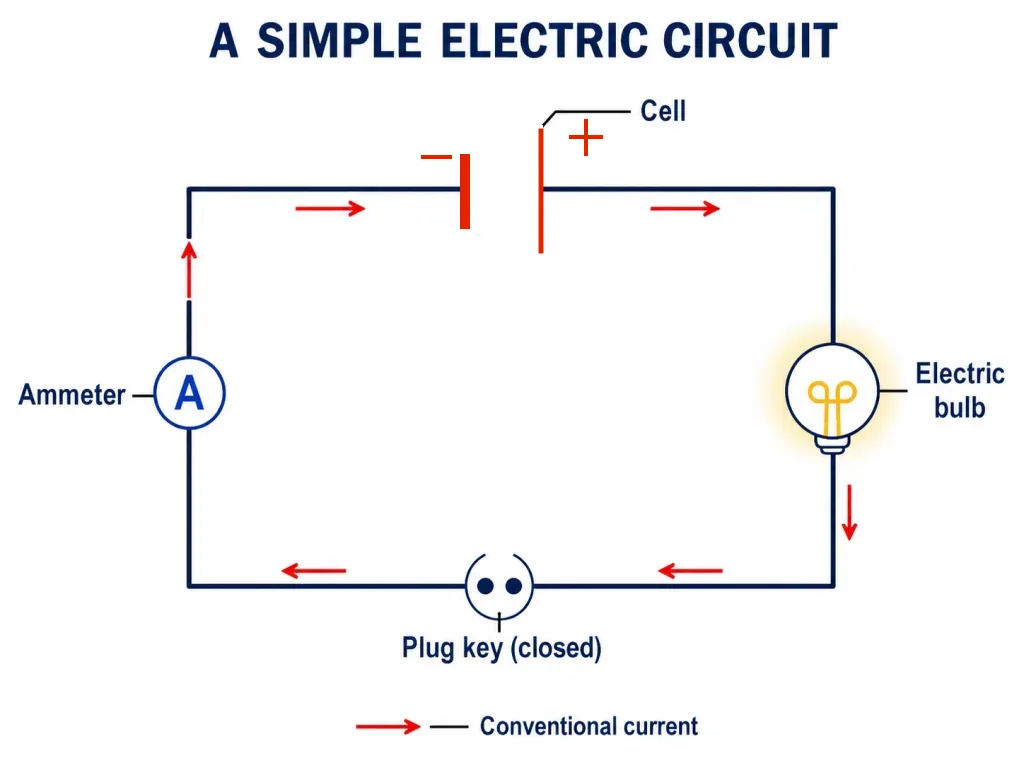
Electric current is the rate of flow of electric charge - the amount of charge flowing through a cross-section in unit time.
Expressing Current: I = Q/t
If a net charge flows across a cross-section of a conductor in time , the current is:
The SI unit of charge is the coulomb (C) - roughly the charge of electrons (one electron carries C).
The SI unit of current is the ampere (A), named after Andre-Marie Ampere. One ampere is one coulomb of charge flowing per second: .
Smaller currents are measured in milliampere () or microampere ().
An ammeter measures current and is always connected in series in the circuit.
Direction of Current: Conventional vs Electron Flow
In metallic wires, it is the electrons (negative charges) that actually move. But electrons were not known when electricity was first studied, so current was taken to be the flow of positive charge.
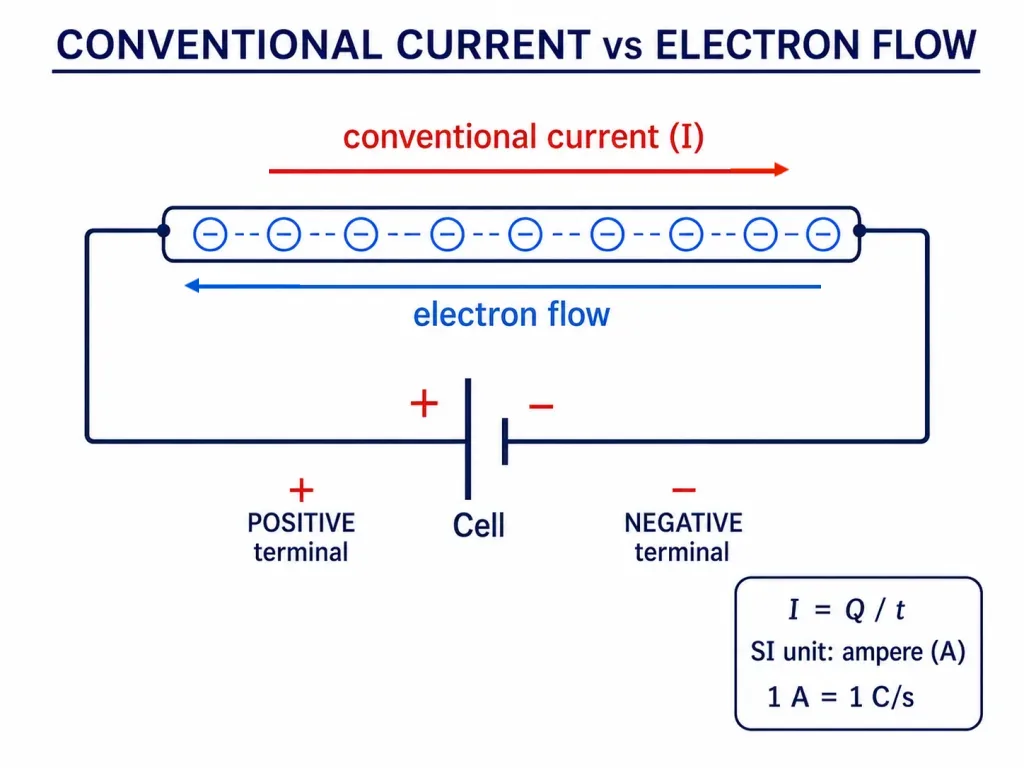
By convention, the direction of electric current is taken opposite to the direction of electron flow. So while electrons drift from the negative terminal to the positive terminal, the conventional current is drawn from the positive terminal to the negative terminal.
Key Point: Conventional current direction = opposite to electron flow.
[Exam Tip] Ammeter → always in series; current ; .
Solved Examples
Example 1: Charge from current and time (NCERT 11.1)
A current of 0.5 A is drawn by the filament of an electric bulb for 10 minutes. Find the amount of electric charge that flows through the circuit.
Solution: Given A, min s.
Example 2: Number of electrons in 1 C
Calculate the number of electrons that make up one coulomb of charge.
Solution: Charge of one electron C. From ,
Example 3: Current from charge and time
If 20 C of charge passes a point in a wire in 4 s, what is the current?
Solution: