
What Makes Charge Flow? Potential Difference
Charges do not flow in a copper wire by themselves - just as water in a perfectly horizontal tube does not flow until there is a pressure difference. For charges to flow in a conductor, there must be a difference of electric pressure, called the potential difference, across it.
This potential difference is produced by a cell or a battery (one or more cells). The chemical action inside a cell maintains the potential difference across its terminals, even when no current flows. When connected in a circuit, this potential difference sets the charges in motion and drives the current. To keep the current flowing, the cell continually spends its stored chemical energy.
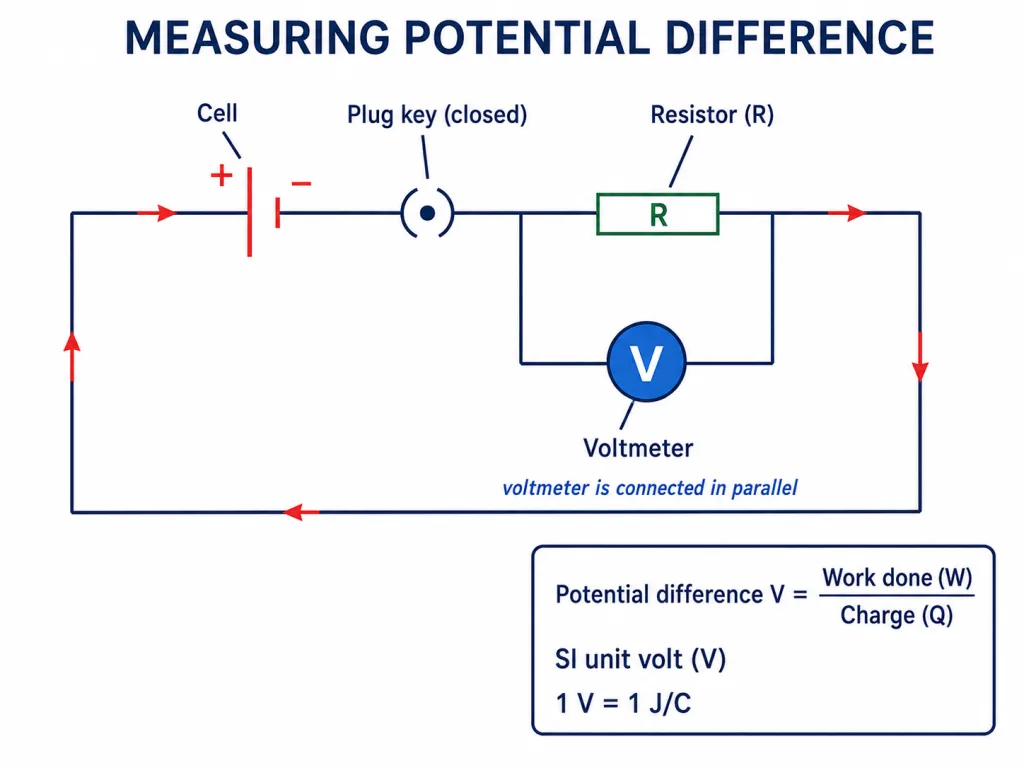
Defining Potential Difference: V = W/Q
The electric potential difference between two points is the work done to move a unit charge from one point to the other:
The SI unit of potential difference is the volt (V), named after Alessandro Volta.
One volt is the potential difference between two points when 1 joule of work is done to move a charge of 1 coulomb from one point to the other:
Potential difference is measured by a voltmeter, which is always connected in parallel across the two points between which the potential difference is to be measured.
Key Point: Ammeter → series; Voltmeter → parallel.
Solved Examples
Example 1: Work done to move a charge (NCERT 11.2)
How much work is done in moving a charge of 2 C across two points having a potential difference of 12 V?
Solution:
Example 2: Energy given by a battery
How much energy is given to each coulomb of charge passing through a 6 V battery?
Solution: , so for C, . Each coulomb gains 6 J of energy.
Example 3: Potential difference from work and charge
If 45 J of work is done to move 5 C of charge between two points, find the potential difference.
Solution: