
Resistors in Series
Resistors can be combined in two ways. When resistors are joined end to end, one after another, they are said to be connected in series.
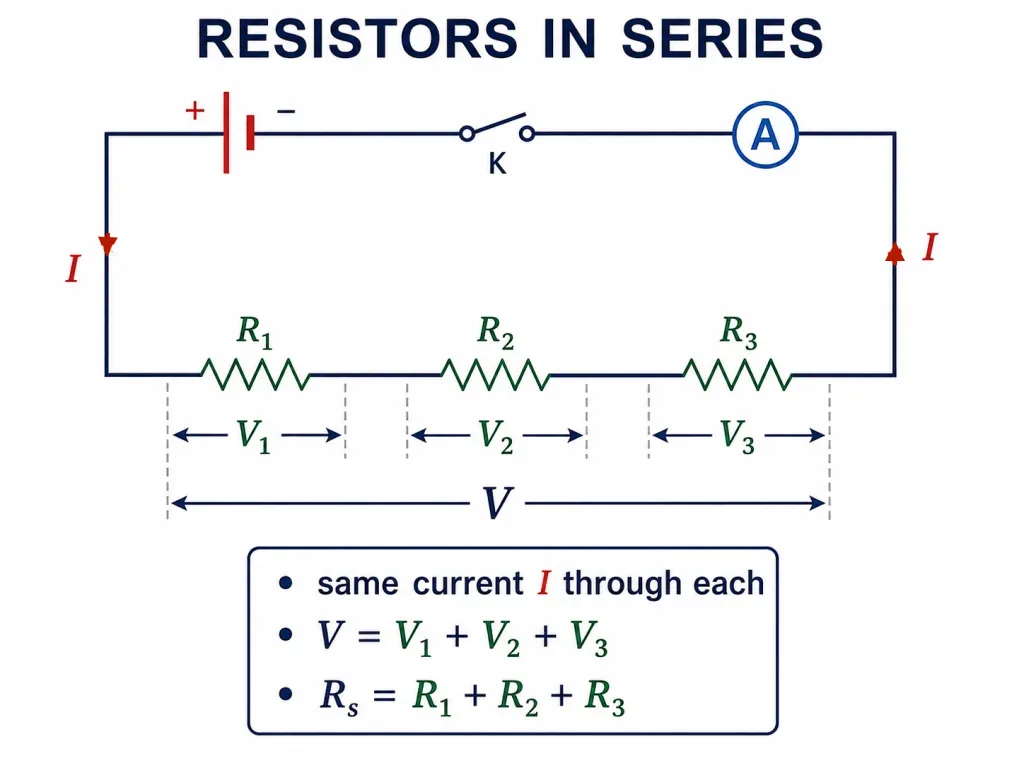
Two key facts about a series combination:
- The same current flows through every resistor (the ammeter reads the same value wherever it is placed in the loop).
- The total potential difference is the sum of the potential differences across the individual resistors:
Equivalent Resistance in Series
We can replace the whole series combination by a single equivalent resistor that draws the same current at the same total voltage . Applying Ohm's law:
Since :
So in series the equivalent resistance is the sum of the individual resistances, and is therefore larger than any single resistance.
[Exam Tip] Series → same current, voltages add, is the sum (biggest). A disadvantage: if one component fails, the whole circuit breaks.
Solved Examples
Example 1: Lamp and conductor in series (NCERT 11.7)
An electric lamp of resistance 20 Ω and a conductor of 4 Ω are connected to a 6 V battery. Find (a) total resistance, (b) circuit current, (c) potential difference across the lamp and the conductor.
Solution: (a) . (b) . (c) ; . (Check: V.)
Example 2: Three resistors in series
Find the equivalent resistance of 5 Ω, 8 Ω and 12 Ω connected in series.
Solution:
Example 3: Current through a large series resistor (NCERT Ex Q9)
A 9 V battery is connected in series with resistors 0.2 Ω, 0.3 Ω, 0.4 Ω, 0.5 Ω and 12 Ω. How much current flows through the 12 Ω resistor?
Solution: . In series the same current flows everywhere: .
Example 4: Voltage across one resistor
Two resistors 5 Ω and 10 Ω are in series across a 6 V battery. Find the voltage across the 10 Ω resistor.
Solution: ; . .