
What Does Resistance Depend On?
Different components allow current to flow more or less easily. Electrons moving through a conductor are held back by the atoms of the material - this opposition is the resistance. A good conductor has low resistance; a resistor has appreciable resistance; an insulator has very high resistance.
Careful experiments show that the resistance of a uniform metallic conductor depends on three things:
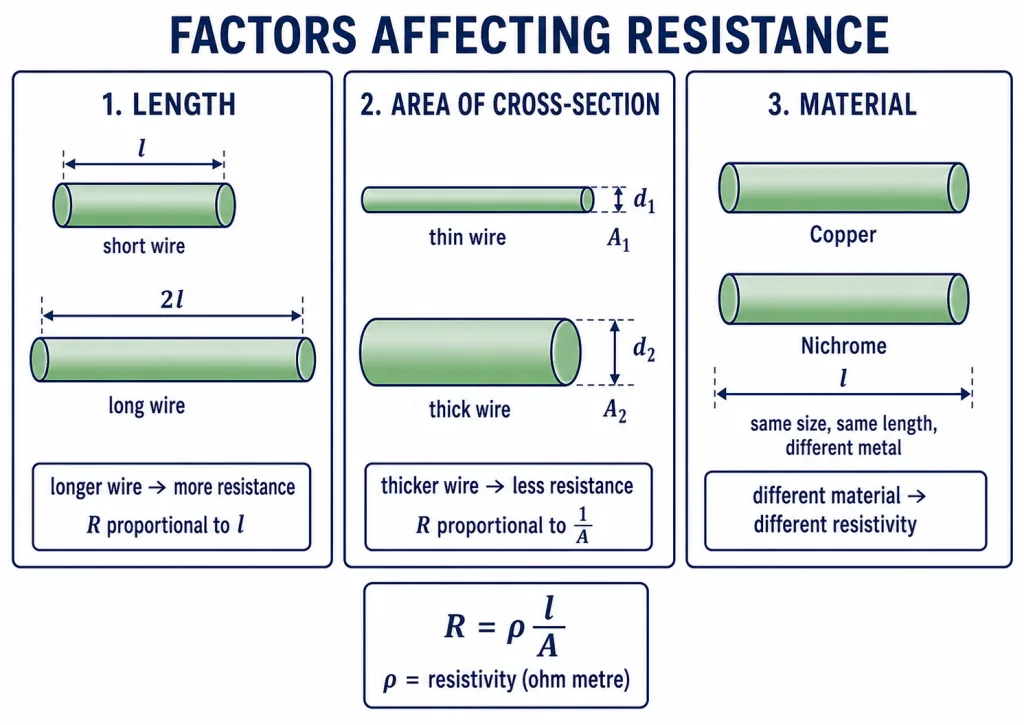
- its length ,
- its area of cross-section , and
- the nature of its material.
The Formula R = ρl/A
Precise measurements show:
- Resistance is directly proportional to length: (a wire twice as long has twice the resistance).
- Resistance is inversely proportional to area of cross-section: (a thicker wire has less resistance).
Combining these:
Here (rho) is the electrical resistivity of the material - a constant that is characteristic of the material. Its SI unit is the ohm metre (Ω m).
Key Point: Longer wire → more resistance; thicker wire → less resistance; the material fixes .
Resistivity and Choice of Materials
- Metals and alloys have very low resistivity ( to Ω m) - they are good conductors.
- Insulators like rubber and glass have very high resistivity ( to Ω m).
- Both resistance and resistivity change with temperature.
The resistivity of an alloy is generally higher than that of its constituent metals, and alloys do not oxidise (burn) readily at high temperature. So alloys like nichrome are used in heating devices (electric iron, toaster, heater).
Tungsten (very high melting point) is used for bulb filaments; copper and aluminium (low resistivity) are used for transmission lines.
[Exam Tip] To halve resistance, use a wire of double the area (thicker). To use in a heater, choose an alloy (high resistivity + no oxidation).
Solved Examples
Example 1: Resistivity from resistance (NCERT 11.5)
A metal wire of length 1 m has resistance 26 Ω at 20°C. Its diameter is 0.3 mm. Find the resistivity and predict the material.
Solution: , so . From the resistivity table this matches manganese.
Example 2: Reshaping a wire (NCERT 11.6)
A wire of length and area has resistance 4 Ω. What is the resistance of another wire of the same material with length and area ?
Solution: . For the new wire,
Example 3: Doubling the length
A wire has resistance 6 Ω. If it is replaced by a wire of the same material and area but twice the length, find the new resistance.
Solution: Since , doubling the length doubles the resistance: .
Example 4: Thicker wire
A wire of resistance 8 Ω is replaced by one of the same length and material but double the cross-sectional area. Find the new resistance.
Solution: Since , doubling the area halves the resistance: .