
Ohm's Law
Is there a relationship between the potential difference across a conductor and the current through it? If we connect a nichrome wire to a varying number of cells and measure and each time, we find that the ratio stays constant. A graph of against is a straight line through the origin.
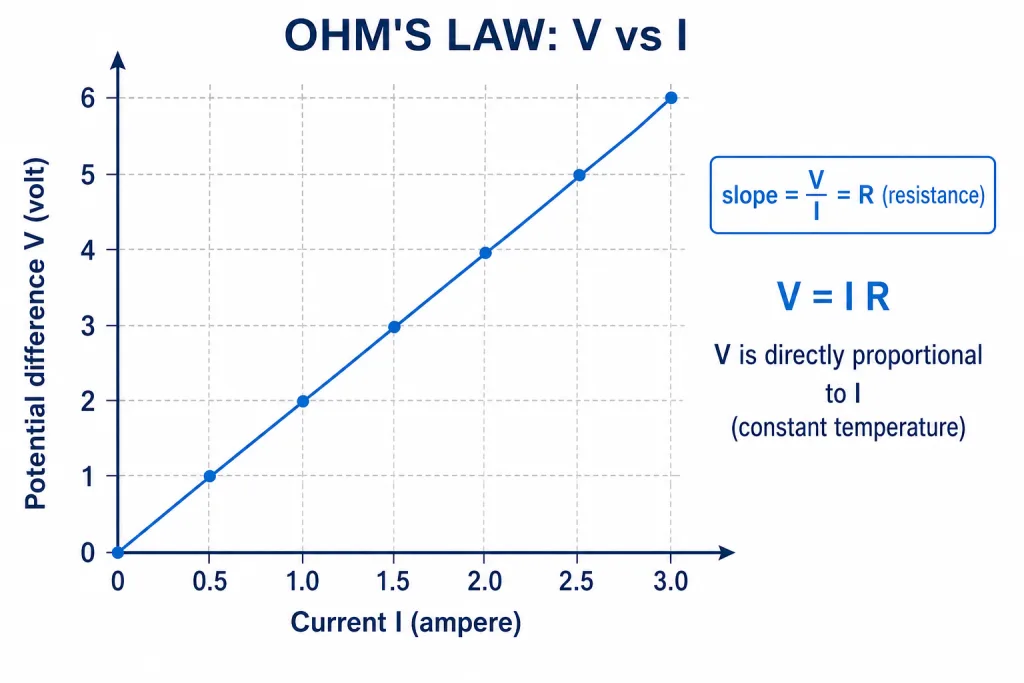
In 1827, Georg Simon Ohm stated this as Ohm's law:
The potential difference across the ends of a given metallic conductor is directly proportional to the current through it, provided its temperature remains constant.
Resistance and the Ohm
The constant is the resistance of the conductor - its property of opposing the flow of charge:
The SI unit of resistance is the ohm (Ω). If a potential difference of 1 V drives a current of 1 A, the resistance is 1 ohm:
Rearranging gives . So for a fixed voltage, the current is inversely proportional to the resistance - double the resistance, and the current halves.
A rheostat (variable resistance) is a component used to change the current in a circuit without changing the voltage source.
[Exam Tip] Slope of the – graph = resistance . A steeper line means a larger resistance. Ohm's law holds only at constant temperature.
Solved Examples
Example 1: Current drawn by a bulb and a heater (NCERT 11.3)
(a) How much current will a bulb of filament resistance 1200 Ω draw from a 220 V source? (b) How much current will a heater coil of resistance 100 Ω draw from the same source?
Solution: (a) . (b) . The heater draws much more current than the bulb from the same 220 V source.
Example 2: Heater current at higher voltage (NCERT 11.4)
The potential difference across a heater is 60 V when it draws 4 A. What current will it draw at 120 V?
Solution: (constant). At 120 V: .
Example 3: Effect of halving the voltage
The resistance of a component is constant. If the potential difference across it is halved, what happens to the current?
Solution: From with constant, . Halving halves the current.
Example 4: Resistance from a V–I reading
A resistor carries 2 A when 10 V is applied. Find its resistance.
Solution: