
Resistors in Parallel
When resistors are connected between the same two points (so each has its own branch), they are said to be connected in parallel.
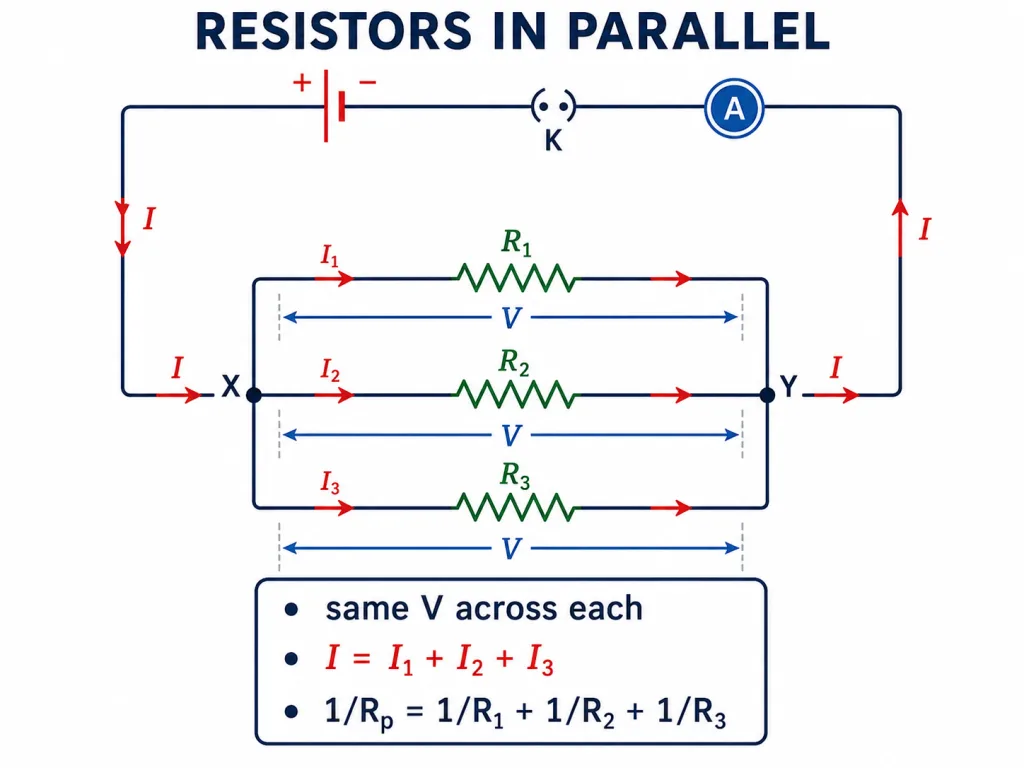
Two key facts about a parallel combination:
- The same potential difference appears across every resistor (they are all across the same two points).
- The total current is the sum of the currents through the separate branches:
Equivalent Resistance in Parallel
Let be the equivalent resistance. Applying Ohm's law to the whole combination and to each branch:
Since :
The reciprocal of the equivalent parallel resistance is the sum of the reciprocals. So is smaller than the smallest individual resistance.
Why Parallel Circuits Are Used at Home
Parallel connections are used for domestic wiring because:
- Each appliance gets the full supply voltage (e.g. 220 V), so devices needing different currents all work properly.
- If one appliance fails or is switched off, the others keep working (the circuit is not broken).
- The total resistance decreases, so more current is available for the appliances.
Key Point: Parallel → same voltage, currents add, is the sum of reciprocals ( is smallest).
[Exam Tip] For two resistors in parallel, a handy shortcut: .
Solved Examples
Example 1: Three resistors in parallel (NCERT 11.8)
R1 = 5 Ω, R2 = 10 Ω, R3 = 30 Ω are connected in parallel to a 12 V battery. Find (a) the current in each, (b) the total current, (c) the total resistance.
Solution: Each has 12 V across it. , , . (b) . (c) , so .
Example 2: Two resistors in parallel
Find the equivalent resistance of 6 Ω and 3 Ω in parallel.
Solution:
Example 3: Series-parallel combination (NCERT 11.9)
R1 = 10 Ω, R2 = 40 Ω in parallel; R3 = 30 Ω, R4 = 20 Ω, R5 = 60 Ω in parallel; the two groups are in series across 12 V. Find total resistance and total current.
Solution: Group 1: , so . Group 2: , so . Total ; .
Example 4: Getting a target resistance (NCERT Ex Q11)
How can three 6 Ω resistors be connected to give (i) 9 Ω, (ii) 4 Ω?
Solution: (i) Put two in parallel () and this in series with the third: . (ii) Put two in series () and this in parallel with the third: .