
Relationship Between Extraction and Reactivity
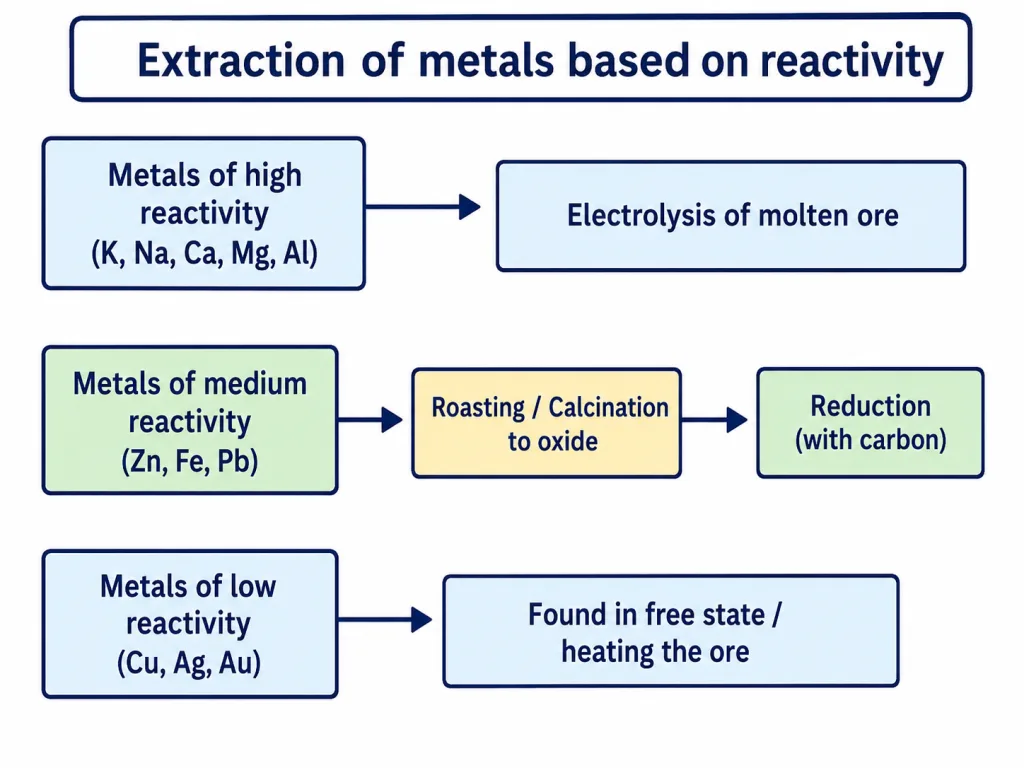
The reactivity of a metal — determines its method of extraction.
Extraction in Three Categories
1. Less Reactive Metals (bottom of series):
- Hg, Cu, Ag, Au
- Very simple — by heating directly or burning in air.
2. Moderately Reactive Metals (middle of series):
- Zn, Fe, Pb, Sn
- Moderately difficult — reduction by carbon (coke).
3. Highly Reactive Metals (top of series):
- Na, K, Ca, Mg, Al
- Very difficult — by electrolysis.
Reactivity and Method — Summary
   Reactivity Series (top → bottom)

   K, Na, Ca, Mg, Al    →  Electrolysis

   Zn, Fe, Pb, (Cu)     →  Reduction by carbon

   Hg, Ag, (Au)         →  Direct heating
Principle
More reactive metal = more stable compound = more energy needed for extraction.
Highly reactive like Na, K — even carbon cannot reduce them. Only electric current. Hg, Ag — less stable compounds — simple heating is enough.
Why Reactivity Matters?
A more reactive metal → more strongly bonded with non-metal. To 'free' it — more effort.
A less reactive metal → weak bond. To 'free' it — easy.
Two Main Processes of Extraction
1. Roasting: Heating a sulphide ore in the presence of air. 2. Calcination: Heating a carbonate/hydroxide without air.
Both — convert ore into oxide. The oxide is then reduced.
Why this? Because reduction of oxide — easy.
Roasting and Calcination
Two methods to convert ore into oxide.
Roasting
Heating a sulphide ore in the presence of air.
Principle: More oxygen — more vigorous oxidation.
Example: Roasting of ZnS:
ZnS → ZnO (oxide) SO₂ — harmful gas, released into atmosphere.
Other Examples:
Roasting of Cu pyrites:
Roasting of HgS:
Roasting of PbS:
Calcination
Heating carbonate/hydroxide ore in the absence of air (or limited).
Principle: Decomposition — CO₂ or H₂O is released, oxide remains.
Example: Calcination of Calamine (ZnCO₃):
Other Examples:
Calcination of Limestone (CaCO₃):
Calcination of Magnesite (MgCO₃):
Calcination of Bauxite (Al(OH)₃):
Comparison — Roasting vs Calcination
| Property | Roasting | Calcination |
|---|---|---|
| Ore | Sulphide | Carbonate/Hydroxide |
| Air | Yes (more) | No (or limited) |
| Product | Oxide + SO₂ | Oxide + CO₂/H₂O |
| Example | ZnS → ZnO | ZnCO₃ → ZnO |
Why Both Are Needed?
Basic Rule: Sulphides and carbonates — not used directly for reduction. First convert them to oxide — then carbon or electrical reduction is easier.
Next Step
Now the oxide is ready — now to convert it into metal. This — depends on reactivity.
Extraction of Less Reactive Metals
Hg, Cu, Ag — at the bottom of the series. Their compounds — less stable. Simple methods of extraction.
Extraction of Mercury (Hg)
Ore: Cinnabar (HgS)
Step 1: Roasting
Step 2: Decomposition of HgO (heat further):
That is — HgO automatically turns into Hg upon heating.
This property of HgO — less stable. Easily decomposes.
Hence — a 'very simple' extraction.
Extraction of Copper (Cu)
Ore: Copper pyrites (CuFeS₂) or Cuprite (Cu₂O)
From Cu₂S (a simple method):
If both Cu₂O and Cu₂S are available — self-reduction:
That is — one ore reduced the other! 'Self-reduction' — an interesting process.
Extraction of Silver (Ag)
Ore: Argentite (Ag₂S)
Modern Method — Cyanide Leaching:
1. Ag₂S in NaCN solution:
2. Displacement by Zn:
Ag precipitate — in pure form.
An Interesting Fact
Hg, Cu, Ag — methods of extraction for all three are very simple. That is why — these metals were known thousands of years ago. After 'Stone Age' — the 'Copper Age' came directly! Fe, Al — only recently (last 200 years).
Extraction of Moderately Reactive Metals — Reduction by Carbon
Zn, Fe, Pb — middle of the series. Ore → Oxide → Reduction by carbon → Metal.
Basic Principle
Carbon — a strong reducing agent. It pulls oxygen towards itself. Frees the metal from 'metal oxide'.
General Reaction
or
Extraction of Fe — In Blast Furnace
Ore: Hematite (Fe₂O₃)
Step 1: Concentration (Section 6 — gravity)
Step 2: Calcination/Roasting Heat ore to remove impurities.
Step 3: Reduction (Blast Furnace):
Tall, cylindrical furnace. From top: ore + coal (coke) + limestone. From bottom: hot air.
Reactions in three zones:
1. Upper zone (~500°C):
2. Middle zone (~1000°C):
3. Lower zone (~1500°C):
CaO + impurity (SiO₂):
That is, CaCO₃ — works as flux.
Final Products:
- From bottom: Molten Fe (Pig iron).
- Above: slag (CaSiO₃) — separated.
Extraction of Zn
Ore: Zinc blende (ZnS) or Calamine (ZnCO₃)
Step 1: Roasting of ZnS:
(Or calcination of ZnCO₃: ZnCO₃ → ZnO + CO₂)
Step 2: Reduction of ZnO by carbon:
Zn metal formed.
Extraction of Pb
Ore: Galena (PbS)
Step 1: Roasting of PbS:
Step 2: Reduction of PbO:
Flux and Slag — Again
Hidden impurities along with ore:
- Acidic gangue (SiO₂) → basic flux (CaCO₃).
- Basic gangue (CaO) → acidic flux (SiO₂).
Flux + Gangue → Slag — in molten state, separated.
Extraction of Highly Reactive Metals — Electrolysis
Na, K, Ca, Mg, Al — at the top of the series. Reduction by carbon — not enough. Only electrolysis.
Principle
Electric current passed through molten oxide or chloride. Metal deposits at Cathode. Non-metal released at Anode.
Extraction of Al — Hall-Héroult Process
Ore: Bauxite ()
Step 1: Concentration (Bayer Process) (Section 6) Pure Al₂O₃ at the end.
Step 2: Electrolysis (Hall-Héroult):
Melting point of Al₂O₃ is very high (~2050°C). Melting alone — very expensive.
Solution: Dissolve Al₂O₃ in cryolite (Na₃AlF₆). Now melting point — ~950°C. Much cheaper.
Setup:
- A steel box — lined with carbon.
- Carbon itself is Cathode (-).
- Carbon rods from above — Anode (+).
- Solution: Al₂O₃ + Na₃AlF₆ + CaF₂ (molten).
Reactions:
At Cathode (-):
Molten Al — collects at bottom.
At Anode (+):
O₂ released — reacts with carbon to form CO/CO₂.
Hence the carbon anodes slowly burn — replaced from time to time.
Overall reaction:
Extraction of Na — Down's Cell
Ore: Rock salt (NaCl)
Step: Electrolysis of molten NaCl
Add CaCl₂ to molten NaCl — lower melting point (800°C → 600°C).
Reactions:
At Cathode:
At Anode:
That is — Na metal + Cl₂ gas.
Extraction of Ca
Electrolysis of molten CaCl₂.
Why Not from Aqueous Solution?
Electrolysis of aqueous solutions of highly reactive metals (Na, K, Ca) — Na/K won't be formed!
Why? At Cathode — H⁺ (from water) gets reduced first (H₂ formed).
Therefore — only from molten ore.
Summary Table — Methods of Extraction
| Metal | Ore | Method |
|---|---|---|
| Hg | HgS | Just heating |
| Cu | Cu₂S | Self-reduction |
| Ag | Ag₂S | Cyanide |
| Pb | PbS | Roasting + carbon |
| Zn | ZnS/ZnCO₃ | Roasting/calcination + carbon |
| Fe | Fe₂O₃ | Blast furnace + carbon |
| Al | Al₂O₃ | Hall-Héroult (electricity) |
| Mg | MgCl₂ | Electrolysis |
| Na | NaCl | Down's cell (electricity) |
| K | KCl | Electrolysis |
Basic Principle
'Level of reactivity' = difficulty of extraction.
Highly reactive = electrolysis. Moderate = reduction by carbon. Less reactive = direct heating.
[Board Important] This table — every year in board, 5-mark question.
🧠 Memory Capsule
A quick glance just before the board exam.
1. Reactivity and Extraction Method
| Series | Metals | Method |
|---|---|---|
| High | K, Na, Ca, Mg, Al | Electrolysis |
| Moderate | Zn, Fe, Pb | Reduction by carbon |
| Low | Hg, Cu, Ag, Au | Direct heating |
2. Roasting vs Calcination
| Property | Roasting | Calcination |
|---|---|---|
| Ore | Sulphide | Carbonate |
| Air | Yes | No |
| Example | ZnS → ZnO + SO₂ | ZnCO₃ → ZnO + CO₂ |
3. Famous Reactions
Roasting of ZnS:
Calcination of ZnCO₃:
Reduction of ZnO by carbon:
Fe extraction:
Decomposition of HgO:
4. Al Extraction (Hall-Héroult)
- Electrolysis: Al₂O₃ + cryolite (Na₃AlF₆).
- Melting point 950°C.
- Cathode: .
- Anode: .
5. Na Extraction (Down's cell)
- Molten NaCl + CaCl₂.
- Cathode: Na.
- Anode: Cl₂.
6. Fe in Blast Furnace
- Ore: Fe₂O₃
- Coke + CaCO₃ + hot air.
- Main reaction: .
- Flux (CaO) + Gangue (SiO₂) → Slag (CaSiO₃).
7. Why Carbon Cannot Reduce Na?
Na more reactive than C. For C to release O₂ — Na would have to do work. Answer: electrolysis.
8. Board's 'Golden' Questions
- Fe extraction — Blast Furnace.
- Al extraction — Hall-Héroult.
- Na extraction — why electrolysis?
- Difference between roasting and calcination.
- Method for less reactive metals.
Final Formula: 'Reactivity ↑ → extraction difficulty ↑ → energy ↑.'
Solved Examples
Example 1: NCERT — Three Categories of Extraction
How does extraction of metals depend on their reactivity? Divide into three categories.
Solution:
Basic Principle
More reactive metal → more stable compound → more energy needed for extraction.
Three Categories
1. Highly Reactive (top of series)
Metals: K, Na, Ca, Mg, Al
Method: Electrolysis.
Why? Even carbon cannot reduce them. Only electric current — sufficient energy.
Examples:
- Al: Hall-Héroult process (Al₂O₃ + cryolite)
- Na: Down's cell (molten NaCl)
- Mg: molten MgCl₂
2. Moderately Reactive (middle of series)
Metals: Zn, Fe, Pb, Sn, (Cu)
Method: Ore → Oxide → Reduction by carbon.
Steps:
- Roasting/Calcination (ore → oxide).
- Reduction by carbon.
Example: Zn:
- (roasting)
- (reduction)
Example: Fe:
- (in Blast Furnace)
3. Less Reactive (bottom of series)
Metals: Hg, Cu, Ag, Au
Method: Direct heating or self-reduction.
Why? Compounds are less stable — heat alone forms metal.
Example: Hg:
Example: Au, Pt:
- Found in free form — just pick and purify.
Summary Table
| Series | Metals | Method |
|---|---|---|
| High | K-Al | Electrolysis |
| Moderate | Zn, Fe, Pb | Reduction by carbon |
| Low | Hg, Cu, Ag, Au | Direct/Natural |
An Interesting Point
This is why:
- After 'Stone Age' came directly the Copper Age (Cu — simple extraction).
- Iron Age — after Cu (Fe extraction harder).
- Al — only recently (1825), because electrolysis technology was needed.
[NCERT textbook — fundamental]
Example 2: NCERT — Roasting and Calcination
What are roasting and calcination? Explain the differences with chemical reactions.
Solution:
Roasting
Definition: Heating sulphide ore in presence of air — to convert it into oxide.
General form:
Examples:
1. Zinc blende (ZnS):
2. Cinnabar (HgS):
3. Galena (PbS):
4. Iron pyrites (FeS₂):
Calcination
Definition: Heating carbonate or hydroxide ore in absence of air (or limited) — to convert it into oxide.
General forms:
or
Examples:
1. Calamine (ZnCO₃):
2. Limestone (CaCO₃):
3. Magnesite (MgCO₃):
4. Bauxite hydroxide (Al(OH)₃):
Main Differences
| Property | Roasting | Calcination |
|---|---|---|
| Ore type | Sulphide | Carbonate / Hydroxide |
| Air | Yes (more) | No (or limited) |
| Product | Oxide + SO₂ | Oxide + CO₂ or H₂O |
| Gas | SO₂ (toxic) | CO₂ (relatively harmless) |
Why Both Are Needed?
Direct reduction from sulphide or carbonate is difficult. Reduction of oxide — easy.
Hence, first convert these ores to oxide — then perform reduction.
An Interesting Point
SO₂ — environmental problem. SO₂ released during roasting — cause of acid rain. Modern industry — captures SO₂ and converts to . That is, 'waste' becomes 'valuable product'.
[NCERT — asked every year]
Example 3: NCERT — Extraction of Fe
Explain the extraction of Fe in Blast Furnace. Write the main reactions.
Solution:
Blast Furnace (Detailed)
Setup:
- Tall, cylindrical furnace (~25-30 m).
- Top: 'charge' (ore + coal + limestone) added.
- Bottom: hot air blown.
What's in the Charge?
1. Ore: Fe₂O₃ (Hematite) — concentrated. 2. Coke: Pure carbon — fuel and reducing agent. 3. Limestone: CaCO₃ — flux.
Reactions in Three Zones
Zone 1: Bottom (~1500-2000°C) — Combustion zone
1. Coal + air:
2. CO₂ + more coal (at high temperature):
CO — main reducing agent.
Zone 2: Middle (~1000°C) — Reduction zone
Reduction of Fe (by CO):
This is the main reaction — Fe is released.
Other reactions:
Zone 3: Upper (~500°C) — Pre-preparation
1. Decomposition of CaCO₃:
2. CaO + impurity (SiO₂):
That is, CaO — works as flux, combining with gangue (SiO₂).
Final Products
At bottom of furnace:
- Molten Fe (down, heavy).
- Molten slag (CaSiO₃) (up, light).
Both — released through different openings.
Pig Iron — First Product
Fe from Blast Furnace — 'pig iron'. 4% C + other impurities.
Further refined — 'cast iron' or 'wrought iron'.
A Main Diagram (in words):
  Top — Charge (ore + coal + lime)
   ↓
  500°C — CaCO₃ → CaO + CO₂
   ↓
  1000°C — Fe₂O₃ + 3CO → 2Fe + 3CO₂
   ↓
  1500°C — C + O₂ → CO₂; CO₂ + C → 2CO
   ↓
  Bottom — Molten Fe (extract)
            Molten slag (separate)

  Hot air in ←
Summary
Blast Furnace = Backbone of modern steel industry. In India: Tata Steel, SAIL, Bhilai Steel Plant — all Blast Furnaces.
[NCERT — every year in board, 5-mark]
Example 4: NCERT — Al Extraction (Hall-Héroult)
Explain the extraction of Aluminium in detail.
Solution:
Ore
Bauxite ()
Impurities: Fe₂O₃, SiO₂, TiO₂
Step 1: Concentration — Bayer Process (Section 6)
Brief here:
1. Al₂O₃ dissolves in NaOH:
2. Filter — remove impurities.
3. Al(OH)₃ from NaAlO₂:
4. Heat Al(OH)₃ (calcination):
Now pure Al₂O₃.
Step 2: Electrolysis — Hall-Héroult
Problem: Melting point of Al₂O₃ ~2050°C. Very expensive.
Solution: Dissolve Al₂O₃ in cryolite (Na₃AlF₆). Now melting point — 950°C.
Setup:
- Steel box — carbon lining.
- Carbon lining = Cathode (-).
- Carbon rods from above = Anode (+).
- Solution: molten (Al₂O₃ + Na₃AlF₆ + CaF₂).
Reactions:
Al₂O₃ → 2Al³⁺ + 3O²⁻ (in molten state)
At Cathode (-):
Molten Al — collects at bottom. Removed from bottom of box.
At Anode (+):
O₂ released — but at high temperature reacts with carbon:
Hence carbon anodes slowly burn. Replaced from time to time.
Overall reaction:
Important Points
1. Role of Cryolite:
- Lowers melting point (2050 → 950°C).
- Increases electrical conductivity.
2. Role of CaF₂:
- Lowers melting point further.
- Stabilises the solution.
3. Energy:
- Al extraction — very energy-intensive.
- 1 kg Al ≈ 14-15 kWh electricity.
- Hence — Al recycling is important.
An Interesting Fact
Al — most abundant metal in Earth's crust (~8%). Yet, commercial production of Al was not possible until 1886.
Hall (USA) and Héroult (France) — both discovered this method independently in 1886. In honour of both — 'Hall-Héroult' process.
[NCERT — board: 5-mark]
Example 5: NCERT — Extraction of Less Reactive Metals
Explain extraction of Hg and Cu.
Solution:
Extraction of Hg
Ore: Cinnabar (HgS)
Step 1: Roasting
HgS first converted to HgO.
Step 2: Self-decomposition of HgO
At higher temperatures, HgO — spontaneously decomposes:
That is, no external reducing agent needed! HgO itself is unstable.
Final product: Molten Hg — collected directly.
An Interesting Demonstration — In One Step
If furnace temperature is kept very high — both steps together:
That is, Hg directly from HgS!
Extraction of Cu
Ore: Copper pyrites (CuFeS₂)
Step 1: Concentration (froth flotation)
Step 2: Roasting
Cu₂S and FeO formed.
Step 3: Smelting with Flux
Cu₂S and FeO + SiO₂ (flux):
Fe separated as slag. Cu₂S — settles as 'matte'.
Step 4: Self-reduction
Heat 'matte' (Cu₂S) in air:
1. Some Cu₂S → Cu₂O:
2. Then Cu₂O + Cu₂S (remaining):
That is — one part reduced the other! This is 'self-reduction'.
Why Self-reduction?
Reactivity of Cu — moderate/low. Compounds not stable. S provides a 'natural reducing agent'.
Summary
| Metal | Ore | Method |
|---|---|---|
| Hg | HgS | Roasting + self-decomposition |
| Cu | CuFeS₂ | Roasting + self-reduction |
| Ag | Ag₂S | Cyanide + Zn displacement |
Final Insight
'Less reactive' = 'simple method'. This is why — Cu, Hg, Ag — known for thousands of years.
[NCERT — important]
Example 6: NCERT — Extraction of Na
Why is Na not extracted by electrolysis of aqueous solution? What is the correct method?
Solution:
Why Not from Aqueous NaCl?
If electrolysis of aqueous NaCl is done:
At Cathode — two options:
- (Reduction of Na)
- (Reduction of water)
Which will happen?
Look at reactivity series: Na (highly reactive) > H₂O
Rule: At Cathode — less reactive ion/molecule will be reduced.
Hence — H₂O is reduced. Na is not.
That is — H₂ comes out from aqueous NaCl, not Na.
Correct Method — Down's Cell
Electrolysis of molten NaCl.
Setup:
- A steel box.
- Solution: molten NaCl + CaCl₂.
- Why CaCl₂? To lower melting point of NaCl from 800°C (~600°C).
- Cathode: steel ring (to collect Na).
- Anode: carbon rod (for Cl₂ release).
Reactions:
At Cathode (-):
Molten Na — light, floats up. Out through a tube.
At Anode (+):
Cl₂ gas — out through separate tube.
Overall:
Precautions
*1. Na and Cl₂ — must be kept apart. *(Otherwise they would form NaCl back — and explosion.)* 2. Air-tight box — protects Na from air. 3. Molten Na put in kerosene — protection.
Comparison — Molten vs Aqueous
| Property | Molten NaCl | Aqueous NaCl |
|---|---|---|
| Electrolysis | Na + Cl₂ | H₂ + Cl₂ + NaOH |
| Product | Na metal | NaOH |
| Melting point | 800°C (less with CaCl₂) | room temp |
| Use | Na extraction | Chlor-alkali process |
Broad Principle
For highly reactive metals (K, Na, Ca, Mg, Al): Extraction only by electrolysis of molten ore.
For moderate (Zn, Fe, Pb): Reduction by carbon.
An Interesting Fact
Aqueous electrolysis of Na — Chapter 2's 'chlor-alkali process'. That gives NaOH, not Na. This process — commercially very important.
[NCERT — every year in board]
Example 7: NCERT — Which Method?
Give the suitable method of extraction for the following metals:
(a) Mg, (b) Cu, (c) Au, (d) Zn, (e) Pb
Solution:
First look at reactivity series: K > Na > Ca > Mg > Al > Zn > Fe > Pb > H > Cu > Hg > Ag > Au
(a) Mg
Series: Highly reactive.
Method: Electrolysis.
Ore: MgCl₂ (in molten form).
At Cathode: Mg²⁺ + 2e⁻ → Mg. At Anode: 2Cl⁻ → Cl₂.
Why not carbon reduction? Mg more reactive than C.
(b) Cu
Series: Less reactive.
Method: Roasting + self-reduction.
Ore: CuFeS₂
Roasting: 2CuFeS₂ + O₂ → Cu₂S + … Self-reduction: 2Cu₂O + Cu₂S → 6Cu + SO₂.
(c) Au
Series: Very low reactivity (bottom of series).
Method: In free form (panning or cyanide leaching).
1. Free gold — picked directly. 2. For concentrated form: cyanide leaching + Zn displacement.
Why no 'reduction'? Au compounds — rare.
(d) Zn
Series: Moderately reactive.
Method: Roasting + reduction by carbon.
Ore: ZnS or ZnCO₃
1. Roasting: 2ZnS + 3O₂ → 2ZnO + 2SO₂ (Or calcination: ZnCO₃ → ZnO + CO₂)
2. Reduction: ZnO + C → Zn + CO.
(e) Pb
Series: Moderately reactive.
Method: Roasting + reduction by carbon.
Ore: PbS (Galena)
1. Roasting: 2PbS + 3O₂ → 2PbO + 2SO₂ 2. Reduction: PbO + C → Pb + CO.
Summary Table
| Metal | Reactivity | Method | Main Reaction |
|---|---|---|---|
| Mg | High | Electrolysis | |
| Cu | Low | Self-reduction | |
| Au | Very low | Natural | (free form) |
| Zn | Moderate | Reduction by C | |
| Pb | Moderate | Reduction by C |
Key Insight
'Reactivity decides — the method.'
[NCERT textbook — application]
Example 8: An Interesting — Self-reduction
How is Cu extracted by the process of self-reduction?
Solution:
Self-reduction — Definition
'Self-reduction' = One part of the ore reduced another part of the ore. No external reducing agent.
Step-by-step for Cu
Ore: Cu₂S ('matte' obtained from Cu pyrites)
Step 1: Partial Roasting
Burn part of Cu₂S in air:
Now mixture: Cu₂O + remaining Cu₂S.
Step 2: Self-reduction
Cu₂O and Cu₂S — react with each other:
That is:
- Cu₂O released O (reduced).
- Cu₂S released S (oxidised).
- Finally: pure Cu is formed.
Analysis
What's what here?
In Cu₂O:
- Cu: +1
- Finally Cu: 0 → Reduction!
In Cu₂S:
- S: -2
- Finally S: +4 (in SO₂) → Oxidation!
That is — one compound of the same metal (Cu) freed Cu.
Why Possible for Cu?
Cu — less reactive. Cu₂O and Cu₂S — both not very stable. Cu freed easily.
Possible for Fe Too?
Fe — more reactive. Fe₂O₃ more stable. Self-reduction won't free Fe.
For Fe — reduction by carbon is necessary.
An Interesting Comparison
| Metal | Extraction | Reducing Agent |
|---|---|---|
| Cu | Self-reduction | Other part of ore (S²⁻) |
| Zn | By C | External carbon |
| Fe | By C (CO) | External carbon |
| Hg | Self-decomposition | None (just heat) |
| Al | Electricity | Electric current |
Practical Importance
Self-reduction — less energy-intensive. No coal needed. Efficient for industry.
This is why Cu — known since Bronze Age (3300 BC).
[Board: 5-mark]
Example 9: NCERT — Flux and Slag
What are flux and slag? Explain their role in Fe extraction.
Solution:
Definitions
Flux: Chemical added during extraction — to remove gangue.
Slag: Molten compound formed by reaction of flux + gangue.
Principle
Acidic flux + Basic gangue → Slag. Basic flux + Acidic gangue → Slag.
That is — opposite natures.
Types of Flux
1. Acidic Flux:
- (silica)
- For basic impurity.
2. Basic Flux:
- (lime — from decomposition of CaCO₃)
- For acidic impurity.
Flux in Fe Extraction
Ore: Fe₂O₃ (Hematite)
Impurity (gangue): (silica — sand) — acidic.
Flux: (limestone) → on heating → CaO — basic.
Reactions:
1. Decomposition of CaCO₃:
2. CaO + SiO₂ → CaSiO₃ (slag):
This is slag — molten, light, floats above Fe. Released through separate opening.
Use of Slag in Industry
Don't think slag is 'waste' — many uses:
- Cement manufacturing: Slag cement.
- Road construction: Slag aggregate.
- Fertilisers: Calcium source.
- Filling material.
Flux in Cu Extraction
Impurity: FeO Flux: SiO₂
Reaction:
That is — Cu and Fe — separated with help of flux.
Summary Table
| Metal | Impurity (gangue) | Flux | Slag |
|---|---|---|---|
| Fe | SiO₂ (acidic) | CaCO₃ (basic) | CaSiO₃ |
| Cu | FeO (basic) | SiO₂ (acidic) | FeSiO₃ |
A Basic Rule
Impurity + Flux = Slag By 'acidic + basic' combination.
This is the fundamental principle of 'metallurgy'.
[NCERT — important]
Example 10: A Numerical — Al Extraction
How much Al is obtained from 100 kg of Al₂O₃? (Al=27, O=16)
Solution:
Reaction:
Molecular masses:
- g/mol
- 1 mol Al = 27 g
Ratio:
- 1 mol Al₂O₃ → 2 mol Al
- 102 g Al₂O₃ → 54 g Al
From 100 kg Al₂O₃:
≈ 53 kg Al.
Answer: From 100 kg Al₂O₃, about 53 kg Al is obtained.
Additional Information
Yield:
- 100 kg Al₂O₃ × 53% = 53 kg Al.
- % of Al in Al₂O₃ = 53%.
Bayer Process: ~2 tonnes bauxite → ~1 tonne Al₂O₃.
Hall-Héroult: ~2 tonnes Al₂O₃ → ~1 tonne Al.
Total: ~4 tonnes bauxite → ~1 tonne pure Al.
Energy Calculation
Energy for Al extraction: ~14-15 kWh per kg of Al.
100 kg Al₂O₃ → 53 kg Al → ~750-800 kWh electricity.
This is equivalent to one month's average Indian household consumption!
Why Al Recycling is Important?
1 kg Al recycled → 95% less energy. Only 0.7-0.8 kWh, instead of 14-15 kWh.
That is, recycling = energy savings + environmental benefits.
'Aluminium can recycling' — across the world.
[Board: 3-mark numerical]
Example 11: A Logical — True or False?
State true/false for the following — with reasons:
(a) Al can be reduced by carbon. (b) Hg is extracted by electrolysis. (c) ZnCO₃ is first calcined. (d) Na is obtained from electrolysis of aqueous NaCl.
Solution:
(a) Al reduced by carbon — False ✗
Reason: Al is more reactive than C.
Reactivity:
More reactive — displaces less reactive. Not the other way round.
Hence: C cannot reduce Al from Al₂O₃.
Correct method: Electrolysis (Hall-Héroult).
(b) Hg by electrolysis — False ✗
Reason: Hg — less reactive. HgO very unstable — decomposes just on heating.
Electrolysis — unnecessary cost.
Correct method: (roasting) (decomposition)
Just heating — sufficient.
(c) ZnCO₃ first calcined — True ✓
Reason: ZnCO₃ is a carbonate ore. Calcination = converting carbonate to oxide.
Now reduction of ZnO by carbon is easy.
This is the standard method.
(d) Na from aqueous NaCl — False ✗
Reason: In aqueous NaCl:
- At Cathode: Na vs H₂O — Na more reactive.
- Hence H₂O reduced (H₂ released).
- Na not formed.
Products: H₂ + Cl₂ + NaOH (chlor-alkali process).
Correct method: Electrolysis of molten NaCl (Down's cell).
Summary
| Statement | T/F | Correct Answer |
|---|---|---|
| Al + C | ✗ False | Electrolysis |
| Hg + electricity | ✗ False | Roasting + decomposition |
| ZnCO₃ + calcination | ✓ True | — |
| Na + aqueous | ✗ False | Molten NaCl |
Key Insight
Knowledge = reactivity series + ore type.
[Board: 5-mark logical]
Example 12: NCERT — Cu Extraction
Explain extraction of Cu from copper pyrites (CuFeS₂) — with all steps.
Solution:
Ore
Copper pyrites — (sulphides of both Cu and Fe).
Step 1: Concentration
Froth flotation method (Section 6). Now concentrated CuFeS₂.
Step 2: Roasting
Heat in air:
Products: Cu₂S, FeO, SO₂.
Step 3: Smelting with Flux
In 'reverberatory furnace':
FeO + SiO₂ (flux) → FeSiO₃ (slag):
That is — Fe separated as slag. Cu₂S — settles as 'matte'.
Step 4: Self-reduction
Partial roasting of Cu₂S in 'Bessemer converter':
Now mixture: Cu₂O + Cu₂S.
Self-reduction:
Finally — blister Cu. This is 99% pure, but has impurities.
Step 5: Refining — Section 8
By electrolytic refining → 99.99% pure Cu.
Flow Diagram
CuFeS₂ (Copper pyrites)
    ↓ Concentration (froth flotation)
Concentrated CuFeS₂
    ↓ Roasting (air + heat)
Cu₂S + FeO + SO₂
    ↓ + SiO₂ (flux)
Cu₂S (matte) + FeSiO₃ (slag)
    ↓ Air + heat
Cu₂O
    ↓ + Cu₂S (remaining)
6Cu + SO₂  (Blister Cu)
    ↓ Electrolytic refining
Pure Cu (99.99%)
Overall Reaction (At a glance)
Ore → metal — in many steps.
Purpose of each reaction:
- Roasting: sulphide to oxide.
- Smelting: removing impurities.
- Self-reduction: freeing Cu.
- Refining: purity.
Practical Use of Cu
99.99% pure Cu — for making electrical wires. High conductivity. Durability.
Lakhs of tonnes of Cu produced in India each year.
[NCERT — every year in board]
Example 13: A Comparative — 3 Examples of Carbon Reduction
Reactions for reduction by carbon for Fe, Zn, Pb — all three.
Solution:
General Principle
All three are moderately reactive. For all three: Ore → Oxide → Reduction by carbon.
Fe Extraction
Ore: Fe₂O₃ (Hematite)
Main Reactions (Blast Furnace):
1. Coal + air:
2. CO₂ + more coal:
3. Main reduction:
Here reducing agent: CO (not C directly).
Suitable temperature: ~1500°C.
Zn Extraction
Ore: ZnS (Zinc blende)
Reactions:
1. Roasting:
2. Reduction:
Reducing agent: C directly.
Suitable temperature: ~1100°C.
Pb Extraction
Ore: PbS (Galena)
Reactions:
1. Roasting:
2. Reduction:
Reducing agent: C directly.
Suitable temperature: ~1000°C.
Comparison Table
| Metal | Ore | First Step | Reducer | Temp |
|---|---|---|---|---|
| Fe | Fe₂O₃ | (None) | CO | 1500°C |
| Zn | ZnS | Roasting → ZnO | C | 1100°C |
| Pb | PbS | Roasting → PbO | C | 1000°C |
Why CO for Fe, but C directly for others?
In Blast Furnace:
- Tall furnace.
- Hot air inside.
- CO formed — throughout the furnace.
- CO more powerful reducing agent — especially at lower temperatures.
Smaller furnace for Zn, Pb:
- Higher temperature (1000-1100°C).
- C alone is enough.
An Interesting Point
If Zn formed in gas state (above 1000°C): Zn gas cools — liquid → solid. That is, pure Zn by 'distillation'.
Fe — melts to liquid. Collected at bottom.
Key Insight
All three = reduction by carbon. But — details of method differ. Specific conditions for each metal.
[Board: 5-mark comparative]
Example 14: NCERT — A Mixed Question
Answer the following:
(a) What is the formula of bauxite? (b) What is the role of cryolite? (c) Materials of cathode and anode in Hall-Héroult process? (d) What is the overall reaction?
Solution:
(a) Formula of Bauxite
Formula:
That is: hydrated aluminium oxide.
'Bauxite' — named after Les Baux village in France. (First discovered there.)
(b) Role of Cryolite
Cryolite () — a 'solvent':
Melting point of Al₂O₃ — ~2050°C. (Very expensive.) Add Al₂O₃ to cryolite — melting point drops to 950°C.
Two functions:
- Lower melting point.
- Increase electrical conductivity.
Additional: CaF₂ also added — further lower melting point.
(c) Cathode and Anode
Cathode (-):
- Carbon lining (inside steel box).
- Carbon itself — works as Cathode.
Anode (+):
- Carbon rods (lowered from above).
- Replaced from time to time — because they keep burning.
(d) Overall Reaction
Electrolysis:
At Cathode: At Anode:
O₂ released at anode reacts with carbon:
Hence carbon anodes slowly burn.
Practical Details
Energy use:
- ~14-15 kWh per kg Al.
- In India: state-level power plants.
- Companies in nearby states: Hindalco, NALCO, Vedanta.
Production:
- 1 kg Al → ~2 kg Al₂O₃ needed.
- 1 kg Al₂O₃ → ~2 kg bauxite needed.
- Total: 1 kg Al → ~4 kg bauxite.
An Interesting Fact
Before Hall-Héroult — Al was so rare it was more expensive than gold!
At the 1855 Paris Exposition — Al declared 'World's most expensive metal'.
Hall (USA) and Héroult (France) — both discovered this method independently in 1886.
Since then, the price of Al — dropped 200 times.
Today: Al → everywhere — aircraft, cars, windows, utensils.
[NCERT — important]
Example 15: An Interesting — History of Steel
From Fe extraction to 'steel' — the entire process.
Solution:
Step 1: Pig Iron from Blast Furnace
Fe₂O₃ + 3CO → 2Fe + 3CO₂ (in Blast Furnace)
Product: Pig iron
- 4% C
- Other impurities (S, P, Si, Mn)
- Brittle, weak.
Step 2: Cast Iron from Pig Iron
Melt pig iron in a smaller furnace — remove some impurities.
Product: Cast iron
- 2-4% C
- Hard, but brittle.
- Use: heavy kitchen utensils, pipes.
Step 3: Wrought Iron from Cast Iron
Further purification — remove most carbon.
Product: Wrought iron
- < 0.1% C
- Soft, ductile.
- Use: gates, grills.
Step 4: Manufacturing of Steel
Cast iron in special furnace. Carbon and other impurities controlled.
Product: Steel
- 0.2-2% C
- Very hard and ductile (both).
- Backbone of modern construction.
Bessemer Process (Steel Manufacturing)
Setup:
- 'Bessemer converter' — egg-shaped.
- Air blown through molten pig iron.
Reactions:
1. C + O₂ → CO₂ (carbon removed) 2. Si + O₂ → SiO₂ 3. P → P₂O₅ 4. Mn → MnO
Impurities — as slag. Finally: steel with controlled C.
Types of Steel
| Type | C % | Use |
|---|---|---|
| Mild Steel | 0.2-0.3% | Buildings, vehicles |
| Medium Carbon Steel | 0.3-0.6% | Railway tracks |
| High Carbon Steel | 0.6-1.5% | Tools, knives |
| Stainless Steel | + Cr, Ni | Utensils, kitchen |
Alloying Elements in Steel
Steel = Fe + C + others.
Other metals:
- Cr (stainless): corrosion-resistant.
- Ni: durable.
- Mn: hardness.
- W: high-temperature.
- V: tool steel.
Fe Industry in India
Major companies:
- TATA Steel (Jamshedpur)
- SAIL (Bhilai, Bokaro)
- JSW Steel
- Vizag Steel
India — second-largest producer of steel in the world.
Summary of the Entire Process
Fe₂O₃ (ore)
   ↓ Blast Furnace + coke + CaCO₃
Pig Iron (4% C)
   ↓ Some refining
Cast Iron (2-4% C)
   ↓ More refining
Wrought Iron (<0.1% C) or Steel (0.2-2% C)
An Interesting Fact
1856 — Bessemer's discovery — a pillar of modern 'Industrial Revolution'. Before that, steel was expensive. After Bessemer — cheap steel — railways, buildings, bridges.
[Board + General Knowledge]
Example 16: A Concluding Question
(a) 3 steps of metal extraction. (b) Al extraction — complete. (c) Main reaction in Fe extraction. (d) Why can't Na be reduced by carbon?
Solution:
(a) 3 Steps of Extraction
Step 1: Concentration
- Removing gangue.
- Methods: hand picking, gravity, magnetic, froth flotation.
Step 2: Reduction
- Ore → metal.
- Methods: by carbon, by electricity, self-reduction.
Step 3: Refining
- Purification.
- Main: electrolytic.
(b) Al Extraction
Ore: Bauxite (Al₂O₃·2H₂O)
1. Concentration (Bayer):
2. Electrolysis (Hall-Héroult):
- Al₂O₃ + cryolite (Na₃AlF₆) → melting point 950°C.
- Cathode: .
- Anode: .
Overall: .
(c) Main Reaction in Fe Extraction
Ore: Fe₂O₃
In Blast Furnace:
Reducing agent: CO (formed from coal).
This is the main reaction.
Others:
- (slag)
(d) Why Can't Na Be Reduced by C?
Principle: More reactive metal — displaces less reactive.
Reactivity: Na > C.
Hence: Na, more strongly bonded with O₂ than C is. C cannot free Na from Na₂O.
If we try: No reaction.
Reverse can happen: — but this is not Na extraction.
Correct method: Electrolysis of molten NaCl (Down's cell).
Here electric current — provides enough energy to 'free' Na.
Summary
Highly reactive metals (Na, K, Ca, Mg, Al) — electrolysis. Moderate (Zn, Fe, Pb) — reduction by carbon. Less reactive (Hg, Cu, Ag) — direct heating.
This is a basic rule — the essence of the entire section.
[Board: 5-mark mixed question]