
Metals and Non-Metals — Introduction
All around us, the elements fall into two main classes — metals and non-metals.
Can You Recognise These?
- Iron, copper, gold, silver — metals
- Coal (carbon), sulphur, phosphorus — non-metals
- Hydrogen, oxygen, chlorine — gaseous non-metals
Position in the Periodic Table
- Left side: most elements are metals.
- Right side: most elements are non-metals.
- Centre band: a few metalloids — like .
Distribution of Elements
- Total known elements ~ 118
- Metals ~ 78%
- Non-metals ~ 22%
Why Are Metals Important?
- Construction: iron, steel, aluminium.
- Daily life: utensils, tools, jewellery.
- Transport: cars, trains, aircraft.
- Electricity: copper/aluminium wires.
- Industry: machines, structures.
Why Are Non-Metals Important?
- For life: oxygen (breath), carbon (organic compounds).
- In food: iodine (in salt), phosphorus (bones).
- Chemical industry: sulphur, chlorine.
- Diamond: the world's hardest substance.
- Fertilisers: nitrogen.
[Board Tip] Identify metals vs. non-metals from their physical properties.
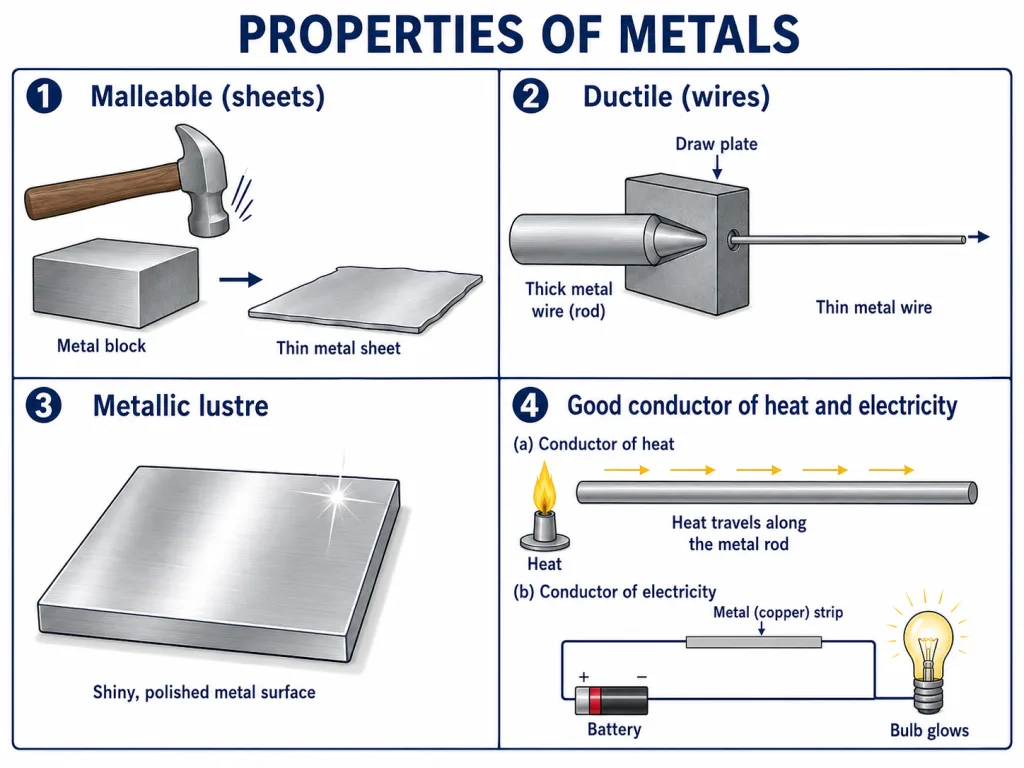
Physical Properties of Metals
1. Metallic Lustre
Metal surfaces are shiny — when freshly cut.
Examples:
- Gold (Au) — yellow lustre
- Silver (Ag) — white lustre
- Copper (Cu) — reddish-brown
2. Hardness
Most metals are hard.
Exceptions: sodium (Na), potassium (K) — can be cut with a knife (soft).
3. Malleability
Metals can be hammered into thin sheets.
Examples:
- Gold leaf — silver foil.
- Aluminium foil — for food packaging.
- 1 g of gold can be hammered into ~ 100 sq cm of foil.
4. Ductility
Metals can be drawn into thin wires.
Examples:
- Copper — electrical wires.
- Aluminium — high-tension wires.
- Gold is the most ductile — 1 g can be drawn into a 2 km long wire.
5. Conductivity
Metals are good conductors of heat and electricity.
Best conductors (in decreasing order):
- Electricity:
- Heat:
Exceptions: lead (Pb) and mercury (Hg) — poor conductors.
6. Sonorousness
Metals produce a ringing sound when struck.
Examples:
- Temple bells (bronze, brass)
- The school bell
7. High Melting/Boiling Points
- Most metals are solids.
- High melting points — tungsten (W) melts at ~ 3422°C.
- Exception: mercury (Hg) — liquid (mp −39°C).
8. Density
- Most metals are dense.
- Exceptions: sodium and potassium — light (less dense than water).
[Board Important] 6 physical properties of metals and their exceptions.
Physical Properties of Non-Metals
The properties of non-metals are mostly the opposite of metals.
1. Lack of Lustre
Non-metals are usually dull (not shiny).
Exception: iodine (I₂) — appears shiny, almost metallic.
2. Hardness
Most non-metals are soft.
Exception: diamond (carbon) — the hardest natural substance.
3. Brittleness
Non-metals shatter when struck — not malleable.
Example: sulphur — shatters under a hammer.
4. Poor Conductors
Non-metals are poor conductors of heat and electricity.
Exception:
- Graphite (an allotrope of carbon) — a good conductor of electricity.
- (A very important exception at the Class 10 level.)
5. Not Sonorous
Non-metals do not ring when struck (or shatter).
6. Variety of States
- Solid: carbon, sulphur, phosphorus, iodine
- Liquid: bromine (Br₂) — the only liquid non-metal at ordinary temperatures
- Gas: oxygen, nitrogen, chlorine, hydrogen
7. Low Melting/Boiling Points
Far lower than metals.
Exception: diamond — extremely high melting point (~ 3550°C, higher than many metals).
8. Low Density
Most non-metals are light.
Exceptions for Non-Metals — A Summary
| Property | Typical | Exception |
|---|---|---|
| Lustre | Dull | Iodine — shiny |
| Hardness | Soft | Diamond — hardest |
| Conductivity | Poor | Graphite — good conductor |
| Melting point | Low | Diamond — very high |
[Board Important] Memorise the exceptions — they are asked frequently.
Metals vs. Non-Metals — Comparison of Physical Properties
This is the most important summary table for the Class 10 exam:
| Property | Metals | Non-Metals |
|---|---|---|
| Lustre | Metallic lustre | Dull (exc. iodine) |
| State | Mostly solid | Solid/liquid/gas |
| Hardness | Hard (exc. Na, K) | Soft (exc. diamond) |
| Malleability | Yes | No (brittle) |
| Ductility | Yes | No |
| Electrical conductivity | Good | Poor (exc. graphite) |
| Heat conductivity | Good | Poor |
| Sonorousness | Yes | No |
| Melting point | High (exc. Na, K, Hg) | Low (exc. diamond) |
| Density | High (exc. Na, K) | Low |
The Key Exceptions That Come Up in Exams
Exceptions for metals:
- Mercury (Hg): liquid at room temperature (mp −39°C).
- Sodium (Na), potassium (K): soft — can be cut with a knife.
- Lithium (Li): the lightest metal — floats on water.
- Gallium (Ga), caesium (Cs): melt with the warmth of the hand.
Exceptions for non-metals:
- Diamond (carbon): the hardest natural substance.
- Graphite (carbon): a good conductor of electricity.
- Iodine (I₂): appears shiny.
- Bromine (Br₂): liquid at room temperature.
Why These Properties?
Metals have 'free electrons':
- These electrons move freely through the metal.
- That's the source of electrical and thermal conduction.
- And of lustre too (electrons reflect light).
Non-metals have no free electrons:
- Covalent bonding — electrons are shared, not free.
- Hence poor conduction.
- (Graphite has free electrons — that's why it's an exception.)
[Board Important] This table is often a 5-mark question.
Metalloids and Some Curious Facts
What Are Metalloids?
Some elements show properties of both metals and non-metals — these are called metalloids.
Main metalloids: B, Si, Ge, As, Sb, Te, Po
Properties of Metalloids
- Slightly shiny
- Moderate hardness
- Moderate electrical conductivity
- Semiconductors — useful in electronics
Uses
Silicon (Si):
- Computer chips
- Solar panels
- The basis of 'Silicon Valley'
Germanium (Ge):
- Transistors
- Semiconductors
Some Curious Facts
1. Most-used metal: iron (Fe) — over 90% of all metal production.
2. Most expensive metal: rhodium (Rh) — costlier than gold.
3. Lightest metal: lithium (Li).
4. Heaviest common metal: osmium (Os) — twice as heavy as gold.
5. The only liquid metal (at ordinary temperatures): mercury (Hg).
6. The only liquid non-metal: bromine (Br₂).
7. Hardest natural substance: diamond (carbon).
8. Best electrical conductor: silver (Ag).
9. Most ductile metal: gold (Au).
10. Most malleable: gold and silver.
A Curious Experiment
On dropping sodium (Na) into water:
- Vigorous reaction.
- gas is released.
- Highly exothermic — fire may even start.
- That's why Na is stored under kerosene.
(Detail in Section 2.)
🧠 Memory Capsule
A one-glance recap just before the board exam.
1. Metal vs. Non-Metal — Main Properties
| Property | Metal | Non-metal |
|---|---|---|
| Lustre | Metallic | Dull |
| Malleability | Yes | No |
| Ductility | Yes | No |
| Conductivity | Good | Poor |
| Sonorousness | Yes | No |
| Melting point | High | Low |
2. Important Exceptions
Exceptions for metals:
- Hg — liquid
- Na, K — soft
- Li — light (floats on water)
Exceptions for non-metals:
- Diamond — hard, high melting point
- Graphite — good conductor
- Iodine — shiny
- Br₂ — liquid
3. Top Conducting Metals
- Electricity:
- Heat:
4. A Few Numerical Facts
- Total elements: ~118
- Metals: ~78%
- Non-metals: ~22%
5. Metalloids
- B, Si, Ge, As, Sb, Te, Po
- Semiconductors — used in electronics.
6. Interesting Facts
- Most ductile: gold
- Best conductor: silver
- Hardest: diamond
- Only liquid metal: mercury
- Only liquid non-metal: bromine
7. Board's 'Golden' Questions
- Compare 5 physical properties of metals and non-metals.
- Why is mercury the only liquid metal?
- How does graphite conduct electricity? Explain.
- What are metalloids? Examples.
- Why are Na/K stored in kerosene?
The Bottom Line: Metal = lustre, conductor, malleable; non-metal = dull, poor conductor, brittle. Memorise the exceptions.
Solved Examples
Example 1: NCERT — Five Physical Properties of Metals
Discuss five physical properties of metals. Give an example of each.
Solution:
1. Metallic lustre: Gold, silver, copper — all are shiny. The freshly cut surface is especially bright.
2. Malleability: Hammered into thin sheets. Examples — gold leaf, aluminium foil.
3. Ductility: Drawn into thin wires. Example — copper wires. 1 g of gold makes a 2 km wire.
4. Electrical conductivity: Conduct electricity well. Example — Ag > Cu > Au > Al.
5. Sonorousness: Ring when struck. Examples — temple bells (bronze, brass).
Other properties:
- Heat conductivity
- High melting/boiling points
- Hardness
- High density
[NCERT textbook question]
Example 2: NCERT — Mercury — The Only Liquid Metal
Mercury (Hg) is the only liquid metal at room temperature. Why is this so?
Solution:
At ordinary temperatures:
- Most metals are solid.
- Sodium/potassium — soft but solid.
- Gallium (Ga) — melts at hand-warmth (~30°C).
Mercury's melting point: −39°C (very low!)
So at ordinary room temperature (~25°C) — mercury is a liquid.
Reason (simplified at Class 10 level):
- The metallic bonding in mercury is weak.
- Its electron arrangement makes electron-sharing weak.
- (Explained in Class 11-12 by the 'inert pair effect'.)
Uses of mercury:
- Thermometers (temperature measurement)
- Barometers
- Fluorescent lamps
Caution: Mercury is toxic — be careful with broken thermometers.
[Board 2-3 marks]
Example 3: NCERT — The Graphite Exception
Graphite is a non-metal yet a good conductor of electricity. Why?
Solution:
General rule: Non-metals are poor conductors of electricity. Graphite is an exception.
Explanation (the structure of graphite):
- Arrangement of carbon atoms:
- Carbon atoms in graphite are arranged in hexagonal sheets.
- Each carbon is bonded to three other carbons (three covalent bonds).
- Of carbon's 4 outer electrons, 3 are in bonds; 1 remains free.
- The role of free electrons:
- These free electrons can move between the layers.
- Electrical conduction comes from these free electrons.
- That is, graphite has 'metal-like' electrical conduction.
Other interesting properties:
- Graphite is soft — used in pencil leads.
- Slippery — used as a dry lubricant.
- High melting point — used in electric furnaces.
Diamond vs. graphite — both are carbon allotropes:
| Property | Diamond | Graphite |
|---|---|---|
| Structure | Three-dimensional (3D) | Layered (2D) |
| Bonds | 4 (no free electron) | 3 (1 free electron) |
| Conductor | Poor | Good |
| Hardness | Very hard | Soft |
[Board 3-mark question]
Example 4: NCERT — Why Are Na/K Stored in Kerosene?
Why are reactive metals like sodium and potassium stored in kerosene?
Solution:
The nature of Na and K:
- Highly reactive metals.
- React quickly when exposed to air.
- React explosively with moisture.
What happens on exposure to air?
(1) With oxygen: (surface tarnishes quickly)
(2) With water/moisture: (the released can ignite — highly exothermic)
Why kerosene?
Kerosene's properties:
- Hydrocarbon — an organic oil.
- Water-repellent — keeps moisture away.
- Air-tight — keeps Na/K away from .
- Chemically inert — does not react with Na/K.
Thus kerosene keeps Na/K safe.
Precautions:
- Never touch with bare hands.
- Don't let water droplets near (Na/K react violently).
- Use tongs in the lab.
Other metals stored carefully:
- Lithium (Li): also under kerosene.
- Mercury (Hg): sealed glass containers (to prevent vapour).
- Caesium (Cs): very fast reaction — kept in oil or vacuum.
[NCERT textbook — repeatedly asked]
Example 5: A Numerical on Gold's Ductility
How long a wire can be drawn from 1 g of gold? Why is this possible?
Solution:
Fact: From 1 g of gold, a wire about 2 km long can be drawn — extremely fine!
How is this possible?
The reason for ductility:
- Gold atoms can 'slide' over one another.
- Metallic bonds are very strong — they keep atoms connected.
- But they are flexible — they allow shape changes.
- So the metal stretches into a long wire.
Why is gold the most ductile?
- Gold's metallic bonding is very strong.
- The arrangement of atoms is uniform.
- Almost no defects — it doesn't break.
Other ductile metals (in decreasing order): Au > Ag > Cu > Al > Fe
Uses of ductility:
- Electrical wires
- In electronics
- In jewellery
Malleability vs. ductility:
| Property | Meaning | Example |
|---|---|---|
| Malleability | Hammered into sheets | Gold leaf |
| Ductility | Drawn into wires | Copper wires |
Most metals show both — but to different degrees.
Example 6: NCERT — Why Is Silver the Best Conductor?
Which is the best conductor of electricity? Why isn't silver used in wires?
Solution:
Order of electrical conductivity:
Best conductor: silver (Ag) — has the most free electrons.
But why isn't silver used in wires?
Reasons:
- Cost: silver is very expensive — copper is cheap.
- Availability: silver is rare; copper is abundant.
- Durability: silver tarnishes quickly (Ag₂S) — corrosion.
- Copper is sufficient: Cu is only slightly less conductive than Ag — practically negligible.
Real uses:
- Household wiring: copper (Cu)
- High-tension wires: aluminium (light, cheap)
- Special electronics: gold (Au) — corrosion-resistant
- Lab instruments: silver (small amounts)
Lesson: 'Best' isn't always 'most used' — practicality and cost matter too.
[Board 3-mark question]
Example 7: The Diamond Exception
Diamond is a non-metal, yet it is extremely hard and has a very high melting point. Why?
Solution:
Diamond = an allotrope of carbon (C) — the element is just carbon.
Special properties:
- The hardest natural substance
- Melting point ~ 3550°C
- Poor conductor of electricity
- Highly transparent and lustrous
Why these properties? — because of structure.
Diamond's structure:
- Three-dimensional (3D) network:
- Each carbon is covalently bonded to 4 other carbons.
- Tetrahedral geometry.
- All 4 electrons are in bonds: no free electrons.
- The whole crystal is one 'giant molecule': giant covalent structure.
What does this give us?
- Hardness: all bonds are strong — hard to break anything.
- High melting point: breaking all bonds takes a lot of energy.
- Poor electrical conduction: no free electrons.
- Transparency: light cannot excite any free electrons.
Uses of diamond:
- Jewellery — the most expensive gemstone.
- Industrial cutting tools — due to hardness.
- Lathe machines.
- Blades — for cutting glass.
Diamond vs. graphite (both are carbon):
| Property | Diamond | Graphite |
|---|---|---|
| Structure | 3D | 2D layered |
| Bonds | 4 | 3 (1 free) |
| Conductor | No | Yes |
| Hardness | Extremely | Soft |
| Use | Jewellery | Pencil, lubricant |
[Board 5-mark question]
Example 8: NCERT — The Iodine Exception
Iodine is a non-metal yet its surface has a metallic lustre. Why?
Solution:
General rule: non-metals are not lustrous.
The iodine exception:
- Iodine crystals are dark purple-black.
- The surface displays a metallic lustre.
Reason (simplified):
- Atoms in molecules are tightly packed.
- A regular arrangement in the crystal lattice.
- Light is reflected from the surface — giving lustre.
- (Full explanation in Classes 11-12.)
Other properties (iodine):
- Solid at room temperature.
- Sublimes — goes directly from solid to gas on heating.
- Gaseous iodine is violet.
- Used as an antiseptic (tincture of iodine).
- Important for health (iodised salt — prevents goitre).
Other similar exceptions:
- Graphite — conducts electricity.
- Diamond — hardest substance.
- Selenium (Se): some metallic properties.
Lesson: Not every property of non-metals applies universally — exceptions appear in exams.
[Board 2-mark question]
Example 9: A Comparative Question
Make a table and fill in the physical properties of these elements — Cu, S, Hg, I₂, graphite: (a) State (b) Lustre (c) Conductivity (d) Hardness
Solution:
| Element | State | Lustre | Electrical Conductivity | Hardness |
|---|---|---|---|---|
| Cu (copper) | Solid | Metallic | Good | Hard |
| S (sulphur) | Solid | Dull | Poor | Soft |
| Hg (mercury) | Liquid (exc!) | Metallic | Good | Liquid — N/A |
| I₂ (iodine) | Solid | Metallic (exc!) | Poor | Soft |
| Graphite | Solid | Slight | Good (exc!) | Soft |
Main exceptions here:
- Mercury — a liquid metal.
- Iodine — a shiny non-metal.
- Graphite — a non-metal that conducts electricity.
Lesson: Both rules and exceptions matter.
[Board 5-mark question]
Example 10: An Interesting Comparison — Gold vs. Iron
Gold (Au) and iron (Fe) — both are metals. Compare their properties.
Solution:
| Property | Gold (Au) | Iron (Fe) |
|---|---|---|
| Colour | Golden-yellow | Brown-grey |
| Lustre | Highly lustrous | Moderate |
| Melting point | 1064°C | 1538°C |
| Hardness | Soft | Hard |
| Density | 19.3 g/cm³ (very heavy) | 7.87 g/cm³ |
| Corrosion | None (noble metal) | Quickly (rust) |
| Reactivity | Very low | Moderate |
| Use | Jewellery, electronics | Construction, machines |
| Cost | Very expensive | Cheap |
Key interesting facts:
Gold is the most ductile: 1 g → 2 km wire.
Gold is corrosion-resistant: stays the same for thousands of years.
Iron is the most-used: ~ 90% of all metal production.
Their alloys:
- Gold: 24-carat (pure) to 22/18/14-carat (alloyed).
- Iron: steel, stainless steel, cast iron.
Lesson: Even within a single class (metals), properties can differ greatly.
Example 11: NCERT — The Difference Between Aluminium and Sodium
Aluminium and sodium — both are metals, but aluminium is hard while sodium is soft. Why?
Solution:
Main differences:
| Property | Al | Na |
|---|---|---|
| Reactivity | Moderate | Very high |
| Hardness | Hard | Very soft |
| Bonding | Strong metallic | Weak metallic |
| Use | Construction | Stored in kerosene |
Why is Na soft?
- Sodium's metallic bonding is weak — low binding force between atoms.
- Only 1 outer electron per atom — the 'sea' of free electrons is sparse.
- Larger atoms — bond distance is bigger.
Why is Al hard?
- Aluminium has 3 outer electrons — many more free electrons.
- Metallic bonding is three times stronger.
- Smaller atoms — packed tightly.
Daily-life examples:
- Sodium — can be cut with a knife (like butter).
- Aluminium — cannot be cut with a knife.
Uses:
- Na — chemical industry, street lamps (sodium vapour lamps).
- Al — aircraft, utensils, food packaging.
Lesson: The strength of metallic bonding (number of outer electrons) determines hardness.
Example 12: A Challenging Question — Metalloids
What are metalloids? Give four examples and their uses.
Solution:
Definition: Elements that show properties of both metals and non-metals are called metalloids.
In the periodic table: along the 'staircase' line between metals and non-metals.
Main metalloids: B, Si, Ge, As, Sb, Te, Po
Four examples and uses:
1. Boron (B):
- Properties: hard, slightly lustrous, poor conductor.
- Uses:
- Borosilicate glass (Pyrex) — heat-resistant.
- Soap, borax.
- Control rods in nuclear reactors.
2. Silicon (Si):
- Properties: lustrous, semiconductor.
- Uses:
- Computer chips (the basis of the entire digital age).
- Solar panels.
- Glass manufacture.
- The name 'Silicon Valley' comes from this.
3. Germanium (Ge):
- Properties: semiconductor.
- Uses:
- Early transistors.
- Fibre optics.
4. Arsenic (As):
- Properties: toxic, semiconductor.
- Uses:
- Electronics (GaAs).
- Pesticides (older).
Special role of metalloids:
- The basis of the semiconductor industry.
- Computers, mobiles, solar panels — all depend on them.
- A pillar of modern technology.
[Board 3-5 marks]
Example 13: Numerical — Density
A metal has a density of 8.9 g/cm³. What is the mass of 100 cm³ of this metal?
Solution:
Formula: density =
So:
Given:
- density = 8.9 g/cm³
- volume = 100 cm³
Calculation:
Answer: 890 g.
Special note: Density 8.9 g/cm³ — this is copper (Cu).
Densities of other metals:
| Metal | Density (g/cm³) |
|---|---|
| Li | 0.53 (floats on water) |
| Na | 0.97 |
| Mg | 1.74 |
| Al | 2.70 |
| Fe | 7.87 |
| Cu | 8.96 |
| Ag | 10.49 |
| Pb | 11.34 |
| Au | 19.30 (very heavy) |
| Os | 22.59 (the heaviest) |
Example 14: A True/False Question
State whether the following are true or false: (a) All metals are hard. (b) Graphite is a conductor of electricity. (c) Mercury is a liquid non-metal. (d) Non-metals are not malleable. (e) Diamond is the hardest natural substance.
Solution:
(a) False — Na, K are soft metals — they can be cut with a knife.
(b) True ✓ — Graphite has free electrons — a good conductor of electricity.
(c) False — Mercury is a liquid metal (not non-metal). Bromine is the only liquid non-metal.
(d) True ✓ — Non-metals are brittle — they shatter when struck.
(e) True ✓ — Diamond (an allotrope of carbon) is the hardest natural substance.
Final summary table:
| Statement | True/False |
|---|---|
| (a) | False |
| (b) | True |
| (c) | False |
| (d) | True |
| (e) | True |
Example 15: NCERT — Black Coating on Silver
Why do silver objects develop a black coating over time? What compound is it?
Solution:
Cause: A trace amount of hydrogen sulphide () is present in the atmosphere. It slowly reacts with silver.
Reaction:
Compound formed: silver sulphide () — black coating.
What kind of process is this?
- Corrosion — slow chemical destruction of a metal.
- It's also an oxidation reaction.
In daily life:
- Silver kept near milk, eggs, or onions blackens faster — these foods contain natural sulphur compounds.
Cleaning methods:
1. Rubbing with toothpaste:
- Toothpaste has a mild abrasive — removes the black layer.
2. Aluminium foil + baking soda:
- Dissolve baking soda (NaHCO₃) in hot water.
- Place silver on aluminium foil.
- A surprising chemical reaction occurs — Al displaces Ag from :
(Section 5 — connected to corrosion.)
[Board 3-mark question]
Example 16: A Closing Multi-Topic Question
(a) Five main differences between metals and non-metals. (b) Three famous exceptions for metals. (c) Three famous exceptions for non-metals. (d) The best electrical conductor metal.
Solution:
(a) Five main differences:
| Property | Metal | Non-metal |
|---|---|---|
| Lustre | Metallic | Dull |
| Malleability | Yes | No |
| Ductility | Yes | No |
| Electrical conductivity | Good | Poor |
| Melting point | High | Low |
(b) Three exceptions for metals:
- Mercury (Hg) — a liquid metal at room temperature.
- Sodium (Na), potassium (K) — soft metals (can be cut with a knife).
- Lithium (Li) — the lightest metal (floats on water).
(c) Three exceptions for non-metals:
- Diamond — the hardest substance; high melting point.
- Graphite — a good conductor of electricity.
- Iodine — a lustrous solid.
(d) The best electrical conductor: silver (Ag) — most free electrons.
But for wires, copper is used — cheaper and almost as good.
[Board 5-mark question]