
Why Do Metals and Non-Metals Combine?
Nature's first discovery: Why are metals and non-metals attracted to each other?
Basic Principle — The Quest for Stability
Every atom seeks to attain the stable electronic configuration of its nearest noble gas — a complete outer shell.
What is a complete outer shell?
- 2 electrons (like helium), or
- 8 electrons (like neon/argon) — the octet rule
Behaviour of Metals
Metals have 1, 2, or 3 electrons in their outer shell — few.
To attain a complete shell — it is easier to lose electrons.
Examples:
- Na (2,8,1) → Na⁺ (2,8) [like neon]
- Mg (2,8,2) → Mg²⁺ (2,8) [like neon]
- Al (2,8,3) → Al³⁺ (2,8) [like neon]
Behaviour of Non-Metals
Non-metals have 5, 6, or 7 electrons in their outer shell — many.
To attain a complete shell — it is easier to gain electrons.
Examples:
- Cl (2,8,7) → Cl⁻ (2,8,8) [like argon]
- O (2,6) → O²⁻ (2,8) [like neon]
- N (2,5) → N³⁻ (2,8) [like neon]
This is How Ionic Bond Forms
Metal → loses electrons (becomes a cation) Non-metal → gains electrons (becomes an anion)
The two ions are held together by electrostatic attraction between opposite charges.
This bond — ionic bond or electrovalent bond.
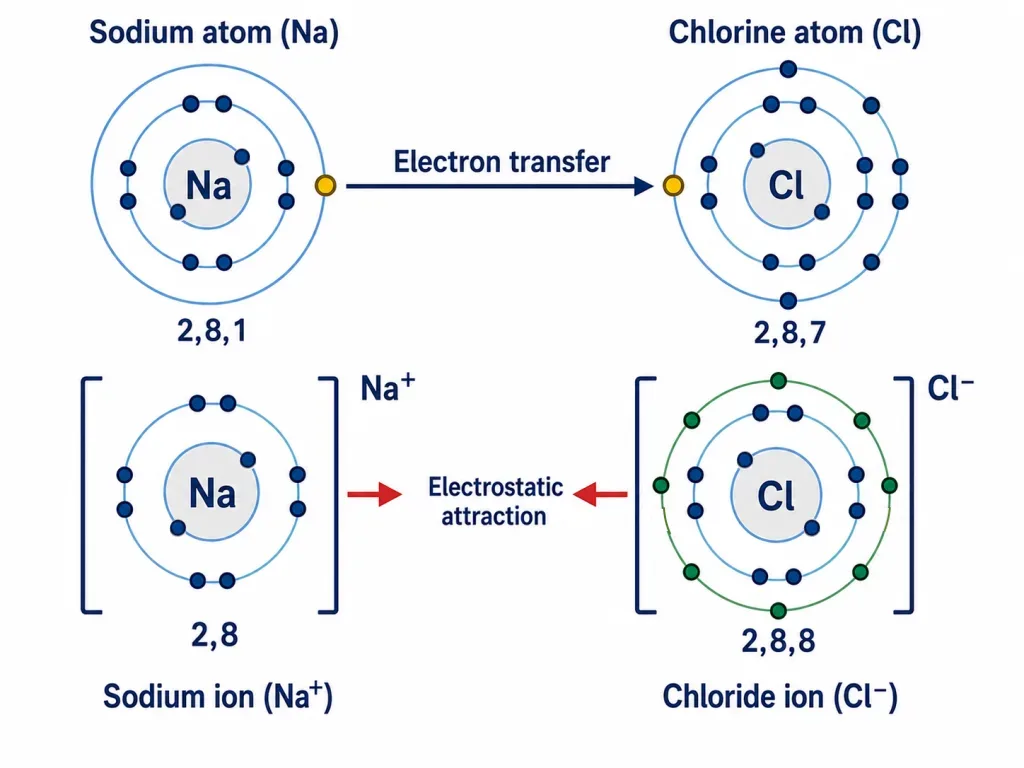
Electronic Configuration and Ion Formation
Configuration of Important Elements
Major Metals:
| Element | Atomic Number | Configuration | Valence Electrons | Ion |
|---|---|---|---|---|
| Li | 3 | 2, 1 | 1 | Li⁺ |
| Na | 11 | 2, 8, 1 | 1 | Na⁺ |
| K | 19 | 2, 8, 8, 1 | 1 | K⁺ |
| Mg | 12 | 2, 8, 2 | 2 | Mg²⁺ |
| Ca | 20 | 2, 8, 8, 2 | 2 | Ca²⁺ |
| Al | 13 | 2, 8, 3 | 3 | Al³⁺ |
Major Non-Metals:
| Element | Atomic Number | Configuration | Valence Electrons | Ion |
|---|---|---|---|---|
| H | 1 | 1 | 1 | H⁻ or H⁺ |
| F | 9 | 2, 7 | 7 | F⁻ |
| Cl | 17 | 2, 8, 7 | 7 | Cl⁻ |
| O | 8 | 2, 6 | 6 | O²⁻ |
| S | 16 | 2, 8, 6 | 6 | S²⁻ |
| N | 7 | 2, 5 | 5 | N³⁻ |
Logic of Charges on Metals
The number of electrons a metal loses = its positive charge.
- Na (loses 1 electron) → Na⁺ (+1)
- Mg (loses 2 electrons) → Mg²⁺ (+2)
- Al (loses 3 electrons) → Al³⁺ (+3)
Logic of Charges on Non-Metals
The number of electrons a non-metal gains = its negative charge.
- Cl (gains 1 electron) → Cl⁻ (-1)
- O (gains 2 electrons) → O²⁻ (-2)
- N (gains 3 electrons) → N³⁻ (-3)
An Interesting Fact
A metal combines with a non-metal that can accept exactly the number of electrons it gives.
Therefore:
- : 1 Na gives 1, 1 Cl takes 1.
- : 1 Mg gives 2; 2 Cl take 1 each.
- : 1 Ca gives 2; 1 O takes 2.
- : 1 Al gives 3; 3 Cl take 1 each.
Formation of Ionic Compounds — Detailed
1. Sodium Chloride ()
Basic Reaction:
Electron Transfer:
Na atom: 2, 8, 1 — one valence electron. Cl atom: 2, 8, 7 — seven valence electrons.
Step by Step:
1. Na loses its 1 valence electron: Now Na⁺ has configuration 2, 8 (like neon — stable!)
2. Cl gains that 1 electron: Now Cl⁻ has configuration 2, 8, 8 (like argon — stable!)
3. Na⁺ and Cl⁻ — opposite charges attract each other:
Appearance:
- Na: shiny, soft, reactive metal.
- Cl₂: yellow-green, toxic gas.
- : white, stable solid — common salt!
This is amazing: From two dangerous elements — life-sustaining everyday salt!
2. Magnesium Chloride ()
Reaction:
Description:
- Mg (2,8,2) → Mg²⁺ (2,8) + 2e⁻
- Cl (2,8,7) + e⁻ → Cl⁻ (2,8,8) — needs two Cl atoms.
1 Mg gave 1-1 electron to two Cl atoms.
Ionic Structure: Mg²⁺ + 2 Cl⁻ →
3. Calcium Oxide () — Quicklime
Reaction:
Description:
- Ca (2,8,8,2) → Ca²⁺ (2,8,8) + 2e⁻
- O (2,6) + 2e⁻ → O²⁻ (2,8)
Ca's 2 electrons — directly to O.
Ionic Structure: Ca²⁺ + O²⁻ →
This is 'quicklime' — used in cement, sugar refining, water treatment.
4. Aluminium Oxide ()
Reaction:
Description:
- 2 Al — make two Al³⁺ (release total 6e⁻).
- 3 O — make three O²⁻ (gain total 6e⁻).
Ionic Structure: 2 Al³⁺ + 3 O²⁻ →
Coefficients adjusted to balance.
Nature of the Ionic Bond
What is an Ionic Bond?
A bond formed between a metal and a non-metal — by the electrostatic attraction between oppositely charged ions.
Electrovalency
The number of electrons a metal loses = its electropositive valency (Electrovalency). The number of electrons a non-metal gains = its electronegative valency.
Properties of Ionic Bond
1. Complete Transfer of Electron:
- Completely leaves one side, completely attaches to the other.
- No 'in-between' state.
2. Attraction between Opposite Charges:
- Coulomb's Law:
- More charge = more attraction.
3. Crystalline Lattice Formation:
- Ions surround each other in three-dimensional structure.
- Called the 'crystal lattice'.
Crystal Structure of NaCl
Each Na⁺ surrounded by 6 Cl⁻ — and each Cl⁻ surrounded by 6 Na⁺. This is 'face-centered cubic' (FCC) structure.
Formulas of Ionic Compounds
The charge of metal and the charge of non-metal — give the formula by cross-multiplication.
Rule: Cross-down rule.
Examples:
- Al³⁺ + O²⁻ → formula: Al₂O₃ (3 from top to 2 below, 2 from top to 3 below)
- Ca²⁺ + N³⁻ → formula: Ca₃N₂
- Mg²⁺ + Br⁻ → formula: MgBr₂
- Na⁺ + S²⁻ → formula: Na₂S
Comparison with Covalent Bond
Non-metal — non-metal → covalent bond (electron sharing). Metal — metal → metallic bond (electron sea). Metal — non-metal → ionic bond (electron transfer).
Oxidation and Reduction — At a Glance
Principle
Formation of an ionic compound = a kind of redox reaction.
Oxidation: Loss of electrons — done by metal. Reduction: Gain of electrons — done by non-metal.
In NaCl Formation:
Na lost an electron → Oxidation of Na
Cl gained an electron → Reduction of Cl
Both happen together — redox reaction.
In MgO:
Mg lost 2 electrons → oxidation. O gained 2 electrons → reduction.
Mg is not the oxidiser — it is the reducing agent (it reduces the other). O is the oxidising agent (oxidises the other).
A Fundamental Role of Metals
Metals — strong reducing agents. Non-metals — strong oxidising agents.
A Little Math
Charge balance in ionic compound:
- Total positive charge = Total negative charge.
Examples:
- : 2 × (+3) = +6, and 3 × (-2) = -6 ✓
- : 3 × (+2) = +6, and 2 × (-3) = -6 ✓
- : 2 × (+1) = +2, and 1 × (-2) = -2 ✓
Summary Table
| Metal Ion | Non-Metal Ion | Formula |
|---|---|---|
| Na⁺ | Cl⁻ | NaCl |
| Mg²⁺ | Cl⁻ | MgCl₂ |
| Ca²⁺ | O²⁻ | CaO |
| Al³⁺ | O²⁻ | Al₂O₃ |
| K⁺ | F⁻ | KF |
| Mg²⁺ | N³⁻ | Mg₃N₂ |
| Al³⁺ | S²⁻ | Al₂S₃ |
| Na⁺ | O²⁻ | Na₂O |
[Board Important] Formula formation and electron transfer — essential!
🧠 Memory Capsule
A quick glance just before the board exam.
1. Basic Principle
The quest for stability — complete outer shell (octet).
Metal → loses electrons (cation, positive ion). Non-metal → gains electrons (anion, negative ion). Opposite charges attract → ionic bond.
2. Important Ions
| Metal | Configuration | Ion | Charge |
|---|---|---|---|
| Na | 2,8,1 | Na⁺ | +1 |
| Mg | 2,8,2 | Mg²⁺ | +2 |
| Al | 2,8,3 | Al³⁺ | +3 |
| Ca | 2,8,8,2 | Ca²⁺ | +2 |
| Non-Metal | Configuration | Ion | Charge |
|---|---|---|---|
| Cl | 2,8,7 | Cl⁻ | -1 |
| O | 2,6 | O²⁻ | -2 |
| N | 2,5 | N³⁻ | -3 |
3. Main Examples
NaCl:
- Na (2,8,1) → Na⁺ (2,8) + e⁻
- Cl (2,8,7) + e⁻ → Cl⁻ (2,8,8)
MgCl₂:
- Mg → Mg²⁺ + 2e⁻
- 2Cl + 2e⁻ → 2Cl⁻
CaO:
- Ca → Ca²⁺ + 2e⁻
- O + 2e⁻ → O²⁻
4. Cross-Multiplication — to Find Formula
Example: Al³⁺ + O²⁻
- 3 from top to bottom of O; 2 from top to bottom of Al
- Formula:
5. Role of Redox
Metal = reducing agent (electron donor) Non-metal = oxidising agent (electron acceptor)
6. Board's 'Golden' Questions
- NaCl formation — electron transfer.
- MgCl₂ formation — detailed.
- What is an ionic bond?
- Formula of Al³⁺ and O²⁻.
- Reaction of Ca + Cl₂.
Final Formula: Metal — donor; Non-metal — receiver; Opposite attraction — ionic compound.
Solved Examples
Example 1: NCERT — Formation of NaCl
Explain the formation of sodium chloride (NaCl) by electron transfer.
Solution:
1. Initial Configuration:
- Na: 2, 8, 1 (1 electron in outer shell)
- Cl: 2, 8, 7 (7 electrons in outer shell)
2. Quest for Stability:
- Na: 1 extra electron — hard to keep. Easy to lose.
- Cl: 1 short of 8. Easy to gain.
3. Electron Transfer:
Na donates its 1 outer electron to Cl.
Now Na⁺ configuration like neon — stable!
Now Cl⁻ configuration like argon — stable!
4. Ionic Bond:
Na⁺ and Cl⁻ attract each other due to opposite charges.
5. Overall Reaction:
Special:
- Silvery-metallic Na + yellow-green Cl₂ gas.
- → White NaCl solid — everyday salt.
- Heat is released (exothermic).
[NCERT textbook — every year in board]
Example 2: NCERT — Formation of MgCl₂
Explain the formation of magnesium chloride (MgCl₂).
Solution:
1. Configuration:
- Mg: 2, 8, 2 (2 electrons in outer shell)
- Cl: 2, 8, 7 (7 electrons in outer shell)
2. Requirements:
- Mg: must give 2 electrons.
- Cl: must take 1 electron.
3. Ratio: 1 Mg → 2 Cl (Mg's 2 electrons — given 1-1 to two Cl atoms)
4. Electron Transfer:
Mg²⁺ — like neon.
Each Cl⁻ — like argon.
5. Ionic Bond:
Mg²⁺ and 2 Cl⁻ → MgCl₂
6. Overall Reaction:
Special:
- MgCl₂ — white crystalline solid.
- Highly soluble in water.
- Found in seawater.
- Compound near to Epsom salt.
- Used in liquid batteries.
Electrovalency
Mg's positive valency = 2 Cl's negative valency = 1
[NCERT — important]
Example 3: NCERT — Formation of CaO
Explain the formation of calcium oxide (CaO) by electron transfer.
Solution:
1. Configuration:
- Ca: 2, 8, 8, 2
- O: 2, 6
2. Requirements:
- Ca: must give 2 electrons (for octet).
- O: must take 2 electrons (for octet).
3. Ratio: 1 Ca ↔ 1 O (Ca's 2 → directly to O)
4. Electron Transfer:
Ca²⁺ — like argon.
O²⁻ — like neon.
5. Ionic Bond:
Ca²⁺ and O²⁻ → CaO
6. Reaction:
Special:
- CaO ≠ slaked lime! That is .
- CaO = quicklime.
- White, solid.
- Vigorous reaction with water (heat):
Practical Uses
- Cement manufacturing.
- Sugar refining.
- Removing water hardness.
- Increasing soil fertility (in acidic soil).
[NCERT textbook]
Example 4: NCERT — Formation of Al₂O₃
Explain the formation and formula of aluminium oxide.
Solution:
1. Configuration:
- Al: 2, 8, 3
- O: 2, 6
2. Requirements:
- Al: must give 3 electrons.
- O: must take 2 electrons.
3. To find ratio — LCM:
LCM of 3 and 2 = 6.
That is, total of 6 electrons exchanged.
2 Al × 3e⁻ = will give 6e⁻. 3 O × 2e⁻ = will take 6e⁻.
4. Electron Transfer:
That is 2 Al → 2 Al³⁺ + 6e⁻
That is 3 O + 6e⁻ → 3 O²⁻
5. Ionic Compound:
2 Al³⁺ + 3 O²⁻ → Al₂O₃
6. Cross-Multiplication (Shortcut):
(O below 3, Al below 2)
7. Overall Reaction:
Special:
- = alumina
- Transparent solid.
- High melting point (~2050°C).
- Found in gemstones: ruby (Cr-doped), sapphire (Fe/Ti-doped).
[Board: 3-5 marks]
Example 5: An Interesting — Formation of Na₂O
Explain the formation of Na₂O from sodium and oxygen.
Solution:
1. Configuration:
- Na: 2, 8, 1
- O: 2, 6
2. Requirements:
- Na: will give 1 electron.
- O: will take 2 electrons.
3. Ratio: 2 Na : 1 O (2 Na give 2 electrons, 1 O takes 2)
4. Electron Transfer:
2 Na (2,8,1) → 2 Na⁺ (2,8) + 2e⁻
O (2,6) + 2e⁻ → O²⁻ (2,8)
5. Compound:
6. Overall Reaction:
Special:
- Na₂O — white solid.
- Vigorous reaction with water — forms NaOH:
- Strongly basic.
- When Na is exposed to air — first Na₂O forms, then NaOH (from moisture).
Answer to 'Why is Na stored in kerosene?':
- Because Na with O₂ and moisture in air forms Na₂O and NaOH.
- Kerosene protects Na from both.
[Board: 3-mark]
Example 6: Formation of Mg₃N₂
Explain the formation of magnesium nitride.
Solution:
1. Configuration:
- Mg: 2, 8, 2
- N: 2, 5
2. Requirements:
- Mg: will give 2 electrons.
- N: will take 3 electrons.
3. Ratio:
LCM of 2 and 3 = 6.
3 Mg × 2 = will give 6e⁻. 2 N × 3 = will take 6e⁻.
Ratio: 3 Mg : 2 N
4. Electron Transfer:
3 Mg → 3 Mg²⁺ + 6e⁻
2 N + 6e⁻ → 2 N³⁻
5. Compound:
6. By Cross-Multiplication:
7. Overall Reaction:
Special:
- Mg₃N₂ — green-yellow solid.
- When Mg burns in air — some Mg reacts with N₂ to give Mg₃N₂.
- Reacts with water to give Mg(OH)₂ + NH₃:
(NH₃ — smell of ammonia.)
Special Note: When Mg burns in air — mainly MgO (white), but some Mg₃N₂ (yellow). If residue appears yellow-green — N₂ has reacted.
[Board: 3-mark]
Example 7: NCERT — Find the Formula
Find the formula for the following (charges on ions are given):
(a) Sodium sulphide (Na⁺, S²⁻) (b) Potassium oxide (K⁺, O²⁻) (c) Calcium chloride (Ca²⁺, Cl⁻) (d) Aluminium sulphide (Al³⁺, S²⁻) (e) Iron(III) chloride (Fe³⁺, Cl⁻)
Solution:
Principle: Cross-multiplication — make the charge of one ion the subscript of the opposite ion.
(a) Na⁺ and S²⁻
1 above, 2 above → cross
Check: 2 × (+1) + 1 × (-2) = 0 ✓
(b) K⁺ and O²⁻
Check: 2 × (+1) + 1 × (-2) = 0 ✓
(c) Ca²⁺ and Cl⁻
Check: 1 × (+2) + 2 × (-1) = 0 ✓
(d) Al³⁺ and S²⁻
3 and 2 — direct cross.
Check: 2 × (+3) + 3 × (-2) = 0 ✓
(e) Fe³⁺ and Cl⁻
Check: 1 × (+3) + 3 × (-1) = 0 ✓
Summary Table
| Compound | Ions | Formula |
|---|---|---|
| Na sulphide | Na⁺, S²⁻ | |
| K oxide | K⁺, O²⁻ | |
| Ca chloride | Ca²⁺, Cl⁻ | |
| Al sulphide | Al³⁺, S²⁻ | |
| Fe(III) chloride | Fe³⁺, Cl⁻ |
Key Insight: Without finding LCM — just cross-multiplication gives the formula.
[NCERT textbook — fundamental]
Example 8: NCERT — Identifying Redox
In the following reactions, identify oxidation and reduction:
(a) (b) (c)
Solution:
Basic Rule:
- Loss of electron = oxidation.
- Gain of electron = reduction.
(a) 2Na + Cl₂ → 2NaCl
Change in Na: Na → Na⁺ + e⁻ Oxidation number: 0 → +1 Na is oxidised. Na — reducing agent (reduced the other).
Change in Cl: Cl + e⁻ → Cl⁻ Oxidation number: 0 → -1 Cl is reduced. Cl — oxidising agent.
(b) 2Mg + O₂ → 2MgO
Mg → Mg²⁺ + 2e⁻ → oxidation. Mg — reducing agent.
O + 2e⁻ → O²⁻ → reduction. O₂ — oxidising agent.
(c) 4Al + 3O₂ → 2Al₂O₃
Al → Al³⁺ + 3e⁻ → oxidation. Al — reducing agent.
O + 2e⁻ → O²⁻ → reduction. O₂ — oxidising agent.
General Pattern
Ionic Compound Formation = Redox Reaction
Always:
- Metal → oxidation (loses electrons)
- Non-metal → reduction (gains electrons)
- Metal = reducing agent
- Non-metal = oxidising agent
Remember: OIL RIG
- O = Oxidation
- I = Is
- L = Loss (of electrons)
- R = Reduction
- I = Is
- G = Gain (of electrons)
[Board: 5-mark]
Example 9: NCERT — Identifying Ionic Bond
Identify the ionic bonds in the following:
(a) (b) (c) (d) (e) (f)
Solution:
Rule: Ionic bond = metal + non-metal. Covalent bond = non-metal + non-metal.
Analysis
(a) — H + O Both non-metals → covalent.
(b) — Na (metal) + Cl (non-metal) ✓ Ionic!
(c) — C + O Both non-metals → covalent.
(d) — Mg (metal) + O (non-metal) ✓ Ionic!
(e) — C + H Both non-metals → covalent.
(f) — K (metal) + S (non-metal) ✓ Ionic!
Summary
| Compound | Type |
|---|---|
| Covalent | |
| NaCl | Ionic |
| Covalent | |
| MgO | Ionic |
| Covalent | |
| K₂S | Ionic |
Insight
In the periodic table:
- Left side elements (metals): Na, K, Mg, Ca, Al etc.
- Right side (non-metals): O, N, F, Cl, S etc.
- When left + right → ionic.
- When right + right → covalent.
[NCERT textbook]
Example 10: An Interesting — Mg and S
Formation of magnesium sulphide. What will be the formula? How does it form?
Solution:
1. Configuration:
- Mg: 2, 8, 2
- S: 2, 8, 6
2. Requirements:
- Mg: will give 2 electrons (for octet).
- S: will take 2 electrons (for octet).
3. Ratio: 1 Mg : 1 S (Mg's 2 → directly to S)
4. Electron Transfer:
5. Ionic Compound:
Both have same charge (2) — so 1:1.
6. Overall Reaction:
Special:
- — pink-brown solid.
- Reacts with water to give Mg(OH)₂ + H₂S gas:
(H₂S — smell of rotten eggs.)
Comparison
Mg + O → MgO — charges 2:2 → 1:1 → MgO Mg + S → MgS — charges 2:2 → 1:1 → MgS Mg + Cl → MgCl₂ — charges 2:1 → 1:2 → MgCl₂ Mg + N → Mg₃N₂ — charges 2:3 → 3:2 → Mg₃N₂
Key Insight
Charge LCM determines the ratio.
[Board: 3-mark]
Example 11: A Numerical — How Many Ions?
How many Na⁺ and Cl⁻ ions are present in 5.85 g of ? (Na=23, Cl=35.5)
Solution:
Molecular mass of = 23 + 35.5 = 58.5 g/mol
Number of moles:
Number of ions:
1 NaCl contains: 1 Na⁺ + 1 Cl⁻
1 mol NaCl contains: Na⁺ + Cl⁻
0.1 mol contains:
Number of Na⁺ ions:
Number of Cl⁻ ions:
Total ions:
Answer:
- Na⁺ ions:
- Cl⁻ ions:
Key Insight: Ionic compounds — not single molecules — but lattice of ions. But mole calculations from formula unit.
Additional — In Solution
If NaCl is dissolved in water:
This will be electrically conducting — because it is an ionic compound.
[Board: 3-mark numerical]
Example 12: A Comparison — Ionic vs Covalent
and — both contain Cl. But one is ionic, the other covalent. Why?
Solution:
NaCl — Ionic
Elements: Na (metal) + Cl (non-metal)
Electronegativity:
- Na: 0.93 (low)
- Cl: 3.16 (high)
- Difference: 2.23 (very high!)
Difference > 1.7 → Ionic.
Behaviour of Electrons:
- Cl takes electron from Na completely.
- Complete transfer.
- Na⁺ Cl⁻ formed.
CCl₄ — Covalent
Elements: C (non-metal) + Cl (non-metal)
Electronegativity:
- C: 2.55
- Cl: 3.16
- Difference: 0.61 (low!)
Difference 0.5-1.7 → polar covalent, here mildly covalent.
Behaviour of Electrons:
- C and Cl share electrons.
- No complete transfer.
- No ions formed.
Comparative Table
| Property | NaCl (Ionic) | CCl₄ (Covalent) |
|---|---|---|
| Bond type | Ionic | Covalent |
| Melting point | High (801°C) | Low (-23°C) |
| Boiling point | 1465°C | 77°C |
| Solubility in water | Soluble | Insoluble |
| Electrical conductivity (molten/in solution) | Yes | No |
| Structure | Crystal lattice | Separate molecules |
Fundamental Difference
Ionic: Complete transfer → ions. Covalent: Sharing → molecules.
[Board: 5-mark comparative]
Example 13: NCERT — A Mixed Question
Answer the following questions:
(a) Between Na and Mg, which loses electrons more easily? (b) Between F and Cl, which gains electrons more easily? (c) Between NaCl and MgO, which is more stable?
Solution:
(a) Na and Mg, which?
Configuration:
- Na: 2, 8, 1 (1 electron)
- Mg: 2, 8, 2 (2 electrons)
Reasoning:
- Na must lose 1 electron → easy.
- Mg must lose 2 electrons → harder (the second one needs more effort).
Answer: Na loses electrons more easily.
That is, Na is more reactive than Mg.
(b) F and Cl, which?
Configuration:
- F: 2, 7 (1 vacancy in outer shell)
- Cl: 2, 8, 7 (1 vacancy in outer shell)
Reasoning:
- F's outer shell is very close to nucleus.
- Cl's outer shell is far (third shell).
- F's nucleus — attracts the incoming electron more strongly.
Answer: F gains electrons more easily.
That is, F is more reactive non-metal than Cl.
(c) NaCl and MgO, which is more stable?
Comparison:
- NaCl: Na⁺ (+1) and Cl⁻ (-1) — relatively weak attraction.
- MgO: Mg²⁺ (+2) and O²⁻ (-2) — attraction 4 times stronger.
Coulomb's Law:
- More charge product → more attraction.
Answer: MgO is more stable.
Evidence:
- Melting point of NaCl: 801°C
- Melting point of MgO: 2852°C Much higher melting point of MgO — more stable bond.
[NCERT — combined question]
Example 14: A Challenge — Charges and Formulas
Find the formulas of the following ionic compounds:
(a) Sodium nitride (Na⁺, N³⁻) (b) Calcium phosphate (Ca²⁺, PO₄³⁻) (c) Ammonium sulphate (NH₄⁺, SO₄²⁻) (d) Aluminium carbonate (Al³⁺, CO₃²⁻)
Solution:
(a) Na⁺ and N³⁻
Cross: 1 ↔ 3
Check: 3 × (+1) + 1 × (-3) = 0 ✓
(b) Ca²⁺ and PO₄³⁻
Cross: 2 ↔ 3
Note: PO₄³⁻ — a 'polyatomic' ion. If multiple, put in brackets.
Check: 3 × (+2) + 2 × (-3) = 0 ✓
(c) NH₄⁺ and SO₄²⁻
Cross: 1 ↔ 2
Both polyatomic — both in brackets.
Check: 2 × (+1) + 1 × (-2) = 0 ✓
(d) Al³⁺ and CO₃²⁻
Cross: 3 ↔ 2
CO₃²⁻ multiple — in brackets.
Check: 2 × (+3) + 3 × (-2) = 0 ✓
Key Insights
Rules:
- Cross-multiplication for formula.
- If polyatomic ion appears more than once — use brackets.
- Subscript of one ion = charge of opposite ion.
Other Important Polyatomic Ions
| Ion | Charge |
|---|---|
| OH⁻ (hydroxide) | -1 |
| NO₃⁻ (nitrate) | -1 |
| HCO₃⁻ (bicarbonate) | -1 |
| CO₃²⁻ (carbonate) | -2 |
| SO₄²⁻ (sulphate) | -2 |
| PO₄³⁻ (phosphate) | -3 |
| NH₄⁺ (ammonium) | +1 |
[Board: 5-mark]
Example 15: An Interesting — Cl₂ and H₂ Example
Do non-metal and non-metal — together form an ionic compound?
Solution:
Reaction:
Answer: No! HCl is covalent — not ionic.
Why?
Rule: Ionic bond = metal + non-metal. Here — both non-metals → covalent.
Behaviour of Electrons
In HCl:
- H and Cl share electrons.
- No complete transfer.
- Hence polar covalent bond.
Although — Cl is more electronegative than H — so the shared electrons are pulled towards Cl. HCl is a polar molecule.
An Interesting Fact
HCl in gaseous state — covalent. HCl when added to water — gets ionised:
That is, in water, H⁺ (H₃O⁺) and Cl⁻ are formed. Then it shows ionic behaviour.
This is why — gaseous HCl is not electrically conducting, but aqueous HCl (dilute acid) conducts electricity.
Comparison
| Property | NaCl (Ionic) | HCl (Covalent) |
|---|---|---|
| Bond | Ionic | Covalent (polar) |
| State | Solid | Gas |
| Melting point | 801°C | -114°C |
| In water | Ionised | Ionised (forms acid) |
| Conductivity in pure form | No | No |
| Conductivity in water | Yes | Yes (when ionised) |
Key Insight: Two non-metals → always covalent. But can be ionic in water.
[Board: 5-mark]
Example 16: A Concluding Question
(a) Difference between ionic bond and covalent bond. (b) NaCl, MgO, Al₂O₃ — electron transfer. (c) Why does have charge +2, not +1? (d) Polyatomic ions — 3 examples.
Solution:
(a) Ionic vs Covalent
| Property | Ionic | Covalent |
|---|---|---|
| Electrons | Complete transfer | Shared |
| Elements | Metal + Non-metal | Non-metal + Non-metal |
| Examples | NaCl, MgO | H₂O, CO₂ |
| Melting point | High | Low |
| Electrical conductivity | Yes (in water/molten) | No |
(b) Formation of all three
NaCl:
- Na (2,8,1) → Na⁺ (2,8) + e⁻
- Cl (2,8,7) + e⁻ → Cl⁻ (2,8,8)
MgO:
- Mg (2,8,2) → Mg²⁺ (2,8) + 2e⁻
- O (2,6) + 2e⁻ → O²⁻ (2,8)
Al₂O₃:
- 2 Al (2,8,3) → 2 Al³⁺ (2,8) + 6e⁻
- 3 O (2,6) + 6e⁻ → 3 O²⁻ (2,8)
(c) Why Mg²⁺?
Configuration: Mg = 2, 8, 2
If Mg lost 1 electron → Mg⁺ (2,8,1) — unstable. If Mg lost 2 electrons → Mg²⁺ (2,8) — stable like neon.
Nature seeks 'complete' octet. Mg²⁺ is more stable — that's why it forms.
(d) Polyatomic Ions
1. Hydroxide:
- 1 O + 1 H, total charge -1
- In NaOH, KOH.
2. Nitrate:
- 1 N + 3 O, total charge -1
- In KNO₃, AgNO₃.
3. Carbonate:
- 1 C + 3 O, total charge -2
- In CaCO₃, Na₂CO₃.
Others:
- (sulphate)
- (phosphate)
- (ammonium — a positive ion)
[Board: 5-mark mixed question]