
Reaction of Metals with Oxygen
When metals react with oxygen, they form metal oxides.
General Form
Reactions According to Reactivity
Highly Reactive Metals (Na, K):
- Burn in air even at room temperature.
- That is why they are stored in kerosene.
Moderately Reactive Metals (Mg, Al, Zn, Fe):
- React when heated in a flame.
- Magnesium burns with a bright dazzling white flame.
Least Reactive Metals (Cu, Ag, Au):
- Copper forms a green coating on the surface (in moist air).
- Silver forms a black coating.
- Gold remains unaffected — called a 'noble metal'.
(Black colour — refer to Section 1)
Nature of Metal Oxides
Metal oxides are generally basic in nature — they react with acids and give ions in water.
Basic Oxides
Most metal oxides are basic.
Examples:
- (forms a base)
That is, when dissolved in water they produce alkalis.
Reaction with Acids
Metal Oxide + Acid → Salt + Water
Examples: (Black CuO turns bluish-green)
Amphoteric Oxides
Some metal oxides react with both acids and bases.
Main Examples: and
Behaviour of Al₂O₃:
With acid (acts as a base):
With base (acts as an acid):
(Sodium aluminate)
ZnO behaves similarly:
An Interesting Point
Not all metal oxides dissolve in water.
- — soluble in water → form alkalis.
- — insoluble in water.
- — insoluble; but reacts with acids/bases.
Reaction of Metals with Water
The reaction of metals with water depends on their reactivity.
General Reaction
or
Highly Reactive Metals (Na, K, Ca)
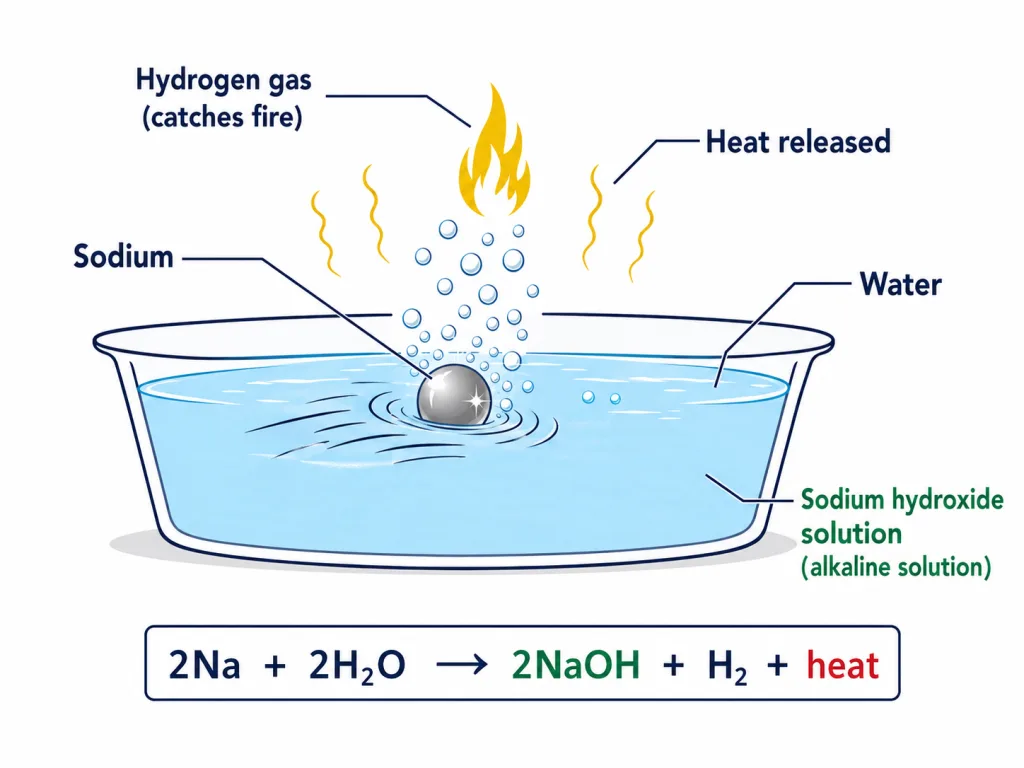
Na and K — react vigorously with cold water:
The hydrogen evolved can immediately catch fire due to the heat released.
Ca — reacts with cold water but less vigorously:
Ca pieces sink and float repeatedly in water — due to hydrogen bubbles sticking to them.
Moderately Reactive Metals
Mg — reacts slowly with hot water:
Mg/Al/Zn/Fe — react with steam (when heated):
(Refer Chapter 1)
Least Reactive Metals
Cu, Ag, Au — do not react with water at all (at any temperature).
This is why utensils/jewellery made from them last for very long.
Reactivity Table — Reaction with Water
| Metal | Cold Water | Hot Water | Steam |
|---|---|---|---|
| K | Violent (explosive) | — | — |
| Na | Vigorous | — | — |
| Ca | Reacts | — | — |
| Mg | Slow | Reacts | — |
| Al | No | No | Reacts |
| Zn | No | No | Reacts |
| Fe | No | No | Reacts (slow) |
| Pb, Cu | No | No | No |
| Hg, Ag, Au | No | No | No |
Special Cases and Exceptions
Combustion of Magnesium
When Mg is burnt in air, it burns with a bright dazzling white flame.
Features:
- The flame is very intense — harmful to the eyes.
- Goggles must be worn while burning.
- Used in flash-bulbs and fireworks.
(Already studied in Section 1 of Chapter 1.)
Protective Layer on Aluminium
When exposed to air, aluminium immediately forms a thin layer of — which protects the inner Al from further corrosion.
This is why aluminium utensils last for years — even though Al is a reactive metal.
Anodising
The process of forming a thicker layer of on aluminium.
Method:
- Aluminium is made the anode in an electrolytic cell.
- Dilute is used as electrolyte.
- Oxygen liberated at the anode combines with Al to thicken the layer.
Uses:
- Window frames
- Kitchen utensils
- Decorative items
The Danger with Sodium
Na + H₂O — a hazardous demonstration:
Even when a small piece is dropped in water:
- Vigorous bubbling (H₂)
- Flames (yellow, due to sodium)
- Sometimes explosion
This is why:
- Na is shown carefully in classrooms.
- Never to be held with bare hands.
- A tiny piece is enough for demonstration.
The Principle of Reactivity
Why are some metals more reactive?
Principle: Metals that lose electrons easily are more reactive.
Highly Reactive (Na, K, Ca):
- 1-2 outer electrons.
- Lose electrons easily.
- Highly reactive.
Moderately Reactive (Mg, Al, Zn, Fe):
- 2-3 outer electrons.
- Lose electrons with moderate ease.
Least Reactive (Cu, Ag, Au):
- More stable outer shell.
- Difficult to lose electrons.
- Less reactive.
Practical Use of Reactivity
1. Storage:
- Na, K → in kerosene.
- Other metals → can be kept in the open.
2. Uses:
- Highly reactive Na, K — not to be exposed in open.
- Less reactive Au, Ag — used in jewellery.
- Moderate Fe, Al — used in structures.
3. Method of Extraction:
- Highly reactive — by electrolysis.
- Moderate — by reduction with carbon (coke).
- Less reactive — found directly.
(Discussed in detail in Section 7.)
Summary Table
| Metal | Reaction with | Reaction with Water | Reaction with Acid |
|---|---|---|---|
| K, Na | Vigorous, at room temp | Vigorous (cold water) | Explosive |
| Ca | On burning | With cold water | Vigorous |
| Mg | On burning | With hot water | Reacts |
| Al | On burning | With steam | Reacts |
| Zn | On burning | With steam | Reacts |
| Fe | On burning | With steam (slow) | Reacts |
| Cu | On strong heating | No | No (with dilute) |
| Ag | No | No | No |
| Au | No | No | No |
[Board Important] This table is frequently asked in 5-mark questions.
🧠 Memory Capsule
A quick glance just before the board exam.
1. Metal + Oxygen
Essential Reactions:
- (white flame)
- (black)
2. Nature of Metal Oxides
- Most: Basic
- Exceptions (): Amphoteric (react with both acids and bases)
3. Metal + Water
With cold water (Na, K, Ca):
With hot water/steam (Mg, Al, Zn, Fe):
No reaction (Cu, Ag, Au): Do not react with water.
4. Anodising
Process of forming a thicker layer on Al.
- Method: Al is made the anode in dilute .
- Uses: window frames, utensils.
5. Reactivity Table — with Water
| Metal | Cold Water | Steam |
|---|---|---|
| K, Na, Ca | Yes (vigorous) | — |
| Mg, Al, Zn, Fe | No/Slow | Yes |
| Cu, Ag, Au | No | No |
6. Board's 'Golden' Questions
- Difference between basic and amphoteric oxides.
- Write the reaction of Na with water — why is it dangerous?
- What is anodising?
- What is the protective layer on Al? How does it protect?
- Reaction of iron with steam.
Final Formula: More reactive metal = loses electrons easily = reacts faster with oxygen/water/acid.
Solved Examples
Example 1: NCERT — Combustion of Magnesium
What happens when magnesium is burnt in air? Write the chemical reaction.
Solution:
Observations:
- Magnesium burns with a bright dazzling white flame.
- A white powder () is formed.
- Intense heat is released.
Reaction:
This reaction is:
- Combination
- Exothermic
- Oxidation (Mg gains O)
Nature of MgO: Basic. Slightly soluble in water giving .
Precaution: Wear safety goggles to protect the eyes.
[NCERT — refer to Chapter 1]
Example 2: NCERT — Sodium and Water
How does sodium react with water? Why is this dangerous?
Solution:
Reaction:
Observations:
- The small piece of Na floats on water (low density).
- Vigorous bubbling (hydrogen gas).
- Yellow flame — sometimes explosion.
- The solution becomes basic.
Why is it dangerous?
- Highly exothermic — releases a lot of heat.
- Hydrogen gas catches fire immediately — risk of explosion.
- Pieces may jump out — danger to skin/eyes.
- NaOH is also corrosive — burns the skin.
Precautions:
- Use a very small piece in classroom.
- Wear safety goggles.
- Never touch with bare hands.
- Watch from a safe distance.
This is why Na/K are stored in kerosene.
[NCERT — repeatedly asked]
Example 3: NCERT — Protection of Aluminium
Why do aluminium articles remain shiny for a long time — even though Al is a reactive metal?
Solution:
Principle: A protective layer is formed on Al.
Mechanism:
On exposure to air, Al immediately reacts with O₂:
This layer is thin and dense, formed on the surface of Al.
This layer is:
- Very thin (a few micrometers)
- Dense and pore-free
- Transparent — Al's shine remains visible
- Protects Al from further corrosion
- The Al beneath this layer is protected.
Why isn't this like rust?
The layer formed on iron is loose and porous — so the iron beneath also rusts.
The layer on Al is dense — does not allow further oxygen to penetrate.
Applications:
- Window frames.
- Kitchen utensils.
- Food packaging.
- Aircraft parts.
Anodising: The process of deliberately thickening this layer.
[3-mark question in board]
Example 4: NCERT — Anodising
What is anodising? Describe its method and uses.
Solution:
Definition: The electrolytic process of forming a thicker layer of on aluminium.
Method:
- The aluminium article is made the anode (+).
- Immerse it in dilute solution.
- Pass an electric current.
- Oxygen is liberated at the anode — reacts with Al to form a thicker layer.
Reaction:
Different from the natural layer:
- Natural layer: a few micrometers.
- Anodised layer: tens of micrometers (much thicker).
Advantages:
- Better corrosion-resistance.
- Colours can be added — dyes get trapped in the layer.
- Durable.
- Scratch-resistant.
Uses:
- Window frames (in various colours)
- Mobile phone cases
- Kitchen utensils
- Decorative items
- Spacecraft parts
[NCERT textbook question]
Example 5: NCERT — Amphoteric Oxides
What are amphoteric oxides? Give two examples and their reactions.
Solution:
Definition: Metal oxides that react with both acids and bases to give salt and water are called amphoteric oxides.
Main Examples: ,
Aluminium Oxide ():
Reaction with acid (acts as a base):
Reaction with base (acts as an acid):
(Sodium aluminate)
Zinc Oxide (ZnO):
Reaction with acid:
Reaction with base:
(Sodium zincate)
Comparison with Other Oxides
| Type of Oxide | With Acid | With Base |
|---|---|---|
| Basic (Na₂O) | Yes | No |
| Amphoteric (Al₂O₃) | Yes | Yes |
| Acidic (SO₃) | No | Yes |
| Neutral (CO) | No | No |
Key Insight: Amphoteric oxides act like a 'bridge' — reacting with both kinds.
[Board Important — 5-mark question]
Example 6: NCERT — Behaviour of Cu and Au
Why do copper and gold not react with water and dilute acids?
Solution:
Principle: Cu and Au lie below H in the reactivity series.
Reactivity Series:
Rule: Only metals above H react with water/acid to release .
Behaviour of Cu:
With water: No reaction (at any temperature).
With dilute /: No reaction.
Exception — Concentrated or : (This is not displacement — it is redox)
Behaviour of Au:
No reaction with any acid.
Exception — Aqua Regia: Conc. + Conc. (1:3) — can dissolve gold.
('Aqua Regia' means 'Royal Water' — because it can dissolve the 'king of metals' (gold).)
Practical Consequences
Cu utensils: Acidic foods can be stored — no direct reaction.
Au jewellery: Lasts for thousands of years — corrosion-resistant.
Ag jewellery: Also less reactive — but turns black with .
Key Insight: The reactivity series gives a deep understanding of metal behaviour.
[Board Important]
Example 7: NCERT — Calcium and Water
When pieces of calcium are dropped in water, they sink and float repeatedly. Why?
Solution:
Reaction:
Observations:
- The Ca piece sinks in water (Ca's density is greater than water).
- Hydrogen gas bubbles are formed.
- These bubbles stick to the Ca piece.
- The bubbles lift Ca up.
- On reaching the surface, the bubbles burst.
- Ca sinks back down.
- The cycle continues — sinking, floating, sinking.
Why is this different from Na?
- Na reacts with water vigorously — can catch fire.
- Ca is slightly less reactive — not explosive, just rapid bubbling.
- Ca's density is greater — it sinks (Na floats).
Other Observations:
- The solution slowly becomes milky — due to low solubility of .
- Yet the solution is basic — increases pH.
Effect of Temperature:
- Ca + cold water — slow but continuous reaction.
- Ca + hot water — fast reaction.
[NCERT textbook question]
Example 8: NCERT — Iron and Steam
How does iron react with steam? Write the chemical reaction.
Solution:
Reaction:
(Iron + Steam → Ferrosoferric Oxide + Hydrogen)
Special Note:
- with (g) — meaning steam.
- Fe does not react with cold or hot water.
- Only with steam (very hot water vapour).
What kind of reaction?
- Displacement — Fe displaced H.
- Redox — Fe oxidised (), H reduced.
Compound formed:
- = Iron (II, III) oxide
- Black colour
- Mineral 'magnetite' is also made of this
Other Metal+Steam Reactions
Zinc:
Aluminium:
Magnesium:
(Mg with hot water gives , but with steam gives .)
Fe + Water — A Special Reason
Why doesn't Fe react with water at room temperature?
- In the reactivity series, Fe is in the middle.
- Not as active as Mg, Ca.
- Only at the high temperature/pressure of steam is enough energy provided.
[Board Important — 3-mark]
Example 9: A Comparison — Na vs Ca
Both sodium and calcium react with water. Compare their behaviours.
Solution:
Reactions:
Comparative Table:
| Basis | Na | Ca |
|---|---|---|
| Reactivity | Very high | High (but less than Na) |
| Density | 0.97 g/cm³ (floats) | 1.55 g/cm³ (sinks) |
| Intensity of Reaction | Explosive | Rapid bubbling |
| Fire | Can catch fire | Usually not |
| Product | NaOH (soluble) | Ca(OH)₂ (less soluble) |
| Colour of Solution | Colourless | Milky (due to low solubility) |
| Heat | Very high | Less |
Visual Demonstration:
- Na: Vigorous, flame, jumping.
- Ca: Sinking-floating (due to bubbles).
Key Insight: Na is above Ca in the reactivity series — hence more vigorous.
Caution: Goggles, gloves are essential while working with both.
[Board: 3-5 marks]
Example 10: Numerical — Mg + O₂
When 12 g of magnesium is completely burnt, how much will be formed? (Mg=24, O=16)
Solution:
Reaction:
Molecular Mass:
- g
- g (40 each)
Ratio: 48 g Mg → 80 g MgO
From 12 g Mg:
Answer: 20 g of will be formed.
Verification (Conservation of Mass):
- Mg + O₂ → MgO
- 12 g + ? g → 20 g
- Oxygen = g (= 0.25 mol O = 0.5 mol… wait)
- Oxygen used = 8 g = 0.25 mol O₂ (since O₂ = 32 g/mol)
- 12 g Mg = 0.5 mol; 0.25 mol O₂ — ratio 2:1 ✓
[Board: 2-3 marks]
Example 11: NCERT — Reactivity of Five Metals
Arrange the following metals in increasing order of reactivity: Cu, Mg, Na, Fe, Au
Solution:
Reactivity Series (Relevant Part):
In Increasing Order of Reactivity:
- Au (Gold) — Least reactive (noble metal)
- Cu (Copper)
- Fe (Iron)
- Mg (Magnesium)
- Na (Sodium) — Most reactive
Comparison Showing Reactions:
| Metal | With Water | With Acid | With |
|---|---|---|---|
| Na | Vigorous with cold water | Explosive | At room temperature |
| Mg | Slow with hot water | Reacts | On burning |
| Fe | Slow with steam | Reacts | On burning (rust) |
| Cu | No | Only with conc. acid | On strong heating |
| Au | No | Only aqua regia | No |
Practical Uses:
- Na - stored in kerosene.
- Mg - flash-bulbs, fireworks.
- Fe - construction, machinery.
- Cu - wires, utensils.
- Au - jewellery, electronics.
[Board Important]
Example 12: An Interesting Question — Food and Utensils
Why should acidic food items (lemon, tomato) not be stored in aluminium utensils?
Solution:
Principle: Aluminium is a reactive metal. It can react with acids.
Surface Protective Layer:
- Normally Al has a thin protective layer of .
- This protects Al from base.
Effect of Acid:
- Acid dissolves this layer.
- Then the Al underneath is exposed.
- Al reacts with the acid.
Reaction (Al + acid):
Or with lemon (citric acid) — similar reaction.
Result:
- Al gets mixed in food (not toxic, but undesirable).
- Taste of food may change.
- Surface of utensil is damaged.
Right Alternatives:
- Stainless steel utensils (inert).
- Glass utensils.
- Earthen traditional utensils.
- Copper/Brass utensils (for some foods).
However: Common acidic foods (curd, buttermilk, tomato) cause very mild reaction with Al — not very concerning.
Best Practice: Stainless steel is best for modern kitchen.
[Board + Daily Life]
Example 13: NCERT — A Mixed Question
Balance the following reactions: (a) (b) (c) (d)
Solution:
(a) Mg + O₂:
Check: Mg=2=2, O=2=2 ✓
(b) Fe + H₂O (steam):
Check: Fe=3=3, H=8=8, O=4=4 ✓
(c) Al + O₂:
Check: Al=4=4, O=6=6 ✓
(d) Ca + H₂O:
Check: Ca=1=1, H=4=4, O=2=2 ✓
Key Tips for Balancing:
- Start from the most complex compound.
- Change coefficients, not formulae.
- Balance H and O at the end.
[Board: 3-mark]
Example 14: NCERT — Behaviour of Sodium and Potassium
Sodium and potassium release intense heat on reacting with water. What is the result of this heat?
Solution:
Reactions:
Result of Heat:
1. Hydrogen gas's temperature rises sharply.
2. The temperature is so high that H₂ + O₂ (from air) burn immediately:
3. A flame is observed:
- With Na — yellow
- With K — violet (more intense)
4. Sometimes explosion — especially with K.
Na vs K — Difference in Intensity
| Basis | Na | K |
|---|---|---|
| Reactivity | High | Very high (more than Na) |
| Heat | More | Even more |
| Flame | Yellow | Violet |
| Explosion | Sometimes | More likely |
Precautions:
- Use very small pieces in classroom.
- Never hold Na/K with bare hands.
- Wear safety goggles.
- Watch from a distance.
- The teacher demonstrating must be a professional.
That is why: Na and K are stored in kerosene — to prevent contact with air.
[NCERT textbook — daily life safety]
Example 15: An Interesting Comparison — Which Oxide is What?
Classify the following oxides as basic, acidic, or amphoteric —
Solution:
Rules:
- Metallic oxides are usually basic.
- Non-metallic oxides are usually acidic.
- Some metallic oxides (Al₂O₃, ZnO) are amphoteric.
Analysis:
| Oxide | Metal/Non-metal? | Type |
|---|---|---|
| Metal | Basic | |
| Non-metal | Acidic | |
| Metal (but) | Amphoteric | |
| Non-metal | Acidic | |
| Metal (but) | Amphoteric | |
| Metal | Basic | |
| Non-metal | Acidic |
Verification (Reaction with Water):
Basic:
Acidic:
Amphoteric:
- (with acid)
- (with base)
[Board: 5-mark question]
Example 16: A Concluding Question
(a) Difference between basic and amphoteric oxides. (b) Reactions of Mg and Fe with O₂ and H₂O. (c) Why is Na stored in kerosene? (d) Purpose of anodising.
Solution:
(a) Basic vs Amphoteric:
| Property | Basic | Amphoteric |
|---|---|---|
| What does it react with? | Only acid | Both acid and base |
| Examples | Na₂O, CaO | Al₂O₃, ZnO |
| With water | Form bases | Mostly insoluble |
(b) Reactions of Mg and Fe:
Mg + O₂:
Mg + H₂O (hot):
Fe + O₂ (hot):
Fe + H₂O (steam):
(c) Na stored in kerosene:
- Na is highly reactive.
- Reacts immediately with O₂ and moisture in air.
- Risk of fire.
- Kerosene keeps Na away from and .
(d) Purpose of anodising:
- To form a thicker layer of on Al.
- Corrosion-resistant.
- Helps in adding colour.
- Used in window frames, utensils.
[Board: 5-mark mixed question]