
Reaction of Metals with Acids
When metals react with dilute acids, they produce salt and hydrogen gas.
General Reaction
(Refer to Chapter 2 — Acids, Bases and Salts.)
Major Examples
With Sodium (very dangerous — explosive):
With Magnesium (common classroom demonstration):
With Zinc (very frequently asked):
With Iron:
With Aluminium:
Intensity of Reaction
More reactive metal = faster reaction.
Order of intensity (visually observed):
- Na/K — explosive (never in classroom!)
- Mg — vigorous bubbling, lots of heat
- Zn — moderate bubbling
- Fe — slow reaction
- Cu, Au — no reaction at all!
Metals That Don't React with Acids
Behaviour of Cu, Ag, Au
Cu, Ag, Au — no reaction with dilute or .
Why? — These are below hydrogen in the reactivity series.
The Main Rule
Only metals above hydrogen (in the reactivity series) can release from acids.
Some Exceptions with Concentrated Acids
Although Cu doesn't react with dilute acid, it does react with concentrated or concentrated .
Cu + Concentrated :
Cu + Concentrated :
(This is not displacement — it is redox. Here Cu is oxidised, is not produced.)
With Gold — Aqua Regia
Gold — unaffected by all acids.
Exception — Aqua Regia (Royal Water):
Concentrated + Concentrated (in 1:3 ratio)
Only this can dissolve gold.
Meaning of the name:
- Aqua = water
- Regia = royal
- 'Royal Water' — because it can dissolve the 'king of metals' (gold).
Why doesn't metal give with ?
is a strong oxidising agent. It immediately converts any released into . That is why metals do not give with — they give or instead.
Exception: Mg and Mn — give with very dilute .
Displacement Reactions — From Metal Salt Solutions
Principle
A more reactive metal displaces a less reactive metal from its salt solution.
General Form
(Where A and B are metals, and A is more reactive.)
Famous Example
Zn + CuSO₄ (blue) → ZnSO₄ (colourless) + Cu (red):
Visual Observations:
- Blue colour of fades gradually.
- A red/brown layer of Cu is deposited on the Zn strip.
- Zn slowly dissolves.
Here Zn displaced Cu — because Zn is more reactive.
Other Examples
1. Fe + CuSO₄: (Light green FeSO₄ formed; copper coating on iron)
2. Cu + AgNO₃: (Colourless AgNO₃ becomes blue Cu(NO₃)₂; silver coating on copper)
3. Mg + CuSO₄: (Colourless MgSO₄; Cu layer on Mg)
When Displacement Doesn't Happen
Less reactive metal → no reaction with salt of more reactive metal.
Examples (no reaction):
Cu + ZnSO₄ → no reaction
(Because Cu is less reactive than Zn.)
Ag + CuSO₄ → no reaction
(Because Ag is less reactive than Cu.)
An Experiment — Confirming the Activity Series
4 test tubes:
- A: + Zn piece → Fe deposits
- B: + Cu piece → no reaction
- C: + Ag piece → no reaction
- D: + Cu piece → Ag deposits
Conclusion:
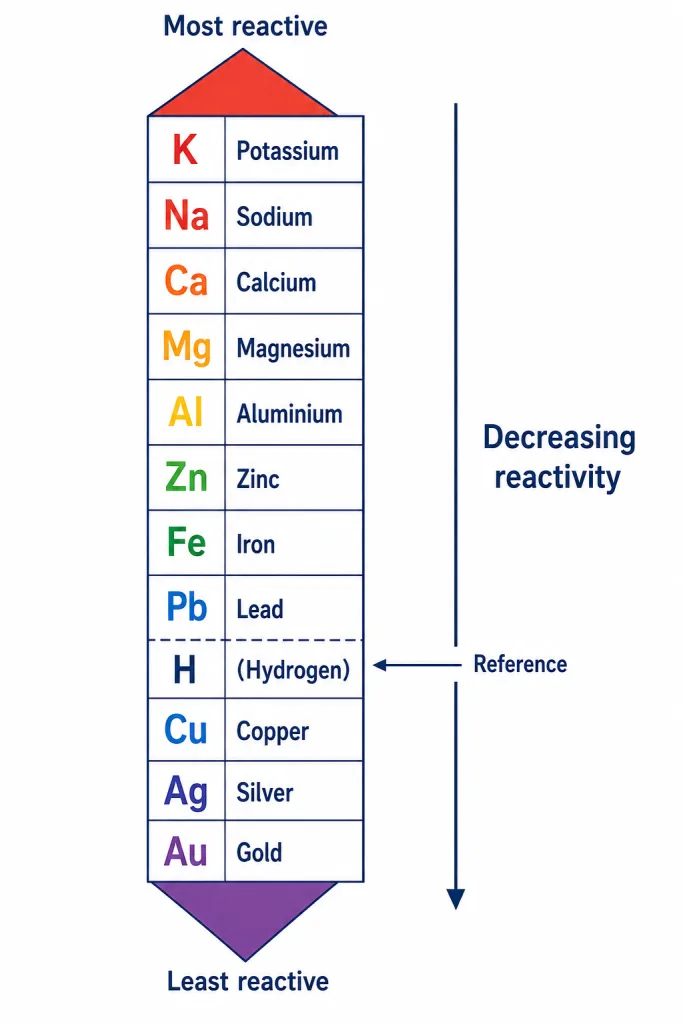
The Reactivity Series
What is it?
An ordered list of metals from most reactive to least reactive.
The Complete Reactivity Series
(Top = more reactive, Bottom = less reactive)
K     Potassium    ↑ Highly reactive
Na    Sodium
Ca    Calcium
Mg    Magnesium
Al    Aluminium    Moderately reactive
Zn    Zinc
Fe    Iron
Pb    Lead
H     Hydrogen   ← ↓ Reference line
Cu    Copper
Hg    Mercury
Ag    Silver
Au    Gold         ↓ Least reactive
Mnemonic to Remember
In English: "Please Stop Calling Me A Zebra Instead Try Learning How Copper Saves Gold"
P - Potassium (K) S - Sodium (Na) C - Calcium (Ca) M - Magnesium (Mg) A - Aluminium (Al) Z - Zinc (Zn) I - Iron (Fe) T - Tin/Lead (Pb) [adjusted] L - Lead (Pb) H - Hydrogen (H) C - Copper (Cu) S - Silver/Mercury (Hg/Ag) G - Gold (Au)
(Adjusted to fit standard metals)
Division
1. Highly Reactive (K to Mg):
- React with cold/hot water.
- Vigorous reaction with all acids.
- Extracted by electrolysis.
2. Moderately Reactive (Al to Pb):
- React with steam.
- React with dilute acids.
- Extracted by reduction with carbon.
3. Least Reactive (Cu to Au):
- No reaction with water/acid.
- Found in free state or extracted by heating.
Role of Hydrogen
H — a reference point (although it's a non-metal).
Only metals above H release from acids.
Metals below H (Cu, Hg, Ag, Au):
- No reaction with dilute acids.
- Do not give .
Applications of the Reactivity Series
1. Storage
| Metal | Storage |
|---|---|
| Na, K | In kerosene (to protect from air) |
| P (phosphorus — non-metal) | In water |
| Mg, Al etc. | Open (protective layer) |
| Au, Ag | As-is (inert) |
2. Displacement — Practical Uses
(a) Thermite Reaction:
Reduction of by Al — used for joining railway tracks.
Very fast reaction, lots of heat is released. Molten Fe drips down.
(b) Silver Mirror Manufacturing:
Cu vessel coated with solution — silvery shiny coating forms.
3. Method of Extraction
The reactivity of a metal determines the method of its extraction.
| Series | Metals | Method |
|---|---|---|
| Top | Na, K, Ca, Al | Electrolysis (Section 7) |
| Middle | Zn, Fe, Pb | Reduction by carbon |
| Bottom | Cu, Hg, Ag, Au | Often found in free state |
(Detailed in Section 7)
4. Electrochemical Cells
More reactive metal — negative end of cell (anode). Less reactive — positive end (cathode).
Example: Daniell Cell
- Zn (more reactive) — anode
- Cu (less reactive) — cathode
5. Most Reactive (Top Five) — At a Glance
Remember: "K Na Ca Mg Al" These are the 'Top 5' of the reactivity series.
6. Which Metal Can Displace Which Salt?
Examples:
- Zn → salts of Cu, Hg, Ag, Au (yes)
- Cu → salts of Ag, Au (yes)
- Cu → salts of Zn, Fe (no — less reactive)
- Au → salt of any metal (no — least reactive)
7. An Interesting Confirmation — Reactivity Visible Through Heat Too!
Oxides of more reactive metals do not decompose even on strong heating. Oxides of less reactive metals — easily decomposed.
Examples:
- (easily)
- (easily)
- — does not decompose on heating! (very stable)
[Board Important] The reactivity series is asked every year in some form.
🧠 Memory Capsule
A quick glance just before the board exam.
1. Metal + Acid
Essential:
2. Who Doesn't Give ?
- Cu, Hg, Ag, Au — below H.
- HNO₃ — no metal gives (it's an oxidiser).
- Exception: very dilute + Mg/Mn → .
3. Aqua Regia
Conc. + Conc. (1:3) — dissolves gold.
4. Displacement Reaction
A + BC → AC + B (A more reactive)
Essential:
- (blue → colourless)
5. Reactivity Series
Top to bottom — Most reactive to least:
K > Na > Ca > Mg > Al > Zn > Fe > Pb > H > Cu > Hg > Ag > Au
(H — reference line)
6. Practical Uses of the Series
| Series | Property | Examples |
|---|---|---|
| Top | Vigorous with water/acid | Na, K, Ca |
| Middle | Slow with steam, acid | Zn, Fe, Al |
| Bottom | Only with strong acid | Cu, Au |
7. Thermite
Use: joining railway tracks.
8. Board's 'Golden' Questions
- What is the reactivity series? — full list.
- Zn + CuSO₄ — with colour change.
- Why doesn't Cu react with dilute HCl?
- What is aqua regia?
- Use of thermite reaction.
Final Formula: More reactive metal = higher in series = faster reaction with acid/salts = loses electrons easily.
Solved Examples
Example 1: NCERT — Zn + Dilute
What happens when zinc metal is added to dilute ?
Solution:
Reaction:
Observations:
- Vigorous bubbling is observed — hydrogen gas.
- Zn slowly dissolves.
- Solution remains colourless.
- Test tube becomes slightly warm (exothermic).
Confirmation of Hydrogen: Bring a burning matchstick (splint) near the mouth of the tube — it burns with a 'pop' sound.
Products formed:
- = zinc sulphate (colourless)
- = hydrogen gas
What kind of reaction is this?
- Displacement (Zn displaced H)
- Redox
[NCERT textbook question — frequently asked]
Example 2: NCERT — Cu and Dilute
What happens when a Cu strip is dipped in dilute ?
Solution:
Answer: No reaction will occur.
Reason:
Look at the reactivity series:
Cu is below H.
Rule: Only metals above hydrogen can release from acids.
Which metals react with dilute acids?
- K, Na, Ca → yes (explosive)
- Mg, Al, Zn, Fe → yes (normal reaction)
- Pb → yes (slow)
- Cu, Hg, Ag, Au → no
Exception:
- Cu reacts with concentrated or — but this is not displacement, it is redox.
(Here is not released — instead is.)
Practical:
- Acidic foods can be stored in copper vessels.
- Copper pipes last in acidic water.
[NCERT — important explanation]
Example 3: NCERT — Zn + (Colour Change)
What happens when a Zn strip is dipped in blue solution?
Solution:
Reaction:
Observations:
- The blue colour of solution fades gradually.
- A red/brown coating of Cu is deposited on the Zn strip.
- After some time, the solution becomes colourless.
- The Zn strip becomes lighter (loses mass).
Analysis:
What happened?
- Reactivity series: .
- Zn displaced Cu from .
- → (went into solution).
- → (deposited on the strip).
This is a displacement reaction.
Reason for blue colour:
- solution — blue (due to Cu²⁺ ions).
- solution — colourless (Zn²⁺ ions are colourless).
Why is this possible? Zn is more reactive — it loses electrons easily. Cu²⁺ accepts electrons to become Cu.
Reverse experiment: Dip a Cu strip in solution — no reaction.
(Because Cu is less reactive than Zn.)
[NCERT — appears every year in board]
Example 4: NCERT — Activity Series Confirmation Experiment
4 test tubes were taken — A, B, C, D. Each contained Fe, Cu, Zn, Ag salt solutions. A metal was added to each in turn. Determine the order of reactivity from these results.
| Tube | Solution | Metal Added | Result |
|---|---|---|---|
| A | Cu | No reaction | |
| B | Zn | Brown coating, colour disappears | |
| C | Ag | No reaction | |
| D | Cu | Shiny coating, blue solution |
Solution:
Analysis:
(B): This means Zn > Cu (Zn is more reactive)
(D): This means Cu > Ag (Cu is more reactive)
(A): Cu + FeSO₄ → No reaction This means Fe > Cu (Fe is more reactive)
(C): Ag + ZnSO₄ → No reaction This means Zn > Ag (Zn is more reactive; confirmation)
Combining all:
This is the same order as the reactivity series!
Key Insight: The reactivity series was determined by such salt-solution experiments.
[NCERT textbook experiment — repeatedly asked]
Example 5: NCERT — Aqua Regia
What is aqua regia? What does it do?
Solution:
Definition: Aqua Regia = Concentrated + Concentrated , in the ratio 1:3.
Meaning of the name:
- 'Aqua' = water (Latin)
- 'Regia' = royal
- 'Royal Water' — because it can dissolve the 'king of metals' gold.
Reaction with Gold:
(Simplified form)
Why are all acids ineffective, but aqua regia effective?
- Concentrated alone — does not dissolve Au.
- Concentrated alone — does not dissolve Au.
- Both together — dissolve Au! (synergy effect)
liberates from — which reacts with Au to form .
Properties:
- Highly corrosive liquid.
- Yellow-orange colour.
- Sharp, pungent smell.
- Stored in glass containers.
Uses:
- Refining of gold.
- Dissolving platinum.
- Laboratory testing.
Aqua Regia for Gold and Platinum — Which Metals are Unaffected?
Only a few — like Rhodium (Rh), Tantalum (Ta) — are unaffected even by aqua regia.
[NCERT — interesting fact]
Example 6: NCERT — Thermite Reaction
What is the thermite reaction? Describe its uses.
Solution:
Definition: A very vigorous reduction of by aluminium powder — releases so much heat that the iron formed melts.
Reaction:
Properties:
- Highly exothermic reaction.
- Temperature reaches up to 3000°C.
- Iron formed is molten.
- Flame and sparks are visible from a distance.
Why is this possible?
- Al is more reactive than Fe.
- Al displaced Fe from .
- Very fast reaction = lots of heat.
Practical Uses
1. Welding Railway Tracks:
- For joining broken tracks.
- Molten Fe flows into the gap and solidifies, joining them.
- Called 'thermite welding'.
2. Joining Machine Parts:
- Filling cracks in heavy machinery.
3. Emergency Fuses:
- In military applications.
Reduction of Other Metals
The thermite principle is also used in extracting Mn, Cr etc.:
Precautions:
- Wear safety goggles.
- Have fire extinguishers ready.
- Perform in open spaces.
- Start from a distance.
[Board: 5-mark question]
Example 7: NCERT — Three Questions from Activity Series
(a) Can Cu displace Fe from solution? (b) Can Zn displace Mg from solution? (c) Can Fe displace Cu from solution?
Solution:
Rule: Only a more reactive metal can displace another.
Reactivity Series:
(a) Cu + FeSO₄ → ?
Compare: Cu vs Fe
- Fe is more reactive (Fe > Cu).
- Cu is less reactive than Fe.
Answer: No. Cu cannot displace Fe.
Reaction: Cu + FeSO₄ → No reaction.
(b) Zn + MgSO₄ → ?
Compare: Zn vs Mg
- Mg is more reactive (Mg > Zn).
- Zn is less reactive than Mg.
Answer: No. Zn cannot displace Mg.
Reaction: Zn + MgSO₄ → No reaction.
(c) Fe + CuSO₄ → ?
Compare: Fe vs Cu
- Fe is more reactive (Fe > Cu).
- Cu is less reactive than Fe.
Answer: Yes! Fe can displace Cu.
Reaction:
Observations:
- Blue solution turns light green (FeSO₄ is light green).
- Red-brown Cu coating on Fe.
Key Insight: In any metal-salt-solution experiment — first check the series, then write the reaction.
[NCERT textbook question]
Example 8: NCERT — Hg and Concentrated Acids
Mercury (Hg) does not react with dilute . Yet, how is mercury used commercially?
Solution:
Behaviour of Hg:
Reactivity series:
Hg is below H.
Dilute : No reaction.
Concentrated :
With Air (on heating):
Decomposition of HgO gives back Hg:
(This is a 'circular' reaction.)
Commercial Uses
Hg's low reactivity is beneficial:
1. Thermometers:
- Hg remains unaffected — by glass, air, normal temperature.
- Linear thermal expansion.
2. Barometers:
- Accurate pressure measurement.
- Negligible Hg vapour.
3. Electrical Switches:
- Hg flows — accurate contact.
4. Fluorescent Lamps:
- Hg vapour gives ultraviolet light.
5. Alloys (Amalgams):
- Hg + other metal = amalgam (dentistry, gold extraction).
Hazards
Hg is highly toxic (biologically):
- Vapour is dangerous if inhaled.
- Accumulates in body — nerve damage.
- 'Minamata Disease' (Japan, 1956) — from Hg pollution.
Reduced use in modern times:
- Hg-thermometers — replaced by digital.
- LEDs — better than Hg-lamps.
[Board: 3-mark]
Example 9: Numerical — Zn + HCl
How many grams of gas is released when 13 g of Zn is reacted with dilute ? (Zn=65, H=1)
Solution:
Reaction:
Molecular Mass:
- 1 mol Zn = 65 g
- 1 mol H₂ = 2 g
Ratio: 65 g Zn → 2 g H₂
From 13 g Zn:
Answer: 0.4 g of released.
Volume too (at NTP):
- 1 mol = 22.4 L
- 0.4 g H₂ = 0.2 mol
- Volume = 0.2 × 22.4 = 4.48 L
[Board: 3-mark numerical]
Example 10: An Interesting Question — Cu Strip and AgNO₃
What happens when a Cu strip is dipped in solution?
Solution:
Reaction:
Observations:
- A shiny silver coating forms on the Cu strip (or fluffy Ag crystals).
- The solution changes from colourless to blue.
- ions in solution — blue.
- metal — silvery surface.
Analysis:
Reactivity: Cu > Ag.
Cu displaced Ag:
This displacement — also a redox reaction.
Reverse Experiment: Ag strip in solution → no reaction.
(Because Ag is less reactive than Cu.)
Decorative Use — Silver Mirror
Based on this principle:
- Light coating with solution on Cu vessels.
- Beautiful 'silver mirror' production.
- Used in serving platters.
Electroplating:
- More controlled coating with electric current.
- (Detailed in Section 8.)
[Board + Practical]
Example 11: NCERT — A Mixed Reaction
Which of the following will react? Write the possible reactions.
(a) Mg + Zn(NO₃)₂ (b) Pb + CuSO₄ (c) Ag + Pb(NO₃)₂ (d) Fe + ZnSO₄
Solution:
Reactivity Series (for this question):
(a) Mg + Zn(NO₃)₂
- Mg > Zn? Yes! (Mg is more reactive)
Reaction occurs:
(b) Pb + CuSO₄
- Pb > Cu? Yes! (Pb is more reactive)
Reaction occurs:
(PbSO₄ is sparingly soluble — white precipitate)
(c) Ag + Pb(NO₃)₂
- Ag > Pb? No! (Ag is less reactive than Pb)
No reaction.
(d) Fe + ZnSO₄
- Fe > Zn? No! (Fe is less reactive than Zn)
No reaction.
Summary Table
| Pair | More Reactive | Reaction |
|---|---|---|
| Mg + Zn(NO₃)₂ | Mg | Yes |
| Pb + CuSO₄ | Pb | Yes |
| Ag + Pb(NO₃)₂ | Pb (in salt) | No |
| Fe + ZnSO₄ | Zn (in salt) | No |
Key Insight: For displacement — the metal strip must be more reactive than the metal in the salt.
[NCERT textbook question]
Example 12: An Interesting Demonstration — Iron Nails and CuSO₄
Take 5 iron nails. Dip them in solution. What will be observed after a day?
Solution:
Reaction:
Observations (with time):
Immediately (0 min):
- Blue solution.
- Shiny Fe nails.
5 min:
- Light red-brown coating starts on nails.
- Solution colour slightly faded.
1 hour later:
- Thick Cu coating on nails.
- Solution greenish-blue.
24 hours later (whole day):
- Nails completely covered with red-brown Cu.
- Solution light green (colour of FeSO₄).
- Blue colour of solution disappeared.
Analysis
What happened?
- Fe → Fe²⁺ + 2e⁻ (electrons lost).
- Cu²⁺ + 2e⁻ → Cu (electrons gained).
- Fe displaced Cu.
Why is this possible?
- Fe is more reactive than Cu.
- Fe loses electrons easily.
Practical Uses
This principle — used in many industrial processes:
- Extraction of Cu:
- From dilute solution by Fe.
- Metal Coating:
- In some experiments.
Caution
Fe + CuSO₄ — Not Reversible!
That is, once Cu is deposited on Fe — the blue colour does not come back.
[Board + Lab]
Example 13: A Challenge — Order of Five Metals
From the results of the following experiments, arrange metals A, B, C, D, E in increasing order of reactivity:
- A displaces B from solution.
- B displaces D from solution.
- C displaces A from solution.
- E does not react with cold water; but D displaces E from solution.
Solution:
Analysis:
(1) A > B (A displaced B)
(2) B > D (B displaced D)
(3) C > A (C displaced A)
(4) D > E (D displaced E)
Combining all:
From (3): C > A From (1): A > B From (2): B > D From (4): D > E
Final Order (most reactive to least):
In Increasing Order of Reactivity:
Explanation
Why is it like this?
- E is the least reactive — does not react with cold water.
- C is the most reactive — can displace all others.
Application
The actual reactivity series was determined by such experiments.
Can you identify?
If C = Mg, A = Zn, B = Fe, D = Cu, E = Au — then the series matches!
[Board: 5-mark logical question]
Example 14: NCERT — Concentrated HNO₃ and Metals
When Mg, Cu, Zn are added to concentrated , why is not released?
Solution:
Basic Rule: Metal + dilute acid → salt + .
But — this rule fails with concentrated .
Why?
is a strong oxidising agent.
That is — even if some is released, immediately oxidises it back to .
(rapidly)
Instead — N in comes to a lower oxidation state.
Actual Reactions
Cu + Concentrated :
(Brown-red gas; not !)
Cu + Dilute :
(Colourless gas — turns to in air.)
Zn + Concentrated :
Exception — Mg and Mn
Very Dilute + Mg:
Here Mg is highly reactive — and is so dilute that oxidation is difficult.
Mn behaves similarly.
Summary
| Situation | Product |
|---|---|
| Mg/Mn + very dilute | |
| Metal + dilute | + salt |
| Metal + concentrated | + salt |
| Cu + dilute/conc. | No (Cu below H) |
| Cu + conc. + heat | + salt |
Key Insight: Oxidising acids — break the general rule.
[NCERT important explanation]
Example 15: A Mixed — Al, Zn, Fe — Which is More Reactive?
Discuss the relationship between Al, Zn, Fe. Write reactions with dilute acid.
Solution:
Reactivity Series (this part):
Reactions — with Dilute
Al + Dilute HCl:
(Very vigorous reaction, lots of bubbles)
Zn + Dilute HCl:
(Moderately vigorous, good bubbling)
Fe + Dilute HCl:
(Slow, fewer bubbles — especially at room temperature)
Order of Intensity
Intensity of reaction: Al > Zn > Fe
Reasons:
- Al — 3 outer electrons, more reactive.
- Zn — 2 outer electrons.
- Fe — d-block, moderate.
Some Surprising Facts
Al is not 'instant' in classroom — why?
- Al has a thin layer.
- First the acid dissolves this layer.
- Then the actual reaction begins.
- That is — first delay, then rapid.
What slows Fe?
- Fe has a thin oxide layer too.
- Dilute acid dissolves this easily.
- Yet the reaction is moderate.
Practical Consequences
1. Which metal vessels are safe?
- Al: not for acidic foods (but protects).
- Fe: rust is a risk.
- Stainless steel: safest (Cr-coating).
2. Pipes/Faucets:
- Galvanised Fe — Zn coating.
- Cu pipes — most durable (but expensive).
[Board: 3-5 marks]
Example 16: A Concluding Question — Detailed
(a) Write the complete reactivity series. (b) Which metals — Cu, Zn, Mg — can displace from AgNO₃ solution? (c) What is released by dilute acid? How to confirm? (d) Formula and use of aqua regia.
Solution:
(a) Reactivity Series
Most to least reactive:
Mnemonic: "Please Stop Calling Me A Zebra Instead Try Learning How Copper Saves Gold"
(b) Which can displace Ag?
Look at series: Mg, Zn, Cu — all more reactive than Ag!
All three can displace Ag from .
Reactions:
(c) Dilute acid + metal → ?
Product: Salt + gas.
Confirmation of :
'Pop' Test:
- Collect gas in test tube.
- Bring a burning matchstick near it.
- If — burns with a loud 'pop' sound.
Reaction:
(Cold water vapour formed.)
(d) Aqua Regia
Formula: Concentrated + Concentrated (1 : 3)
Meaning: 'Royal Water' — dissolves gold.
Main Uses:
- Refining of gold.
- Dissolving platinum.
- Laboratory testing.
Special: 'Magic' — neither acid alone dissolves Au, but together they form — which dissolves Au.
[Board: 5-mark mixed question]