
Physical Properties of Ionic Compounds — Introduction
Ionic compounds — familiar in everyday life: salt, lime, baking soda. All their properties trace to one root cause: the crystal lattice of ions.
The Core Idea
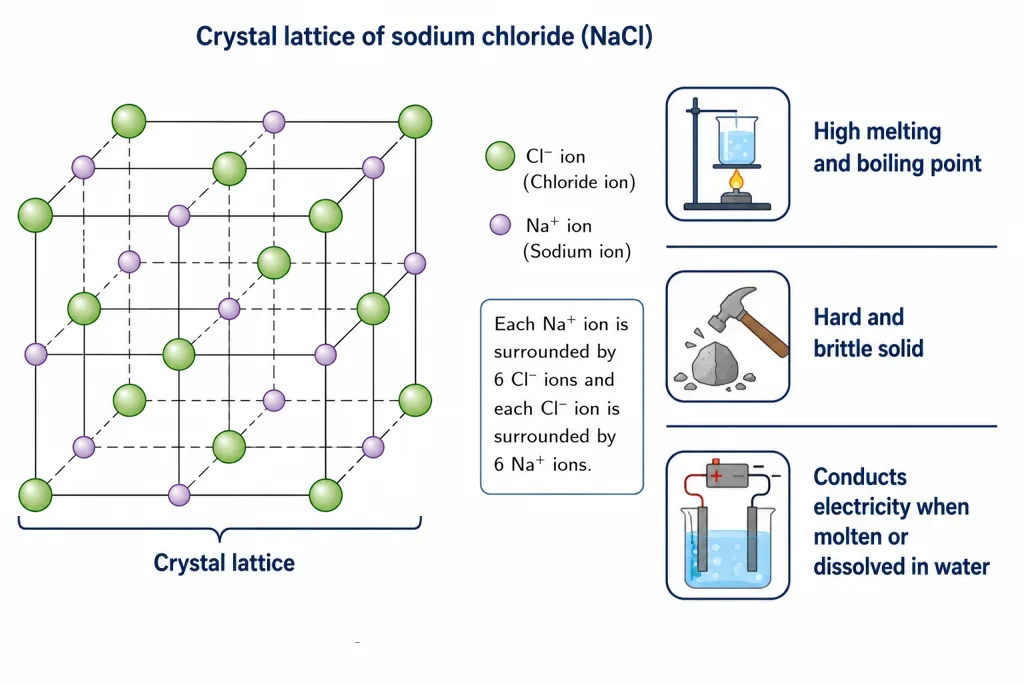
In ionic compounds:
- There are no separate 'molecules'.
- Ions are bonded in a three-dimensional lattice.
- One Na⁺ — surrounded by 6 Cl⁻.
- One Cl⁻ — surrounded by 6 Na⁺.
- (In NaCl — face-centered cubic structure.)
This structure — the root of all properties.
Main Physical Properties
1. Physical State:
- Ionic compounds are typically solid.
- Hard but brittle.
- Crystalline.
2. Melting Point and Boiling Point:
- High melting and boiling points.
- Because of strong attraction between ions.
Examples:
- NaCl: melting point 801°C
- MgO: melting point 2852°C
- Al₂O₃: melting point ~2050°C
- CaO: melting point 2572°C
3. Brittleness:
- Ionic crystals are brittle.
- Break with slight force.
- Why? Pressure shifts ions, bringing like charges face-to-face — repulsion breaks the crystal.
4. Hardness:
- Generally hard.
- Strong forces between ions.
Properties Linked to Strong Ionic Attraction
Coulomb's Law:
That is:
- More charge → more attraction → higher melting point.
Comparison:
| Compound | Charges | Melting Point |
|---|---|---|
| NaCl | +1, -1 | 801°C |
| MgO | +2, -2 | 2852°C |
| Al₂O₃ | +3, -2 | 2050°C |
Melting points of MgO and CaO are much higher than NaCl — because charges are larger.
Solubility
Solubility in Water
Most ionic compounds — are soluble in water.
Examples:
- NaCl, KCl, KNO₃ — fully soluble.
- , , — soluble.
- , — soluble.
Insoluble ones:
- AgCl, BaSO₄, PbI₂, CaCO₃ — sparingly soluble or insoluble.
Why Soluble in Water?
Nature of water: Water is a polar molecule.
- end — partial positive.
- end — partial negative.
Mechanism of dissolution:
- Water's () — surrounds .
- Water's () — surrounds .
- Ions are pulled out of crystal lattice.
- Aqueous solution is formed.
This process = Hydration.
Solubility in Organic Solvents
Kerosene, petrol, benzene — non-polar.
Ionic compounds are insoluble in these.
Rule: 'Like dissolves like'.
- Polar substance — in polar solvent.
- Non-polar substance — in non-polar solvent.
An Interesting Fact
Why don't oil and water mix?
- Oil: non-polar (organic).
- Water: polar.
- Rule: polar and non-polar don't mix.
Solubility Table — Some Famous Ionic Compounds
| Compound | In Water | In Kerosene |
|---|---|---|
| NaCl | ✓ Highly soluble | ✗ |
| KNO₃ | ✓ | ✗ |
| CuSO₄ | ✓ (blue) | ✗ |
| AgCl | ✗ Insoluble | ✗ |
| CaCO₃ | ✗ | ✗ |
| MgO | ✗ Sparingly | ✗ |
Electrical Conductivity
Main Question: When are ionic compounds electrical conductors?
Ionic compounds — in three states:
1. In solid state: Not electrical conductors. Why? Ions are fixed in crystal lattice — cannot move.
2. In molten state: Electrical conductors. Why? On melting, lattice breaks — ions become mobile.
3. In aqueous solution: Electrical conductors. Why? Ions move freely in water.
Mechanism of Conduction
Positive ions (cations) → move to negative end (cathode). Negative ions (anions) → move to positive end (anode).
This movement of ions = electric current.
Practical Demonstration
Simple Experiment:
- A battery, bulb, and two electrodes.
- Three media: dry NaCl solid, molten NaCl, NaCl solution.
- In which will the bulb glow?
Answer:
- Dry NaCl: No.
- Molten NaCl: Yes! (brightly)
- NaCl solution: Yes.
Electrolysis
This principle — the basis of many industrial processes:
- Extraction of metals (Na, K, Al — by electrolysis) (Section 7)
- Electroplating (Section 8)
- Decomposition of water (refer Chapter 1)
- Manufacturing of NaOH and Cl₂ (Chapter 2 — chlor-alkali)
Contrast — Covalent Compounds
Covalent compounds — generally not electrical conductors. (No ions formed.)
Exception: Acids like HCl, H₂SO₄ — get ionised in water.
Chemical Nature and Other Properties
Nature of Metallic Oxides
Oxides of metals — mostly basic. (Refer to Section 2.)
Examples:
- (alkali)
- (alkali)
Exceptions — Amphoteric:
- , — react with both acids and bases.
Metallic Hydroxides
Most are basic (alkali).
Examples:
- (caustic soda)
- (caustic potash)
- (slaked lime)
- (milk of magnesia)
Non-metallic Hydrides
Non-metal + H — covalent. Examples: H₂O, NH₃, HCl, HF
HCl and HF — become ionic in water → acidic.
A Comparison — Ionic vs Covalent
| Property | Ionic | Covalent |
|---|---|---|
| Bond | Electron transfer | Electron sharing |
| Melting point | High | Low |
| Boiling point | High | Low |
| State | Solid | Solid/Liquid/Gas |
| Solubility in water | Soluble | Mostly insoluble |
| In non-polar solvent | Insoluble | Soluble |
| Conductivity in solid | No | No |
| In molten/solution | Yes | Mostly No |
| Examples | NaCl, MgO | H₂O, CO₂ |
Some Interesting Facts
1. Diamond:
- Covalent crystal — but very hard!
- Exception — not all covalents are soft.
2. Graphite:
- Covalent, but — electrical conductor!
- Because of delocalised electrons.
3. Taste of salt:
- NaCl — salty.
- KCl — bitter-salty.
- Human tongue specifically recognises Na⁺.
Practical Uses of Ionic Compounds
1. NaCl (Common Salt)
Uses:
- In food — taste, digestion.
- Pickling, food preservation.
- Raw material for NaOH, Cl₂, Na.
- To prevent dehydration in hot countries.
2. CaO (Quicklime)
Uses:
- Cement manufacturing.
- Sugar refining.
- Paper manufacturing.
- Increasing pH of acidic soil.
3. Ca(OH)₂ (Slaked Lime)
Uses:
- Whitewashing walls.
- Making cheese.
- pH adjustment of water.
- Manufacturing bleaching powder.
4. CaCO₃ (Calcium Carbonate)
Sparingly-soluble ionic compound.
Uses:
- Major component of cement.
- Marble, limestone.
- Food additive (E170).
- In classroom dusters as 'chalk'.
- Component of toothpaste.
5. Na₂CO₃ (Washing Soda)
Uses:
- Washing clothes.
- Glass manufacturing.
- Paper industry.
6. NaHCO₃ (Baking Soda)
Uses:
- Cooking.
- Fire extinguishers.
- Antacid (stomach acidity).
7. CuSO₄ (Blue Vitriol)
Uses:
- Pesticide.
- Fungicide.
- Electroplating.
- Pigment.
Summary Table — Properties and Examples
| Property | Ionic | Reason |
|---|---|---|
| Physical state | Solid | Strong attraction |
| Melting point | High | Strong ionic bond |
| Brittleness | Brittle | Charge repulsion |
| In water | Soluble | Water is polar |
| In non-polar | Insoluble | Opposite nature |
| Solid conductivity | No | Ions fixed |
| Aqueous/Molten | Yes | Ions mobile |
[Board Important] Cause of all properties = crystal lattice + strong ionic forces.
🧠 Memory Capsule
A quick glance just before the board exam.
1. 5 Main Physical Properties of Ionic Compounds
- Solid state — hard, brittle, crystalline.
- High melting/boiling points — strong attraction.
- Soluble in water — water is polar.
- Insoluble in non-polar solvents — kerosene, benzene.
- Electrical conductivity: No in solid, Yes in molten/solution.
2. Examples of Melting Points
| Compound | Melting Point |
|---|---|
| NaCl | 801°C |
| MgO | 2852°C |
| CaO | 2572°C |
| Al₂O₃ | ~2050°C |
3. Rule of Electrical Conductivity
Solid — no (ions fixed) Molten — yes (ions free) Aqueous — yes (ions free)
4. Mechanism of Dissolution
- Polar water → surrounds ions → ions leave the lattice.
- 'Like solvent dissolves like solute.'
5. Reason for Brittleness
- Slight force → ions shift → like charges face-to-face → repulsion → crystal breaks.
6. Ionic vs Covalent (Quick recall)
| Property | Ionic | Covalent |
|---|---|---|
| Melting point | High | Low |
| Water | Soluble | Insoluble |
| Solid conductivity | No | No |
| Water conductivity | Yes | No |
7. Board's 'Golden' Questions
- Five properties of ionic compounds.
- Why is solid NaCl not an electrical conductor?
- Why is melting point of MgO higher than NaCl?
- Why are ionic compounds brittle?
- Why are ionic compounds soluble in water?
Final Formula: All properties = crystal lattice + strong ion-ion attraction.
Solved Examples
Example 1: NCERT — Properties of Ionic Compounds
Write five main physical properties of ionic compounds.
Solution:
5 Physical Properties of Ionic Compounds:
1. Physical State and Structure
- Ionic compounds are typically solid.
- Hard but brittle.
- Crystalline. Examples: NaCl, KCl — table salt.
2. Melting and Boiling Point
- High melting and boiling points.
- Due to strong electrostatic attraction between ions. Examples: NaCl - 801°C; MgO - 2852°C.
3. Solubility
- Soluble in water (mostly).
- Insoluble in non-polar solvents (kerosene, petrol). Reason: water is polar.
4. Electrical Conductivity
- In solid state: No (ions fixed).
- In molten/aqueous: Yes (ions mobile).
5. Nature
- Mainly metal + non-metal.
- Ions in a crystal lattice.
[NCERT textbook — asked every year]
Example 2: NCERT — Comparison of Melting Points
Which has a higher melting point — NaCl or MgO? Why?
Solution:
Comparison:
| Compound | Ions | Charges |
|---|---|---|
| NaCl | Na⁺, Cl⁻ | +1, -1 |
| MgO | Mg²⁺, O²⁻ | +2, -2 |
Melting Points:
- NaCl: 801°C
- MgO: 2852°C (3.5× higher than NaCl!)
Reason — Coulomb's Law
Force of attraction:
In NaCl: (unit)
In MgO: (unit)
Attraction in MgO is 4 times stronger.
More attraction → more energy needed to melt → higher melting point.
Additional Reason — Size of Ions
- Mg²⁺ and O²⁻ — both smaller ions (smaller radii).
- (distance) less → more (Coulomb's Law).
- Na⁺ and Cl⁻ — relatively larger → less.
Final Answer
MgO has a higher melting point because:
- Charges of ions are higher (±2 vs ±1).
- Attraction between ions is 4× stronger.
- Ions are smaller — distance is less.
The same principle explains the very high melting point of Al₂O₃ (Al³⁺O²⁻).
[Board: 3-mark]
Example 3: NCERT — Electrical Conductivity
In an experiment, current was passed through dry NaCl, molten NaCl, and aqueous NaCl. In which did the bulb glow?
Solution:
Setup: Battery + bulb + two electrodes + test medium.
(a) Dry NaCl Solid
Result: Bulb did not glow.
Reason:
- In solid NaCl, Na⁺ and Cl⁻ ions are fixed in the crystal lattice.
- They cannot move.
- Electric current = movement of ions. No movement here → no current.
(b) Molten NaCl
Result: Bulb glowed! (very brightly)
Reason:
- Above the melting point (801°C), NaCl melts.
- Crystal lattice breaks down.
- Ions become mobile in the melt.
- Na⁺ → goes to negative electrode (cathode).
- Cl⁻ → goes to positive electrode (anode).
- This ionic movement = current.
(c) Aqueous Solution of NaCl
Result: Bulb glowed. (moderate)
Reason:
- In water, NaCl → Na⁺ + Cl⁻ (ionised).
- Aqueous ions move freely.
- Current flows.
- (Slightly less than molten — because ions are surrounded by water molecules, slight resistance.)
Summary
| Medium | Conductor? | Reason |
|---|---|---|
| Dry NaCl | No | Ions fixed |
| Molten NaCl | Yes (bright) | Ions mobile |
| NaCl solution | Yes | Aqueous ions |
Key Insight
Conductivity of ionic compounds depends on movement of ions. This is the basis of industrial 'electrolysis'.
[NCERT textbook — important experiment]
Example 4: NCERT — Solubility
Why is NaCl soluble in water but insoluble in kerosene?
Solution:
Principle — 'Like dissolves like'
Polar solute — in polar solvent. Non-polar solute — in non-polar solvent.
NaCl: Ionic → 'Highly polar'
Na⁺ and Cl⁻ — fully charged ions.
Water: Polar Molecule
- end: partial positive ().
- end: partial negative ().
That is, water — a 'dipole'.
Mechanism of Dissolution
Step 1: Add NaCl to water.
Step 2: Water molecules surround the ions.
- 's () → towards .
- 's () → towards .
Step 3: Water's attraction — stronger than ion-ion attraction.
- Ions are pulled out of crystal lattice.
Step 4: Aqueous ions = and .
- This is 'Hydration'.
Kerosene: Non-polar
Kerosene — hydrocarbon (C-H bonds). Non-polar — no partial charges.
Reaction with kerosene:
- No attraction towards Na⁺ or Cl⁻.
- Ions remain in crystal lattice.
- NaCl insoluble.
An Interesting Demonstration
Oil and water with NaCl:
- NaCl dissolves in water.
- Not in oil.
- Finally: bottom — water + NaCl; top — oil.
Summary
NaCl + water → solution (soluble) — water is polar. NaCl + kerosene → insoluble — kerosene is non-polar.
'Like dissolves like' — fundamental rule of chemistry.
[NCERT — 3-mark]
Example 5: NCERT — Brittleness
Why are ionic compounds brittle?
Solution:
Crystal Lattice
In NaCl: each Na⁺ surrounded by 6 Cl⁻. Each Cl⁻ by 6 Na⁺. This structure — 3D cubic lattice.
Normal State
Ions are arranged so that:
- Opposite charges are close.
- Like charges are far. = electrostatic stability.
When Force is Applied
1. We apply slight force on the crystal (hammer, pressure).
2. Ions of one layer — shift relative to another layer.
3. Now like charges come face-to-face!
- Na⁺ in front of Na⁺ — repulsion.
- Cl⁻ in front of Cl⁻ — repulsion.
4. Strong repulsion → crystal breaks.
Comparison — with Metals
In metals: sea of electrons.
- Layers can shift — electrons fill the gap.
- Metals — malleable and ductile.
In ionic compounds: fixed ions.
- Shift = immediately breaks.
- Ionic — brittle.
Practical Demonstration
Hammer on a large salt crystal:
- Immediately — breaks into many small pieces.
- Pieces are also — cubic! (because they break along the crystal lattice).
Other Famous Brittle Substances
- Glass (covalent, yet brittle — crystal-like structure).
- Ceramics (Al₂O₃ based — ionic, brittle).
- Salt crystals.
- Sugar (although covalent, crystal-like).
Summary
Ionic compounds are brittle because:
- Ions are fixed in crystal lattice.
- Force → displacement of layers.
- Like charges face each other → repulsion.
- Crystal breaks.
[Board: 3-mark]
Example 6: NCERT — Two Demonstrations
(a) Connect a dry NaCl rod to a bulb and battery. What happens? (b) Place two graphite rods in NaCl solution and light the bulb — what happens?
Solution:
(a) Dry NaCl Rod
Result: Bulb did not glow.
Reason:
- In solid NaCl, ions are fixed in crystal lattice.
- No mobile charge carriers.
- Electrical conductivity = 0.
Conclusion: solid ionic compound — non-conductor.
(b) NaCl Solution
Setup:
- Beaker with NaCl + water solution.
- Two graphite rods — as electrodes.
- Connected to battery.
- Bulb in circuit.
Result: Bulb glowed! (with moderate brightness)
Mechanism:
1. NaCl ionised in water:
2. Movement of ions:
- Na⁺ → at cathode (-)
- Cl⁻ → at anode (+)
3. Reactions at electrodes:
- Cathode: (or actually, in aqueous — instead of less reactive Na)
- Actually:
- Anode:
4. Observations:
- Bubbles at cathode (H₂).
- Bubbles and pale yellow gas at anode (Cl₂).
- Bulb glows.
Important Point
This is the basic method of the 'chlor-alkali process'! (Refer to Chapter 2)
In industry:
Summary
| Experiment | Conductor? |
|---|---|
| Dry NaCl rod | No |
| NaCl solution | Yes |
[NCERT textbook experiment]
Example 7: NCERT — Identifying Ionic vs Covalent
Which of the following have ionic properties? NaCl, sugar (C₁₂H₂₂O₁₁), MgO, glucose, KBr,
Solution:
Analysis
1. NaCl:
- Elements: Na (metal) + Cl (non-metal)
- ✓ Ionic.
2. Sugar (C₁₂H₂₂O₁₁):
- Elements: C, H, O — all non-metals.
- ✗ Covalent.
3. MgO:
- Elements: Mg (metal) + O (non-metal).
- ✓ Ionic.
4. Glucose (C₆H₁₂O₆):
- Elements: C, H, O.
- ✗ Covalent.
5. KBr:
- Elements: K (metal) + Br (non-metal).
- ✓ Ionic.
6. CO₂:
- Elements: C + O (both non-metals).
- ✗ Covalent.
Confirmation by Properties
Confirming three ionic ones:
| Property | NaCl | MgO | KBr |
|---|---|---|---|
| High melting point? | 801°C ✓ | 2852°C ✓ | 734°C ✓ |
| Soluble in water? | ✓ | ✗ Sparingly | ✓ |
| Conducts in water? | ✓ | Slightly | ✓ |
Confirming three covalent ones:
| Property | Sugar | Glucose | CO₂ |
|---|---|---|---|
| Melting point | 186°C (low) | 146°C | -78°C |
| Conducts in water? | ✗ | ✗ | ✗ |
Final List
Ionic: NaCl, MgO, KBr Covalent: sugar, glucose, CO₂
A Caveat
Not all ionic compounds have all properties identical. Example: AgCl — ionic, but insoluble in water. MgO — ionic, but sparingly soluble in water. These exceptions due to specific reasons.
[Board: 5-mark]
Example 8: An Interesting — Ranking Melting Points
Arrange the following ionic compounds in increasing order of melting point — with reasons: NaCl, MgO, NaF, MgCl₂
Solution:
Analysis of Each
1. NaCl:
- Charges: +1, -1
- Attraction
2. MgO:
- Charges: +2, -2
- Attraction (very high!)
3. NaF:
- Charges: +1, -1
- Attraction
- But F⁻ is small, smaller than Cl⁻ → distance less → attraction slightly higher.
4. MgCl₂:
- Charges: +2, -1 (less 'pure' ionic)
- Attraction
Melting Point Values
| Compound | Melting Point |
|---|---|
| MgO | 2852°C |
| NaF | 993°C |
| NaCl | 801°C |
| MgCl₂ | 714°C |
Increasing Order
Reasoning
MgO is highest:
- ±2 charges, small ions — strongest attraction.
NaF higher than NaCl:
- Both ±1, but F⁻ is smaller.
- Slightly more attraction.
MgCl₂ is lowest:
- Special: Mg²⁺ is very strong — slightly 'pulls' on the electron.
- Result — partial covalent character.
- (Fajans' Rules.)
- Slightly lower melting point.
Key Insight
Melting points depend on:
- Charges of ions (more → higher).
- Size of ions (smaller → higher).
- Partial covalent character (more → lower).
[Board: 5-mark reasoning]
Example 9: NCERT — Choice of Solvent
Choose the best solvent — with reason:
(a) For NaCl — water or kerosene? (b) For naphthalene (non-polar) — water or benzene? (c) For sodium chloride — ethanol (mildly polar) or water (highly polar)?
Solution:
Principle
'Like solvent dissolves like solute.'
(a) For NaCl
Options:
- Water: polar.
- Kerosene: non-polar.
NaCl is ionic — highly polar. Polar solvent needed.
Answer: Water.
Evidence: NaCl is soluble in water (35-40 g per 100 g water). Insoluble in kerosene.
(b) For Naphthalene (C₁₀H₈)
Options:
- Water: polar.
- Benzene: non-polar.
Naphthalene — non-polar (hydrocarbon). Non-polar solvent needed.
Answer: Benzene.
Evidence: Naphthalene (camphor / 'moth-balls') is insoluble in water. Highly soluble in benzene.
(c) For NaCl — ethanol or water?
Options:
- Ethanol (C₂H₅OH): mildly polar (OH group).
- Water: highly polar.
NaCl needs the more polar solvent.
Answer: Water.
Evidence: NaCl highly soluble in water (~360 g/L). Very low in ethanol (~0.65 g/L).
Summary Table
| Solute | Nature | Good Solvent |
|---|---|---|
| NaCl | Ionic | Water |
| MgSO₄ | Ionic | Water |
| Naphthalene | Non-polar | Benzene |
| Iodine | Non-polar | CCl₄ |
| Sugar | Polar (OH) | Water |
Final Insight
This rule — not just chemistry — daily life.
'Oil and water don't mix' — proof of this rule!
[NCERT textbook]
Example 10: An Interesting — Role of Electrolysis
What will be obtained on electrolysis of an aqueous NaCl solution?
Solution:
Setup
- Aqueous NaCl solution (brine).
- Two graphite electrodes.
- DC power source.
Mechanism
NaCl ionised in water:
Water also slightly ionised:
Reactions at Electrodes
At Cathode (-): Less reactive ion is liberated.
Here — Na⁺ vs H⁺ (from water):
- Na — highly reactive (no H₂).
- H₂ — easily formed.
At Anode (+): Less reactive ion is oxidised.
Here — Cl⁻ vs OH⁻:
- Cl⁻ → Cl₂ (more likely in concentrated solution).
Overall Reaction
Observations
- At Cathode: Colourless gas (H₂) — pop test.
- At Anode: Pale yellow gas (Cl₂) — suffocating smell.
- In solution: NaOH (base).
Industrial Use
This is the 'chlor-alkali process':
- NaOH (caustic soda): soap, paper, textile.
- Cl₂: water purification, bleaching powder.
- H₂: fuel, ammonia.
Some Interesting Facts
'Chlor-alkali':
- Chlor = chlorine (Cl₂)
- Alkali = base (NaOH)
- One process, three products!
Volume calculation: If 1 mol NaCl is taken (NTP):
- 0.5 mol H₂ = 11.2 L
- 0.5 mol Cl₂ = 11.2 L
- 1 mol NaOH (in solution).
[Board + Industrial]
Example 11: Numerical — Electrical Conductivity
0.1 mol NaCl was dissolved in 1 L of water. How many free ions are present?
Solution:
Ionisation:
From 0.1 mol NaCl:
- 0.1 mol Na⁺
- 0.1 mol Cl⁻
- Total = 0.2 mol ions
Number of ions:
1 mol = .
- Na⁺ =
- Cl⁻ =
- Total = ions
Concentration:
ions in 1 L solution.
= ions per mL.
Contribution to Electrical Conduction:
Na⁺ → at cathode. Cl⁻ → at anode.
Both together — generate electric current.
Comparison — Effect of Concentration
1 mol/L NaCl: more conductivity. 0.1 mol/L NaCl: less conductivity. 0.001 mol/L NaCl: very low conductivity.
That is — concentration ↑ → ions ↑ → conductivity ↑.
Final Numbers
0.1 mol NaCl in 1 L solution:
- Total ions:
- Na⁺ ions:
- Cl⁻ ions:
[Board: 3-mark numerical]
Example 12: NCERT — Daily Life Compounds
Mention daily uses of the following ionic compounds:
(a) NaCl (b) CaO (c) NaHCO₃ (d) Na₂CO₃
Solution:
(a) NaCl — Sodium Chloride (Common Salt)
Daily Uses:
- In food: taste, digestion, electrolyte.
- Food preservation: fish, pickles, meat.
- Industrial: for manufacturing NaOH, Cl₂, Na₂CO₃, Na.
- Medical: saline — IV fluid.
- In winter: for melting ice.
In India: most obtained by evaporation of seawater.
(b) CaO — Calcium Oxide (Quicklime)
Daily Uses:
- Cement manufacturing: main ingredient.
- Sugar refining: removing impurities.
- Water pH: making acidic water alkaline.
- Lime: for whitewashing (as Ca(OH)₂).
- Paper manufacturing.
- Soil fertility.
(c) NaHCO₃ — Sodium Bicarbonate (Baking Soda)
Daily Uses:
- In cooking: for cakes, biscuits — to make them rise.
- Antacid: stomach acidity.
- Fire extinguisher: CO₂ extinguishes fire.
- Toothpaste.
- Cleaning fabrics.
(d) Na₂CO₃ — Sodium Carbonate (Washing Soda)
Daily Uses:
- Washing: with detergents for clothes.
- Glass manufacturing: main raw material.
- Paper industry.
- Removing water hardness.
- Manufacturing borax.
'Washing soda' — Na₂CO₃·10H₂O.
Summary
These four compounds — everywhere from kitchen to industry!
[NCERT — chemistry in daily life]
Example 13: NCERT — A Comparative Question
NaCl and sugar (sucrose) — both white solids, both soluble in water. But what is the difference in physical properties?
Solution:
Fundamental Difference — Bond Type
NaCl: Ionic (Na — metal, Cl — non-metal). Sugar (C₁₂H₂₂O₁₁): Covalent (C, H, O — all non-metals).
Detailed Comparison
| Property | NaCl | Sugar |
|---|---|---|
| Bond | Ionic | Covalent |
| Melting point | 801°C | 186°C |
| Boiling point | 1465°C | Decomposes |
| Solubility in water | 36 g/100mL | 200 g/100mL |
| Conducts in water? | Yes | No! |
| Conducts in molten state? | Yes | No |
| Crystal | Cubic | Tricyclic |
| Taste | Salty | Sweet |
| Brittleness | Brittle | Brittle (less so) |
Special — Electrical Conductivity
NaCl + water → Na⁺ + Cl⁻ → conducts electricity.
Sugar + water → C₁₂H₂₂O₁₁ molecules (intact) → no ions → no conduction.
A Demonstration
Two beakers:
- One: NaCl + water
- Other: sugar + water
Connect to bulb-battery:
- NaCl: bulb glows.
- Sugar: bulb does not glow.
A Confusion — Sugar 'dissolves' in water, yet doesn't conduct?
Sugar dissolves in water as molecules — not as ions. Ions = required for conduction. Molecules — not for conduction.
Key Insight
Ionic compound: gives ions → conducts. Covalent compound: molecules → does not conduct. Exception: Acids like HCl — covalent, but ionised in water → conducts.
[Board: 5-mark comparative]
Example 14: An Interesting — KMnO₄ vs MgO
Both are ionic. Yet KMnO₄ gives violet colour in water, MgO is sparingly soluble. Why?
Solution:
KMnO₄
Ions: (+1) and (-1)
— polyatomic ion.
Solubility:
- K⁺ small but charge +1.
- MnO₄⁻ large.
- Moderate attraction.
- Water easily separates them.
That is — highly soluble in water.
MnO₄⁻ gives violet colour.
MgO
Ions: and
Solubility:
- Both ±2 charge — strong attraction.
- Both small — distance less.
- Attraction .
- Water's attraction — less than Mg²⁺-O²⁻ attraction.
- Ions remain in crystal lattice.
That is — sparingly soluble in water.
Principle
'Solubility' depends on:
- Lattice Energy (): ion-ion attraction.
- Hydration Energy (): ion-water attraction.
If → soluble. If → insoluble.
Comparison
| Compound | Solubility | ||
|---|---|---|---|
| KMnO₄ | Low | High | Soluble (violet) |
| NaCl | Moderate | High | Soluble |
| MgO | Very high | Moderate | Insoluble |
| AgCl | High | Low | Insoluble |
Key Insight
'All ionic — soluble in water' — not entirely true. Depends on this balance.
More charge + smaller ions → higher lattice energy → less soluble.
[Board + Practical]
Example 15: A Challenging Question
Is it true that — "All ionic compounds are soluble in water, all are electrical conductors"? Explain with reasoning.
Solution:
Original Statement
"All ionic compounds are soluble in water, all are electrical conductors."
Answer: This is not entirely true.
Analysis
'Soluble in water' — exceptions exist:
| Compound | Solubility | Reason |
|---|---|---|
| NaCl, KCl | Highly soluble | Balanced charges |
| AgCl | Insoluble | High lattice energy |
| BaSO₄ | Insoluble | Very stable lattice |
| PbI₂ | Insoluble | Large ions, strong attraction |
| CaCO₃ | Insoluble | Strong forces |
| CaSO₄ | Sparingly soluble | Moderate |
| MgO | Sparingly soluble | ±2 charges |
Therefore: About 70-80% of ionic compounds are soluble, 20-30% are not.
Electrical Conductivity — Correct?
Two situations:
1. In solid state:
- Ions fixed — no conductivity.
- All solid ionic compounds — non-conductors.
2. In molten or aqueous:
- Ions free — conductors.
- All ionic — conductors in molten/aqueous.
Exception:
- If insoluble (AgCl), then aqueous not conductor (ions don't come out).
- In molten state — still a conductor.
Updated Statements
Correct statements:
'Most ionic compounds are soluble in water.' 'All ionic compounds — conductors in molten state.' 'Soluble ionic compounds — conductors in aqueous solution.' 'Solid ionic compounds — non-conductors of electricity.'
Final Reasoning
The original statement is a 'generalisation'. Several exceptions exist. The actual test depends on properties.
[Board: 5-mark]
Example 16: A Concluding Question
(a) 5 physical properties of ionic compounds. (b) Why is solid NaCl not a conductor, but molten is? (c) Why is the melting point of MgO higher than NaCl — explain. (d) Ionic vs Covalent — most important difference.
Solution:
(a) 5 Physical Properties
- Solid state: hard, crystalline, brittle.
- High melting/boiling points: strong ion-ion attraction.
- Soluble in water: polar water surrounds ions.
- Insoluble in non-polar: kerosene, benzene.
- Electrical conductivity: No in solid, Yes in molten/aqueous.
(b) Conductivity of NaCl
Solid NaCl:
- Ions fixed in crystal lattice.
- No motion → no current.
- ✗ Not a conductor.
Molten NaCl:
- Above 801°C — melts.
- Crystal lattice breaks.
- Ions free — mobile.
- Na⁺ → cathode, Cl⁻ → anode.
- ✓ Highly conducting.
This is the basic principle of 'electrolysis'.
(c) Melting Point of MgO — Higher than NaCl
Comparison:
- NaCl: ±1 charges, melting point 801°C
- MgO: ±2 charges, melting point 2852°C
Reason (Coulomb):
Attraction in MgO = 4 × NaCl.
More attraction → more energy needed to melt → higher melting point.
+ Smaller ion size → less distance → more attraction.
(d) Ionic vs Covalent — Most Important Difference
Most fundamental difference:
Ionic: complete transfer of electrons → ions. Covalent: sharing of electrons → molecules.
Practical evidence: Ionic — conducts in aqueous solution. Covalent — does not conduct (exception: acids).
Quick Table
| Property | Ionic | Covalent |
|---|---|---|
| Melting point | High | Low |
| Conducts in water | Yes | No (generally) |
| Bond | Transfer | Sharing |
| Examples | NaCl, MgO | H₂O, CO₂ |
[Board: 5-mark mixed question]