
Natural Occurrence of Metals
Metals — found in the Earth's crust. Some in pure form, most as compounds.
Basic Terms — At a Glance
1. Minerals:
- All natural compounds obtained from the earth.
- Can be metallic or non-metallic.
- Examples: limestone (CaCO₃), coal (carbon), rock salt (NaCl).
2. Ores:
- Those minerals from which a metal can be profitably extracted in sufficient quantity.
- (Not every mineral is an ore — but every ore is a mineral.)
Distinction — Ore vs Mineral
'Mineral' is a broader term. 'Ore' is narrower.
All ores → minerals, but all minerals → not ores.
Some Famous Ores
Sodium (Na):
- Sodium chloride (sea salt): NaCl
- Sodium carbonate: Na₂CO₃
Potassium (K):
- Potassium chloride: KCl
Magnesium (Mg):
- Magnesite: MgCO₃
- Dolomite: CaCO₃·MgCO₃
Calcium (Ca):
- Limestone: CaCO₃
- Marble: CaCO₃
Aluminium (Al):
- Bauxite: Al₂O₃·2H₂O ← Main ore!
Iron (Fe):
- Hematite: Fe₂O₃ ← red-brown, main ore!
- Magnetite: Fe₃O₄ ← magnetic!
Zinc (Zn):
- Zinc blende: ZnS
- Calamine: ZnCO₃
Copper (Cu):
- Copper pyrites: CuFeS₂
- Native copper (pure form)
Silver (Ag):
- Native silver (pure form)
- Argentite: Ag₂S
Gold (Au):
- Native gold (pure form — in river sand, rocks)
Mercury (Hg):
- Cinnabar: HgS
Availability of Metals on Earth
Gold and Platinum — In Free State
Au, Pt — least reactive. Unaffected by air or water. Hence — found in pure form.
Known to humans for thousands of years:
- Gold pieces directly from river sand.
- Ancient civilizations — used gold in jewellery.
Silver and Copper — Partially
Ag, Cu — partly in pure form, partly as compounds.
Ag: Native silver, Argentite (Ag₂S) Cu: Native copper, Copper pyrites (CuFeS₂)
Iron, Magnesium, Sodium — Only as Compounds
These are more reactive — react quickly with air/water/others. Found only in compound form in nature.
Fe: Fe₂O₃, Fe₃O₄ (never pure) Mg: MgCO₃, MgCl₂ (never pure) Na: NaCl, Na₂CO₃ (never pure)
Relationship Between Reactivity and Occurrence
| Reactivity | Occurrence | Examples |
|---|---|---|
| Very low | Free form | Au, Pt |
| Low | Partial free | Ag, Cu, Hg |
| Moderate | Only compounds | Pb, Zn, Fe |
| High | Only compounds | Mg, Al, Ca |
| Very high | Only compounds | Na, K |
Principle: The higher the reactivity — the higher the chance of compound form.
Major Types of Ores
1. Sulphide Ores:
- ZnS (zinc blende)
- CuFeS₂ (copper pyrites)
- HgS (cinnabar)
- PbS (galena)
Generally for less reactive metals.
2. Oxide Ores:
- Al₂O₃·2H₂O (bauxite)
- Fe₂O₃ (hematite)
- Fe₃O₄ (magnetite)
- MnO₂ (pyrolusite)
For moderately reactive metals.
3. Carbonate Ores:
- ZnCO₃ (calamine)
- MgCO₃ (magnesite)
- CaCO₃ (limestone)
- FeCO₃ (siderite)
For many metals.
4. Halide Ores:
- NaCl (rock salt)
- KCl
- CaF₂ (fluorspar)
For highly reactive metals.
Basic Steps of Extraction
Metal extraction = the process of obtaining pure metal from ore.
Three Main Steps
1. Concentration of ore:
- Removing gangue (impurities) from ore.
- Topic of this section.
2. Reduction of ore:
- Obtaining metal from concentrated ore.
- Topic of Section 7.
3. Refining of metal:
- Making impure metal pure.
- Topic of Section 8.
Flow Chart
  Mining
      ↓
  Ore obtained
      ↓
  Concentration (removing impurities)  ← Section 6
      ↓
  Reduction (obtaining metal)           ← Section 7
      ↓
  Refining (pure metal)                  ← Section 8
      ↓
  Pure metal — for use
Gangue — What is it?
The unwanted substances found along with the ore = Gangue.
Examples:
- Clay
- Sand
- Pieces of stone
- Other minerals (unwanted)
Purpose of concentration: To remove gangue and obtain pure ore.
Basic Methods of Concentration
Based on physical/chemical differences between ore and gangue:
- Hand picking: visual difference.
- Gravity separation: density difference.
- Magnetic separation: magnetic difference.
- Froth flotation: surface property difference.
- Leaching: chemical difference.
We will mainly study the first four methods.
Four Main Methods of Concentration
1. Hand Picking
Selection by 'visible difference'.
When to use?
- When ore and gangue are clearly different in appearance.
- Such as: difference in colour, size, lustre.
Method:
- Workers pick by hand.
- Or by machines (modern).
Examples:
- Identifying gold pieces.
- Separating red hematite from clay.
Limitations:
- Slow.
- Expensive (labour).
- For small quantities.
2. Gravity Separation
By difference in density.
Principle: Heavier ore — settles down, lighter gangue — flows away with water.
Method (Hydraulic Washing principle):
- Crush the ore into fine powder.
- Place on a sloping incline.
- Pour a stream of water.
- Lighter gangue — flows away with water.
- Heavier ore — stays back.
Use:
- Oxide ores — Hematite (Fe₂O₃) — heavier than gangue.
- Gold ores.
By 'sieve' pan:
- Ancient method of catching gold pieces in river sand.
- Still used in some places today.
3. Magnetic Separation
Either ore or gangue — must be magnetic.
Principle:
- Magnetic part — towards magnet.
- Non-magnetic part — stays away.
Method:
- Crush the ore into fine powder.
- Place on a rotating conveyor belt.
- At the end of the belt, an electromagnet.
- Magnetic part — near the magnet, in one heap.
- Non-magnetic part — in the heap further away.
Main Example:
Magnetite (Fe₃O₄):
- Itself magnetic.
- Gangue (clay, stone) — non-magnetic.
- Separated by electromagnet.
Removing impure Fe from Tinstone (SnO₂):
- Fe — magnetic.
- SnO₂ — not.
- Fe pulled out by electromagnet.
Pyrolusite (MnO₂):
- Mn is magnetic.
Advantages:
- Fast.
- Automatic.
- Accurate.
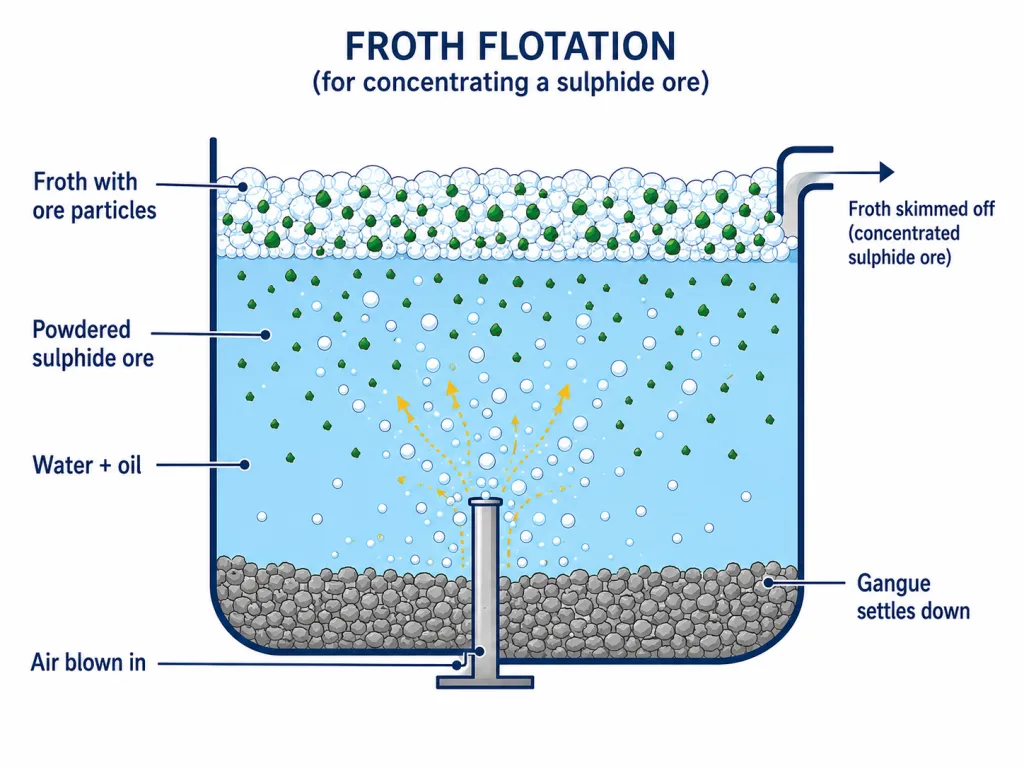
4. Froth Flotation Method
By difference in surface properties.
This method — for sulphide ores.
Main Examples:
- ZnS (zinc blende)
- PbS (galena)
- CuFeS₂ (copper pyrites)
Principle: Sulphide ores — get wetted by oil (hydrophobic — not wetted by water). Gangue — gets wetted by water (hydrophilic).
Method (detailed):
- Fine powder of the ore.
- Add water in a large tank.
- Add a little oil (pine oil).
- Pass a strong current of air through the tank.
- What happens:
- Oil surrounds the ore particles.
- Air creates froth (foam).
- Bubbles in froth — bring ore particles up.
- Gangue — settles at the bottom in water.
- Collect the froth — dry — concentrated ore.
Auxiliary Chemicals:
- Collector: pine oil, fatty acids — 'wets' the ore.
- Frother: stabilises the foam.
- Depressant: keeps unwanted ore at the bottom.
Example: Concentration of Zinc Blende (ZnS)
- ZnS particles — up with froth.
- Clay, stone — down in water.
Comparison and Choice of Methods
Which Method When?
| Method | When to use? | Example |
|---|---|---|
| Hand picking | Visual difference | Gold pieces |
| Gravity | Density difference | Hematite (Fe₂O₃) |
| Magnetic | Magnetic difference | Magnetite (Fe₃O₄) |
| Froth flotation | Sulphide ores | ZnS, CuFeS₂, PbS |
An Interesting Comparison
Two ores of Fe — two different methods!
Hematite (Fe₂O₃):
- Non-magnetic.
- Heavy.
- → Gravity separation.
Magnetite (Fe₃O₄):
- Magnetic.
- → Magnetic separation.
That is — different ores of the same metal — different methods!
Leaching — 5th Method
Chemical method of concentration.
Principle: Dissolve the ore in a chemical solution — leaving the gangue behind.
Example: Leaching of Bauxite (Bayer Process):
Al₂O₃·2H₂O has impurities — Fe₂O₃, SiO₂.
1. Add bauxite to concentrated NaOH:
Al has dissolved (NaAlO₂ — sodium aluminate). Fe₂O₃, SiO₂ — did not dissolve.
2. Filter:
- Liquid: NaAlO₂
- Solid: Fe₂O₃, SiO₂ (discarded)
3. Separate Al(OH)₃ from NaAlO₂:
4. Heat Al(OH)₃:
Now pure Al₂O₃ — ready for electrolysis.
After Concentration
Concentrated ore — now ready for next step: reduction. This is the topic of Section 7.
A Basic Rule
'Concentration method' is determined by the property of the ore. No single 'best' method — different for each ore.
[Board Important] Four main methods + a simple example = 5-mark question in board.
🧠 Memory Capsule
A quick glance just before the board exam.
1. Mineral vs Ore
Mineral: all natural compounds. Ore: those minerals from which metal can be profitably extracted.
2. Important Ores
| Metal | Ore | Formula |
|---|---|---|
| Al | Bauxite | Al₂O₃·2H₂O |
| Fe | Hematite | Fe₂O₃ |
| Fe | Magnetite | Fe₃O₄ |
| Cu | Copper pyrites | CuFeS₂ |
| Zn | Zinc blende | ZnS |
| Hg | Cinnabar | HgS |
| Pb | Galena | PbS |
| Na | Rock salt | NaCl |
3. Occurrence Table
| Reactivity | Form |
|---|---|
| Very low (Au, Pt) | Free |
| Low (Cu, Ag) | Partial |
| Moderate (Fe, Zn) | Compound |
| High (Mg, Na) | Only compound |
4. 3 Steps of Extraction
- Concentration (Section 6) — removing gangue
- Reduction (Section 7) — obtaining metal
- Refining (Section 8) — purification
5. 4 Methods of Concentration
Hand picking: visual difference (gold). Gravity: density difference (hematite). Magnetic: magnetic property (magnetite). Froth flotation: surface property (sulphide ores — ZnS, PbS, CuFeS₂).
6. Materials in Froth Flotation
- Collector: pine oil
- Ore up (in froth)
- Gangue down (in water)
7. Bayer Process
For leaching of bauxite:
- Al₂O₃ + 2NaOH → 2NaAlO₂ + H₂O
- Then Al(OH)₃ → Al₂O₃ + H₂O
8. Board's 'Golden' Questions
- Difference between mineral and ore.
- Description of froth flotation method.
- When is magnetic separation useful?
- Main ore of Al and its formula.
- 4 methods of concentration.
Final Formula: 'Concentration = removing gangue — choose method based on ore properties.'
Solved Examples
Example 1: NCERT — Mineral and Ore
What is the difference between mineral and ore? Explain with examples.
Solution:
Definitions
Mineral: All natural compounds found in the Earth's crust — whether metal can be extracted or not.
Ore: That mineral in which the metal is in such a sufficient quantity that it can be profitably extracted.
Main Differences
| Basis | Mineral | Ore |
|---|---|---|
| Scope | Broader | Narrower |
| Metal content | May be low | Sufficient |
| Economic gain | Not necessary | Required |
| Examples | All rocks, soil | Only selected |
Important Rule
Every ore → is a mineral. Every mineral → is not an ore.
An Interesting Example
Al — found in two minerals:
1. Bauxite (Al₂O₃·2H₂O):
- Al content: 50-60%
- Economically beneficial.
- This is an ore.
2. Clay (ordinary clay):
- Al content: 5-10% (alumino-silicate)
- Very expensive to extract.
- Not an ore, only a mineral.
That is — both contain Al, but only bauxite is called ore.
Other Examples
Ore vs Mineral:
- Hematite (Fe₂O₃) — ore [for Fe extraction]
- Magnetite (Fe₃O₄) — ore
- Coal — mineral, not ore (Fe is not extracted from it)
- Rock salt (NaCl) — both (ore for Na)
Final Definition
'Ore' = economically useful mineral.
This economic criterion changes with time — clay with low Al may also become an 'ore' if better technology is found in future.
[NCERT textbook — fundamental]
Example 2: NCERT — Major Ores
Write the major ores and their chemical formulas of the following metals:
(a) Al, (b) Fe, (c) Cu, (d) Zn, (e) Hg
Solution:
(a) Aluminium (Al)
Major Ore: Bauxite
Formula: (hydrated aluminium oxide)
Al — most abundant metal in Earth's crust (~8%). In India: Odisha, Jharkhand, Gujarat.
(b) Iron (Fe)
Major Ores:
1. Hematite:
- Red-brown colour.
- Most important.
2. Magnetite:
- Black colour.
- Itself magnetic.
3. Siderite:
4. Iron pyrites: (Also known as 'fool's gold' — bright yellow, but iron ore.)
In India: Odisha, Jharkhand, Chhattisgarh, Karnataka.
(c) Copper (Cu)
Major Ores:
1. Copper pyrites: — most abundant. 2. Cuprite: 3. Malachite: — green. 4. Native copper — pure form, rare.
(d) Zinc (Zn)
Major Ores:
1. Zinc blende: — most prominent. 2. Calamine: 3. Zincite:
In India: Rajasthan (Zawar Mines).
(e) Mercury (Hg)
Major Ore: Cinnabar
Formula: (bright red)
Spain (Almaden Mines) — most famous in the world.
Summary Table
| Metal | Ore | Formula | Type |
|---|---|---|---|
| Al | Bauxite | Al₂O₃·2H₂O | Oxide (hydrated) |
| Fe | Hematite | Fe₂O₃ | Oxide |
| Fe | Magnetite | Fe₃O₄ | Oxide |
| Cu | Copper pyrites | CuFeS₂ | Sulphide |
| Zn | Zinc blende | ZnS | Sulphide |
| Hg | Cinnabar | HgS | Sulphide |
Note: Sulphide ores — for less reactive metals.
[NCERT textbook — important]
Example 3: NCERT — Hand Picking and Gravity Separation
When are hand picking and gravity separation methods useful? Explain with examples.
Solution:
Hand Picking
Principle: Visual difference — colour, size, lustre.
When useful? When there is a clear visual difference between ore and gangue.
Method:
- Break the mineral into small pieces.
- Pick by hand (or machine).
- Ore pieces in one place, gangue in another.
Examples:
- Picking gold pieces from river sand (visible yellow shine).
- Separating hematite (red) from clay (brown).
- Some coloured ores.
Advantages: simple, cheap. Disadvantages: slow, small quantities.
Gravity Separation (Hydraulic Washing)
Principle: Density difference. Heavier ore — lighter gangue.
When useful? When ore density is higher than gangue.
Method (detailed):
- Crush ore to fine powder.
- Place on a sloping metal plate / hydraulic chamber.
- Pour stream of water.
- What happens:
- Light gangue — flows away with water.
- Heavy ore — remains.
- Collect the ore.
Examples:
Fe extraction from Hematite (Fe₂O₃):
- Density of hematite ~5.3 g/cm³
- Gangue (clay, sand): ~2.5 g/cm³
- Fe₂O₃ heavier than water — settles.
Tinstone (SnO₂):
- Density ~7 g/cm³
- Gangue lower density.
- Easily by gravity.
Comparison
| Property | Hand Picking | Gravity |
|---|---|---|
| Basis | Visual | Density |
| Speed | Slow | Moderate |
| Use | Small scale | Large scale |
| Cost | High (labour) | Moderate |
| Example | Gold | Hematite |
Key Insight
Both — old, traditional methods. Used as initial stage even in modern industry.
[Board: 3-5 marks]
Example 4: NCERT — Magnetic Separation
Describe the magnetic separation method with an example.
Solution:
Principle
Either ore or gangue — must be magnetic.
Then they can be separated by an electromagnet.
Method
Setup:
- A conveyor belt (rotating moving belt).
- Place fine powder of ore at one end of belt.
- Electromagnet at the other end of belt.
- Two heaps form below.
What happens:
- Conveyor carries ore to magnet.
- Magnetic part — pulled by magnet — falls in nearby heap.
- Non-magnetic part — falls at end of conveyor — in farther heap.
Diagram (in words):
    Pour ore
    ↓
    Belt moves →→→→→→→
                     [Magnet]
                       |
                       |
              Non-magnetic    Magnetic
              (Far heap)     (Near heap)
Main Example
Magnetite (Fe₃O₄):
Fe₃O₄ — itself magnetic. Gangue (clay, sand) — non-magnetic.
Process:
- Powder of ore + gangue on conveyor.
- Fe₃O₄ — pulled towards magnet → concentrated ore.
- Gangue — stayed away → discarded.
Other Examples
Removing Fe from Tinstone (SnO₂):
- SnO₂ non-magnetic (main ore).
- Fe (impurity) magnetic.
- Pull Fe out with magnet — pure SnO₂ remains.
Pyrolusite (MnO₂):
- MnO₂ weakly magnetic.
- Separated with stronger magnet.
Wolframite (tungsten ore):
- W slightly magnetic.
- Can be separated.
When NOT to Use?
If both ore and gangue — non-magnetic. Then magnetic method is useless.
Example: Bauxite (Al₂O₃·2H₂O) — non-magnetic. Here leaching (Bayer) is useful.
Advantages
- Fast.
- Automatic.
- Less labour.
- Accurate.
- Large scale.
[Board: 5-mark — with diagram]
Example 5: NCERT — Froth Flotation Method
Describe the froth flotation method in detail. For which type of ores is it used?
Solution:
For Whom?
This method — for sulphide ores.
Main Examples:
- ZnS (zinc blende)
- PbS (galena)
- CuFeS₂ (copper pyrites)
- HgS (cinnabar)
Basic Principle
Two types of substances:
- Sulphide ores — get wetted by oil (hydrophobic — not wetted by water).
- Gangue (clay, stone) — gets wetted by water (hydrophilic).
Method (Detailed)
Setup:
- A large water-filled tank.
- Air circulation at the bottom.
- An agitator outside.
Steps:
1. Crush the ore to fine powder.
2. Add to tank — with water and some chemicals:
- Pine Oil — Collector. 'Wets' the ore.
- Frother — stabilises the foam.
- Depressant — keeps unwanted ore down.
3. Pass strong air current into tank.
4. What happens:
- Oil surrounds ore particles.
- Air creates foam (froth).
- Bubbles in froth — bring ore particles up.
- Gangue — stays at bottom in water.
5. Collect the froth from the surface.
6. Dry the froth — concentrated ore is obtained.
Specific Example: Concentration of ZnS
Ore: ZnS + clay + sand + other impurities
Process:
- Powder → tank.
- Pine oil + water + air.
- ZnS particles up with froth.
- Clay, sand — down in water.
- ZnS extracted from froth at the top.
Major Chemicals (Detailed)
1. Collector:
- Pine oil (most common)
- Sodium ethyl xanthate (Sodium ethyl xanthate)
- Fatty acids
2. Frothers:
- Pine oil
- Cresylic acid
3. Depressant:
- NaCN (Sodium cyanide) — keeps some ore at bottom.
4. Activator:
- CuSO₄ — activates some inactive ore.
An Interesting Fact
PbS and ZnS together — how to separate?
Answer: Differential Froth Flotation. Add NaCN → ZnS stays down, PbS floats up. That is, selection by the same process.
Summary
Froth flotation — most widely used modern method. Sulphide ores around the world — by this method.
[NCERT — every year in board]
Example 6: NCERT — Types of Ores
How many main types of ores are there? Two examples for each.
Solution:
Main Types of Ores (4)
1. Oxide Ores
Formula:
Examples:
- Hematite () — ore of Fe
- Bauxite () — of Al
- Magnetite ()
- Cuprite ()
- Zincite ()
- Pyrolusite ()
For most moderately reactive metals.
2. Sulphide Ores
Formula:
Examples:
- Zinc blende ()
- Galena ()
- Copper pyrites ()
- Cinnabar ()
- Argentite ()
- Iron pyrites ()
For most less reactive metals.
3. Carbonate Ores
Formula:
Examples:
- Limestone ()
- Magnesite ()
- Calamine ()
- Dolomite ()
- Siderite ()
- Malachite ()
4. Halide Ores
Formula: (X = F, Cl, Br, I)
Examples:
- Rock salt ()
- Sylvite ()
- Carnalite ()
- Fluorspar ()
- Cryolite ()
For most highly reactive metals.
Summary Table
| Type | Formula | Famous Examples |
|---|---|---|
| Oxide | M_xO_y | Hematite, Bauxite |
| Sulphide | M_xS_y | Zinc blende, Galena |
| Carbonate | MCO₃ | Limestone, Magnesite |
| Halide | MX | Rock salt, Cryolite |
Reactivity-Ore Type Relationship
This is a 5-mark question:
| Reactivity | Preferred Compound Type |
|---|---|
| High (Na, K, Ca) | Halide, Carbonate |
| Moderate (Al, Zn, Fe) | Oxide, Carbonate |
| Low (Cu, Hg, Pb) | Sulphide |
| Very low (Au, Ag, Pt) | Free form |
This is an interesting principle — relationship between reactivity and ore type.
[Board: 5-mark — structured]
Example 7: NCERT — Bayer Process
How is pure Al₂O₃ extracted from bauxite? Explain with chemical reactions.
Solution:
The Basic Problem
Bauxite () has impurities:
- Fe₂O₃ (iron oxide)
- SiO₂ (silica)
- TiO₂ (titanium oxide)
These impurities — must be removed before Al extraction.
Bayer Process — Steps
This is a method of leaching.
Step 1: Reaction with NaOH
Add fine powder of bauxite to concentrated NaOH at 150°C and high pressure.
Al₂O₃ — dissolves in NaOH:
(NaAlO₂ — sodium aluminate; soluble in water.)
Impurities — do not dissolve:
- Fe₂O₃, TiO₂ — insoluble in NaOH.
- SiO₂ — partially dissolves to Na₂SiO₃, but separated later.
Step 2: Filtration
Liquid NaAlO₂ — on one side. Solid impurities (Fe₂O₃, TiO₂, SiO₂) — on the other side.
Solid — discarded.
Step 3: Precipitation of Al(OH)₃
Add small Al(OH)₃ seed crystals to the NaAlO₂ liquid.
Cool and stir.
(Al(OH)₃ — white precipitate; NaOH — in solution.)
Step 4: Calcination (heating)
Filter Al(OH)₃, wash, then heat at 1100°C.
Now pure Al₂O₃ (alumina).
Step 5: Electrolysis (Section 7)
Now Al₂O₃ → ready for Al extraction.
This is the 'Hall-Héroult' process.
Summary Diagram
Bauxite (impure Al₂O₃)
      ↓ + NaOH (concentrated, hot)
NaAlO₂ + insoluble impurities
      ↓ filter
NaAlO₂ solution
      ↓ + Al(OH)₃ seed crystal
Al(OH)₃ (precipitate)
      ↓ heat (1100°C)
Al₂O₃ (pure)
      ↓ electrolysis
Al (pure metal)
Importance
Bayer Process = Backbone of modern Al industry.
Millions of tonnes of Al₂O₃ each year — by this process.
[Board: 5-mark]
Example 8: A Mixed — Choose the Right Method
For the following ores, suggest the most suitable concentration method:
(a) Fe₃O₄ (Magnetite) (b) Fe₂O₃ (Hematite) (c) ZnS (Zinc Blende) (d) Native Au (pure gold) (e) Bauxite (Al₂O₃·2H₂O)
Solution:
(a) Fe₃O₄ (Magnetite)
Method: Magnetic separation.
Reason: Fe₃O₄ is itself magnetic. Gangue (clay, stone) non-magnetic.
Process: Conveyor belt + electromagnet.
(b) Fe₂O₃ (Hematite)
Method: Gravity separation.
Reason: Fe₂O₃ non-magnetic (unlike Fe₃O₄). But heavy (~5.3 g/cm³).
Process: Hydraulic washing with water stream.
Fe₂O₃ stays down, light clay flows away with water.
(c) ZnS (Zinc Blende)
Method: Froth flotation.
Reason: ZnS is a sulphide ore. Gets 'wetted' by oil.
Process: Water + pine oil + air. ZnS up with froth.
(d) Native Au (pure gold)
Method: Hand picking / gravity.
Reason: Au itself in pure form. Recognized by yellow shine.
Ancient: gold caught from river sand by sieve. Modern: cyanide leaching too.
(e) Bauxite (Al₂O₃·2H₂O)
Method: Chemical leaching (Bayer Process).
Reason: Al₂O₃ — dissolves in NaOH. Impurities (Fe₂O₃, SiO₂) — don't.
Process: With concentrated NaOH → NaAlO₂ → Al(OH)₃ → Al₂O₃.
Summary Table
| Ore | Method | Principle |
|---|---|---|
| Fe₃O₄ | Magnetic | Magnetic property |
| Fe₂O₃ | Gravity | Density difference |
| ZnS | Froth flotation | Surface property |
| Native Au | Hand picking | Visual difference |
| Bauxite | Leaching | Chemical solubility |
Principle
'Concentration method' is decided by the specific property of the ore.
Physical property → physical method. Chemical property → chemical method.
[Board: 5-mark — application]
Example 9: NCERT — Chemicals in Froth Flotation
Which chemicals are used in froth flotation method? Explain the role of each.
Solution:
Four Main Chemicals
1. Collector
Role: To make ore particles 'wet' by oil (i.e., wet with oil, not water).
Examples:
- Pine oil (most common)
- Sodium ethyl xanthate ()
- Fatty acids
How does it work? A thin layer of oil forms around the ore particles. This layer — disliking water, liking air. Hence ore sticks to air bubbles.
2. Frother
Role: To make air bubbles stable.
Examples:
- Pine oil (dual function)
- Cresylic acid
- Methyl isobutyl carbinol (MIBC)
How does it work? Forms a stable film on the surface of bubbles. Bubbles don't burst quickly — froth lasts.
3. Depressant
Role: To keep unwanted ore at the bottom (not let it come into froth).
Examples:
- NaCN (Sodium cyanide) — most common
How does it work? Example: PbS and ZnS together — both are sulphides.
- PbS to be separated.
- NaCN makes ZnS particles 'water-loving'.
- ZnS stays down, PbS comes up in froth.
This is Differential Flotation.
4. Activator
Role: To activate some inactive ore (so it can come into froth).
Examples:
- (copper sulphate)
How does it work? Example: To activate ZnS — add CuSO₄. Cu²⁺ deposits on ZnS surface. Now it gets wet by oil — comes up in froth.
Summary of the Process
Unwanted ore + Depressant → at bottom. Wanted ore + Collector + Activator (if needed) → in froth. Air bubbles + Frother → stable froth.
An Example — Separating Cu and Zn
Mixed ore: CuFeS₂ + ZnS + gangue
Step 1: NaCN (depressant) → ZnS down; CuFeS₂ up. Step 2: ZnS in separate tank → CuSO₄ (activator) → ZnS up.
That is, both ores separated by the same process.
Key Insight
Froth flotation — not a 'simple' method. Precise use of many chemicals. Modern chemical engineering.
[Board: 5-mark]
Example 10: Numerical — Metal in Ore
An ore has 80% Fe₂O₃. How much Fe is in 1000 kg of ore? (Fe=56, O=16)
Solution:
Step 1: Quantity of Fe₂O₃
1000 kg ore × 80% = 800 kg Fe₂O₃.
Step 2: Molecular Mass of Fe₂O₃
g/mol.
% of Fe in Fe₂O₃:
Step 3: Quantity of Fe
From 800 kg Fe₂O₃: Fe = 70% of 800 = 560 kg.
That is:
Answer: In 1000 kg of ore, there will be 560 kg of Fe.
Additional Calculation
Total % Fe in ore:
That is, ore has 56% Fe.
(80% Fe₂O₃ × 70% Fe in Fe₂O₃ = 56%)
Practical Insight
The 'metal capacity' of an ore — fundamental measure of its value.
High-capacity ore — more valuable. Low-capacity ore — sometimes economically unviable.
A Comparison
% Fe in iron ores:
- Hematite (Fe₂O₃) — 70% (pure)
- Magnetite (Fe₃O₄) — 72% (pure)
- Siderite (FeCO₃) — 48% (pure)
- Iron pyrites (FeS₂) — 47% (pure)
In industry, those with higher Fe% — preferred.
[Board: 3-mark numerical]
Example 11: An Interesting — How is Gold Obtained?
In both ancient and modern methods.
Solution:
Gold — A Special Metal
Properties:
- Very low reactivity.
- Mostly in free form — river sand, rock crevices.
- Sometimes with sulphide ores too.
Ancient Methods
1. Gravity (Panning)
Ancient method of catching gold pieces in river sand:
Method:
- Take river sand in a sieve pan.
- Wash with water.
- Gold heavy — stays at bottom.
- Light sand — flows away with water.
- Gold left in the pan.
This method — still used in some places as 'gold panning'.
2. Hand Picking
Direct picking of bright yellow pieces.
Modern Method — Cyanide Leaching
This takes advantage of gold's very low reactivity.
Principle: Gold — forms a soluble compound with cyanide.
Step 1: Forming a compound of gold
(Sodium dicyanoaurate — soluble.)
Step 2: Filtration Liquid — gold (soluble). Solid — stones (discarded).
Step 3: Displacement of Au by Zn
Au precipitate — in pure form.
This is the 'McArthur-Forrest' process.
Comparison
| Method | Type | Time | Cost |
|---|---|---|---|
| Panning | Physical | Slow | Low |
| Hand picking | Physical | Slow | High (labour) |
| Cyanide | Chemical | Fast | Moderate (environmental damage) |
Warning
NaCN — very toxic. Dangerous for health and environment.
Modern efforts — research on green alternatives (thiosulphate leaching).
An Interesting Fact
'Fool's gold' — Iron Pyrites (FeS₂). Looks like real gold — but much lighter. Real gold — 19.3 g/cm³ (very heavy). FeS₂ — ~5 g/cm³ (less heavy).
Against fraud — panning is very important!
[Board + General Knowledge]
Example 12: NCERT — Impurities in Ore
What are the unwanted impurities found in minerals called? Two examples.
Solution:
Definition
The unwanted impurities found along with ore — Gangue.
This English word 'Gangue' — comes from German.
Major Examples of Gangue
1. Clay:
- Al-silicate compound.
- With most ores.
2. Sand / Silica (SiO₂):
- In all types of ores.
- Common in Fe, Cu, Au ores.
Other examples of gangue:
- Stone fragments
- Other minerals (unwanted)
- Organic matter
- Calcium compounds
Why Remove Gangue?
1. Economic:
- Transporting gangue — expensive (useless weight).
- More energy in reduction.
2. Process:
- Gangue — obstacle in reduction.
- Affects purity.
3. Quality:
- Impurity in final metal.
- Weak metal.
Gangue vs Matrix
'Gangue' and 'matrix' — sometimes synonymous. Both = unwanted material along with ore.
Removing Gangue — Concentration
This is the main purpose of concentration.
Four methods (learnt earlier):
- Hand picking
- Gravity
- Magnetic
- Froth flotation
5th — chemical (leaching).
An Example — Bauxite
Ore: Al₂O₃·2H₂O
Gangue:
- Fe₂O₃ (hematite)
- SiO₂ (silica)
- TiO₂
These impurities — removed by Bayer process.
Flux — An Interesting Element
Chemical added during reduction — to remove gangue.
Examples:
- Acidic gangue (SiO₂) → basic flux (CaCO₃).
- Basic gangue (CaO) → acidic flux (SiO₂).
Flux + Gangue = Slag.
This happens during reduction — covered in detail in Section 7.
Key Insight
'Gangue' = unwanted material in ore. Removal = concentration. Remaining during reduction = slag with flux.
[NCERT — fundamental question]
Example 13: A Logical — Identifying Inappropriate Method
Which of the following concentration methods is inappropriate for the given ore? Give reasons:
(a) Bauxite + magnetic separation (b) ZnS + gravity separation (c) Magnetite + froth flotation (d) Native Gold + leaching (cyanide)
Solution:
(a) Bauxite + Magnetic separation — Inappropriate ✗
Reason:
- Bauxite (Al₂O₃·2H₂O) — non-magnetic.
- Fe₂O₃ impurity also weakly magnetic.
- No clear difference.
Suitable method: Chemical leaching (Bayer).
(b) ZnS + Gravity separation — Inappropriate ✗
Reason:
- Density of ZnS ~4 g/cm³.
- Gangue (clay, sand) — similar or close density.
- Difference is insufficient.
Suitable method: Froth flotation.
(c) Magnetite + Froth flotation — Inappropriate ✗
Reason:
- Fe₃O₄ — oxide ore, not sulphide.
- Froth flotation is for sulphides.
- Fe₃O₄ not 'wet' by oil — wet by water.
Suitable method: Magnetic separation (since itself magnetic).
(d) Native Gold + Leaching (cyanide) — Appropriate ✓
This is appropriate.
Reason:
- Native Au — pure gold trapped in rock.
- NaCN dissolves Au:
- Then Au precipitated by Zn.
This is the standard modern industrial method.
Summary
| Ore + Method | Appropriate? | Correct method |
|---|---|---|
| Bauxite + Magnetic | ✗ | Bayer |
| ZnS + Gravity | ✗ | Froth flotation |
| Magnetite + Froth | ✗ | Magnetic |
| Au + Cyanide | ✓ | Same |
Key Insight
Choice of concentration method — depends on specific properties of ore.
Three wrong combinations — all can be identified!
This is frequently asked in board.
[Board: 5-mark logical]
Example 14: NCERT — Ores and India
Main ores found in India and their geographic locations.
Solution:
India — A Mineral-Rich Country
For 60+ metals worldwide — sufficient ore in India.
Major Fe Ores
Hematite ():
- Odisha (Barbil-Koena region)
- Jharkhand (Noamundi, Gua)
- Chhattisgarh (Bailadila)
- Karnataka (Bellary-Hospet)
Magnetite ():
- Karnataka (Kudremukh)
- Tamil Nadu (Salem)
- Andhra Pradesh
India — fourth-largest producer of Fe in the world.
Al — Bauxite
Bauxite ():
- Odisha (Koraput, Rayagada)
- Jharkhand (Lohardaga)
- Gujarat (Jamnagar)
- Maharashtra (Kolhapur)
- Andhra Pradesh
India — fifth-largest producer of Al in the world.
Cu — Copper Pyrites
Copper pyrites ():
- Rajasthan (Khetri, Alwar)
- Madhya Pradesh (Malanjkhand)
- Jharkhand (Mosaboni)
Zn — Zinc Blende
Zinc blende ():
- Rajasthan (Zawar Mines, Rampura-Agucha)
- Andhra Pradesh
India — largest producer of Zn in Asia.
Pb — Galena
Galena ():
- Rajasthan (Zawar)
- Andhra Pradesh Often along with Zn.
Au — Gold
Gold mines:
- Karnataka (Kolar Gold Fields — KGF)
- Karnataka (Hutti)
- Andhra Pradesh (Ramagiri)
KGF — once one of the deepest mines in the world. Now closed, but historically important.
Ag — Silver
Argentite ():
- Rajasthan (mainly with zinc mines)
- Karnataka
Mn — Manganese
Pyrolusite ():
- Odisha
- Karnataka
- Madhya Pradesh
India — second-largest producer of Mn in the world.
Cr — Chromium
Chromite ():
- Odisha (Sukinda Valley) — world-famous.
Summary Table
| Ore | States |
|---|---|
| Hematite | Odisha, Jharkhand |
| Bauxite | Odisha, Gujarat |
| Cu pyrites | Rajasthan, Madhya Pradesh |
| Zinc blende | Rajasthan |
| Au | Karnataka |
| Mn | Odisha, Karnataka |
Importance
Mineral sector — important in India's economic policy. Exports + domestic industry. 'Make in India' — from minerals to manufacturing.
[Board + General Knowledge]
Example 15: A Comparative — Two Ores, One Metal
Two ores of Fe — Hematite and Magnetite. Compare them and explain different concentration methods.
Solution:
Introduction to Both
Hematite:
- Formula:
- Colour: red-brown
- Fe%: ~70%
- Density: ~5.3 g/cm³
- Magnetic: No
Magnetite:
- Formula: (= )
- Colour: black
- Fe%: ~72%
- Density: ~5.2 g/cm³
- Magnetic: Yes! (very strong)
Comparative Table
| Property | Hematite | Magnetite |
|---|---|---|
| Formula | Fe₂O₃ | Fe₃O₄ |
| Colour | Red-brown | Black |
| Oxidation states | +3 | +2 and +3 |
| Fe% | 70% | 72% |
| Density | 5.3 g/cm³ | 5.2 g/cm³ |
| Magnetic? | Non-magnetic | Magnetic |
| Crystal | Trigonal | Cubic |
| Concentration method | Gravity | Magnetic |
Difference in Concentration Methods
Hematite — Gravity Separation
Reason: Non-magnetic. But heavy (5.3 g/cm³).
Method:
- Powder.
- Hydraulic washing (with water stream).
- Heavy Fe₂O₃ stays down; light clay flows away with water.
Magnetite — Magnetic Separation
Reason: Itself magnetic.
Method:
- Powder.
- Conveyor belt + electromagnet.
- Fe₃O₄ — pulled towards magnet.
- Gangue — at end of conveyor.
An Interesting Question
Can we separate Hematite by magnetic method?
Answer: No! Fe₂O₃ is non-magnetic.
Yes — if we first convert it to Fe₃O₄:
This is 'magnetic roasting' — done in some mines.
After Extraction
Concentrated ores of both → blast furnace. (Section 7)
Pure Fe from both.
Key Insight
'One metal — multiple ores — multiple methods.' Properties of ore = choice of method.
This is the art of 'Metallurgy'.
[Board: 5-mark comparative]
Example 16: A Concluding Question
(a) Difference between mineral and ore. (b) Concentration method for ZnS. (c) 2 examples of magnetic separation. (d) What are the 3 steps of extraction?
Solution:
(a) Mineral vs Ore
| Basis | Mineral | Ore |
|---|---|---|
| Scope | Broader | Narrower |
| Metal | May be low | Sufficient |
| Economic | Any | Profitable |
| Examples | All rocks | Only selected |
Rule: Every ore → mineral, but every mineral → not an ore.
(b) Concentration of ZnS — Froth Flotation
Principle: ZnS gets 'wet' by oil; gangue by water.
Method:
- ZnS powder + water + pine oil → tank.
- Pass air current.
- ZnS coated by oil — floats up in froth.
- Gangue — at bottom in water.
- Collect froth from top — dry.
Chemicals:
- Collector: pine oil
- Depressant (if other ores): NaCN
(c) Examples of Magnetic Separation
1. Magnetite (Fe₃O₄):
- Fe₃O₄ magnetic.
- Clay, stone non-magnetic.
- Fe₃O₄ pulled by electromagnet.
2. Removing Fe from Tinstone (SnO₂):
- SnO₂ non-magnetic (main ore).
- Fe (impurity) magnetic.
- Pull Fe with magnet — pure SnO₂.
Others: Pyrolusite (MnO₂), Wolframite (W ore).
(d) 3 Steps of Extraction
Step 1: Concentration
- Removing gangue from ore.
- Methods: hand picking, gravity, magnetic, froth flotation, leaching.
- Topic of Section 6.
Step 2: Reduction
- Obtaining metal from concentrated ore.
- Methods: with carbon, by electrolysis, by aluminothermite.
- Topic of Section 7.
Step 3: Refining
- Purifying impure metal.
- Main method: electrolytic refining.
- Topic of Section 8.
Flow Diagram
Mining → Concentration → Reduction → Refining → Pure metal
[Board: 5-mark mixed question]