
Refining of Metals
Metals obtained from Section 7 — are still impure. Final step: Refining — making pure metal.
Why Refining?
Fe from Blast Furnace — 4% C + other impurities. Cu (Blister) — 99% pure, but has impurities. Al — Hall-Héroult ~99% pure, needs further purification.
Each application requires specific purity.
Main Methods of Refining
1. Electrolytic Refining — most widely used. 2. Distillation — for volatile metals like Hg, Zn. 3. Liquation — for low-melting-point metals. 4. Zone Refining — for very pure metals.
We will mainly study electrolytic refining.
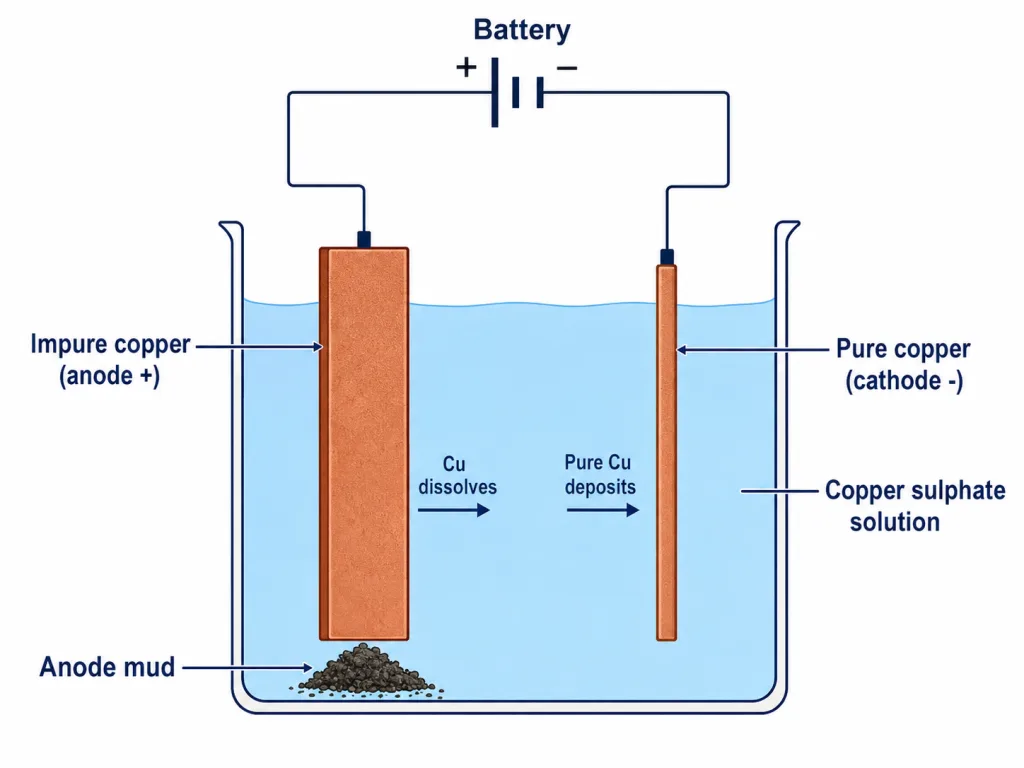
Electrolytic Refining — Principle
Make impure metal the Anode. Make a thin strip of pure metal the Cathode. Salt solution of the same metal — electrolyte.
Pass electric current.
What happens:
- Metal from Anode (impure) — into solution as ions.
- Metal ions from solution — deposited at Cathode in pure form.
- Impurities — fall below Anode as 'anode mud'.
Finally: pure metal at Cathode; valuable metals like Au, Ag, Pt in anode mud.
Electrolytic Refining of Cu
Setup:
- Thick strip of impure Cu = Anode (+)
- Thin strip of pure Cu = Cathode (-)
- Electrolyte: + dilute .
Reactions:
At Anode:
At Cathode:
Fate of impurities (Au, Ag, Pt, Fe, Zn):
- Au, Ag, Pt — fall below anode as 'anode mud'.
- Fe, Zn — go into solution as ions, but don't deposit at Cathode.
Finally: pure Cu (99.99%) at Cathode.
Al, Zn, Ni — Same Method
For each — that metal's salt as electrolyte.
- Al:
- Zn:
- Ni:
Anode Mud — An Interesting Yield
Anode mud from Cu refining contains:
- Gold (Au)
- Silver (Ag)
- Platinum (Pt)
This is not 'unwanted waste' — valuable! A 'bonus' product of Cu industry.
Corrosion — Introduction
The biggest enemy of metals: corrosion.
Definition
Slow chemical degradation of metals — by air, water, or other chemicals = Corrosion.
Products: oxides, hydroxides, sulphides, carbonates of metals.
Corrosion of Different Metals
1. Iron — Rust: — hydrated ferric oxide. Brown-red colour. Loose, porous — Fe inside also rusts.
2. Copper — Green Layer (Patina): Cu(OH)₂·CuCO₃ or CuCO₃ — green colour. On ancient copper objects — green layer.
3. Silver — Black Layer (Tarnish): Ag₂S — black sulphide. From (in air).
4. Aluminium — Silvery Layer: — thin, dense layer. Protects Al inside (Section 2 reference).
5. Gold — No Corrosion! Au very low reactivity.
Rust — Detailed
Required Elements:
- Water (moisture).
- Oxygen (air).
Rust occurs only when both are present. Not from water alone or air alone.
Reaction (simplified):
Fe₂O₃·xH_2O = rust.
Demonstration — Rust Experiment
Three test tubes:
A: Fe + water (air removed) → no rust. B: Fe + dry air (no water) → no rust. C: Fe + water + air → rust!
Conclusion: Both required.
Mechanism of Rust — Electrochemical
On Fe surface:
- Some areas — Anode (Fe → Fe²⁺ + 2e⁻).
- Some areas — Cathode (O₂ + 2H₂O + 4e⁻ → 4OH⁻).
Fe²⁺ and OH⁻ → Fe(OH)₂ → Fe(OH)₃ → Fe₂O₃·xH₂O.
That is, rust = a 'micro-electric cell'.
Influencing Factors
1. Moisture: more → more rust. 2. Pollution (): acid rain → faster. 3. Salt (): more on coasts. 4. Temperature: higher → faster. 5. Surface state: cracks → faster.
Practical Impact
Each year worldwide — lakhs of tonnes of Fe destroyed by rust. India: ~10% of Fe production lost to rust. Economic loss: crores of rupees.
Prevention of Corrosion
Many ways to prevent rust — in modern industry.
1. Painting
Layer of paint on Fe surface. Protection from both oxygen and moisture.
Advantages:
- Cheap.
- Easy.
- Available in various colours.
Disadvantages:
- If paint scratches off — rust below.
- Needs periodic replacement.
Use: cars, windows, garden iron items.
2. Oiling/Greasing
Thin layer of oil.
Advantages:
- Immediate.
- Simple.
- Easy to apply.
Disadvantages:
- Dries up in some time.
- Needs reapplication.
Use: machine parts, locks, tools.
3. Galvanisation
Coating Fe surface with Zn.
Zn — more reactive than Fe. If layer scratches off — Zn corrodes first (not Fe!).
This is 'cathodic protection'.
Method: Dip Fe in molten Zn — Zn layer formed.
Use:
- Taps
- Pipes
- Buckets
- Roofs
- Fences
'Galvanised iron' (GI) — common market name.
4. Chromium Plating
Cr layer by electrolytic method.
Advantages:
- Shiny.
- Durable.
- Corrosion-resistant.
Use: taps, car parts.
5. Electroplating
Coating one metal with another by electrolytic method.
Common Examples:
- Ni on Fe
- Sn on Fe
- Cr on Fe
6. Anodising
Forming thicker Al₂O₃ layer on Al. (Refer Section 2.)
Only Al — no foreign substance.
7. Use of Alloys
Alloys are better than pure metal. Example: Stainless steel — Fe + Cr + Ni.
A layer of Cr — protects Fe.
Alloys — What and Why?
Definition: A homogeneous mixture of two or more metals — or one metal + one non-metal.
Major Examples:
| Alloy | Composition | Use |
|---|---|---|
| Stainless steel | Fe + Cr + Ni | Utensils, knives |
| Brass | Cu + Zn | Decoration, utensils |
| Bronze | Cu + Sn | Statues, medals |
| Solder | Pb + Sn | Welding |
| Duralumin | Al + Cu + Mg + Mn | Aircraft |
| Magnalium | Al + Mg | Light fixtures |
Advantages of Alloys:
- Increased hardness.
- Corrosion resistance.
- Lower melting point (in some).
- More useful.
Example: pure Au — soft. 22-carat gold (Au + Cu) — durable.
Electroplating — Detailed
A famous refining-protection method.
Principle
By electrolytic method — coating one metal with a thin, uniform layer of another metal.
Basic Setup
Example: Ag plating on Fe object
- Cathode (-): Fe object (the one to be coated).
- Anode (+): Ag strip.
- Electrolyte: solution.
Reactions
At Anode:
Ag into solution.
At Cathode:
Ag — deposited on Fe object.
That is, the concentration of electrolyte remains constant.
Commercial Uses
1. Gold plating:
- Gold on cheap jewellery.
- Looks expensive, but light weight.
2. Silver plating:
- On dining utensils.
- On decorative items.
3. Cr plating:
- Taps, bathroom fittings.
- Car parts (chrome trim).
4. Ni plating:
- On coins (in some countries).
- Electrical switches.
5. Tin plating:
- Inside food cans (Fe + Sn = 'tin can').
- Sn — non-reactive with food.
Advantages of Electroplating
- Thin, uniform layer.
- Precise control.
- For various metals.
- On complex shapes too.
Practical Example — Tin Can
Fe + Sn coating = food can.
Why Sn?
- No reaction with food.
- Easy plating.
- Cheap.
If Sn layer scratches → Fe rusts. Hence open tin cans rust quickly.
Comparison — Galvanisation vs Plating
| Property | Galvanisation | Electroplating |
|---|---|---|
| Principle | Physical | Electrochemical |
| Metal | Zn | Cr, Ag, Au, Sn |
| Purpose | Protection | Protection + Decoration |
| Example | GI tap | Cr-plated faucet |
| If Fe scratches | Zn first corrodes | Fe rusts under layer |
An Interesting Fact
'Galvanisation' — named after Luigi Galvani. He studied 'bioelectricity' in 1791. Same name — 'galvanometer' and 'galvanisation'.
Comparison of Anti-Corrosion Methods
A Summary Table
| Method | Principle | Advantages | Limitations |
|---|---|---|---|
| Paint | Physical barrier | Cheap | Bad on scratches |
| Oil | Barrier | Immediate | Short term |
| Galvanisation (Zn) | Cathodic protection | Durable | Expensive |
| Cr plating | Electroplating | Shiny | Complex |
| Anodising | Oxide layer | Special | Only for Al |
| Alloy | Composition | Permanent | Initial cost |
Which Method When?
1. At home:
- Taps (GI)
- Doors (paint)
- Food utensils (stainless steel)
2. In industry:
- Pipes (galvanised)
- Cars (paint + Cr plating)
- Railway tracks (special alloy)
3. Special:
- Aircraft (Al + anodising)
- Ships (special alloy + paint)
Cathodic Protection — An Interesting Method
Make Fe a 'cathode' — and 'sacrifice' another metal.
Principle:
- A more reactive metal (Mg, Zn) — connected to Fe.
- On corrosion — that metal first (sacrificial).
- Fe protected.
Examples:
- Hulls of ships: Mg/Zn strips on Fe.
- Underground pipes: Mg-block attached.
- Aqueous storage tanks: Zn-anode.
This is 'sacrificial protection'.
Mg/Zn keep getting consumed — replaced periodically.
Stainless Steel — A 'Miracle'
Composition: Fe + Cr (>10%) + Ni + others
Why doesn't this rust?
Because of Cr — a very thin layer of on the surface. This layer — dense, pore-free. Protects Fe inside.
Even if scratched — Cr forms again (Cr in air automatically).
That is, 'self-healing' protection.
Alloys — In Detail
Stainless Steel
- 18% Cr + 8% Ni + 74% Fe.
- Kitchen utensils, knives.
- India: Tata, Jindal — major.
Brass
- Cu + Zn.
- Decoration, utensils, musical instruments.
- Yellow colour.
Bronze
- Cu + Sn.
- Statues, medals, bells.
- Brown colour.
Solder
- Pb + Sn (50:50).
- Electrical welding.
- Low melting point (~180°C).
Amalgam
- Hg + another metal.
- Dentistry (Hg + Ag + Sn).
- In gold extraction.
Properties of Alloys
Compared to pure metal:
- Hardness ↑
- Corrosion resistance ↑
- Melting point usually ↓
- Electrical conductivity usually ↓
An Interesting Comparison
Pure Au: very soft — jewellery cannot be made. 22-carat Au (Au + Cu): hard — jewellery can be made. 18-carat Au: even harder. 'White Gold' (Au + Pd/Ni): white colour, durable.
That is — alloy makes 'gold' more useful.
[Board Important] Remember 4-5 examples of alloys.
🧠 Memory Capsule
A quick glance just before the board exam.
1. Electrolytic Refining (Cu example)
- Anode: impure Cu (thick strip).
- Cathode: pure Cu (thin strip).
- Electrolyte: CuSO₄ + H₂SO₄.
- At Anode: .
- At Cathode: .
- Impurities: Anode mud (Au, Ag, Pt) + solution (Fe, Zn).
2. Corrosion Products
| Metal | Corrosion Product | Colour |
|---|---|---|
| Fe | Fe₂O₃·xH₂O (rust) | Brown-red |
| Cu | Cu(OH)₂·CuCO₃ | Green |
| Ag | Ag₂S | Black |
| Al | Al₂O₃ (layer) | Silvery |
3. Required for Rust
Both: Water (moisture) + Oxygen (air). Not from one alone.
Basic Reaction:
4. Anti-Corrosion Methods
- Paint (cheap).
- Oil/Grease (immediate).
- Galvanisation (Zn coating — Cathodic protection).
- Cr plating (shiny).
- Electroplating (thin layer).
- Anodising (on Al).
- Alloy (stainless steel).
5. Famous Alloys
| Alloy | Composition |
|---|---|
| Stainless steel | Fe + Cr + Ni |
| Brass | Cu + Zn |
| Bronze | Cu + Sn |
| Solder | Pb + Sn |
| Duralumin | Al + Cu + Mg + Mn |
| Amalgam | Hg + others |
6. Galvanisation (Special)
- Layer of Zn on Fe.
- Zn corrodes first (cathodic protection).
- Taps, pipes, buckets.
7. Electroplating Example (Ag on Fe)
- Cathode: Fe object.
- Anode: Ag strip.
- Electrolyte: AgNO₃.
8. Board's 'Golden' Questions
- Electrolytic refining — diagram.
- Mechanism of rust and prevention.
- Method of galvanisation.
- 5 famous alloys names and uses.
- What is anode mud? How valuable?
Final Formula: 'Refining = pure; Corrosion = degradation; Alloy = better.'
Solved Examples
Example 1: NCERT — Electrolytic Refining (Cu)
Explain the electrolytic refining of Cu in detail.
Solution:
Setup
Required:
- Thick strip of impure Cu — Anode (+).
- Thin strip of pure Cu — Cathode (-).
- Electrolyte: solution of dilute + .
- A tank — to hold solution.
- DC power source.
Electrolyte
In solution:
Reaction at Anode (+)
Impure Cu — into solution as ions:
Cu²⁺ — go into solution.
Fate of impurities:
- Less reactive than Cu (Au, Ag, Pt) — fall as 'anode mud' below the Anode.
- More reactive than Cu (Fe, Zn, Ni) — go into solution as ions, but don't deposit at Cathode.
Reaction at Cathode (-)
Cu²⁺ — accept electrons from solution:
Pure Cu — deposits on Cathode.
Net Result
- Anode: keeps decreasing (Cu → Cu²⁺ → solution).
- Cathode: keeps increasing (Cu²⁺ → Cu → deposited).
- Solution: Cu²⁺ concentration constant.
- Anode mud: Au, Ag, Pt (valuable!).
Role of Anode Mud
Not 'unwanted waste' — highly valuable! A 'bonus' product of Cu industry.
Each year in India — significant amount of gold/silver from Cu refining.
Diagram (in words)
  | + | - |
  | A |   |   ← two electrodes
  |   |   |
  | i | p |   ← impure Cu (Anode), pure Cu (Cathode)
  | m | u |
  | p | r |
  | u | e |
  | r |   |
  | e |   |
  | Cu | Cu |
  +---+---+
  CuSO₄ + H₂SO₄ solution

  Below anode — anode mud (Au, Ag)
Purity
Finally: Cu at Cathode = 99.99% pure.
This — suitable for making electrical wires.
For Other Metals
Al, Zn, Ni — refined by similar method. For each — corresponding metal salt solution.
[NCERT textbook — every year in board]
Example 2: NCERT — Rust Experiment
What are the elements required for rust? Prove with an experiment.
Solution:
Basic Question
Rust on Fe — from water, from air, or from both?
Famous Experiment — Three Test Tubes
Setup: Three test tubes. An Fe nail in each.
Tube A:
- Fe nail + boiled water (air removed).
- Layer of oil on top (to prevent air).
Tube B:
- Fe nail + dry air.
- Below: CaCl₂ (drying agent — absorbs water).
Tube C:
- Fe nail + water + air (both available).
Observe after a few days.
Observations
| Tube | Conditions | Result |
|---|---|---|
| A | Water, no air | No rust |
| B | Air, no water | No rust |
| C | Water + air | Rust! |
Conclusion
Required for Rust:
- Water (moisture).
- Oxygen (air).
Not from one alone. Both needed.
Basic Reaction
Product: = rust. Brown-red colour.
Practical Effect
This is why:
- Coastal areas have more rust (more moisture).
- Rust inside water pipes (water + small air).
- Less rust in deserts (less moisture).
Accelerating Factors
1. Salt (NaCl):
- As electrolyte.
- Rust 5-10× faster.
2. Pollution ():
- Acid rain.
3. Temperature:
- More heat → more speed.
An Interesting Fact
Rust on Fe — can also be 'cyclic'. Surface that has rust — gets more rust. That is, 'autocatalytic'.
This is why — even a small rust grows a lot over time.
[NCERT textbook — every year in board]
Example 3: NCERT — Galvanisation
What is galvanisation? Explain its process and benefits.
Solution:
Definition
'Galvanisation' = process of coating Fe with Zn.
Purpose: To protect Fe from corrosion.
Method
1. Cleaning of Fe object:
- Wash with dilute acid.
- Remove surface impurities.
2. Dipping in molten Zn:
- Melting point of Zn ~420°C.
- Dip Fe object for a few seconds.
3. Cooling:
- Take out and cool.
- Thin layer of Zn settles on Fe.
Finally: Fe + Zn coating = Galvanised Iron (GI).
Principle — 'Cathodic Protection'
Zn — more reactive than Fe.
Reactivity:
If layer scratches and water/air reaches inside:
- Zn corrodes first (Anode).
- Fe becomes Cathode and remains protected.
That is, Zn — 'sacrificial' metal.
Practical Benefits
1. Protection even on scratches.
- Paint scratches → rust.
- Zn scratches → Fe still protected (Zn first!).
2. Long-term protection.
- For 20-50 years.
3. Simple method.
- Possible on mass scale.
4. Economical.
- Cheaper than other methods.
Practical Examples
Examples of 'Galvanised Iron' (GI):
- Water pipes (especially taps, tanks).
- Roofs (with asbestos).
- Buckets, garden items.
- Cables of bridges.
- Some car parts.
A Comparison — Paint vs Galvanisation
| Property | Paint | Galvanisation |
|---|---|---|
| Principle | Physical barrier | Electrochemical |
| Durability | Less | More |
| On scratches | Rust | Zn first |
| Cost | Low | High |
| Purpose | Decoration + protection | Only protection |
An Interesting Demonstration
Two Fe nails:
- A: Plain.
- B: Zn coating.
Place both in saltwater. After 1 week:
- A: completely rusted.
- B: no rust (Zn coating still).
Then scratch them and check:
- A: more rust.
- B: still no rust! (Zn left).
That is, 'sacrificial protection' — works.
[NCERT — important]
Example 4: NCERT — Alloys
What is an alloy? Mention five famous alloys' name, composition, and uses.
Solution:
Definition
'Alloy' = a homogeneous mixture of two or more metals — or one metal + one non-metal.
Purpose: better properties than pure metal.
Why Alloys Are Necessary?
Weaknesses of pure metals:
- Pure Fe rusts quickly.
- Pure Au is very soft.
- Pure Al is soft.
Improvements with alloys:
- Hardness ↑
- Corrosion-resistance ↑
- Lower melting point (in some)
- More durable
Five Famous Alloys
1. Stainless Steel
Composition:
- 74% Fe
- 18% Cr (main)
- 8% Ni
Properties:
- Corrosion-resistant ( layer from Cr).
- Shiny.
- Strong.
Uses:
- Kitchen utensils, knives.
- Medical instruments.
- Building construction.
2. Brass
Composition:
- 70% Cu
- 30% Zn
Properties:
- Yellow colour.
- Corrosion-resistant.
- Decorative.
Uses:
- Decorative items (statues, plates).
- Musical instruments (trumpet).
- Taps, handles.
3. Bronze
Composition:
- 88% Cu
- 12% Sn
Properties:
- Hard.
- Brown colour.
- Good acoustic properties.
Uses:
- Statues (ancient).
- Medals (Olympics).
- Bells, clocks.
'Bronze Age' — an era of human history.
4. Solder
Composition:
- 50% Pb
- 50% Sn
Properties:
- Low melting point (~180°C).
- Strong bond.
Uses:
- Electrical welding.
- Wire-joining.
- Circuit boards.
5. Duralumin
Composition:
- 95% Al
- 4% Cu
- 0.5% Mg
- 0.5% Mn
Properties:
- Light (like Al).
- Strong (like steel).
- Corrosion-resistant.
Uses:
- Aircraft.
- Rockets.
- Cars.
Other Important Alloys
6. Amalgam
Composition: Hg + another metal
Uses:
- Dentistry (Hg + Ag + Sn + Cu).
- Refining of gold.
7. Magnalium
Composition: Al + 5-30% Mg
Uses: light aircraft parts.
8. 22-carat Gold
Composition: 91.7% Au + 8.3% Cu
Properties: harder than pure Au.
Uses: jewellery.
Summary Table
| Alloy | Composition | Main Use |
|---|---|---|
| Stainless steel | Fe + Cr + Ni | Utensils, knives |
| Brass | Cu + Zn | Decoration |
| Bronze | Cu + Sn | Statues, medals |
| Solder | Pb + Sn | Welding |
| Duralumin | Al + Cu + Mg + Mn | Aircraft |
[NCERT textbook — every year in board]
Example 5: NCERT — Electroplating
Describe the process of Ag plating on Fe object.
Solution:
Setup
Required:
- Fe object (the one to be Ag plated).
- Ag strip.
- solution.
- DC power source.
- Tank.
Connections:
- Fe object = Cathode (-).
- Ag strip = Anode (+).
- Solution: AgNO₃.
Reactions
Ionisation of :
At Anode (+): Ag from Ag strip — into solution as ions:
Ag into solution.
At Cathode (-): Ag⁺ — reaches Fe object:
Ag — as thin layer on Fe object.
Net Process
From Anode → through solution → to Cathode.
Solution concentration remains constant.
Ag strip (Anode) — slowly dissolves. Fe object (Cathode) — gets covered with Ag.
Practical Control
Electric current:
- More current → thick layer, but uneven.
- Less current → thin, uniform layer.
Time:
- More time → thicker layer.
Solution concentration:
- Must be precise.
Other Examples
Cr plating on Fe
Solution: + . Anode: Pb (Cr is supplied from solution). Cathode: Fe object.
Use: taps, bathroom, car parts.
Sn plating on Fe (Tin Plating)
Solution: .
Use: food cans.
Sn — non-reactive with food. Fe — cheap and strong.
Advantages of Electroplating
- Thin, uniform layer.
- On complex shapes too.
- For various metals.
- Precise by electric control.
Commercial Use
On a large scale in India:
- Jewellery industry (gold/silver plating).
- Automobile industry (Cr, Ni).
- Food industry (Sn).
- Household utensils (Cr, Ni).
An Interesting Fact
'Imitation jewellery' = gold plating on cheap metal. Looks expensive, but cost 1/100. Thus — electroplating changed the world of decoration.
[NCERT — important]
Example 6: NCERT — Prevention of Corrosion
Mention 5 ways to protect metals from corrosion.
Solution:
1. Painting
Principle: Layer of paint on Fe surface.
Advantages:
- Cheap.
- Easy.
- Various colours.
Disadvantages:
- Rust on scratches.
- Periodic replacement.
Use:
- Cars.
- Windows, doors.
- Iron items at home.
2. Oiling/Greasing
Principle: Thin layer of oil.
Advantages:
- Immediate.
- Simple.
- Daily use.
Disadvantages:
- Dries up quickly.
- Reapplication needed.
Use:
- Machine parts.
- Locks.
- Tools.
3. Galvanisation
Principle: Layer of Zn on Fe.
Zn — more reactive than Fe. If layer scratches — Zn corrodes first. 'Cathodic protection'.
Advantages:
- Durable.
- Protection even on scratches.
Method:
- Dip Fe in molten Zn.
- (Hot dipping).
Use:
- Taps, pipes, buckets.
- Roofs, fences.
- 'GI sheet' — common market name.
4. Chromium Plating
Principle: Cr layer by electrolytic method.
Advantages:
- Shiny.
- Durable.
- Corrosion-resistant.
Use:
- Taps, bathroom fittings.
- Car bumpers.
- Motorcycle parts.
5. Use of Alloys
Principle: Mixing other metals into pure metal.
Example: stainless steel (Fe + Cr + Ni).
Advantages:
- Intrinsic protection.
- Protection even on scratches.
- Permanent.
- No external layer.
Use:
- Kitchen utensils.
- Medical instruments.
- Building construction.
Additional: Anodising
Principle: Thick layer on Al.
Only for Al. Use: window frames, utensils.
Summary Table
| Method | For Whom | Durability |
|---|---|---|
| Paint | All | Less |
| Oil | All | Very less |
| Galvanisation | Fe | More |
| Cr plating | Fe | More |
| Alloy | Special | Very high |
| Anodising | Al | More |
Choice — Which Method?
'Most durable — alloy.' Though initial cost is higher.
'Cheapest — paint.' But periodic replacement.
'Most popular — galvanisation.' For Fe.
[NCERT — every year in board, 5-mark]
Example 7: NCERT — A Mixed Question
(a) What is the formula of rust? (b) What is the green layer on Cu? (c) What is the black layer on Ag? (d) What is the layer on Al, and why does it protect?
Solution:
(a) Formula of Rust
Rust = Fe₂O₃·xH₂O
That is: hydrated ferric oxide. 'x' = variable number of water molecules.
Reaction:
Features:
- Brown-red colour.
- Loose, porous.
- Doesn't protect Fe inside (more rust below).
This is 'autocatalytic' — promotes itself.
(b) Green Layer on Cu
Green layer on Cu over time = 'Patina'.
Formula: Several possible:
- (basic Cu carbonate)
- (in urban pollution)
- (from acid rain)
Reaction (main):
Special: Unlike rust — patina is protective! Protects inner Cu from further corrosion.
Famous example: Statue of Liberty (USA) — Cu statue, covered in green patina.
(c) Black Layer on Ag
Black layer on Ag over time = 'Tarnish'.
Formula: (silver sulphide)
Reaction: Ag + small amount of in air:
or:
Sources of :
- Rotten eggs, onions.
- Some food items.
- Sulphur-containing air pollution.
How to remove:
- Polish with toothpaste.
- Aluminium foil + soda + hot water (electrochemical).
(d) Layer on Al
Layer formed instantly on Al = .
Reaction:
Features:
- Thin (a few micrometers).
- Dense (pore-free).
- Transparent (Al's shine visible).
- Hard.
Why Protective?
Three reasons:
1. Dense, pore-free.
- Fe₂O₃ loose — air inside.
- Al₂O₃ dense — air doesn't penetrate.
2. Tightly attached to inner Al.
- Doesn't peel off easily.
3. 'Self-healing' on scratches.
- In air, Al immediately forms again.
- Cracks fill automatically.
This is why: Al is shiny and durable.
Summary
| Metal | Layer | Formula | Nature |
|---|---|---|---|
| Fe | Rust | Fe₂O₃·xH₂O | Harmful |
| Cu | Patina | Cu(OH)₂·CuCO₃ | Protective |
| Ag | Tarnish | Ag₂S | Surface only |
| Al | Oxide | Al₂O₃ | Protective |
Al, Cu — protective layer. Fe — harmful layer. Ag — only surface.
[Board: 5-mark]
Example 8: An Interesting — Stainless Steel
What is stainless steel? Why doesn't it rust?
Solution:
Definition
'Stainless Steel' = an alloy of Fe + Cr (at least 10%) + Ni.
Stain = mark, less = without — that is, 'mark-less steel'.
Standard Composition
Most common (304 grade):
- 70-72% Fe
- 18% Cr
- 8% Ni
- 0.08% C
- Others in small amounts
Other grades:
- 316 — medical instruments (Mo too).
- 410 — knives.
Why Doesn't It Rust?
Main reason: Cr layer.
Cr — more reactive than Fe. On stainless steel surface — Cr reacts with air immediately.
Reaction:
— a very thin layer (a few nanometres!).
Special Properties of This Layer
1. Dense.
- Pore-free.
- O₂, H₂O — don't penetrate.
2. Hard.
- Doesn't peel easily.
3. Transparent.
- Fe-Cr shine visible.
4. 'Self-healing'.
- If scratched → Cr forms again.
- Cracks fill automatically.
That is, stainless steel — 'self-protecting'.
Role of Ni
Ni — more strength and density. Cr-Ni combination — most secure.
Without Ni — only 'martensitic' steel.
Types of Stainless Steel
1. Austenitic:
- 304, 316
- Most kitchen utensils.
- Highly corrosion-resistant.
2. Martensitic:
- 410, 420
- Hard, knives.
- Moderately corrosion-resistant.
3. Ferritic:
- 430
- Car exhaust.
- Moderate.
Practical Uses
Universal:
- Kitchen utensils (plates, bowls, spoons).
- Medical instruments.
- Building construction.
- Food industry.
- Chemical industry.
- Modern jewellery.
Stainless Steel in India
Major companies:
- TATA Steel
- Jindal Stainless
- Hindustan Stainless Steel
India — second-largest producer in the world.
An Interesting Comparison
Plain Fe vs Stainless Steel:
| Property | Fe | Stainless |
|---|---|---|
| Rust | Quickly | Never (in normal conditions) |
| Shine | Lost quickly | Lasting |
| Maintenance | More | Less |
| Cost | Low | High |
| Suitability | Heavy work | Food, medical |
A Famous Example
Iron Pillar of Delhi (near Qutub Minar):
1600 years old. No rust till today! Why? — special phosphorus-containing alloy.
This — 'Indian' technology before stainless steel. Our ancestors knew the secrets of alloys.
[Board + General Knowledge]
Example 9: NCERT — Comparison of Fe and Cu Refining
Differences between methods of refining Fe and Cu.
Solution:
Refining of Fe
'Pig Iron' (4% C, impurities) from Blast Furnace.
Main methods:
1. Bessemer Process
In egg-shaped 'converter'. Air blown through molten pig iron.
Impurities removed:
Impurities — as slag.
2. Open-hearth Process
In a large open furnace. Fe oxide + impurities. More controlled.
3. Electric Steel Furnace
For very pure steel. For special alloys.
Finally: steel with controlled C.
Refining of Cu
'Blister Copper' (~99%, but has impurities) from Cu pyrites.
Method: Electrolytic Refining.
Setup:
- Anode: thick strip of impure Cu.
- Cathode: thin strip of pure Cu.
- Electrolyte: + dilute .
Reactions: Anode: Cathode: (pure)
Impurities:
- Au, Ag, Pt: anode mud.
- Fe, Zn: in solution.
Finally: 99.99% pure Cu.
Comparative Table
| Property | Fe | Cu |
|---|---|---|
| Initial | Pig Iron (4% C) | Blister Cu (99%) |
| Main impurities | C, S, P, Si | Fe, Zn, Au, Ag |
| Method | Bessemer / Open-hearth | Electrolytic |
| Final | Steel | Pure Cu |
| Purity | Controlled C | 99.99% |
| Product impurity | Some (controlled) | Very low |
Why the Difference?
Fe:
- More production (lakhs of tonnes each year).
- Electrolytic impractical (very expensive).
- 'Bessemer' — cheap.
- Need controlled C in steel.
Cu:
- Less production (thousands of tonnes).
- 99.99% purity from electrolytic.
- Required for electrical wires.
- Bonus gold from anode mud.
An Interesting Point
That is — refining method depends on final use of the product.
Fe → steel (controlled C — Bessemer). Cu → wires (very pure — electrolytic).
[NCERT — important]
Example 10: A Numerical — Electrolytic Refining
How much electric charge is needed to reduce 10 g of Cu²⁺ ions? (Cu = 63.5)
Solution:
Reaction (at Cathode):
Basic Principle: 1 mol Cu = 63.5 g. 2 mol electrons for 1 mol Cu. Charge of 1 mol e⁻ = 1 Faraday = 96500 C.
Calculation:
Moles in 10 g Cu:
Quantity of electrons:
Total charge:
≈ 30,300 C (Coulombs).
Answer: About 30,300 C of charge needed.
Additional Calculation
If current is 5 A — what time?
That is ~1 hr 41 min.
Practical Relevance
In Cu industry:
- Hundreds of Cu strips in one tank.
- Currents of thousands of amperes.
- Runs for many days.
- Active day and night.
Energy use:
- 1 kg Cu refining ≈ 200-300 kWh.
- Less than Al (Al — 14000 kWh/ton).
- Cu — relatively 'cheap'.
Faraday's Law
This is Faraday's First Law:
'Amount of metal deposited is proportional to charge passed.'
Where Z = electrochemical equivalent.
Key Insight
Electrolytic refining = precise control. Current, time → amount of pure metal.
[Board: 3-mark numerical]
Example 11: An Interesting Question — Anode Mud
What is in the anode mud during electrolytic refining of Cu? Is it 'waste' or 'valuable'?
Solution:
What's in Anode Mud?
Impurities in thick strip of Cu (Anode):
- Cu (main)
- Less reactive metals:
- Gold (Au)
- Silver (Ag)
- Platinum (Pt)
- Iridium (Ir)
- More reactive metals:
- Fe, Zn, Ni
What Happens in Electrolysis?
At Anode:
- Cu — into solution as ions.
- Fe, Zn, Ni — also into solution (more reactive).
- Au, Ag, Pt — not into solution! (less reactive — don't form ions).
- They fall below the Anode.
At Cathode:
- Cu²⁺ — deposited as Cu.
- Fe²⁺, Zn²⁺ — above Cu in ionic series — don't deposit.
- Stay in solution.
Anode Mud — Analysis
Muddy sediment at the bottom of the tank below the anode — 'anode mud'.
Typical composition (~%):
- Au: 0.5-2%
- Ag: 5-15%
- Pt, Pd: 0.1-1%
- Cu (small): few%
- Others: selenium, tellurium
Valuable!
This is not 'waste' — highly valuable!
Economic value:
- 1 ton of anode mud has ~5-10 kg Au, 50-150 kg Ag.
- Value: lakhs of rupees.
In Cu industry:
- Profit from selling Cu.
- Additional profit from selling anode mud.
- 'Double profit'.
How to Extract Metals from Anode Mud?
Method:
- Collect anode mud.
- Smelting:
- Melting at high temperature.
- Cu and others separated in first phase.
- Chemical treatment:
- Au, Ag — cyanide leaching.
- Pt — special solvents.
- Electrolytic refining again:
- Pure Au, Ag, Pt.
Commercial Importance
Worldwide:
- ~20% profit of Cu industry — from anode mud.
- India: Hindustan Copper Limited — commercial production from anode mud.
'Gold mines' — old. Now a big share of Au — from Cu refining!
An Interesting Fact
Amount of Au extracted from Cu refining in a year — more than several 'gold mines'!
That is — Cu industry = indirectly Au industry.
Key Insight
'Waste' and 'valuable' — a matter of perspective. Anode mud is a famous example. This is — modern 'circular economy' principle.
[Board + General Knowledge]
Example 12: NCERT — A Comparative Question
(a) What is patina (green layer)? Why is it protective? (b) What is tarnish (black layer)? How to remove?
Solution:
(a) Patina
Definition: Green layer formed on Cu over time.
Formula (main):
That is: basic copper carbonate.
Reaction:
This is a slow reaction — visible over many years.
Why Protective?
Three reasons:
1. Dense layer.
- O₂, CO₂ don't penetrate.
2. Tightly held to inner Cu.
- Doesn't peel off easily.
3. Lasts for generations.
- 100+ years.
This — opposite to rust on Fe. Rust loose, more rust inside; patina dense, protective.
Famous Example
Statue of Liberty (USA):
- Cu statue, installed 1886.
- Initially shiny red-brown.
- After ~30 years — completely covered in green patina.
- Cu inside still safe today!
Others:
- Cu doors of old temples.
- Copper statues (ancient).
- Some roofs of Cu sheets.
(b) Tarnish
Definition: Black layer formed on Ag over time.
Formula: (silver sulphide)
Reaction:
or (with O₂ in air with H₂S):
Sources of :
- Rotten eggs, onions, garlic.
- Some food items.
- Sulphur-containing air pollution.
- Some rubber items.
How to Remove?
Method 1: Mechanical (Polish)
- Toothpaste + soft cloth.
- Silver polish.
- Simple, but some Ag also removed.
Method 2: Chemical — Aluminium Foil Method
This is an electrochemical method.
Materials:
- Al foil (a piece).
- Hot water.
- Soda (NaHCO₃ or Na₂CO₃).
Method:
- Put Al foil at the bottom of a container.
- Place tarnished Ag on Al foil.
- Pour soda + hot water.
- Wait a few minutes.
Reaction:
That is:
- Al displaced Ag (Al > Ag in reactivity).
- Ag freed — shiny back.
- Al — as Al₂S₃ on the foil.
This is a displacement reaction.
Why Al?
Al — more reactive than Ag. Forming Al₂S₃ — easy. Ag freed.
This is 'sacrificial' method — Al sacrificed, Ag saved.
Comparison — Patina vs Tarnish
| Property | Patina | Tarnish |
|---|---|---|
| Metal | Cu | Ag |
| Formula | Cu(OH)₂·CuCO₃ | Ag₂S |
| Colour | Green | Black |
| Nature | Protective | Surface only |
| Removal | Unnecessary | Toothpaste / Al foil |
Key Insight
Different layers on different metals — different behaviour. Some protective (Cu, Al), some harmful (Fe), some surface (Ag).
[Board + Practical]
Example 13: NCERT — A Challenge
State true/false for the following — with reasons:
(a) Alloys are weaker than pure metals. (b) In galvanisation, Cu coating is given on Fe. (c) Only water is required for rust. (d) Anode mud is waste of Cu industry.
Solution:
(a) Alloys weaker — False ✗
Truth: Alloys are mostly stronger than pure metals.
Reasons:
- Increased hardness (other atoms create obstruction in 'crystal lattice').
- Corrosion-resistance.
- Durability.
Examples:
- Stainless steel (Fe + Cr + Ni) — much stronger than Fe.
- Duralumin (Al alloy) — 4× stronger than Al.
- 22-carat Au — harder than pure Au.
Exception: Some alloys — less in electrical conductivity. Example: steel compared to Cu.
(b) Cu on Fe — False ✗
Truth: In galvanisation, Zn layer on Fe.
Why Zn, not Cu?
Reactivity:
- Zn — more reactive than Fe.
- On scratch, Zn corrodes first.
- Fe protected ('cathodic protection').
If Cu layer:
- Cu, less reactive than Fe.
- On scratch — Fe corrodes first!
- Reverse — no protection of Fe, more damage.
Hence Cu layer — harmful.
(c) Only water for rust — False ✗
Truth: For rust both water and air (O₂) are required.
Evidence — three test tubes experiment:
- A: water + no air → no rust.
- B: air + no water → no rust.
- C: water + air → rust!
Basic Reaction:
All three in reaction — Fe, O₂, H₂O.
Not just water. Not just air either.
(d) Anode mud waste — False ✗
Truth: Anode mud — highly valuable.
Why? Anode mud has:
- Gold (Au)
- Silver (Ag)
- Platinum (Pt)
These metals less reactive than Cu — don't form ions in electrolysis — fall below Anode.
Economic value:
- 1 ton anode mud has 5-10 kg Au + 50-150 kg Ag.
- Price: lakhs of rupees.
Commercial use:
- ~20% profit of Cu industry — from anode mud.
- Separate companies — just for extracting metal from anode mud.
That is, 'waste' — a 'treasure'!
Summary
| Statement | T/F | Reality |
|---|---|---|
| Alloy weaker | ✗ | Stronger |
| Cu on Fe | ✗ | Zn coating |
| Only water rust | ✗ | Water + O₂ |
| Anode mud waste | ✗ | Valuable |
All four false — learn the correct answers.
[Board: 5-mark logical]
Example 14: A Numerical — Composition of Brass
50 g of brass (Cu + Zn) has 70% Cu. Quantity of each metal?
Solution:
Given:
- Total brass = 50 g
- Cu content = 70%
- Zn content = 30% (remainder)
Quantity of Cu:
Quantity of Zn:
Verification: 35 + 15 = 50 g ✓
Answer:
- Cu = 35 g
- Zn = 15 g
Additional Calculation
Quantity in moles:
- Cu: mol
- Zn: mol
Mole ratio: Cu : Zn = 0.551 : 0.229 = 2.4 : 1
That is, ~2.4 atoms of Cu for every 1 atom of Zn.
Types of Brass
70:30 — common brass (Brass 70/30). Use: cartridges, jewellery.
Other types:
| Composition | Type | Use |
|---|---|---|
| 95% Cu, 5% Zn | Gilding metal | Decoration |
| 70% Cu, 30% Zn | Cartridge brass | Bullets |
| 60% Cu, 40% Zn | Muntz metal | Building |
| 90% Cu, 10% Zn | Commercial bronze | Utensils |
Why This Ratio?
More Cu → soft, less corrosion. More Zn → hard, but brittle. 70:30 — balance.
An Interesting Demonstration
If 30% Cu and 70% Zn:
- Colour: silvery
- Properties: like Zn.
- Now this is not 'brass' — different name.
That is — Cu predominance defines brass.
Practical Use
70:30 brass:
- Decorative statues.
- Plates, bowls.
- Musical instruments (trumpet, bell).
- Taps, handles.
Most 'brass utensils' — this composition.
[Board: 3-mark numerical]
Example 15: A Mixed — An Interesting Experiment
Three Fe nails:
- A: Plain.
- B: Zn coating (galvanised).
- C: Oiled.
All three placed in salt water. After 1 week — what?
Solution:
Analysis
Nail A — Plain
Result: Completely rusted.
Reason:
- Salt water = electrolyte.
- Both O₂ and H₂O available.
- No protection.
- Fe → Fe₂O₃·xH₂O (rust).
Rust 5-10× faster in presence of salt.
Nail B — Galvanised
Result: No rust!
Reason:
- Zn layer — active.
- Zn — more reactive than Fe.
- If any corrosion — Zn first.
- Fe protected (Cathodic protection).
At end of week:
- Zn layer slightly reduced.
- Fe — shiny, no rust.
Nail C — Oiled
Result: Some rust.
Reason:
- Oil — physical barrier.
- Slight protection from O₂ and H₂O.
- But oil dissolves slightly in water or evaporates.
- Over time, oil is removed.
- Some Fe exposed.
At end of week:
- Some part rust-free.
- Some part rusted.
- Better than A, worse than B.
Comparative Table
| Nail | Protection | Result | Durability |
|---|---|---|---|
| A (plain) | None | Full rust | — |
| B (galvanised) | Zn coating | No rust | Highest |
| C (oiled) | Physical | Some rust | Less |
Conclusion
Best protection: B (galvanisation).
Zn layer — most effective.
Practical Insight
If we want to keep Fe object in salt water (sea) for a long time:
1. Best: Galvanised + additional paint. 2. Moderate: Galvanised. 3. Less: Oil. 4. Worst: No protection.
A Question: Why Do Items Rust Quickly on Coasts?
Answer:
- More moisture.
- NaCl (salt) — electrolyte.
- Cl⁻ ions — attack Fe surface.
- Rust 5-10× faster.
Hence — special paint and alloys on sea ships. Coastal cities of India — Kolkata, Mumbai, Chennai — Fe items rust quickly.
Final Formula
'Sea + Fe = ideal for rust.' Hence in marine environment: galvanisation + paint + special alloys.
[Board + General Knowledge]
Example 16: A Concluding Question
(a) Process of electrolytic refining. (b) Required elements for rust. (c) Why is galvanisation useful? (d) Names and compositions of 5 famous alloys.
Solution:
(a) Electrolytic Refining
Setup (Cu example):
- Anode (+): thick strip of impure Cu.
- Cathode (-): thin strip of pure Cu.
- Electrolyte: + dilute .
Reactions: At Anode: At Cathode:
Fate of impurities:
- Au, Ag, Pt → anode mud.
- Fe, Zn → in solution.
Final: 99.99% pure Cu at Cathode.
(b) Required Elements for Rust
Two required elements:
- Water (H₂O / moisture).
- Oxygen (O₂).
Not from one alone. Both needed.
Reaction:
Evidence:
- A test tube: water (no air) — no rust.
- B test tube: air (no water) — no rust.
- C test tube: both — rust.
(c) Why is Galvanisation Useful?
1. Cathodic Protection:
- Zn — more reactive than Fe.
- On scratch, Zn corrodes first.
- Fe protected.
2. Long Durability:
- 20-50 years.
3. Protection on Scratches:
- Unlike other methods.
4. Economical:
- Cheap on mass scale.
Use: taps, pipes, buckets, roofs.
(d) 5 Famous Alloys
1. Stainless Steel
- Composition: 74% Fe + 18% Cr + 8% Ni
- Use: kitchen utensils, knives.
2. Brass
- Composition: 70% Cu + 30% Zn
- Use: decoration, utensils, musical instruments.
3. Bronze
- Composition: 88% Cu + 12% Sn
- Use: statues, medals.
4. Solder
- Composition: 50% Pb + 50% Sn
- Use: electrical welding.
5. Duralumin
- Composition: 95% Al + 4% Cu + 0.5% Mg + 0.5% Mn
- Use: aircraft, cars.
Final Formula
'Refining + Protection + Alloys = Modern metal industry.'
[Board: 5-mark mixed question]