
Immunity That Learns and Remembers
Unlike the innate defences we are born with, acquired immunity is pathogen-specific — it is tailored to the particular invader — and its defining feature is memory.
Here is what memory means. The first time the body meets a given pathogen, it mounts a primary response, which is of low intensity. If the same pathogen turns up again later, the body launches a far stronger secondary response, also called the anamnestic response. The second reaction is highly intensified precisely because the body remembers the first encounter. This memory is the whole basis of how vaccines protect us.
The Two Lymphocytes Behind the Response
Both the primary and secondary responses are carried out with the help of two special types of lymphocytes found in our blood: B-lymphocytes and T-lymphocytes.
The roles differ in an important way. B-lymphocytes produce an army of proteins called antibodies that are released into the blood to fight the pathogens. T-lymphocytes, on the other hand, do not themselves secrete antibodies — instead they help the B-cells produce them. Keep this distinction clear, because it is a favourite point to test.
What an Antibody Looks Like
Each antibody molecule is built from four peptide chains — two shorter ones called light chains and two longer ones called heavy chains. Because of this, an antibody is represented as H2L2. The molecule is Y-shaped, with antigen-binding sites at the tips that lock onto the specific pathogen.
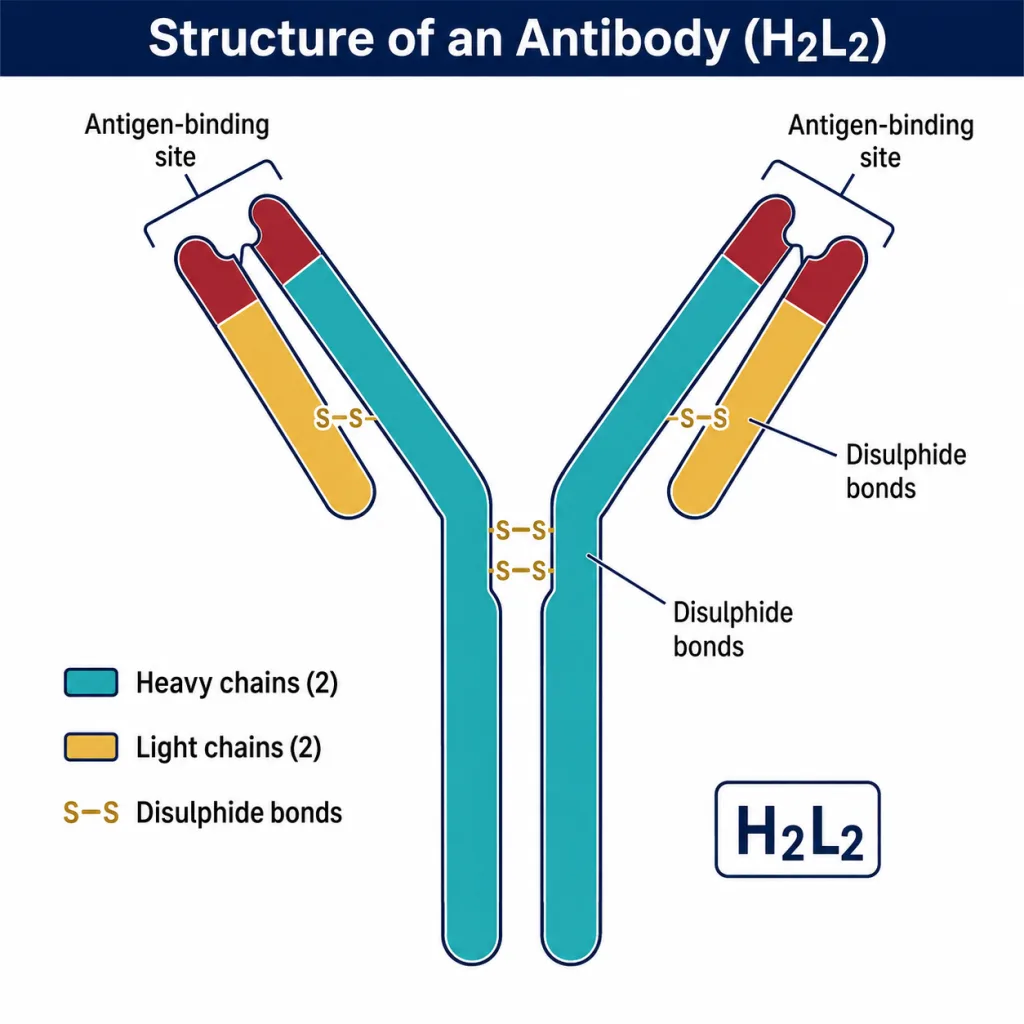
The body makes several classes of antibodies, among them IgA, IgM, IgE and IgG.
Humoral and Cell-Mediated Immunity
Because antibodies circulate in the blood (the body "humor"), the antibody-based defence is called the humoral immune response. This is one of the two arms of acquired immunity — the antibody-mediated arm.
The second arm is cell-mediated immunity (CMI), and it is mediated by the T-lymphocytes. CMI is what lets the body tell self from non-self. This ability has a very practical consequence in medicine: when an organ such as the heart, kidney or liver is transplanted, the body recognises the graft as non-self and the cell-mediated response causes graft rejection. This is why tissue matching and blood-group matching are done before any transplant, and why the patient must take immunosuppressants for life to keep the graft from being rejected.
Quick Recap
- Acquired immunity is pathogen-specific and characterised by memory.
- First exposure gives a low-intensity primary response; a later exposure to the same pathogen gives a strong secondary (anamnestic) response.
- Carried out by two lymphocytes: B-lymphocytes (make antibodies) and T-lymphocytes (help B-cells; do not secrete antibodies).
- An antibody has four peptide chains — two light and two heavy — written as H2L2; classes include IgA, IgM, IgE, IgG.
- Antibody-based defence = humoral immune response.
- Cell-mediated immunity (CMI) is run by T-lymphocytes, distinguishes self from non-self, and causes graft rejection — hence tissue/blood-group matching and lifelong immunosuppressants.
Solved Examples — Section 6
Q1. What two features distinguish acquired immunity from innate immunity?
Answer: Acquired immunity is pathogen-specific and it shows memory, whereas innate immunity is non-specific and present from birth.
Q2. Distinguish between the primary and secondary immune responses.
Answer: The primary response occurs on first exposure to a pathogen and is of low intensity; the secondary (anamnestic) response occurs on a later exposure to the same pathogen and is highly intensified because of memory.
Q3. How do the roles of B-lymphocytes and T-lymphocytes differ?
Answer: B-lymphocytes produce antibodies; T-lymphocytes do not secrete antibodies but help the B-cells produce them.
Q4. Why is an antibody written as H2L2?
Answer: Each antibody has four peptide chains — two light (L) chains and two heavy (H) chains — so it is represented as H2L2.
Q5. Why is the antibody-mediated defence called the humoral immune response?
Answer: Because the antibodies are found in the blood (a body "humor"), the antibody-mediated response is called the humoral immune response.
Q6. Which type of immunity causes graft rejection, and what precautions does this force on transplant surgery?
Answer: Cell-mediated immunity (CMI), run by T-lymphocytes, distinguishes self from non-self and causes graft rejection. So tissue matching and blood-group matching are done first, and the patient takes immunosuppressants for life.