
Malaria — a Disease Caused by a Protozoan
Malaria is a disease human beings have been fighting for centuries, and the culprit is not a bacterium or a virus but a tiny protozoan called Plasmodium. Different species cause different types of malaria — P. vivax, P. malariae and P. falciparum. Of these, the malignant malaria caused by Plasmodium falciparum is the most serious form and can even be fatal, which is why it is treated as a medical emergency.
What makes malaria unusual is that the parasite cannot complete its life on its own or inside a single host. It needs two hosts — a human and the female Anopheles mosquito. The mosquito is not just a place the parasite lives in; it is the vector, the transmitting agent that carries the parasite from one person to the next.
The Life Cycle of Plasmodium
The parasite enters the human body as sporozoites, the infectious form, through the bite of an infected female Anopheles mosquito. Once inside, the parasites do not attack the blood straight away. They first travel to the liver and multiply within the liver cells. Only after this stage do they move out and attack the red blood cells (RBCs), multiplying inside them until the cells rupture.
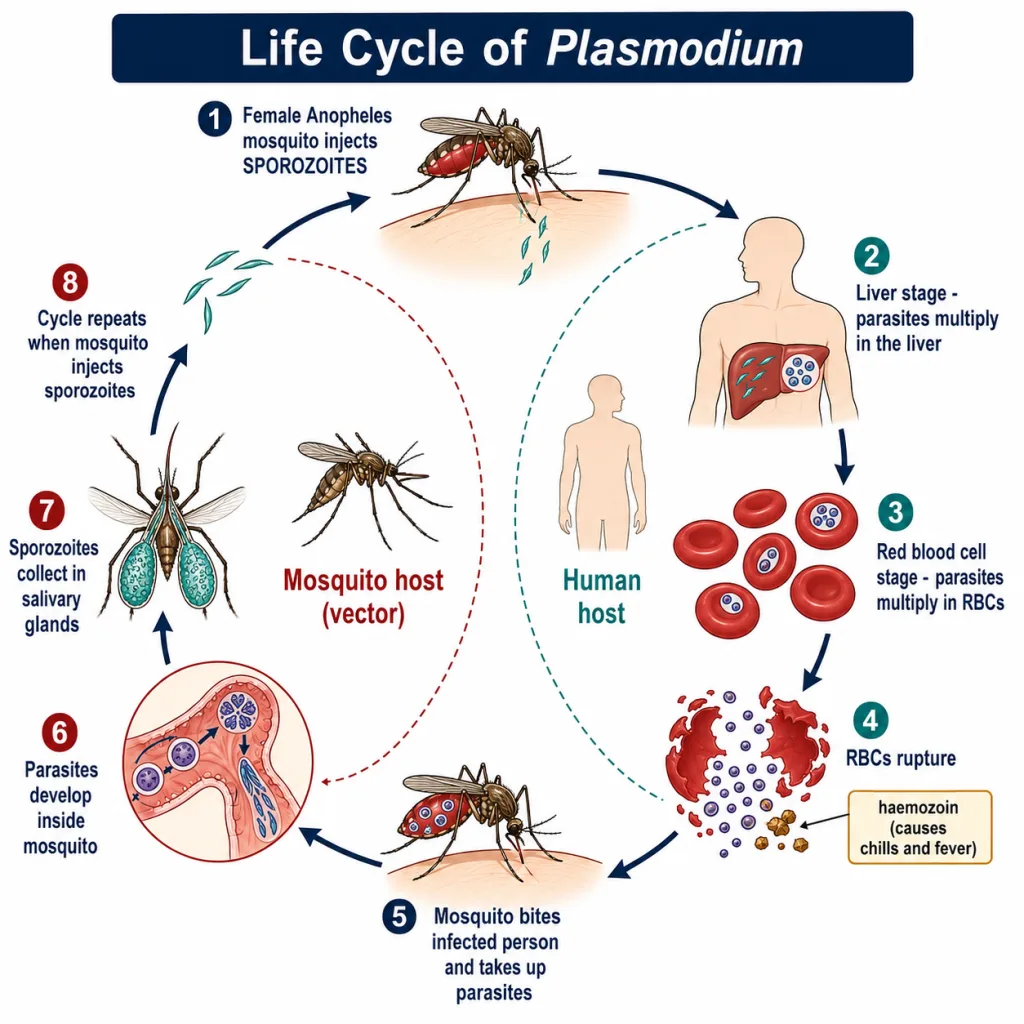
The cycle is completed in the mosquito. When a female Anopheles bites an infected person, the parasite's gametocytes (sexual stages formed inside the human's red blood cells) are taken up along with the blood. Fertilisation and further development take place in the mosquito's gut, and the parasites multiply to form fresh sporozoites. These are stored in the mosquito's salivary glands, ready to be injected into the next human it bites — and so the events begin all over again.
Why the Fever Comes in Waves
The rupture of the red blood cells is not just damage — it is what produces the classic symptoms of malaria. When the RBCs burst, they release a toxic substance called haemozoin. It is this toxin that is responsible for the chill and high fever that recur, characteristically, every three to four days. The repeating pattern of shivering followed by fever is a direct reflection of successive batches of parasites bursting out of the red blood cells together.
The Mosquito as Host and Vector
It helps to keep the two roles of the female Anopheles clear. It is a host, because part of the parasite's life cycle — the development into sporozoites — actually takes place inside its body. It is also the vector, because it physically transports the parasite from an infected person to a healthy one. Only the female mosquito bites and feeds on blood, so only the female is involved in transmission. Because the parasite needs the mosquito to spread, controlling the mosquito breaks the cycle — which is why mosquito control is at the heart of every malaria programme.
Quick Recap
- Malaria is caused by the protozoan Plasmodium; species include P. vivax, P. malariae and P. falciparum.
- Malignant malaria (P. falciparum) is the most serious form and can be fatal.
- The parasite needs two hosts — human and the female Anopheles mosquito, which is also the vector.
- Sporozoites (infectious form) enter through the mosquito bite → multiply in the liver → then attack the RBCs, causing them to rupture.
- RBC rupture releases the toxin haemozoin, causing the chill and high fever recurring every 3–4 days.
- In the human RBCs the parasite also forms gametocytes (sexual stages); the mosquito picks these up during a blood meal, fertilisation and development occur in the mosquito's gut, and the resulting sporozoites are stored in the salivary glands, ready to infect the next person.
Solved Examples — Section 3
Q1. Name the parasite that causes malaria and the species responsible for its most serious form.
Answer: Malaria is caused by the protozoan Plasmodium. Its most serious, malignant form is caused by Plasmodium falciparum, which can be fatal.
Q2. Why is malaria said to require two hosts?
Answer: The life cycle of Plasmodium cannot be completed in one host. It develops in the human (liver and red blood cells) and in the female Anopheles mosquito (where sporozoites form), so both are needed.
Q3. In what form does Plasmodium enter the human body, and where does it first multiply?
Answer: It enters as sporozoites (the infectious form) through the bite of an infected female Anopheles mosquito, and first multiplies within the liver cells before attacking the red blood cells.
Q4. What is haemozoin, and what is its role in the disease?
Answer: Haemozoin is a toxic substance released when the infected red blood cells rupture. It is responsible for the chill and high fever that recur every three to four days in malaria.
Q5. Explain why the female Anopheles mosquito is called both a host and a vector.
Answer: It is a host because part of the parasite's life cycle (formation of sporozoites) occurs inside it; it is a vector because it transmits the parasite from an infected person to a healthy one.
Q6. Where are the sporozoites stored in the mosquito, and why does this matter?
Answer: They are stored in the mosquito's salivary glands. This is why the next bite injects sporozoites into a new person, passing on the infection and continuing the cycle.