
Diseases We Catch from Bacteria and Viruses
Many of the everyday illnesses people pick up are caused by bacteria and viruses. In this section we look at three well-known ones — typhoid and pneumonia (bacterial) and the common cold (viral) — noting the pathogen behind each, the organ it attacks, and how it spreads.
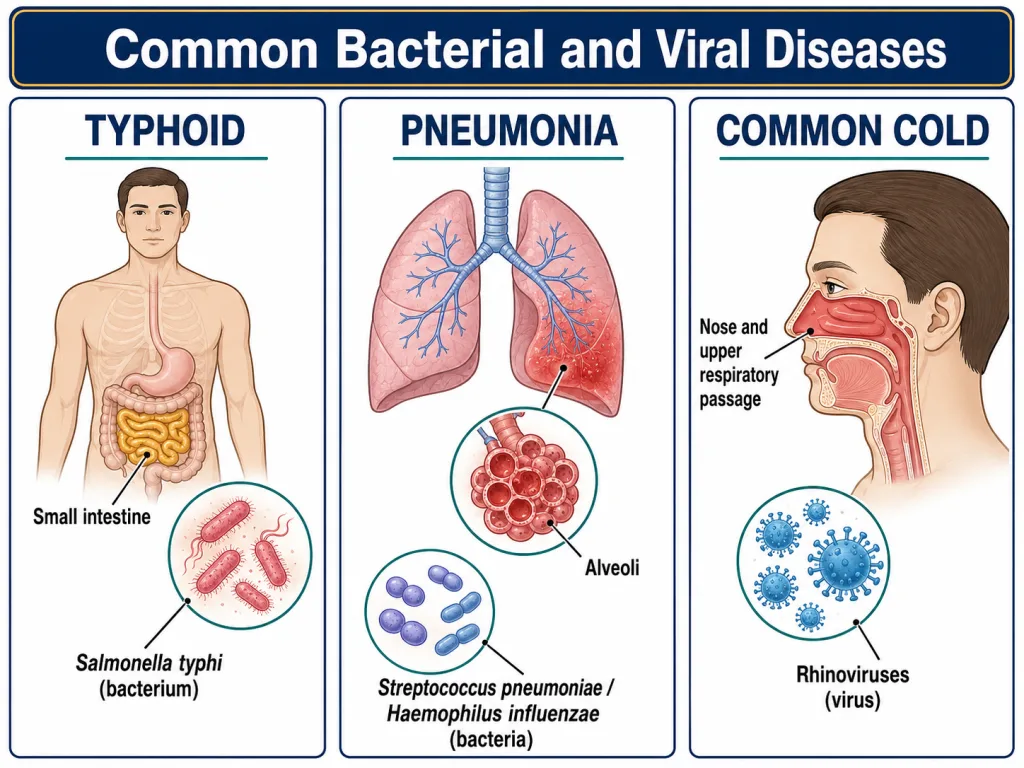
Typhoid — Salmonella typhi
Typhoid fever is caused by the bacterium Salmonella typhi. The pathogen usually enters through food and water contaminated with it, reaches the small intestine, and then spreads to other organs through the blood. Typical signs are a sustained high fever (39–40 °C), weakness, stomach pain, constipation, headache and loss of appetite; in severe cases the intestine can perforate, which may be fatal.
Typhoid can be confirmed by the Widal test. A famous case is that of Mary Mallon — "Typhoid Mary" — a cook who was a healthy carrier and unknowingly spread typhoid through the food she prepared for years.
Pneumonia — an Attack on the Alveoli
Pneumonia is caused by bacteria such as Streptococcus pneumoniae and Haemophilus influenzae, which infect the alveoli (the air sacs of the lungs). The infected alveoli fill with fluid, making breathing difficult. Symptoms include fever, chills, cough and headache; in severe cases the lips and fingernails may turn grey to bluish. A healthy person catches it by inhaling droplets or aerosols from an infected person, or even by sharing glasses and utensils with them.
Dysentery, plague and diphtheria are some other bacterial diseases of humans.
The Common Cold — Rhinoviruses
The common cold is one of the most infectious human ailments, caused by rhinoviruses. These infect the nose and respiratory passage but not the lungs. It brings nasal congestion and discharge, sore throat, hoarseness, cough, headache and tiredness, usually lasting 3–7 days. It spreads through droplets from coughs and sneezes — inhaled directly or picked up from contaminated objects like pens, cups, doorknobs or a shared keyboard.
Quick Recap
- Typhoid — Salmonella typhi; enters via contaminated food/water → small intestine; sustained fever 39–40 °C; confirmed by the Widal test ("Typhoid Mary" = healthy carrier).
- Pneumonia — Streptococcus pneumoniae and Haemophilus influenzae; infects the alveoli, which fill with fluid; spreads by droplets and shared utensils.
- Common cold — rhinoviruses; infect the nose and respiratory passage (not the lungs); last 3–7 days; spread by droplets and contaminated objects.
- Other bacterial diseases: dysentery, plague, diphtheria.
Solved Examples — Section 2
Q1. Name the pathogen of typhoid and the test used to confirm it.
Answer: Typhoid is caused by Salmonella typhi, and it is confirmed by the Widal test.
Q2. Why was "Typhoid Mary" able to spread typhoid without being ill herself?
Answer: She was a healthy carrier — she harboured Salmonella typhi without symptoms and passed it on through the food she cooked.
Q3. Which part of the lung does pneumonia affect, and what happens there?
Answer: It infects the alveoli (air sacs), which fill with fluid, causing serious difficulty in breathing.
Q4. How does the common cold differ from pneumonia in the part of the respiratory system it affects?
Answer: The common cold (rhinoviruses) affects the nose and upper respiratory passage but not the lungs, whereas pneumonia infects the alveoli within the lungs.
Q5. Give two ways the common cold spreads.
Answer: Through droplets from an infected person's cough or sneeze (inhaled directly), and through contaminated objects such as pens, cups, doorknobs or a shared keyboard.
Q6. A patient has sustained fever of about 40 °C, stomach pain and constipation after drinking contaminated water. What disease is likely, and which organ is first involved?
Answer: Typhoid (Salmonella typhi), which first establishes in the small intestine before spreading through the blood.