
Why We Do Not Fall Sick Every Day
Every single day we breathe in, swallow and touch enormous numbers of microbes, yet only a handful of these exposures ever turn into disease. The reason is that the body defends itself against most foreign agents. This overall ability of the host to fight off disease-causing organisms, conferred by the immune system, is what we call immunity.
Immunity comes in two forms — innate immunity, the defence we are born with, and acquired immunity, the defence the body learns over a lifetime. This section deals with the first line: innate immunity.
What Makes Innate Immunity "Innate"
Innate immunity is a non-specific type of defence that is present from the time of birth. Non-specific means it does not single out one particular pathogen — it works the same way against anything foreign that tries to get in. It does this by putting up different kinds of barriers so that microbes never establish themselves in the first place.
There are four such barriers, and it is worth learning them as a set: physical, physiological, cellular and cytokine.
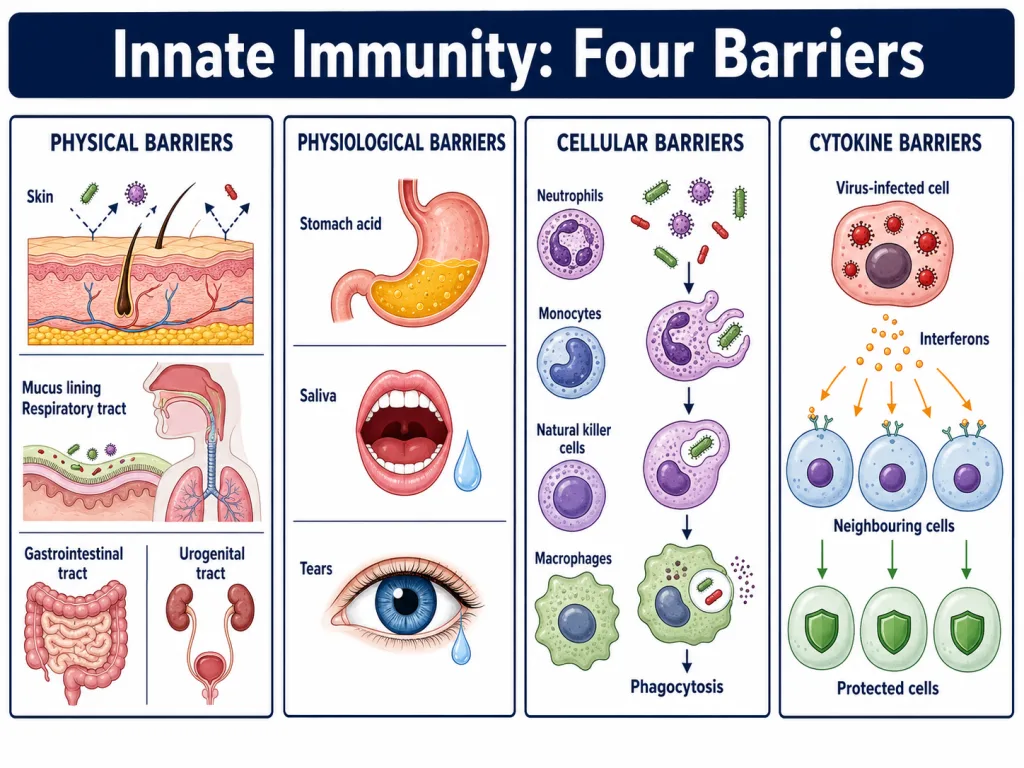
Physical and Physiological Barriers
The physical barriers are the ones that physically block entry. The skin on our body is the main barrier, keeping micro-organisms out. Alongside it, the mucus coating of the epithelium that lines the respiratory, gastrointestinal and urogenital tracts traps microbes trying to slip in through these openings.
The physiological barriers work through the chemistry of body fluids rather than a solid wall. The acid in the stomach, the saliva in the mouth and the tears in the eyes all create conditions that prevent microbial growth.
Cellular and Cytokine Barriers
When a microbe does get past skin and mucus, the cellular barrier takes over. Certain leukocytes (white blood cells) — polymorpho-nuclear leukocytes (PMNL-neutrophils) and monocytes in the blood, natural killer (NK) cells, and macrophages in the tissues — can phagocytose and destroy the invaders. In other words, they engulf and digest them.
The cytokine barrier is a clever chemical alarm used against viruses. A cell that has been infected by a virus secretes proteins called interferons, and these interferons protect the neighbouring non-infected cells from being invaded next. So even before the immune system mounts a specific attack, a virus finds its spread slowed down.
Quick Recap
- Immunity = the host's overall ability to fight disease-causing organisms, provided by the immune system.
- Two types: innate (present from birth) and acquired (developed over life).
- Innate immunity is non-specific and works through four barriers.
- Physical — skin (the main barrier) and mucus coating of the respiratory, gastrointestinal and urogenital linings.
- Physiological — stomach acid, saliva, tears prevent microbial growth.
- Cellular — PMNL-neutrophils, monocytes, natural killer cells and macrophages phagocytose and destroy microbes.
- Cytokine — virus-infected cells release interferons that protect nearby non-infected cells.
Solved Examples — Section 5
Q1. Define immunity in one sentence.
Answer: Immunity is the overall ability of the host to fight disease-causing organisms, conferred by the immune system.
Q2. Why is innate immunity described as non-specific?
Answer: Because it does not target one particular pathogen — it acts the same way against any foreign agent that tries to enter, and it is present from birth.
Q3. Name the four barriers of innate immunity.
Answer: Physical, physiological, cellular and cytokine barriers.
Q4. Which barrier do skin and the mucus lining of body tracts belong to, and what is the main physical barrier?
Answer: They are physical barriers; the skin is the main physical barrier, while mucus traps microbes entering the respiratory, gastrointestinal and urogenital tracts.
Q5. How do interferons help, and which barrier are they part of?
Answer: Interferons are proteins secreted by virus-infected cells that protect neighbouring non-infected cells from viral infection. They form the cytokine barrier.
Q6. Give two examples of cells that act in the cellular barrier and state what they do.
Answer: Neutrophils (PMNL) and macrophages (also monocytes and natural killer cells) — they phagocytose and destroy microbes that get past the outer barriers.