
When Cell Growth Goes Out of Control
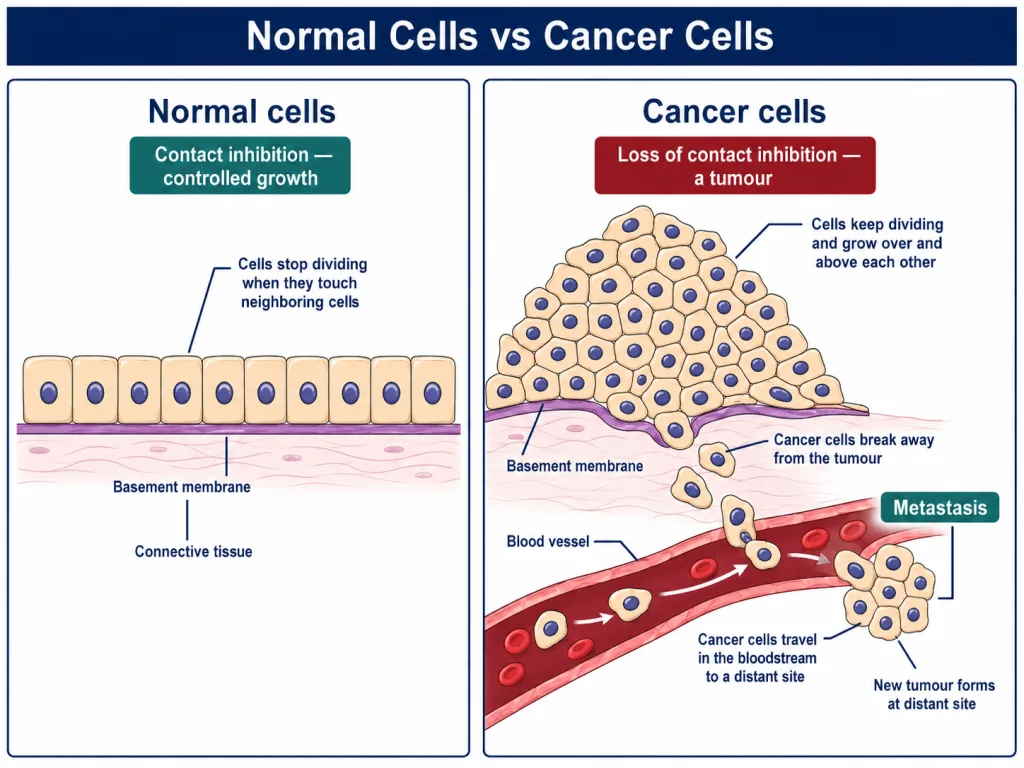
In a healthy body, cell growth and differentiation are kept under tight control. Cells divide when they are supposed to and stop when they are supposed to. A neat everyday sign of this control is contact inhibition — when a normal cell comes into contact with its neighbours, that contact tells it to stop dividing.
Cancer cells appear to have lost this property. Freed from the usual brakes, they keep dividing without regard for their neighbours, piling up into masses of cells called tumours. Cancer is one of the most dreaded human diseases and a leading cause of death worldwide, which is why the way normal cells turn cancerous — their treatment and control — has been such an intense area of research.
Benign and Malignant Tumours
Tumours come in two kinds. A benign tumour usually stays confined to its original location, does not spread to other parts of the body, and generally causes little damage.
A malignant tumour is a very different matter. It is a mass of proliferating cells called neoplastic or tumour cells that grow rapidly, invading and damaging the surrounding normal tissue. As they divide and grow so actively, they also starve the normal cells by competing for vital nutrients. Worst of all, cells slough off from such a tumour, travel through the blood, and wherever they lodge they start a fresh tumour. This spread to distant sites is called metastasis, and it is the most feared property of malignant tumours.
What Causes Cancer — Carcinogens
The transformation of a normal cell into a cancerous one can be triggered by physical, chemical or biological agents, together called carcinogens.
Ionising radiations such as X-rays and gamma rays, and non-ionising radiation like UV, damage DNA and can push a cell towards neoplastic transformation. Among chemical carcinogens, those present in tobacco smoke stand out as a major cause of lung cancer.
Biology plays a part too. Cancer-causing viruses, called oncogenic viruses, carry genes known as viral oncogenes. Beyond that, normal cells themselves contain genes called cellular oncogenes (c-onc) or proto-oncogenes; when these are activated under certain conditions, they can drive the cell towards cancer.
Detecting and Diagnosing Cancer
Early detection matters enormously, because caught in time many cancers can be treated successfully.
The classic approach is a biopsy: a piece of the suspected tissue is cut into thin sections, stained, and examined under a microscope by a pathologist — this is histopathological study. For leukaemias, blood and bone-marrow tests reveal the raised cell counts. Cancers of the internal organs are picked up by imaging — radiography (X-rays), CT scans and MRI. CT uses X-rays to build a three-dimensional image of the body's interior, while MRI uses strong magnetic fields and non-ionising radiation to detect changes in living tissue.
Two more modern tools round this out. Antibodies against cancer-specific antigens help detect certain cancers, and techniques of molecular biology can spot the genes carried by people with an inherited susceptibility to particular cancers — such individuals can then be advised to avoid the carcinogens they are most vulnerable to.
Treating Cancer
The common approaches to treatment are surgery, radiation therapy and chemotherapy, often supported by immunotherapy.
In radiotherapy, the tumour cells are irradiated lethally while proper care is taken to spare the normal tissue around the tumour mass. In chemotherapy, drugs are used to kill the cancer cells; some are specific for particular tumours, though most carry side effects such as hair loss and anaemia.
Because tumour cells can avoid detection and destruction by the immune system, patients may also be given biological response modifiers such as α-interferon, which activates the immune system and helps it destroy the tumour — this is immunotherapy. In practice, most cancers are treated by a combination of surgery, radiotherapy and chemotherapy.
Quick Recap
- Normal cells show contact inhibition; cancer cells lose it and divide uncontrollably into masses called tumours.
- Benign tumours stay confined and cause little damage; malignant (neoplastic) tumours invade, starve normal cells, and spread through the blood — this spread is metastasis, their most feared property.
- Causes are carcinogens (physical, chemical, biological): ionising (X-rays, gamma) and non-ionising (UV) radiation damage DNA; tobacco-smoke chemicals cause lung cancer; oncogenic viruses carry viral oncogenes; cells carry proto-oncogenes (c-onc).
- Detection: biopsy and histopathology, blood/bone-marrow tests (leukaemias), radiography, CT and MRI, antibodies against cancer antigens, and molecular tests for inherited susceptibility.
- Treatment: surgery, radiotherapy, chemotherapy, and immunotherapy with biological response modifiers like α-interferon; most cancers need a combination.
Solved Examples — Section 10
Q1. What is contact inhibition, and how do cancer cells behave differently?
Answer: Contact inhibition is the property by which contact with neighbouring cells stops a normal cell from dividing further. Cancer cells lose this property, so they keep dividing uncontrollably and form tumours.
Q2. Distinguish between benign and malignant tumours.
Answer: A benign tumour stays confined to its original site, does not spread, and causes little damage. A malignant tumour is a mass of neoplastic cells that grows rapidly, invades and damages surrounding tissue, starves normal cells, and can spread to distant sites.
Q3. What is metastasis, and why is it the most feared property of malignant tumours?
Answer: Metastasis is the spread of cancer when cells slough off a malignant tumour, travel through the blood, and start new tumours at distant sites. It is most feared because it makes the disease spread throughout the body rather than staying in one place.
Q4. Name the types of carcinogens and give one example of each mechanism.
Answer: Carcinogens may be physical, chemical or biological. Ionising radiation (X-rays, gamma rays) and non-ionising radiation (UV) damage DNA; chemical carcinogens in tobacco smoke cause lung cancer; oncogenic viruses (biological) carry viral oncogenes.
Q5. What are proto-oncogenes?
Answer: Proto-oncogenes, also called cellular oncogenes (c-onc), are normal genes present in our cells that, when activated under certain conditions, can lead to the cancerous transformation of the cell.
Q6. How does α-interferon help in cancer treatment?
Answer: α-interferon is a biological response modifier used in immunotherapy. Since tumour cells can evade the immune system, α-interferon activates the patient's immune system and helps it detect and destroy the tumour.