
When the Immune System Overreacts
Immunity usually protects us, but the same machinery can misfire in two very different ways. Sometimes it reacts far too strongly to harmless things in the environment — that is an allergy. At other times it turns on the body's own cells — that is autoimmunity. This section looks at both, and then at the lymphoid organs where all the immune cells are made and where they meet their targets.
Allergies — an Exaggerated Response
An allergy is an exaggerated response of the immune system to certain antigens present in the environment. The substances that trigger it are called allergens — common ones being dust mites, pollen and animal dander. The antibodies produced against allergens are of the IgE type.
The typical symptoms are sneezing, watery eyes, a running nose and difficulty in breathing. These are caused by the release of chemicals like histamine and serotonin from mast cells. To find out what a person is allergic to, small doses of possible allergens are introduced and the reactions watched. The symptoms are quickly relieved by drugs such as anti-histamine, adrenalin and steroids. Modern lifestyles seem to have made more children in metro cities sensitive to allergens, possibly because of the very protected environment they grow up in.
Autoimmunity — Attacking the Self
Acquired immunity depends on the body's ability to tell its own cells apart from foreign organisms. Occasionally, due to genetic and other reasons we still do not fully understand, this ability breaks down and the body begins to attack its own self-cells. The damage that follows is called an autoimmune disease. A familiar example, affecting many people, is rheumatoid arthritis.
The Lymphoid Organs
The immune system is built from lymphoid organs, tissues, cells and soluble molecules such as antibodies. Lymphoid organs are the sites where lymphocytes originate, mature and proliferate.
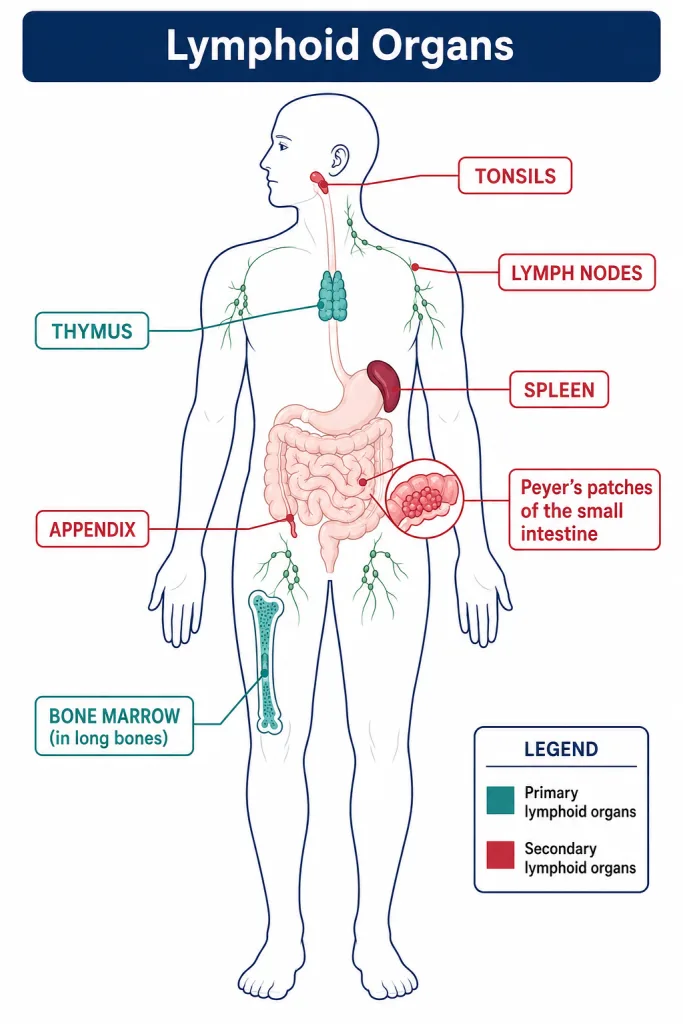
The primary lymphoid organs are the bone marrow and the thymus, where immature lymphocytes become antigen-sensitive. Once mature, the lymphocytes move out to the secondary lymphoid organs — the spleen, lymph nodes, tonsils, Peyer's patches of the small intestine and the appendix — which provide the sites where lymphocytes actually meet antigens and go on to become effector cells.
What Each Organ Does
The bone marrow is the main lymphoid organ; it makes all the blood cells, including lymphocytes. The thymus is a lobed organ located near the heart and beneath the breastbone; it is quite large at birth but keeps shrinking with age and is very small by puberty. Both bone marrow and thymus provide the micro-environment for T-lymphocytes to develop and mature.
The spleen is a large bean-shaped organ packed with lymphocytes and phagocytes; it filters the blood by trapping blood-borne micro-organisms and also holds a large reservoir of erythrocytes. The lymph nodes are small solid structures along the lymphatic system that trap antigens from the lymph and tissue fluid, activating the lymphocytes there. Finally, MALT (mucosa-associated lymphoid tissue) lines the respiratory, digestive and urogenital tracts and makes up about 50 per cent of the lymphoid tissue in the body.
Quick Recap
- Allergy = an exaggerated immune response to environmental antigens called allergens (dust mites, pollen, animal dander); antibodies are of the IgE type.
- Allergy symptoms — sneezing, watery eyes, running nose, difficulty breathing — come from histamine and serotonin released by mast cells; treated with anti-histamine, adrenalin and steroids.
- Autoimmunity = the body attacking its own self-cells (genetic and other unknown causes); example — rheumatoid arthritis.
- Primary lymphoid organs = bone marrow and thymus (lymphocytes mature and become antigen-sensitive); secondary = spleen, lymph nodes, tonsils, Peyer's patches and appendix (lymphocytes meet antigens).
- Bone marrow makes all blood cells; thymus lies beneath the breastbone and shrinks by puberty; spleen filters blood and stores RBCs; lymph nodes trap antigens; MALT is ~50% of the body's lymphoid tissue.
Solved Examples — Section 8
Q1. What is an allergy, and what are the triggering substances called?
Answer: An allergy is an exaggerated response of the immune system to certain antigens in the environment. The triggering substances are called allergens — for example dust mites, pollen and animal dander.
Q2. Which antibody type and which cells are involved in an allergic reaction?
Answer: The antibodies produced are of the IgE type, and the symptoms arise from histamine and serotonin released by mast cells.
Q3. Name three drugs used to relieve allergy symptoms.
Answer: Anti-histamine, adrenalin and steroids quickly reduce the symptoms of allergy.
Q4. What is an autoimmune disease? Give one example.
Answer: It is a condition in which the body, for genetic and other unknown reasons, attacks its own self-cells and damages them. Rheumatoid arthritis is a common example.
Q5. Name the primary and secondary lymphoid organs.
Answer: The primary lymphoid organs are the bone marrow and thymus; the secondary lymphoid organs are the spleen, lymph nodes, tonsils, Peyer's patches of the small intestine and the appendix.
Q6. What is MALT and how significant is it?
Answer: MALT is mucosa-associated lymphoid tissue lining the respiratory, digestive and urogenital tracts. It constitutes about 50 per cent of the lymphoid tissue in the human body.