
What AIDS Means
AIDS stands for Acquired Immuno Deficiency Syndrome. Breaking the name apart tells you almost everything: it is a deficiency of the immune system, acquired during a person's lifetime — so it is not a congenital disease — and "syndrome" simply means a group of symptoms. It was first reported in 1981 and has since spread across the world, killing millions.
AIDS is caused by the Human Immunodeficiency Virus (HIV), a member of the group called retroviruses, which have an envelope enclosing an RNA genome.
How HIV Spreads
HIV is transmitted in four main ways: through sexual contact with an infected person; through transfusion of contaminated blood and blood products; by sharing infected needles, as among intravenous drug users; and from an infected mother to her child through the placenta. So the people at highest risk include those with multiple sexual partners, intravenous drug addicts, people needing repeated blood transfusions and babies born to HIV-infected mothers.
It is important to remember that HIV does not spread by mere touch or ordinary physical contact — only through body fluids. For this reason infected persons must not be isolated from family and society. There is always a time-lag between infection and the appearance of symptoms, ranging from a few months to many years, usually 5 to 10 years.
How HIV Replicates Inside the Body
Once inside the body, the virus enters macrophages. There the enzyme reverse transcriptase copies the viral RNA genome into viral DNA, which then gets incorporated into the host cell's DNA and directs the cell to make new virus particles. In this way the macrophage keeps churning out virus and acts like an HIV factory.
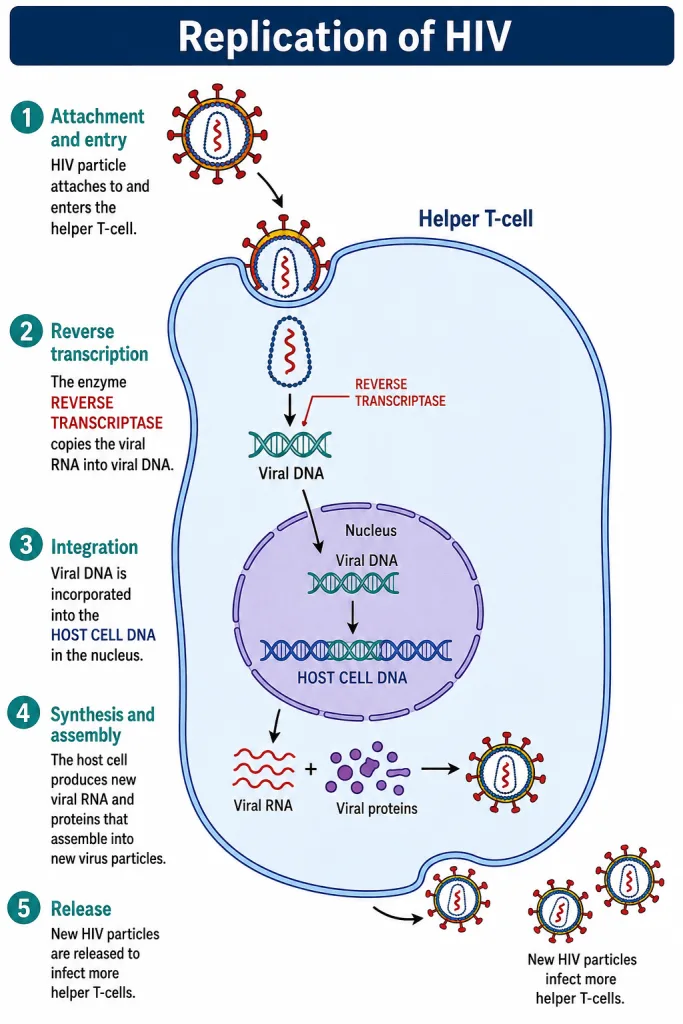
At the same time, HIV enters the helper T-lymphocytes (TH), replicates and produces progeny viruses. These progeny are released into the blood and attack still more helper T-cells. Repeated over and over, this causes a progressive fall in the number of helper T-lymphocytes.
Falling Immunity and Diagnosis
As the helper T-cell count drops, the person suffers bouts of fever, diarrhoea and weight loss, and then becomes vulnerable to opportunistic infections that a healthy body would normally shrug off — infections by bacteria such as Mycobacterium, by viruses and fungi, and by parasites like Toxoplasma. The patient becomes so immuno-deficient that the body can no longer protect itself.
The widely used diagnostic test for AIDS is ELISA (enzyme-linked immuno-sorbent assay). Treatment with anti-retroviral drugs is only partially effective — it can prolong the patient's life but cannot prevent the eventual outcome.
Prevention — the Best Option
Since AIDS has no cure, prevention is the best option, and much of the spread comes from behaviour that can be changed. In India the National AIDS Control Organisation (NACO) and various NGOs work to educate people, and WHO runs programmes to check the spread of HIV. The practical steps include making blood from blood banks safe, using only disposable needles and syringes, free distribution of condoms, controlling drug abuse, advocating safe sex and promoting regular HIV check-ups in susceptible groups. Infected people need help and sympathy, not to be shunned. As the message rightly goes — "don't die of ignorance".
Quick Recap
- AIDS = Acquired Immuno Deficiency Syndrome — an immune deficiency acquired in life (not congenital); "syndrome" = a group of symptoms; first reported in 1981.
- Caused by HIV, a retrovirus with an envelope enclosing an RNA genome.
- Transmission — sexual contact, contaminated blood transfusion, sharing infected needles, and infected mother to child via the placenta; NOT by touch, so patients must not be isolated. Time-lag to symptoms is usually 5 to 10 years.
- Replication — HIV enters macrophages, where reverse transcriptase makes viral DNA that inserts into host DNA (macrophage = HIV factory); it also destroys helper T-lymphocytes, so their count falls, leading to opportunistic infections (Mycobacterium, viruses, fungi, Toxoplasma).
- Diagnosed by ELISA; anti-retroviral drugs only prolong life. Prevention through NACO, NGOs and WHO — safe blood, disposable needles, condoms, safe sex and regular check-ups.
Solved Examples — Section 9
Q1. What does the abbreviation AIDS stand for, and why is it called "acquired"?
Answer: AIDS stands for Acquired Immuno Deficiency Syndrome. It is called acquired because the immune deficiency develops during a person's lifetime rather than being present from birth — it is not congenital.
Q2. Name the causative agent of AIDS and the group of viruses it belongs to.
Answer: AIDS is caused by the Human Immunodeficiency Virus (HIV), which belongs to the group called retroviruses — viruses with an envelope enclosing an RNA genome.
Q3. List the four main routes by which HIV is transmitted.
Answer: (a) sexual contact with an infected person, (b) transfusion of contaminated blood and blood products, (c) sharing infected needles (as among intravenous drug users), and (d) from an infected mother to her child through the placenta.
Q4. Explain how HIV lowers the body's immunity after entering it.
Answer: HIV enters macrophages, where reverse transcriptase copies its RNA into viral DNA that inserts into the host DNA and makes new viruses. It also enters helper T-lymphocytes, replicates, and the progeny attack more helper T-cells, so their number falls progressively, leaving the person open to opportunistic infections.
Q5. Which test is used to diagnose AIDS, and how effective is the treatment?
Answer: AIDS is diagnosed by ELISA (enzyme-linked immuno-sorbent assay). Treatment with anti-retroviral drugs is only partially effective — it can prolong life but cannot cure the disease.
Q6. Why should HIV-infected persons not be isolated from society?
Answer: Because HIV does not spread by touch or ordinary physical contact — only through body fluids. Isolating patients is unnecessary and harmful; they need help and sympathy for their physical and psychological well-being.